

China's Domestic COVID-19 Vaccine Set for Year-End Launch: Assessing Raw Materials, Production Capacity, and Cold Chain as Key Bottlenecks to Mass Rollout
Recently, Liu Jingzhen, Party Secretary and Chairman of China National Pharmaceutical Group Co., Ltd. (hereinafter referred to as “Sinopharm”), stated that domestically produced inactivated COVID-19 vaccines are expected to hit the market by the end of December, with a two-dose regimen priced at under RMB 1,000. News that domestically produced COVID-19 vaccines are likely to be launched by year-end provided a significant boost to market confidence. On August 18, shares of Sinopharm Accord and Sinopharm Holdings surged, with Sinopharm Holdings hitting its daily upper limit.
After all, the COVID-19 pandemic remains formidable worldwide, with over 23 million confirmed cases and more than 770,000 deaths globally. The global epidemic is still in a phase of expansion. Multiple regions across China have also experienced resurgences of the outbreak. As no specific antiviral drug has yet been identified for treating SARS-CoV-2 infection, vaccines have become the critical tool in combating COVID-19.
Although Russia has launched a COVID-19 vaccine, its safety has not yet been verified as the vaccine has not completed Phase III clinical trials. In addition to Russia’s COVID-19 vaccine, several other candidates worldwide have entered Phase III clinical trials. While there is currently no definitive timeline for the delivery of effective COVID-19 vaccines, if progress remains smooth, they could hit the market as early as the end of 2020. The key issue is whether vaccine production capacity can keep pace with demand.
Even if vaccines were approved by the end of 2020, it did not mean that most people could receive the COVID-19 vaccine in a timely manner. This is because, beyond the research and development phase, the journey from regulatory approval to mass vaccination involves multiple steps, including mass production, cold-chain transportation, and appointment-based inoculation.Obviously, the global demand for COVID-19 vaccines is at least in the order of 1 billion doses. Achieving widespread coverage within a short period appears to be an impossible task for every link in the supply chain.
In contrast to the market launch of HPV vaccines in China, these vaccines have been in short supply since their introduction in 2018. In 2019, the total batch release volume of quadrivalent and nonavalent HPV vaccines in China reached 8.17 million doses, with actual sales likely exceeding 8 million doses; however, many regions still face stockouts and difficulties in securing appointments for HPV vaccination.
Demand for COVID-19 vaccines is on the order of one billion doses, far exceeding that for HPV vaccines. Following the launch of COVID-19 vaccines, VCBeat has compiled and analyzed relevant information to assess whether China’s vaccine industry—from manufacturing capacity to cold-chain logistics—can withstand the significant impact brought by their market introduction.
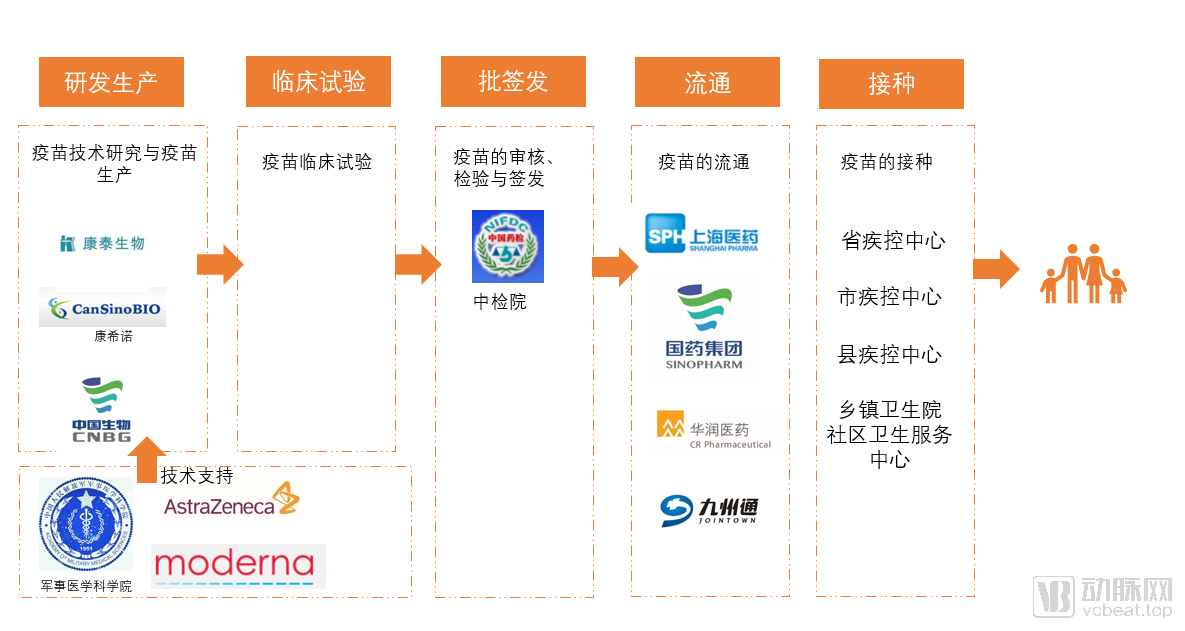
China's Vaccine Industry Chain
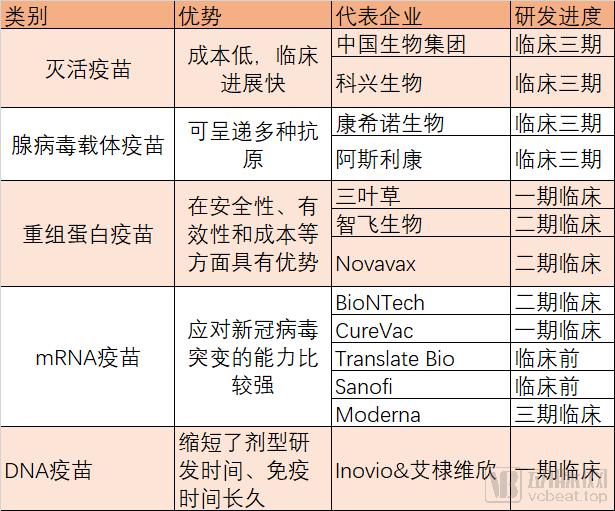
According to publicly available information, there are currently more than 118 candidate COVID-19 vaccines under development worldwide. Companies attracting significant attention include CanSino Biologics from China with its recombinant novel coronavirus vaccine (adenovirus vector), the U.S. company Moderna with its mRNA vaccine, AstraZeneca in collaboration with the University of Oxford on their adenovirus vector COVID-19 vaccine, the German biotechnology company BioNTech with its mRNA vaccine, and the U.S. biotechnology company Inovio with its DNA vaccine.
VCBeat has compiled the primary R&D pathways for COVID-19 medical products, along with representative companies and their development progress. Apart from Sputnik V, which has already been approved for marketing in Russia, it is evident that inactivated vaccines and adenovirus vector vaccines, which are advancing more rapidly, have all entered Phase III clinical trials.
Of course, a vaccine that first meets clinical trial endpoints is not necessarily the best one. The World Health Organization (WHO) has stated that the world needs multiple types of candidate vaccines to maximize the chances of finding successful solutions.
WHO Director-General Tedros stated that the development of COVID-19 vaccines is a complex, risky, and costly process, and once new vaccines are successfully developed, demand will far exceed supply.
How Many COVID-19 Vaccine Doses Are Needed Globally? According to estimates by experts at Johns Hopkins University, herd immunity is generally achieved when 70–90% of the population becomes immune to the virus. This means that, based on a global population of 7.5 billion, approximately 5.25 to 6.75 billion people need to acquire immunity. Given that some vaccines require two doses to confer immunity (while adenovirus vector vaccines require only one dose), the world will need at least 10 billion doses of COVID-19 vaccines.
A production volume of 10 billion vaccine doses is an astronomical figure for global vaccine manufacturing capacity.
Currently, the global vaccine market is characterized by an oligopolistic competitive landscape, with four major vaccine giants—GlaxoSmithKline (GSK), Sanofi, Merck & Co., and Pfizer—collectively accounting for more than 90% of the market. Among them, GSK ranks first globally in vaccine revenue, with an annual supply capacity of approximately 1 billion doses. This indicates that the massive demand of 10 billion doses will place immense pressure on the global vaccine industry.
To address the potential future crisis in COVID-19 vaccine production capacity, global vaccine developers are gearing up for large-scale mass production.
GSK previously announced plans to produce 1 billion doses of adjuvant compatible with any brand of vaccine, to support next year’s COVID-19 vaccination efforts. In the context of COVID-19 vaccines, incorporating adjuvants into certain formulations can enhance immune responses, thereby generating stronger and more durable immunity compared to using the vaccine alone.
AstraZeneca Announces Construction of Adenoviral Vector Vaccine Production Facility with Capacity for 2 Billion Doses. Meanwhile, AstraZeneca is collaborating with manufacturers worldwide to alleviate production capacity pressures, localize COVID-19 medical product manufacturing, and establish parallel supply chains to support broad and equitable global vaccine distribution.
In China, AstraZeneca and CanSino Biologics have reached a licensing agreement. As one of the largest vaccine manufacturers in China, CanSino Biologics, as the technology licensee, will ensure that its annual production capacity for the AZD1222 COVID-19 vaccine reaches at least 100 million doses by the end of 2020, and will expand the designed annual production capacity to 200 million doses by the end of 2021.
Johnson & Johnson also announced that it is building a production facility for adenovirus-vector vaccines with an annual capacity of 1 billion doses. The company revealed that its vaccine active pharmaceutical ingredient (API) manufacturing will utilize the same bioreactors employed for its Ebola virus vaccine, but the scale of equipment required for the COVID-19 vaccine is approximately 90 times larger than that for the Ebola vaccine.
Moderna has partnered with Lonza, the world’s largest biologic CDMO, to produce vaccines at two facilities in the United States and Switzerland, with an annual production target of 1 billion doses.
Pfizer and BioNTech initially co-developed the COVID-19 vaccine in the United States and Europe, and expanded production capacity to support global supply. The two companies planned to deliver millions of doses by the end of 2020, and rapidly scale up capacity to hundreds of millions of doses in 2021.
Specifically in China, what is the maximum possible number of COVID-19 vaccine doses that can be produced in a short period? In China, according to data disclosed in Walvax Biotechnology’s 2019 annual report, there are currently more than 40 vaccine manufacturers capable of producing 65 types of vaccines to prevent 35 infectious diseases.With an annual production capacity exceeding 1 billion doses, it is one of the few countries in the world capable of meeting all its Expanded Program on Immunization (EPI) vaccine needs through domestic production.
The current annual production capacity of nearly 1 billion doses is based on a variety of vaccines, and this figure is even more limited for COVID-19 vaccines.
In terms of vaccine batch release volume, China’s vaccine batch release volume in the first half of 2020 reached 290 million doses, representing a year-on-year increase of 22.2%. In recent years, China’s vaccine market has overall shown a fluctuating trend; the batch release volume in 2019 was approximately 565 million doses, basically on par with that of 2018.
It goes without saying that the demand for COVID-19 vaccines far exceeds China’s vaccine production capacity.
Short-term capacity expansion also faces numerous obstacles.
Generally, COVID-19 vaccine production lines are dedicated facilities with limited flexibility in capacity. According to the Vaccine Administration Law of the People's Republic of China, unless approved by the drug regulatory department under the State Council, vaccine manufacturers must produce vaccines in-house and are prohibited from outsourcing production to other manufacturers through contract manufacturing organizations (CMOs).
The production of COVID-19 vaccines requires facilities operating at Biosafety Level 3 (BSL-3). However, China previously lacked BSL-3 manufacturing workshops compliant with Good Manufacturing Practice (GMP) standards. To ensure the accessibility of COVID-19 vaccines post-launch, multiple enterprises—including Hualan Biological Engineering, Sinopharm’s China National Biotec Group (CNBG), the production facilities of the Beijing Institute of Biological Products, and the production facilities of the Wuhan Institute of Biological Products—have initiated the construction of BSL-3 manufacturing workshops, with an average production capacity of approximately 100 million doses.
In terms of production capacity constraints, domestic companies are also preparing for the mass production of COVID-19 vaccines.
CanSino, the first publicly listed COVID-19 vaccine company, disclosed in its prospectus that its vaccine production base has a total construction area of approximately 38,000 square meters, with an annual bulk drug substance capacity designed at around 70 to 80 million doses. Yu Xuefeng, Chairman of CanSino, stated at the Hillhouse HCare Global Health Industry Summit that the company is currently accelerating the completion of facility construction, and upon completion, the annual production capacity is expected to reach 200 million doses.
Sinopharm has invested approximately RMB 2 billion to construct two Biosafety Level 3 (BSL-3) production facilities. The annual production capacity of inactivated vaccines at the Beijing Institute of Biological Products (a subsidiary of China National Biotec Group, which is under Sinopharm) is expected to reach 120 million doses, while that at the Wuhan Institute of Biological Products (also a subsidiary of China National Biotec Group under Sinopharm) is projected to reach 100 million doses. In addition, genetically engineered subunit vaccines are expected to enter clinical trials in October this year; once development is successful, they can be rapidly scaled up for mass production.
Yin Weidong, Chairman of Sinovac Biotech Ltd., stated that the Beijing Municipal Government has allocated a nearly 70,000-square-meter industrialization base for Sinovac in the Daxing Pharmaceutical Park, with production workshops under construction around the clock.
Currently, there are multiple candidate types of COVID-19 vaccines, and different vaccine types impose distinct requirements on manufacturing processes. This has also constrained the rapid, large-scale production of COVID-19 vaccines.
For traditional inactivated vaccines, scaling up production capacity and manufacturing facilities is not particularly challenging. Yingde Biology, a subsidiary of Xinhua Medical, provides comprehensive solutions for human vaccine manufacturers, with key core process equipment including bacterial fermentation systems, cell culture systems, inactivation/detoxification systems, and vaccine formulation systems. Yingde Biology supplied key process module equipment for the new high-biosafety-level production workshop built by the Wuhan Institute of Biological Products under China National Biotec Group (CNBG), facilitating the development of the first COVID-19 vaccine.
However, for mRNA vaccines, Pfizer has stated that the mRNA vaccine co-developed with BioNTech requires smaller-scale equipment and involves a unique formulation process, necessitating the design of new equipment and retrofitting of manufacturing facilities. This undoubtedly increases the difficulty of scaling up production capacity.
In addition to production line constraints, the supporting industries essential for vaccine manufacturing may also invisibly limit the production capacity of COVID-19 vaccines. Key bottlenecks could include raw materials, adjuvants, and pharmaceutical glass vials required for COVID-19 vaccines.
Regarding pharmaceutical glass vials, experts had previously expressed concerns that mass production of COVID-19 vaccines could lead to a global shortage. This anxiety over a potential shortfall in pharmaceutical glass vials drove a significant surge in the stock prices of related companies, including Shandong Pharmaceutical Glass, Zhengchuan Shares, and Kibing Group.
In response, the China Vaccine Industry Association stated that China has a solid industrial foundation for producing high-quality vaccine vials, with an annual output of at least 8 billion glass vials, which is sufficient to meet the production demands for COVID-19 vaccines.
Pharmaceutical glass bottles are classified into two types: one is the neutral borosilicate glass bottle, and the other is the low-borosilicate glass bottle.
Borosilicate glass vials offer superior water resistance, thermal stability, and freeze-thaw resistance, thereby ensuring vaccine quality when used for vaccine packaging. In Europe and the United States, regulations mandate the use of borosilicate glass vials for injectable formulations and biologics. The leading global manufacturers of borosilicate glass vials are Germany’s SCHOTT AG, Japan’s NEG (Nippon Electric Glass), and America’s Corning Incorporated.
In terms of production capacity, SCHOTT AG, one of the world’s largest manufacturers of specialty glass and pharmaceutical packaging, announced that its current supply of neutral borosilicate glass is sufficient to produce vaccine vial packaging for 2 billion doses. The company has entered into cooperation agreements with major global pharmaceutical companies, which have taken effect immediately. The first batch of vials will be delivered to pharmaceutical companies in China and overseas.
Compared with neutral borosilicate glass, low-borosilicate glass exhibits significantly poorer stability; however, there are no mandatory requirements for pharmaceutical glass containers in China. China has not yet achieved large-scale mass production capability for neutral borosilicate glass vials, and the pharmaceutical glass containers domestically produced are primarily made of low-borosilicate glass. Although the National Medical Products Administration (NMPA) of China stated in 2017 that the use of low-borosilicate glass and soda-lime glass is not recommended, it has not imposed mandatory requirements.
According to publicly available data, the global shortage of pharmaceutical glass vials primarily involves medium borosilicate glass vials. In China, the annual production capacity of 8 billion pharmaceutical glass vials is predominantly comprised of low borosilicate glass.
In addition to pharmaceutical glass vials, adjuvants and excipients required for COVID-19 medical care will also be critical in future mass production.
Currently, the most commonly used adjuvants in human vaccines are aluminum hydroxide and MF59. In the event of a pandemic, the use of adjuvants is particularly important, as they can reduce the amount of antigen required per dose, thereby enabling the production of more vaccine doses for broader distribution. As previously mentioned, GSK has already planned to produce 1 billion doses of adjuvant. However, mRNA vaccines do not require additional adjuvants, as the mRNA itself serves as an effective adjuvant.
Raw materials required for vaccine production mainly include fillers, culture media, and trypsin. Based on their sources, they can be classified into animal-derived pancreatic enzymes extracted from porcine or bovine pancreas, and recombinant trypsin produced through genetic engineering techniques. Recombinant trypsin is further categorized into recombinant porcine trypsin, recombinant human trypsin, and others, depending on the gene source.
Following the market launch of COVID-19 vaccines, coupled with the ongoing production of vaccines under the national immunization program, demand for vaccine raw materials is expected to be substantial. Media reports have indicated that the raw materials required for clinical production of COVID-19 vaccines, as well as related purification equipment, currently rely heavily on imports. Consequently, driven by the pandemic, the upstream sector for vaccine raw materials and equipment manufacturing is poised to seize a rare opportunity for import substitution.
Once COVID-19 vaccines are launched, even if production meets targets, they must be distributed across China through a stringent cold chain logistics system. The substantial demand for vaccine distribution will place significant pressure on the cold chain’s delivery and warehousing capabilities.
In China’s vaccine logistics and distribution model, vaccines under the National Immunization Program are subject to centralized tendering or unified negotiations organized by the national health authority in conjunction with the national finance department and other relevant agencies. The winning bid prices or transaction prices are determined and publicly announced, and all provinces, autonomous regions, and municipalities directly under the Central Government implement unified procurement. Other immunization program vaccines not included in the National Immunization Program, as well as non-program vaccines, are procured by each province, autonomous region, and municipality through their respective provincial public resource trading platforms.
For transportation, vaccine marketing authorization holders and disease prevention and control institutions that distribute vaccines on their own shall possess the conditions for cold-chain storage and transportation of vaccines, or may entrust qualified vaccine distribution entities to distribute vaccines.
Vaccine logistics comprises two core components: transportation and warehousing.. Vaccines must be maintained within the specified temperature range throughout storage and transportation. Cold chain storage and transportation shall comply with relevant requirements, with regular temperature monitoring and recording. As sensitive biological products, vaccines require cold chain logistics and low-temperature storage to ensure quality and efficacy, maintaining a temperature of 2°C–8°C throughout the entire process.
The priorities for vaccine distribution are, first, maintaining an unbroken cold chain throughout the entire process, which requires real-time visual monitoring. Logistics providers must have comprehensive emergency response plans to handle unexpected incidents during transit; for instance, in the event of a vehicle breakdown, they must still ensure that temperature conditions remain compliant with vaccine storage requirements. Second, regarding warehousing, vaccine distribution necessitates the use of dedicated vaccine warehouses.
In China, the primary vaccine logistics and distribution enterprises are pharmaceutical logistics leaders such as Sinopharm, Shanghai Pharmaceuticals, and China Resources Pharmaceutical. In their vaccine distribution models, these companies primarily operate self-built cold storage facilities while outsourcing last-mile delivery to regional logistics service providers.
Regarding the cold-chain transportation of COVID-19 vaccines, Jointown Pharmaceutical Group responded that, as of the end of 2019, it had 419 cold-storage warehouses covering 98% of China’s administrative regions, with a total cold-storage area (including low-temperature freezers) of 36,658.3 square meters, of which 25,632 square meters are suitable for vaccine storage. The company’s 120 cold-chain delivery vehicles in the corresponding regions can provide door-to-door vaccine delivery services. Meanwhile, Jointown has its own information technology platform that enables real-time monitoring, tracking, and traceability of warehousing and transportation resources nationwide.
In vaccine distribution, Jointown Pharmaceutical Group enables real-time monitoring of vaccine locations, warehouse inventory, logistics center capacity, and distribution capabilities through its information technology platform.
The final concern, perhaps an unfounded one, relates to vaccine counterfeiting and traceability. Since batch numbers for vaccines issued by the state are publicly available, counterfeiters can replicate these batch numbers to produce fake products; therefore, verifying the batch number alone is insufficient to determine a vaccine’s authenticity. Only by assigning a unique code to each box, which allows users to query vaccine information, can forgery be effectively prevented.
Amidst the scarcity of HPV vaccines, issues of counterfeit products have emerged. Merck’s updated nine-valent HPV vaccine features a drug traceability code on its packaging, allowing recipients to scan the code to verify vaccine information and authenticate the product. Additionally, each individual dose is affixed with a heat-stable label on its inner packaging, enabling recipients to assess whether the vaccine has deteriorated based on the label’s color change. This approach may offer valuable insights for the distribution of COVID-19 vaccines.
Under normal circumstances, vaccine research proceeds sequentially through Phase I, Phase II, and Phase III clinical trials. In particular, Phase III trials require monitoring changes in incidence rates between the control group and the vaccine group over the course of an epidemic cycle, which may take one, two, or even three years. In contrast, the overall timeline for COVID-19 vaccines, from development to delivery, was compressed into less than a year—a pace that exceeded expectations. However, it is foreseeable that COVID-19 vaccination will be a sustained, long-term endeavor. This entire process tests the capacity of China’s vaccine industry to respond to health crises. Currently, certain segments of China’s vaccine supply chain remain relatively fragile, and the mass production of COVID-19 vaccines may well serve as a catalyst for strengthening the country’s vaccine industry.
Reference: Shortage of glass vials for COVID-19 vaccines; Europe and the US seize control, demanding early payment from China before June
COVID-19 Vaccine Mass Production Imminent; Upstream Raw Material Manufacturers Rush to Stockpile—These Companies in the Industry Chain Poised for Import Substitution Opportunities — STAR Market Daily
CanSino Biologics Prospectus
Walvax Biotechnology Annual Report