

Desight Bio Launches Fully Automated Chromosome Karyotype Analysis Workstation, Delivering Diagnostic Reports in 5 Minutes
Diagens
Medical Imaging AI and High-End Medical Equipment Developer
“China’s birth rate has reached an inflection point, plummeting precipitously each year. At this pace, there will be no newborns in China within six years.” Dr. Song Ning, founder of Diagens, stated that while this is an exaggerated claim, it reflects the increasingly severe situation regarding China’s birth rate. “As explorers in the medical field, what can we do? The decline in birth rates is not only due to eligible couples being unwilling to have children, but also because one in six couples are unable to conceive naturally and require assisted reproductive technologies.”
At assisted reproductive technology (ART) centers, karyotype analysis of both partners in couples of appropriate reproductive age is required to detect chromosomal abnormalities, assess the risk of carrying hereditary diseases, and guide the selection of the most suitable ART regimen.
Traditional chromosome testing requires physicians to perform manual operations under a microscope, which is not only inefficient but also makes it difficult to guarantee accuracy. Due to the limitations of traditional detection methods, Dr. Song Ning began exploring alternatives to manual chromosome testing as early as 2005, attempting to rely on computer assistance to complete chromosome detection. During this period, a prototype product developed by Dr. Song’s team won the Second Prize of the National Science and Technology Progress Award, laying the foundation for Diagens’ future development of the AutoVision Intelligent Analysis Workstation for Human Chromosomes.
In 2016, Dr. Song Ning founded Hangzhou Diagens Biotechnology Co., Ltd. (hereinafter referred to as “Diagens”), marking a significant step toward the development of an intelligent workstation for human chromosome analysis.
Chromosome karyotyping is the fundamental method and gold standard in medical genetics research, serving as an indispensable tool for investigating abnormalities in chromosome number, structure, and morphology. Through chromosome karyotyping, it is possible to determine whether a patient suffers from a genetic disorder due to anomalies such as abnormal chromosome numbers, deletions, insertions, duplications, or translocations of chromosomal segments. To date, more than 4,000 common and rare genetic diseases have been identified worldwide. The purpose of genetic counseling is to clarify the type of chromosomal abnormality, diagnose potential genetic disorders, and provide medical guidance on reproduction for patients. In China, millions of individuals undergo this diagnostic procedure annually.
Diagens, in collaboration with top Chinese universities and genetic diagnosis centers at Grade III Class A hospitals, has dedicated years of research to develop a novel, fully automated recognition algorithm. By training machine learning models on millions of chromosomal data points, the system enables machines to accurately identify chromosomes. This innovation allows for the completion of karyotype counting, arrangement, and analysis, along with the generation of diagnostic reports, within five minutes per patient.
Diagens has named this AI-powered system for human chromosome detection “AutoVision,” which has already obtained product registration with the National Medical Products Administration (NMPA) and CE certification in the European Union. The Diagens team’s ability to rapidly develop and commercialize the product is attributable to Dr. Song Ning’s interdisciplinary expertise, combining a background in clinical medicine with computer science.
Dr. Song Ning initially majored in computer science as an undergraduate before being selected to further his studies at the National Base for Life Science Education and Talent Training at Central South University. Dr. Song has openly stated that both computer science and medicine are fields of great interest to him, widely recognized as two of the most promising disciplines of the 21st century. He has since dedicated himself to these two areas, and upon returning to China after completing his studies, he resolved to translate his academic achievements into practical medical products, leading to the establishment of Diagens.
Diagens is headquartered in the core area of Hangzhou Future Sci-Tech City in Zhejiang Province. Its core team comprises overseas-returnee talents, Chief Scientists of the National 973 Program, and professors from renowned universities. The company focuses on the field of human assisted reproductive health, engaging in technological innovation as well as the research, development, manufacturing, and sales of products. The Diagens team boasts over 20 years of development experience in clinical reproductive medicine, AI-based image recognition, and induced regeneration of reproductive stem cells. Holding multiple core independent intellectual property rights, the company has successfully developed six major product series. At a time when clinical reproductive products in China rely heavily on imports and there is an urgent need for the rapid development of domestically produced alternatives, Diagens has initially established an innovative product portfolio integrating three key areas: early diagnosis of genetic defects, assisted reproductive technologies, and diagnosis of reproductive system tumors.
Diagens’ independently developed AutoVision Intelligent Workstation for Human Chromosome Analysis enables fully automated, intelligent, and integrated chromosome analysis, completely replacing cumbersome manual procedures and making the tedious and inefficient task of chromosome analysis easier and more intuitive. Compared with traditional chromosome analysis methods, the AutoVision Workstation reduces the time required for karyotype analysis per patient by approximately 20-fold, achieves a single-chromosome recognition accuracy rate of 99.6%, significantly minimizes manual intervention, and delivers more reliable analytical results. The system leverages millions of chromosome data points to train machine learning algorithms in chromosome identification, thereby assisting physicians in diagnosing thousands of genetic disorders.
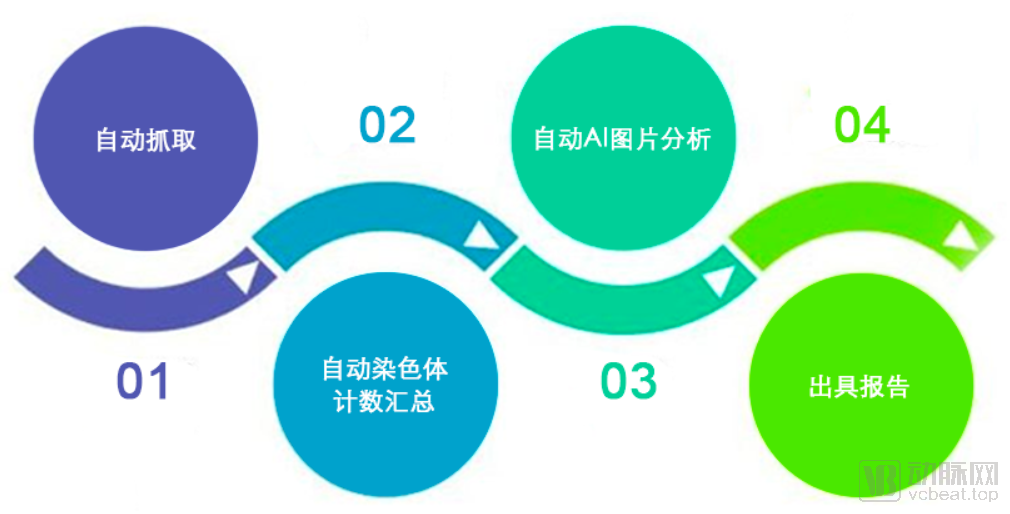
AutoVision Workstation Computational Workflow (Image source: Company website)
AutoVision automatically classifies, pairs, and numbers human chromosomes in digital images of metaphase spreads captured via photography. It then analyzes these metaphase spreads to automatically identify abnormalities in the human karyotype. Finally, it outputs arranged karyotype images and highlights any detected karyotypic defects.
It is reported that Diagens’ product has been launched and sold across China. The company has established collaborations with dozens of Grade A tertiary hospitals, and clinical demand far exceeds supply.
In addition to its flagship product, AutoVision, Diagens also supplies cell culture media, microscopy-specific fertilization dishes, and assisted reproductive technology (ART) reagents, further enriching the company’s product portfolio. Notably, Diagens’ independently developed HPV genotyping diagnostic platform received the Excellence Award at the 3rd China Innovation and Entrepreneurship Competition.
Fosun·Star Future Institute is an incubation and investment platform focused on the broader healthcare sector, established by Star Future Capital in reliance on Fosun and Fosun Pharma. Adopting a “community + incubation + investment” model, it explores frontier innovation areas, focuses on entrepreneurial talent, and secures early-stage investments in future unicorns. Diagens has also joined this incubation program, with the expectation of bringing more promising products to the field of assisted reproduction.
Diagens has completed two rounds of financing. Founder Song Ning stated that the company currently has relatively ample capital and welcomes contact from well-known investment institutions with industry resources.
Fosun Star Future Research Institute is an incubation and investment platform focused on the broader healthcare sector, established by Star Future Capital in reliance on Fosun Group and Fosun Pharma. Adopting a “community + incubation + investment” model, it explores frontier innovation fields, focuses on entrepreneurial talent, and secures early-stage investments in future unicorns.
In 2020, the Big Health Entrepreneurship Camp launched its second cohort. Targeting entrepreneurs in the medical and healthcare sector as well as aspiring innovators, the program invited top-tier global mentors and introduced six core incubation modules, offering entrepreneurship courses with the most robust industrial background and practical experience in China.