

Yinchuan Introduces Groundbreaking Internet Healthcare Regulations: Mandates Medicine-Physician Separation and Prohibits Deletion of Patient Negative Reviews
Innovative Explorations in Internet Healthcare: Yinchuan Introduces New Regulations—Recently, the “Yinchuan Internet Diagnosis and Treatment Service Standards (Trial)” (hereinafter referred to as the “Standards”) was issued.(The full policy text is available at vbdata.cn)
To help the public understand the policy as soon as possible, on the morning of August 20, the Yinchuan Municipal Health Commission conducted an online live-streamed policy interpretation, with VCBeat providing exclusive full-process live coverage.(Scan the QR code at the end of the article to watch the replay)。
Ma Xiaofei, Director of the Yinchuan Municipal Health Commission; Liu Yu, Director of the Medical Law Working Committee of the Beijing Health Law Society; and Chen Qiulin, Director of the Health Economics Research Office at the Institute of Population Studies, Chinese Academy of Social Sciences, introduced and analyzed the “Specifications” from different perspectives. Representatives from internet hospitals such as WeDoctor, DXY, VY Orthopedics, and Haodf Online also discussed the value of the new regulations for the industry at the interpretation meeting.
As the moderator of this online policy interpretation session, Yuan Fang, Director of the Information Center of the Yinchuan Municipal Health Commission, introduced the current policy landscape in Yinchuan. Since 2016, the locality has successively issued 18 supporting policies, including the Interim Measures for the Administration of Internet Hospitals in Yinchuan City, the Interim Detailed Rules for the Implementation of the Measures for the Administration of Internet Hospitals in Yinchuan City, and the Interim Measures for the Management Services of Internet Hospitals for Outpatient Major Diseases under Medical Insurance in Yinchuan City, along with five industry self-regulatory standards, thereby establishing a relatively comprehensive institutional framework.
During the pandemic, the Yinchuan Municipal Health Commission established an Internet Hospital Alliance, opening up a “second front” in the fight against the epidemic and playing a significant role in pandemic control. As internet-based diagnosis and treatment have gained widespread public attention and recognition, the frequency of such services has risen substantially. Standardizing internet-based diagnosis and treatment practices and ensuring their quality and safety have become critical issues for the internet healthcare industry. Against this backdrop, the Yinchuan Municipal Health Commission issued the Specifications.
At the interpretation session, Ma Xiaofei introduced that internet healthcare has developed rapidly in the past two years, driven by strong national support and widely recognized by patients. In particular, during the pandemic, internet healthcare played a significant role, with its strategic importance in the medical industry growing increasingly prominent.
However, during its more than three years of exploring internet-based healthcare, Yinchuan has also identified certain issues affecting the industry’s healthy development. The quality of internet hospitals varies significantly, and relevant policies and standards remain insufficiently specific. As application scenarios for internet-based healthcare continue to evolve, some complaints and reports have arisen in service delivery. In 2018, Ningxia was designated as China’s first “Internet + Healthcare” demonstration zone, with Yinchuan serving as its core area and assuming the responsibility of pioneering trial initiatives. In response to recent developments within the industry, and after several months of planning and repeated deliberations, the “Specifications” were ultimately formulated.
Ma Xiaofei believes that while internet healthcare should be vigorously supported, its unchecked growth must be prevented. “We do not want minor issues to undermine the healthy development of the entire industry. We aim to provide tangible medical convenience to the public and address various pain points and challenges in current healthcare, while also preventing internet healthcare from posing risks to medical safety. Our goal is to guide the sector toward sound and sustainable development.”
Against this backdrop, Ma Xiaofei outlined several principles guiding the development of the Guidelines:
First is the principle of prioritizing life, where the ultimate goal of any medical practice is to safeguard life, health, and safety. By standardizing medical activities across all aspects of internet-based diagnosis and treatment, improving the efficiency of medical services, ensuring medical quality and safety, and enhancing patient satisfaction, we can provide better protection for life, health, and safety.
Second, we adhere to a problem-oriented approach to address vulnerabilities in a targeted manner. “The standards we have established, along with the strengthened and refined end-to-end management processes, were not devised arbitrarily in an office setting. Instead, they were developed through a comprehensive review of issues raised in complaints over the past few years, covering the entire patient journey from consultation to treatment. In particular, these measures were formulated to address practical challenges such as the lack of standardized guidelines for online physician consultations.”
Third, strengthen the sense of responsibility and service. The “Specifications” further clarify that internet hospitals must reinforce their primary responsibilities in areas such as practice qualification review, internet-based diagnosis and treatment, electronic medical records, pharmaceutical affairs management, medical quality management, and data security.
Fourth, we have fully drawn on practical experience. “In the process of formulating the guidelines, we extensively solicited input from industry associations and individual internet hospitals,” Ma Xiaofei explained. The development of the new regulations also incorporated extensive feedback from medical administration experts and health policy specialists in cities such as Beijing and Shanghai, with their suggestions widely adopted.
So, what specific innovations and breakthroughs does the “Guidelines” introduce? How does it refine existing policies? And which industry-specific issues does it aim to address? By examining the specific provisions of the new regulations alongside Ma Xiaofei’s online interpretation, and comparing them with existing national regulations, we have identified four key aspects.
Encourage Artificial Intelligence, But Not as a Substitute
Source: National Health Commission, Yinchuan Municipal Health Commission; Chart by VCBeat
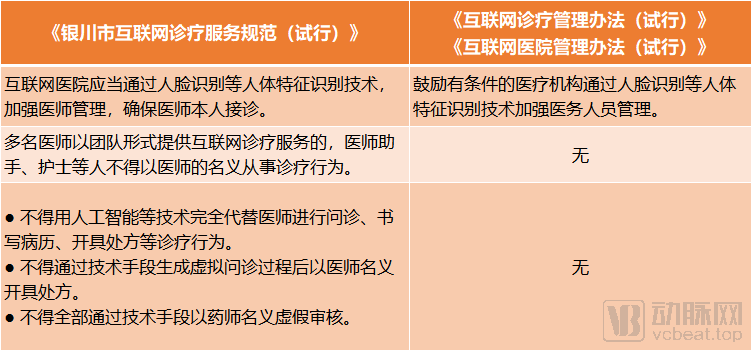
In internet-based medical consultation services, particularly text-and-image consultations, it is difficult for patients to verify whether the attending physician is indeed the registered practitioner. The Yinchuan Regulations stipulate that biometric recognition technologies, such as facial recognition, must be employed to ensure that consultations are conducted by the physicians themselves. This requirement carries greater mandatory force compared to the national guidelines, which merely “encourage” the use of such technologies. Leveraging artificial intelligence and other technologies to address identity authentication issues can also enhance efficiency and accuracy.
Meanwhile, Ma Xiaofei also emphasized this viewpoint: “We encourage the use of artificial intelligence as an auxiliary tool, but AI must never fully replace the professional conduct of physicians.”
The “Specifications” state that artificial intelligence and other technologies shall not be used to fully replace physicians in performing diagnostic activities such as patient consultations, medical record documentation, and prescription issuance; it is prohibited to generate virtual consultation records through technical means and issue prescriptions under a physician’s name; and it is also prohibited to conduct entirely automated, fraudulent prescription reviews under a pharmacist’s name using technical means.
These provisions are scattered across multiple articles of the Regulations, repeatedly emphasizing the moderate use of technological measures. This is undoubtedly aimed at addressing phenomena that previously occurred on some internet healthcare platforms, such as uploading fake prescriptions to purchase medications and platform “doctors” issuing prescriptions in three seconds. In fact, these issues were not confined to internet hospitals in any single region.
Following the implementation of the “Guidelines,” it is expected that the authenticity of a series of processes—including consultation, prescription, and prescription review—will be more specifically safeguarded, providing a reference for standardizing the entire industry.
Online and Offline Consistency: "Negative Reviews" Cannot Be Deleted
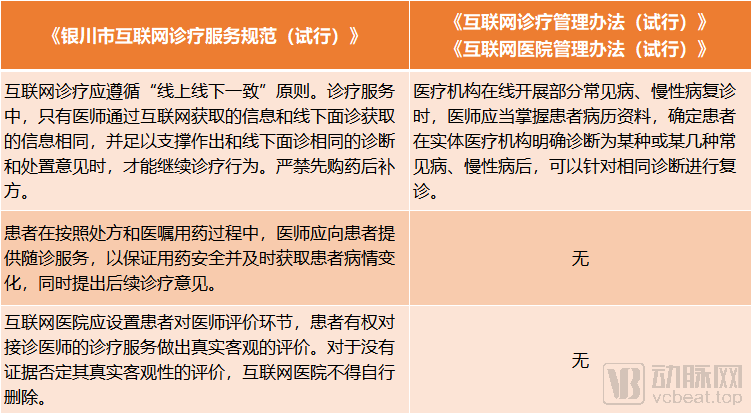
The Regulations emphasize the principle of consistency between online and offline services. Ma Xiaofei explained that, at the first level, standards must be consistent; the diagnostic criteria required for offline clinical consultations must also apply to online services. At the second level, processes must be consistent; just as offline practice requires consultation followed by diagnosis and prescription based on various laboratory and imaging tests, online practice must follow the same procedure and cannot allow medication purchases before prescriptions are issued. At the third level, regulatory oversight must be consistent; while physicians in offline settings are subject to specific access requirements, qualifications, and regulatory provisions, online practices must align with these offline standards, particularly when online regulations are not yet fully developed.
It is understood that this is the first initiative in China to clearly define consistent conduct across online and offline channels.
 Source: National Health Commission, Yinchuan Municipal Health Commission; graphic by VCBeat
It is worth noting that the Regulations explicitly clarify the patient evaluation system, requiring internet hospitals to provide an evaluation function. Patients have the right to submit truthful and objective evaluations, which internet hospitals are prohibited from deleting. “Establishing a patient evaluation system is crucial; internet hospitals must not unilaterally delete negative reviews,” stated Ma Xiaofei.
Evaluation systems in the internet healthcare industry are still in their infancy. Currently, most internet hospitals display patient reviews, which may take the form of full-text comments, keywords, or star ratings. However, these features are largely superficial additions rather than effective tools for holding physicians accountable or providing meaningful references for patients. Moreover, there are no national regulations governing this aspect.
Taobao reviews and Dianping have largely eliminated information asymmetry, driving the development of the internet consumer industry. If online healthcare can establish a practical and effective evaluation system, it will also promote industry growth.
Strictly prohibit kickbacks; doctors' income is not linked to prescription amounts.
Chapter 6 of the Guidelines, titled “Pharmaceutical Services,” comprises 12 provisions, underscoring Yinchuan’s emphasis on regulating pharmaceutical-related activities.
Source: National Health Commission, Yinchuan Municipal Health Commission; graphic by VCBeat
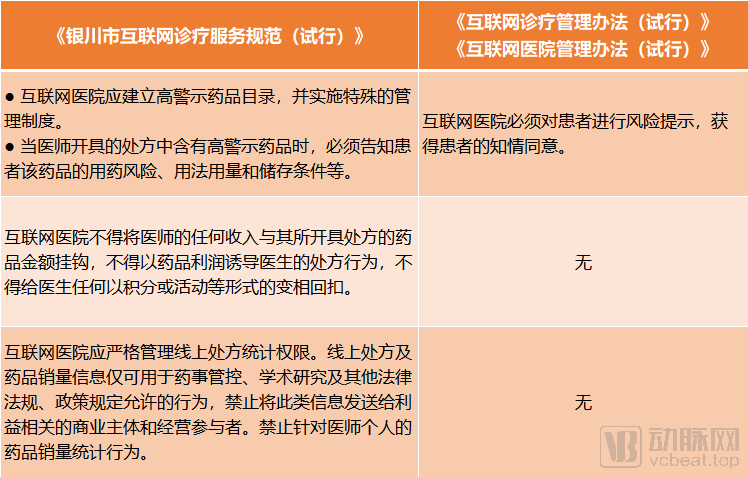
In addition to requiring internet hospitals to establish a list of high-alert medications and inform patients of medication risks, the most significant breakthrough in this chapter lies in the separation of medical services from pharmaceutical services within online diagnosis and treatment, along with the strict management of prescription statistics.
“The Guidelines” stipulate that internet hospitals must not link physicians’ income in any way to the monetary value of medications prescribed, nor induce prescribing behavior through drug profits. “The Yinchuan Municipal Health Commission will strictly prohibit transferring offline kickback schemes for pharmaceuticals to online platforms!” stated Ma Xiaofei, noting that some platforms had previously been found suspect of using point-based systems or other methods to provide disguised kickbacks, a practice that is firmly prohibited.
In the past, under the system of subsidizing healthcare with drug profits, offline medical institutions developed entrenched problems such as pharmaceutical kickbacks and doctors’ illicit income, which in turn led to a series of issues including over-treatment and rising healthcare costs. In recent years, the advancement of new healthcare reform measures has significantly improved this situation. However, with the emergence of internet hospitals, an operating license has become a “pass” for some platforms to sell medications, and this phenomenon is not limited to specific regions.
Selling medications based on prescriptions in a reasonable and compliant manner is certainly feasible. However, once prescriptions become linked to drug sales volume and revenue, and once internet hospitals turn into tools for boosting drug sales, the persistent problems that have just been addressed in offline settings may resurface online.
By issuing the “Guidelines,” Yinchuan has demonstrated its keen awareness of the aforementioned issues and taken timely measures to nip them in the bud.
Code of Conduct for Physicians: Tailored for Online Practice
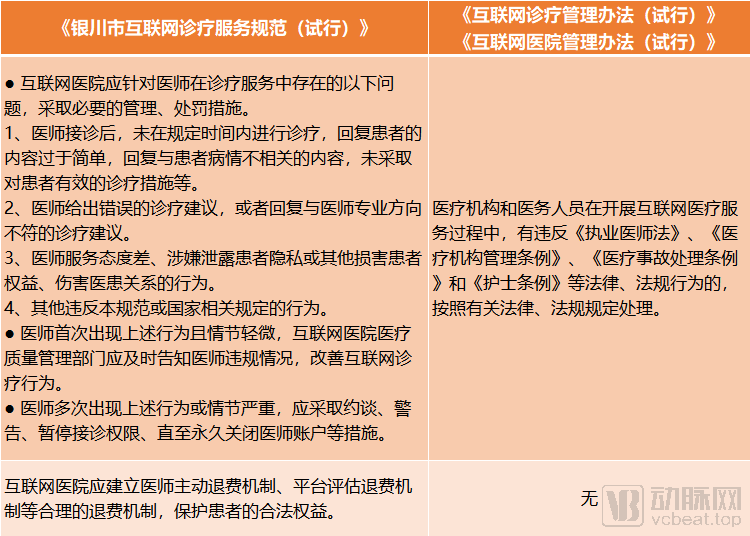
"In relevant documents issued by the National Health Commission, violations of regulations by medical personnel in internet diagnosis and treatment services are addressed with reference to the laws and regulations governing offline clinical practice."
In contrast, the innovation of Yinchuan’s “Specifications” lies in the formulation of more targeted regulations tailored to various scenarios of online diagnosis and treatment. For instance, behaviors subject to penalties for physicians under the “Specifications” include failure to provide diagnosis and treatment within the prescribed time after accepting a consultation, providing overly simplistic responses to patients, poor service attitude, and suspected disclosure of patient privacy.
On internet healthcare platforms, many physicians practice during their spare time, resulting in irregular response hours. Furthermore, some doctors are accustomed to the brief, cursory consultation style typical of offline settings and replicate this approach online. However, the lack of face-to-face interaction in the digital environment means that overly simplistic responses can easily lead to misunderstandings and even exacerbate doctor-patient conflicts. Therefore, the detailed provisions outlined in the “Specifications” address issues that are prevalent in internet-based diagnosis and treatment scenarios and warrant significant attention.
Standards tailored for online scenarios are also expected to bring about improvements in the aforementioned issues.
Source: National Health Commission, Yinchuan Municipal Health Commission; graphic by VCBeat
“Based on our supervision of internet hospitals over the past two years, there is still a lack of specific regulatory grounds, leading to insufficient oversight,” said Ma Xiaofei. “We are now establishing detailed regulations step by step and improving corresponding supervisory measures accordingly. This will enable us to impose appropriate penalties for routine violations, and to penalize, rectify, or even revoke licenses in cases of serious violations. Therefore, these regulations provide the basis for further strengthening supervision in the next phase.”
At the interpretation session, Liu Yu, Chairman of the Medical Law Committee of the Beijing Health Law Society, elaborated on the value of the "Specifications" from a legal perspective. He stated that the introduction of the "Specifications" marks another milestone in Yinchuan's internet healthcare sector, establishing six key institutional frameworks.
Regarding the credentialing and access system, physician teams are a product of continuous innovation and development in medical management models, capable of enhancing efficiency. However, it is strictly prohibited for students to perform work on behalf of their supervisors or for junior physicians to substitute for senior physicians; the "Code" specifies the boundaries of responsibilities among team members.
In terms of behavioral management systems, the Guidelines emphasize the principle of consistency between online and offline services. The Civil Code, enacted this year, stipulates that diagnostic and treatment activities must meet the standard level of medical care. In the future, consistency between online and offline services may become a key indicator for assessing whether internet-based healthcare meets the standard level of medical care.
Regarding the medical record management system, in addition to their roles in clinical care, scientific research, and teaching, medical records also serve as a critical basis for determining legal liabilities. The Guidelines have initially established provisions related to medical records for internet hospitals. In the future, these can be further refined to standardize medical record regulations and clinical documentation templates applicable to internet-based healthcare, while also improving the quality control system for electronic medical records in this sector.
In terms of medication management systems, the high-alert medication list in the "Guidelines," the emphasis on pharmacist-led prescription review, and the adverse drug reaction reporting system are all highly necessary.
Regarding the complaint management system, the "Specifications" not only stipulate complaint channels but also require internet hospitals to establish dedicated complaint departments to handle issues properly and efficiently. Meanwhile, corresponding evaluation mechanisms and disciplinary measures for medical personnel have been improved, forming a complete process.
In terms of safety regulations, echoing the Civil Code’s standalone book on personality rights, Yinchuan’s “Specifications” place significant emphasis on patients’ personality rights, with a particular focus on the right to privacy.
“The institutional design does not seek to be all-encompassing; rather, it focuses on establishing practical and feasible core systems.” Liu Yu believes that the six key systems outlined in Yinchuan’s “Specifications” serve as the cornerstone for the steady development of internet healthcare, laying a solid foundation to unlock broader opportunities.
Chen Qiulin, Director of the Health Economics Research Office at the Institute of Population Studies, Chinese Academy of Social Sciences, summarized his observations on the new regulations into two sets of “three key points.”
The first “three sentences” concern the issuance of the new regulations themselves.
First, normalization and standardization are key to the current development of internet healthcare. The two major policy focuses for the future—health insurance reimbursement and initial consultations—both depend on normalization and standardization.
Secondly, Yinchuan took the lead in issuing the "Specifications," thereby fulfilling its role as a national demonstration zone and discharging its corresponding responsibilities.
Finally, the regulations have broad applicability and cover internet hospitals registered in Yinchuan. Although these rules are specific to a local pilot region, they serve as a guiding model for the entire industry.
The second “three-sentence” statement concerns the specific content of the specifications.
First, the scope of regulation covers both internet hospitals and physicians. Special emphasis is placed on the liability that internet hospitals must bear in the event of medical malpractice.
Next are the standardized contents, which are problem-oriented and practical. For instance, regarding refund policies, traditional offline healthcare rarely has refund mechanisms, but internet healthcare, as a new model, has generated similar demands. Another example is information security, where it is necessary to comprehensively collect data while also protecting patient information.
Finally, there is innovation in standardization. For instance, regarding standardization methods, online patient reviews are more authentic than offline ones; for example, concerning standardization entities, administrative departments serve as the primary actors while fully leveraging the role of social organizations.
“Amid the pandemic-driven surge in demand for internet-based healthcare, Yinchuan has refined its standards for online diagnosis and treatment services in accordance with higher-level legislation and the practical realities of digital health development. This approach not only regulates existing online consultation services but also leaves room for further innovation,” said Chen Qiulin. He believes that future innovations will inevitably give rise to new challenges, necessitating updated regulatory frameworks. It is hoped that Yinchuan’s exploratory efforts will continue to provide practical case studies for the industry’s development.
What Impact Will the “Guidelines” Have on the Internet Healthcare Industry? At the interpretation meeting, administrators from multiple internet hospitals shared their perspectives.
Li Gang, President of Ningxia Weiyi Internet Hospital, stated that the "Specifications" emphasize the principle of consistency between online and offline services, further clarifying the homogeneous management of diagnostic and treatment activities across both channels. The document also serves a preventive and early-warning function against current medical irregularities, such as prescribing medication before issuing a formal prescription and providing commissions for online prescriptions, all of which are explicitly prohibited by the "New Regulations." These prohibitions represent the baseline requirements for practicing internet-based healthcare. In Li Gang’s view, the "Specifications" place greater emphasis on medical safety; real-name registration for consultations ensures the traceability of medical practices, thereby further defining medical safety standards and accountability.
Mao Weiming, Vice President of DXY, stated that internet healthcare played a significant role during the pandemic. The issuance of the "Regulations" by Yinchuan at this juncture serves to supplement and refine existing national provisions. While some enterprises had previously attempted measures such as verifying the authenticity of physicians' identities and separating prescribing from dispensing, the promulgation of the "Regulations" requires all industry platforms to jointly comply with and implement these standards. Only through such policy innovation can better safeguards be provided for internet healthcare.
Yang Jun, Deputy Director of the Northwest Center for Orthopedics at Weiyi, noted that internet hospitals must adhere to management rules governing clinical medical practice. The recently issued “Specifications” uphold the fundamental principle of consistency between online and offline services, thereby maximizing the safety and efficacy of internet-based diagnosis and treatment and laying a solid foundation for innovative development in internet healthcare. “Guided by the ‘Specifications,’ Yinchuan’s internet healthcare services can deliver an improved patient experience while fostering faster and healthier industry growth.”
Wang Hang, Founder and CEO of Haodf Online, holds the view that a sound and orderly industry ecosystem benefits all participants. Standardized operations will inevitably enhance service quality, fostering robust and scalable business growth. Wang believes that practice is the source of innovation; as internet-based medical consultation represents an innovation, its operational rules, business standards, and regulatory frameworks must also emerge from practical experience. “We will implement and adhere to these standards in practice, while promptly feeding back insights and challenges encountered to the relevant authorities, thereby driving continuous innovation.”
As one of the earliest regions in China to explore internet-based healthcare, Yinchuan established an Internet Hospital Base in 2017. Currently, it is home to more than 50 internet hospitals, predominantly platform-based models.
Ma Xiaofei believes that new technologies are advancing at a rapid pace, and the internet healthcare model is evolving quickly, changing significantly every year. It was in response to the shifting application scenarios and emerging issues in recent years that we introduced the “Guidelines.”
Conversely, the emergence of new issues signifies that Yinchuan Internet Hospital has never ceased its pace of innovation.
It is understood that the “Specifications” will come into effect on September 1, 2020. Ma Xiaofei stated that the “Specifications” are being implemented on a trial basis and will be dynamically adjusted in the future based on development trends and emerging issues.
VCBeat believes that if the series of policies introduced in 2017 for Yinchuan Internet Hospital drove the development of China’s internet healthcare policies from scratch, then the current “Specifications” are poised to advance the sector from mere existence to standardized regulation, and from availability to enhanced quality.
Scan the QR code to watch the replay of the interpretation session livestream.
