

Tencent Healthcare and WeBank Establish Joint Lab to Advance Medical Federated Learning for Privacy-Preserving AI Applications
On August 21, 2020, Tencent Healthcare and WeBank announced the establishment of a joint laboratory. Leveraging Tencent’s Tianyan Laboratory’s technical expertise in medical imaging, medical machine learning, and natural language processing, as well as WeBank’s AI team’s leading capabilities in federated learning, the two parties will jointly tackle challenges in Medical Federated Learning, build a privacy-preserving data platform, and explore intelligent applications in the healthcare sector.
Dr. Wu Wenda, Vice President of Tencent Healthcare, pointed out that addressing data privacy concerns in healthcare scenarios is crucial. While technological advancements drive innovation in healthcare, they must also prioritize privacy protection to foster the industry’s healthy development and provide users with a convenient and secure environment. The medical federated learning framework offers new approaches to safeguarding medical privacy and data security. The establishment of the joint laboratory will enable both parties to leverage their respective technical strengths, deepen the application of medical federated learning, and overcome challenges in implementing AI-driven innovations in healthcare.
WeBank’s AI team is a pioneer in federated learning technology. The driving force behind WeBank’s AI team being the first to conduct research on “federated learning” and apply it to business operations is Professor Yang Qiang, Chief Artificial Intelligence Officer of WeBank, who is also one of the earliest international AI experts to study “federated learning.” According to Professor Yang, federated learning is an encrypted distributed machine learning technique that enables participating parties to collaboratively build models without disclosing raw data or their encrypted (obfuscated) forms, representing a win-win approach to machine learning. “Federated learning” allows multiple participants to collaborate while keeping their data local and preserving privacy. “Transfer learning” involves transferring “knowledge” acquired from existing problems to new ones, thereby enabling adaptive generalization. “Federated transfer learning” combines “transfer learning” with “federated learning,” helping different institutions break down barriers and jointly build AI models while ensuring that all parties’ data remain local and user privacy is optimally protected. Currently, WeBank has already deployed these new technologies in industries such as finance and healthcare.
Following the establishment of the joint laboratory, both parties will continue to pool their advantages and resources to engage in in-depth collaboration across multiple areas, including AI-assisted medical imaging diagnosis, healthcare big data, and machine learning models for healthcare. The two sides will conduct research on collaborative learning under conditions that protect multi-party data (such as that from hospitals and enterprises), thereby breaking down the barriers of data silos. In particular, during the pandemic, many AI technologies were unable to be fully deployed due to the absolute privacy requirements for patient data; in this context, a medical federated learning framework is poised to become an effective solution to this challenge.
Professor Yang Qiang of WeBank introduced that, based on the joint laboratory project for big data and artificial intelligence, the joint laboratory will actively explore the tracking, diagnosis, and prognosis of COVID-19 within the framework of medical federated learning. For instance, in routine screenings and disease source tracing during the epidemic, it aims to assess individuals’ infection risks while safeguarding user privacy, representing such risks through green and red health codes.
Furthermore, the joint laboratory will develop an auxiliary diagnostic model for COVID-19 CT imaging based on a federated learning framework, enabling hospitals worldwide to engage in collaborative learning and joint modeling without compromising patient privacy, thereby significantly improving diagnostic accuracy for hospitals with limited case volumes.
Meanwhile, as a foundational technical framework, medical federated learning can mine and leverage healthcare data to build applications for diverse medical scenarios. These include privacy-preserving modeling for electronic health cards, cost containment of medical insurance funds, and identification of payment denials by individuals and institutions, thereby fostering the development of the healthcare industry and enhancing the quality of medical services.
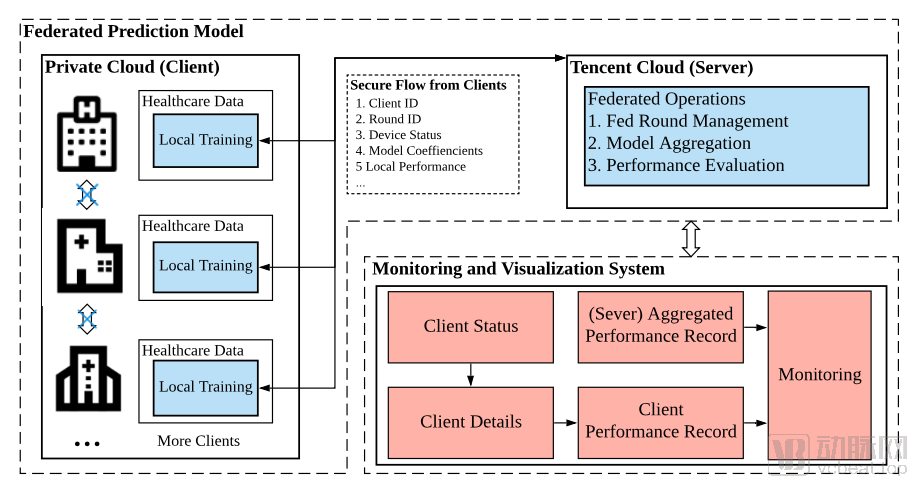
As early as last year, Tencent’s Tianyan Laboratory and WeBank initiated collaboration in fields such as medical big data and AI-assisted diagnosis of medical imaging, effectively improving the efficiency of healthcare professionals through the translation of AI-enabled achievements. Zhao Ruihui and Ju Ce, researchers at the joint laboratory, jointly developed a “Stroke Onset Risk Prediction Model” based on a medical federated learning framework. This model successfully addresses the challenges of information silos and privacy protection in the healthcare industry, enabling precise disease prediction while safeguarding data privacy across different hospitals, with a prediction accuracy as high as 80%. Furthermore, through federated learning technology, data resources from large tertiary Grade-A hospitals have helped small hospitals with limited medical services and few cases improve their model prediction metrics by 10–20%. This work is presented in a paper (paper link:https://arxiv.org/abs/2006.10517), and was accepted with high scores by FL-IJCAI'20. Meanwhile, this work received the Tencent Top Ten Micro-Innovation Project Award.
Dr. Zheng Yefeng, Head of Tencent’s Tianyan Laboratory, pointed out that the establishment of a joint laboratory will help accelerate the research and application of federated learning technology in the healthcare sector. Especially in the post-pandemic era, there has been a surge in demand for the translation and application of technologies such as AI and big data in healthcare. He expressed hope that both parties will further accelerate breakthroughs in innovative medical technologies and effectively promote the development of AI-driven healthcare services.