

Kangyuan Jiuyuan Breaks Through PEG Dual-Linker Technology Barrier, Enabling Bispecific ADCs and 'Tri-specific' Therapies for Precision Immuno-Oncology
If bispecific antibodies represent the next generation following the upgrade of monoclonal antibodies, then PEG dual-linker technology constitutes the next-generation upgrade of traditional PEG single-linker technology.
The emergence of PEG dual-linker technology has not only enabled the breakthrough of previously intractableBispecific Antibody-Drug Conjugate (ADC)become a reality, and also let“Triple Antibodies” (Triple Immune Action)The development of the drug has become possible.
What is PEG? What role does PEG technology play in the drug development process? Why have bispecific antibody ADCs and “trispecific” antibody drugs yet to emerge in the antibody therapeutics market? How can PEG dual-linker technology change this landscape? To address these questions, VCBeat (WeChat ID: vcbeat) conducted an exclusive interview with Dr. Liu Shumin, founder of Shenzhen Kangyuan Jiuyuan Biotechnology Co., Ltd. (hereinafter referred to as “Kangyuan Jiuyuan”), a company that alsoCurrently the only company in the world holding a patent for PEG-terminal bispecific linkers. company.

Dr. Liu Shumin, Founder of Kangyuan Jiuyuan
1History: PEG-Conjugated Proteins Take Center Stage in the Era of Long-Acting Drugs
PEG, or polyethylene glycol, is a widely used component in new drug development.
In the late 1960s, due to the absence of recombinant DNA technology on the market, researchers often used animal-derived proteins in drug preparation, which led to serious immunogenicity issues. Professor Davis at Rutgers University in New Jersey, USA, conjugated PEG—widely used clinically as an excipient—to proteins during new drug development, thereby reducing immunogenicity and extending half-life. This marked the prototype of long-acting drugs.
This process of coupling PEG to proteins is also known as protein pegylation, which is essentially a drug delivery technology.
Conjugating activated PEG with protein molecules can improve the three-dimensional spatial conformation of proteins, leading to changes in various biochemical properties. These include increased solubility and chemical stability, enhanced resistance to proteolytic degradation, reduced or eliminated immunogenicity and toxicity, prolonged half-life in vivo, and decreased plasma clearance rate.
In 1981, Professor Davis and his graduate student Abuchowski co-founded Enzon Pharmaceuticals, a biopharmaceutical company focused on protein PEGylation. In 1990, ADAGEN, the world’s first PEGylated protein drug developed by Enzon, received FDA approval for market launch. Subsequently, in 1994, Enzon’s second PEGylated drug, ONCASPAR, was also approved for marketing.
New drugs such as Schering-Plough’s PEGINTRON (2000) and Roche’s PEGASYS (2002) were developed using Enzon’s pegylation technology. To date, the FDA has approved 20 pegylated drugs.PEGylated drugs have become the drug development technology with the highest druggability, second only to monoclonal antibodies.
Notably, Dr. Liu Shumin, the founder of Kangyuan Jiuyuan, came from Enzon Pharmaceuticals, where he worked for 13 years. He led his team in completing the research and development, manufacturing, technology transfer, and FDA regulatory submissions for multiple pegylated drugs, including the second-generation ONCASPAR (ASPARLAS) and ADAGEN (REVCOVI).
Wu Dechun, another co-founder of Kangyuan Jiuyuan, was a colleague of Dr. Liu Shumin at Enzon and an expert in organic synthesis. During his nearly 20-year tenure at Enzon, he was primarily responsible for the design and development of PEGylation linkers, participated in the technological upgrades of multiple generations of linker platforms, and is listed as an inventor on numerous patents.
Dr. Liu Shumin introduced that during his tenure at Enzon, he collaborated with Wu Dechun on multiple protein PEGylation projects. Wu Dechun was responsible for PEG linkers, while Dr. Liu Shumin oversaw protein PEGylation. Their work was complementary and synergistic, laying a solid foundation for their future joint establishment of Kangyuan Jiuyuan.
2Innovation: Overcoming the Challenge of Light and Heavy Chain Mismatch in Bispecific Antibodies, Upgrading PEG from Single-Linker to Dual-Linker Subunits
Over the past three decades, advances in PEGylation technology have primarily been reflected in progress in linker technology, evolving from early non-specific conjugation to site-specific conjugation, and further to degradable, sustained-release linkers. In all these cases, PEG is attached to a drug target via a chemical linker.
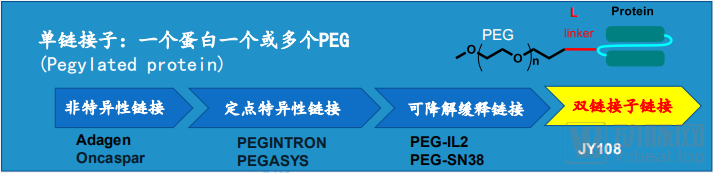
Development of PEG Technology
In 2013, clinical trial data on bispecific antibodies (bsAbs) began to be reported, sparking a surge of interest in the development of bsAb therapeutics. Dr. Liu Shumin and Wu Dechun had been closely monitoring advances in oncology antibody drugs, and naturally took note of the technical challenges inherent in bsAb development—During the manufacturing of bispecific antibodies, mispairing between the heavy and light chains of the two parental antibodies generates impurities that are difficult to separate, thereby making drug development and purification exceptionally challenging.
“At the time, we thought that if we could develop two linker subunits capable of specifically binding one-to-one to two antibody fragments respectively, we would have the opportunity to avoid impurity formation and overcome this technical challenge,” Dr. Liu Shumin told VCBeat.
Guided by this idea, Dr. Liu Shumin and Wu Dechun established the laboratory “Princeton EverBright (PEB)” in New Jersey, USA, at the end of 2015, dedicated to the development of this bispecific antibody technology. In 2017, leveraging their expertise in PEG technology, they completed the development of a dual-linker and filed a patent for a PEG-terminal bispecific linker, becoming the world’s only co-inventors holding this patent.
This PEG dual-linker technology enables the sequential conjugation of antibody fragments targeting different antigens in vitro through linker specificity, effectively circumventing impurities caused by mismatching and enhancing the success rate of drug development.
In July 2018, the R&D achievements of Dr. Liu Shumin and Wu Dechun attracted the attention of Fenxiang Capital, which then introduced them to Shenzhen to establish Kangyuan Jiuyuan. Meanwhile, Kangyuan Jiuyuan completed the acquisition of U.S.-based PEB, making PEB a wholly-owned subsidiary of Kangyuan Jiuyuan.
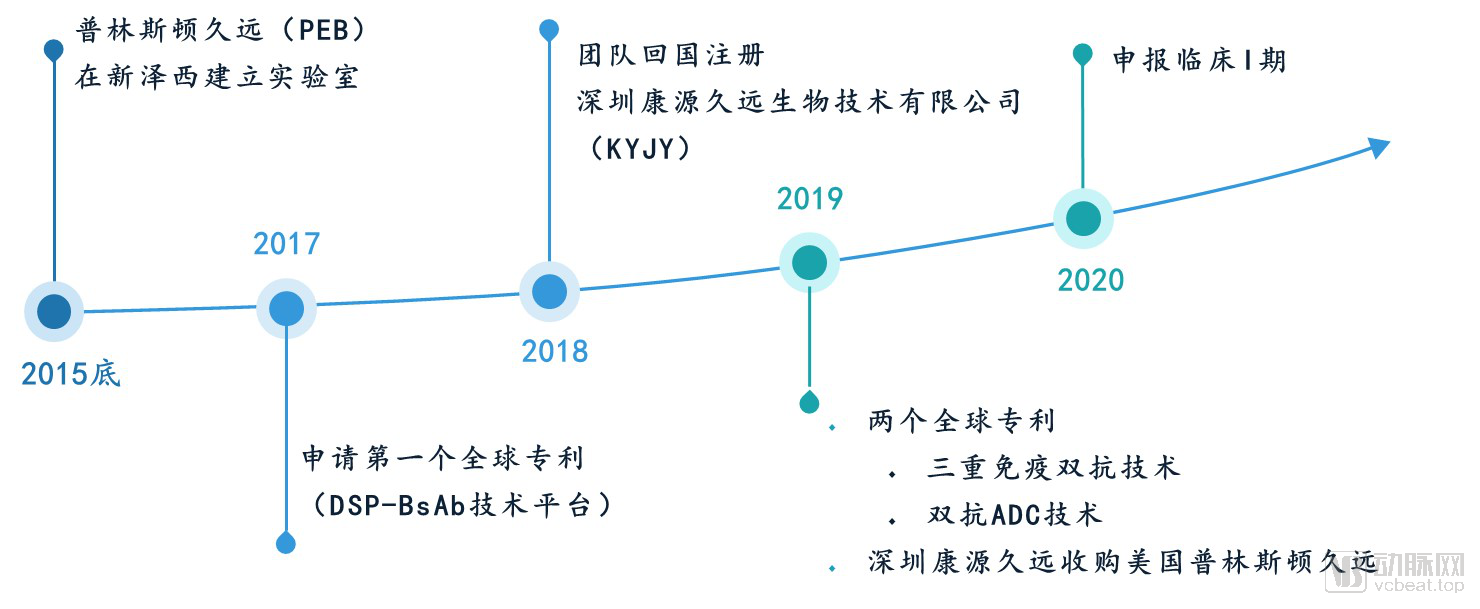
Kangyuan Jiuyuan’s Development History
3Application: PEG Dual-Linker Technology Blueprint, Facilitating the Development of Bispecific Antibody ADCs, Triple Immunotherapy, and More
If Kangyuan Jiuyuan’s original mission was to address the issue of heavy- and light-chain mispairing in bispecific antibodies, then subsequent research on PEG-based dual-linker technology has enabled the team to identify broader application prospects for this technology.
By combining existing drug targets using two linkers with distinct specificities, this approach expands the application of current drug targets and successfully overcomes certain technical barriers in traditional drug development, such as those associated with bispecific antibody-drug conjugates (ADCs) and triple-immune therapies. Based on this technology and molecular combinations, Kangyuan Jiuyuan has strategically laid out patents in three major fields.
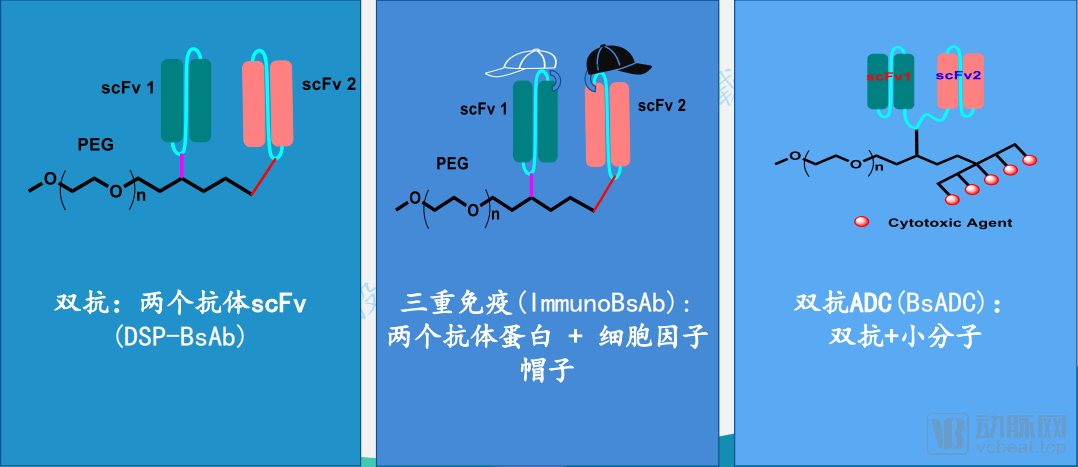
Three Major Applications of PEG Dual-Linker Technology
If two antibody fragments (scFv) are linked, it forms a bispecific antibody technology platform that utilizes PEG to replace the Fc region; if an antibody and a cytokine are linked to form a recombinant protein, it establishes a development technology for multi-specific immunotherapeutics; if one linker is used to attach a small-molecule drug and another linker is used to attach a bispecific antibody containing an scFv, it results in the formation of a bispecific antibody-drug conjugate (ADC).
These are the three primary application scenarios developed by Kangyuan Jiuyuan based on PEG dual-linker technology. In the future, the company will leverage this technology to create more combinations of existing targets and develop additional drugs.
Bispecific Antibody-Drug Conjugate (BsADC)
ADC stands for antibody-drug conjugate. To date, only eight monoclonal antibody-based ADCs have been approved and marketed, while no bispecific antibody-based ADCs have yet received regulatory approval for commercialization. In clinical research, fewer than five bispecific antibody-based ADCs are currently undergoing early-stage clinical trials at various phases.
Very few bispecific antibody-drug conjugates (bsADCs) have entered clinical trials. The primary reason is that pursuing a high drug-to-antibody ratio (DAR) during ADC manufacturing leads to in vivo instability, thereby increasing toxicity. Furthermore, hydrophobic small-molecule cytotoxic agents directly adversely affect various other critical attributes of ADCs. Consequently, bsADCs produced using current conjugation technologies exhibit varying degrees of negative impacts on druggability, in vivo stability, toxicity, and endocytosis.
However, Kangyuan Jiuyuan's PEG dual-linker technology is well-positioned to address these technical challenges:Applying bispecific antibody-drug conjugate (ADC) technology to link drugs to polyethylene glycol (PEG), and then conjugating the resulting PEGylated drug complexes with bispecific antibodies, can overcome the limitations associated with traditional ADC preparation and application.
Dr. Liu Shumin stated that Kangyuan Jiuyuan’s technology is currently in the development stage, and initial data have already demonstrated the validity of its research direction and approach.
Triple Immunity
The low clinical response rate of monoclonal antibody therapy for solid tumors has long been a major pain point in the medical community. Taking breast cancer as an example, the clinical response rate to Herceptin monotherapy is approximately 18%, leaving nearly 80% of patients unable to benefit from this antibody-based treatment. Therefore, enabling more patients to benefit from antibody therapies has become an urgent technical challenge in clinical practice.
In fact, the use of anti-CD3/anti-PD-L1 bispecific antibodies can enhance immune-mediated cytotoxicity and improve clinical response rates in patients. However, because anti-CD3/anti-PD-L1 bispecific antibodies simultaneously leverage the potent T cell-engaging effect for cancer cell elimination and immune checkpoint blockade (PD-1/PD-L1), certain normal tissue cells expressing PD-L1, such as endothelial cells, macrophages, and natural killer (NK) cells, may also be destroyed. This can lead to toxic side effects and diminish the overall antitumor efficacy.
To address the potential toxic side effects of anti-CD3/anti-PD-L1, Kangyuan Jiuyuan introducedTwo cytokine “caps” shield the active binding sites of the antibody, preventing the drug from exerting cytotoxic effects on cells expressing PD-L1 in normal tissues., thereby achieving the effect of avoiding toxic side effects.
The structure of the triple immunotherapy drug designed by Kangyuan Jiuyuan includesT-cell Redirection for Efficient Immune Cytotoxicity, Immune Checkpoint Blockade Therapy, and Cytokine Immunotherapy. The triple immune action exerts a synergistic effect, ultimately achieving“1+1+1>3”effects.
It is reported that Kangyuan Jiuyuan has launched its Series A financing round, aiming to raise RMB 60 million. The funds will be primarily used for dual regulatory filings in China and the United States for its core pipeline, research and development of follow-on products, and advancement into Phase I clinical trials.