

LianRen Health Files IPO Prospectus: Empowering Healthy China Strategy with Central SOE Strength through Medical Big Data Ecosystem

LIANREN Digital Health
Medical Big Data Analytics Service Provider
As the most influential annual event in the field of healthcare informatization, CHINC (China Hospital Information Network Congress) was postponed twice due to the pandemic, yet enthusiasm among industry participants remained undiminished. On August 21, in Nanjing, the ancient capital of six dynasties, CHINC finally kicked off amid keen anticipation from the healthcare sector.

LIANREN Digital Health Vice President Li Yunfei Delivers Address at the Conference
At the conference, Ms. Li Yunfei, Vice President of LIANREN Digital Health, was invited to deliver a speech, in which she elaborated on the critical roles played by medical big data, internet healthcare, and artificial intelligence in the prevention and control of the COVID-19 pandemic, and extended warm congratulations on the successful convening of the conference in the post-pandemic era.
In fact, since China Mobile took the lead in initiating its preparatory establishment in 2017, LIANREN Digital Health has been under intense industry scrutiny. This conference marked LIANREN Digital Health’s first public appearance since its official unveiling in April this year. Following the event, VCBeat conducted an exclusive interview with Vice President Li Yunfei to gain a more comprehensive understanding of LIANREN Digital Health and its future development strategy.
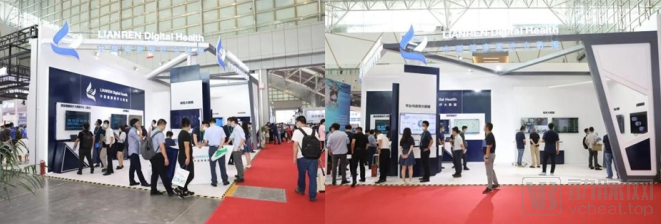
LIANREN Digital Health Makes Debut at CHINC Exhibition
In recent years, big data in healthcare has been the industry’s “darling,” highly favored by capital markets. Many companies have rushed to enter this space, aiming to carve out a share of the market through data or technology.
Since 2020, China has witnessed continuous policy initiatives at the national level. It began with the launch of “new infrastructure,” represented by 5G, big data, and artificial intelligence. In early April, the State Council issued the “Opinions on Building a More Complete System and Mechanism for Market-Based Allocation of Production Factors,” explicitly recognizing data as a new type of production factor. This signifies that China has officially entered an era of large-scale release of digital economy dividends, with data transitioning from the input stage to the stages of output and distribution.
“Data possesses the inherent attributes of being replicable, shareable, and capable of infinite growth and supply.” In Li Yunfei’s view, industry participants leverage data aggregation and governance capabilities based on artificial intelligence and information technology to transform massive, dynamic, rapidly growing, and diverse medical data into “medical big data” with enhanced capabilities for insight discovery, decision support, and process optimization, thereby facilitating the improvement and completion of the healthcare industry ecosystem.
Meanwhile, Li Yunfei also expressed concerns about the current pain points in the development of medical big data. Due to considerations for medical data security and patient privacy protection, medical data is often scattered among individual entities such as healthcare institutions and insurance companies, making it difficult to achieve scalable and standardized management and application. Although many healthcare institutions and enterprises are building scientific research big data platforms to consolidate data collection and governance for various diseases, the data sources used are often limited to their own organizations. This inability to aggregate data from patients with similar conditions within a certain region has also hindered medical scientific research. “Overall, medical big data is characterized by being ‘small in scale, fragmented, disordered, and of poor quality,’” said Li Yunfei.
Against this backdrop, a “national team” was established. To strengthen the secure application and quality protection of data related to public health and medical care, the National Health Commission deployed the formation of a “national team” in the field of healthcare big data to build and operate a national-level healthcare big data center, leading to the establishment of LIANREN Digital Health. “We aim to leverage data analysis and insights to enhance overall service levels and the management capabilities of medical institutions in areas such as internet-based healthcare, thereby empowering the transformation of the ‘three-medical linkage’ new healthcare service system and providing support for the realization of the ‘Healthy China’ strategy,” said Li Yunfei, reflecting on the original mission behind the founding of LIANREN Digital Health.
LIANREN Digital Health’s status as a national team player is primarily reflected in three aspects:
First, obtain the relevant authorization from the National Health and Medical Big Data Northern Center.“Northern Center” is one of the five national-level pilot regional centers for health and medical big data (covering East, South, West, North, and Central China) designated by the National Health Commission. Hailed as the “most powerful brain,” it is the only pilot center for national health and medical big data officially approved and authorized through a formal agreement by the National Health Commission. On April 27, 2018, while still in its preparatory phase, LIANREN Digital Health received authorization to operate the Northern Center for National Health and Medical Big Data, becoming the first enterprise in China to secure comprehensive government contracting and authorization mechanisms. With this national mandate for health and medical data operations, LIANREN Digital Health can lawfully aggregate nationwide health and medical big data resources, building corresponding capabilities in data processing, data mining, and the development of industry-specific ecosystem applications.
Second, robust data integration capabilities and ecosystem-building capabilities.To comprehensively grasp the development direction of healthcare big data, a company must possess strong internal capabilities. In terms of corporate strength, LIANREN Digital Health boasts a professional technical team and an expert medical team. Regarding resources, LIANREN Digital Health can aggregate the resource advantages of its eight major investors—including China Mobile and China Pacific Insurance—in areas such as medical technology, healthcare informatization, health insurance, healthcare big data, and commercial channels, thereby exploring and fostering the development of new business models.
Third, the “technology + capital + qualifications + operations” four-in-one overall model.LIANREN Digital Health can engage in extensive collaboration with national-level platforms, authoritative medical institutions, and industry partners, extending its business scope from infrastructure development to the subsequent operation of platforms and applications. It aims to expand its reach across the entire healthcare industry—including public health, internet hospitals, integrated elderly care and medical services, health management, insurance innovation, pharmaceutical R&D, and medical education—thereby building a comprehensive healthcare ecosystem and reshaping the landscape of the medical big data industry.
In response to the industry assertion that “the big data in healthcare has entered its second half,” Li Yunfei also shared his reflections.
As data has become a highly sought-after foundational resource, the demand for its deeper application continues to rise. Previously, efforts in data application were primarily undertaken by startups and private companies, resulting in an industry-wide dilemma of low data utilization rates. With data officially recognized as a new factor of production and operating institutions joining under the guidance of the National Health Commission, the medical big data ecosystem will gradually become more standardized. Consequently, the value of data will evolve from merely summarizing medical practices to progressively supporting clinical decision-making and providing comprehensive medical decision support.
Leveraging its inherent strengths, LIANREN Digital Health has established three core business segments: healthcare big data, internet-based healthcare services, and healthcare industrial parks. Why were these three areas selected? According to Li Yunfei, this business layout was formulated by integrating LIANREN Digital Health’s corporate positioning and objectives with the resource advantages of its shareholders.
The corporate positioning and objective of striving to become China’s largest operator of digital health and medical services have determined that big data in health and medicine is a key focus area for LIANREN Digital Health. Internet-based healthcare and medical services, meanwhile, were established based on shareholders such as China Mobile’s accumulated expertise in medical informatization and their understanding of the future healthcare market.
The big data in health and healthcare business segment can promote the development of internet-based medical and health services, including enhancing the capacity of medical institutions and government departments to deliver and manage such services. In turn, internet-based medical and health services feed back into the big data in health and healthcare business, facilitating effective data aggregation and value-driven applications. Furthermore, through industrial parks, these two segments integrate upstream and downstream enterprises within the medical and health sector, bringing together R&D institutions, academic disciplines, universities, and companies into a unified ecosystem. This integration aims to strengthen national-level governance of medical big data and enhance the overall capabilities of internet-based medical and health services.
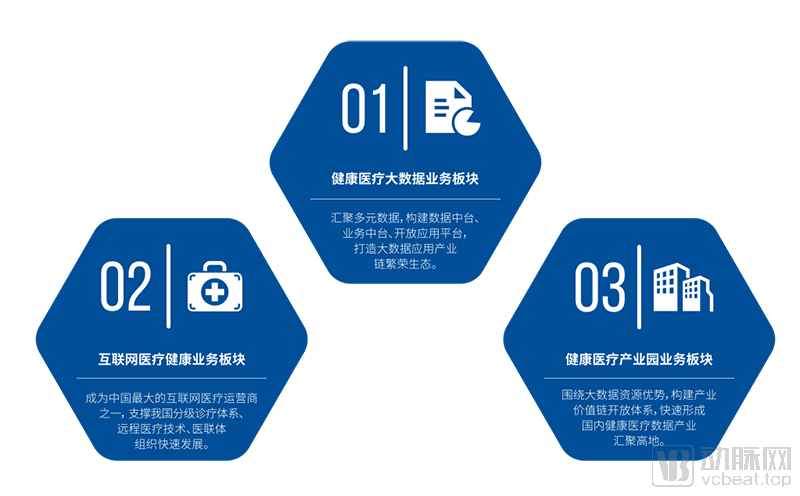
LIANREN Digital Health Business Layout Diagram
To possess sufficient capability to manage data on a national scale in the future, it is essential to have a stable product architecture as support. When planning its business layout, LIANREN Digital Health conducted comprehensive considerations regarding the security, stability, scalability, and maintainability of its product architecture.
Drawing on best practices in big data storage and governance from the financial sector, and integrating the unique characteristics of the healthcare industry, LIANREN Digital Health has adopted a top-tier “two locations, three data centers” infrastructure to build its “One Lake, Three Platforms, N Applications” framework. This system establishes a unified health and medical big data lake, constructs three core platforms—namely, a data middle platform, a technology middle platform, and an open platform—to support big data applications across numerous domains such as insurance, pharmaceuticals, and clinical care, thereby fostering an industrial ecosystem for health and medical big data.
“In the future, the medical big data industry will see tremendous growth driven by the rapid deployment of 5G,” said Li Yunfei. While steadily advancing the construction of the “Northern Center” and building domestic leading infrastructure support capabilities, LIANREN Digital Health will also integrate 5G technology to establish a data-intensive internet healthcare business system represented by regional internet hospitals, cloud imaging, cloud electronic medical records, and health management. The company will accelerate the cultivation of extended industries in internet healthcare, connect with and introduce national-level platform resources such as the National Remote Medical Collaboration Platform and the National Family Doctor Platform, and actively create new economic growth points.
Currently, LIANREN Digital Health has achieved phased milestones: it jointly established the “National Remote Consultation Platform for Severe and Critically Ill COVID-19 Patients” with the National Telemedicine and Internet Medicine Center, which has onboarded 2,188 medical institutions and registered over 14,000 physicians, and facilitated China’s first 5G-enabled remote consultation. Additionally, the remote consultation center and internet hospital project co-developed with Wuhan Tongji Hospital has successfully launched services across 75 specialties, engaged 870 physicians, and accumulated 186,200 patient consultations.
Based on the “Three Major Segments” and the “One Lake, Three Platforms” framework, LIANREN Digital Health has established an integrated business system encompassing six key areas: government services for health and medical big data, healthcare delivery, health services and management, medical education, and medical research. Looking ahead, Li Yunfei stated that LIANREN Digital Health will, in accordance with the requirements of relevant national authorities and industry development plans, progressively expand business collaborations with multiple provinces and municipalities, universities, industry partners, and key medical institutions.