

Aweifo Secures China's First Approval for Domestic Embryo Culture Oil, Breaking Foreign Monopoly
Driven by factors such as the continuous increase in the number of infertile patients in China and the gradual rise in the penetration rate of assisted reproductive technology (ART), the Chinese ART market has witnessed a rapid surge in demand. According to data from Zhiyan Consulting, the market size of China’s ART sector grew to USD 4.4 billion in 2019, up from USD 2.3 billion in 2014, representing a compound annual growth rate (CAGR) of 13.85%. As of December 31, 2019, the number of domestic ART centers had reached 517.
However, in contrast to the sustained boom in the downstream sector of the industry, the upstream market for assisted reproductive technology (ART) in China, particularly the ART culture media market, faces a grim outlook. Due to significant challenges in industrialization and lengthy regulatory approval cycles, China has long relied 100% on imports for ART culture media, with four foreign companies—Life Global, SAGE, Vitrolife, and COOK—dominating the vast majority of the domestic market share.
Recently, the culture oil for assisted reproduction developed by Aifu obtained the Class III medical device registration certificate issued by the National Medical Products Administration (NMPA), breaking the monopoly of imported products that had lasted for many years.
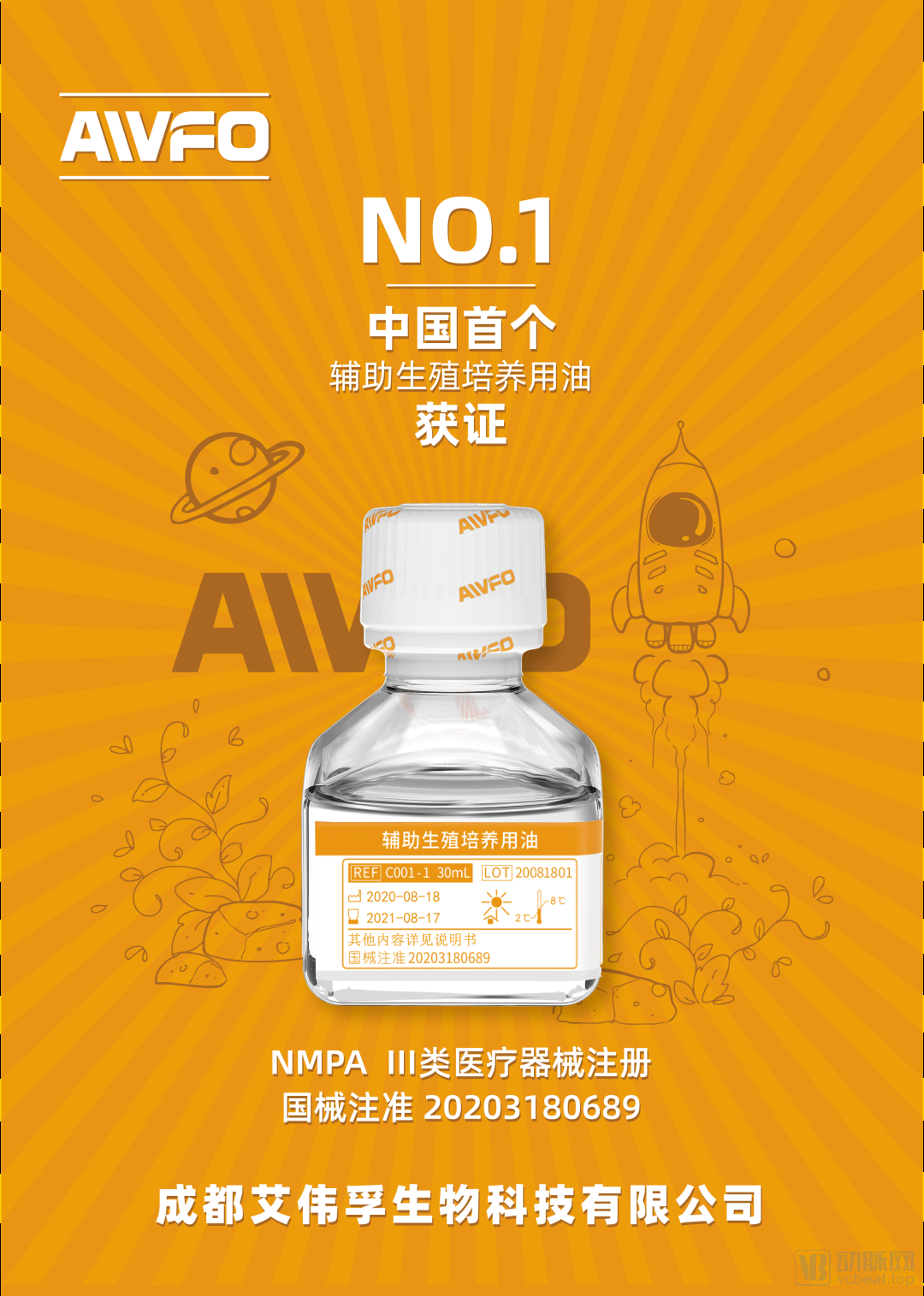
Culture oil for assisted reproduction is used to overlay culture media during in vitro fertilization and micromanipulation procedures, establishing a protective barrier between gametes, zygotes, or embryos and the external environment. It is a critical factor in ensuring the success rate of in vitro fertilization (IVF). Chengdu Aifu Bio Technology Co., Ltd. subjects its products to rigorous and specialized processing and optimization to control peroxides, heavy metals, and endotoxins (the physicochemical safety indicators of the product far exceed those required for vaccines).The blastocyst formation rate of the product (MEA) remains stable at over 95%, demonstrating equivalence to imported products.
“This is the first domestically produced assisted reproductive culture medium product to be approved in China in the true sense,” said Yan Fei, Founder and Director of Aifu Bio. “The approval of this product also establishes the company’s leading position in the industry and will serve as a significant incentive for its subsequent R&D and regulatory approval efforts.”
Next, Aifu will leverage its core team’s nearly 20 years of experience in channel development and import agency within the assisted reproductive technology (ART) market, combined with academic promotion, to rapidly penetrate hundreds of ART centers across China.
Oil for Assisted Reproductive Culture can isolate the culture medium from the external environment during in vitro manipulation and culture of gametes and embryos, which helps maintain the stability of pH, osmotic pressure, and humidity of the culture medium, preventing contamination and evaporation. It can also absorb hydrophobic harmful components and some volatile organic compounds in the culture medium to ensure the safety and success rate of in vitro culture of gametes and embryos.
The blastocyst formation rate is a critical indicator for evaluating the performance of culture oils used in assisted reproductive technology. Test results showed that,The blastocyst formation rate (MEA) of the culture oil for assisted reproduction developed by Aifu remains stable at over 95%, demonstrating equivalence to imported products.
Due to the unique characteristics of assisted reproductive technology (ART) culture media, domestically produced products hold significant advantages over imported ones.
A major characteristic of assisted reproductive technology (ART) culture media is their short shelf life, which precludes bulk stockpiling.Therefore, most assisted reproductive technology centers in China experience product shortages due to fluctuations in the volume of clinical patient cycles.
Generally, the procurement of imported products typically requires 2–4 months for delivery. Amid the ongoing instability of the global pandemic, the risk of supply disruptions for imported products has further increased, which is highly likely to affect the smooth conduct of clinical operations at domestic assisted reproductive technology (ART) centers.
Domestically produced culture media for assisted reproduction have significantly shortened product lead times, resolving the issue of unstable supply cycles associated with imported products. Yan Fei stated, “For products in stock, customers can receive their shipments within 1–3 days. For out-of-stock items, the entire process—from order placement and production to sterility testing and delivery—takes no more than 15 days. This ensures that assisted reproduction centers receive their supplies promptly and efficiently, thereby eliminating the risk of product shortages.”
Another distinctive feature of assisted reproductive culture media is the requirement for cold-chain transportation throughout the entire process.Imported products may suffer adverse effects on performance due to long-distance air transportation. Chengdu Aifu Bio Technology Co., Ltd. has established standardized and controlled product transportation protocols, strictly selecting cold-chain logistics suppliers to ensure consistent 2–8°C refrigerated transport throughout the entire supply chain.
Meanwhile, by eliminating the need for long-distance transportation and customs approval, Aifu’s culture oil for assisted reproduction offers greater cost-effectiveness. Yan Fei revealed:"Domestic products are approximately 20% cheaper than imported ones."
The research and development, industrialization, and regulatory approval of assisted reproductive culture media are extremely challenging and typically require many years. However, Chengdu Aifu Bio Technology Co., Ltd. took only three years from its establishment to obtain approval for its first product. This achievement was made possible by the company’s core team, which brought years of foundational expertise and experience in developing comprehensive culture systems for assisted reproduction.
The founding team of Aifu Bio has been deeply rooted in the healthcare industry for many years. With over 20 years of industrial experience in the biopharmaceutical sector, they have successfully facilitated the market launch of multiple IVD products and possess extensive expertise in the industrialization standards and regulatory approval processes for medical devices.
The company’s core founders have many years of experience in embryo culture operations at IVF centers and in serving as import agents for assisted reproductive technology (ART) medical devices. They previously helped an imported brand secure China’s first registration certificate for an ART product.
The company’s CTO earned his Ph.D. in Genetics from the former West China University of Medical Sciences, possesses extensive clinical experience, participated in establishing China’s first batch of assisted reproductive technology (ART) centers, and has been dedicated to research on ART culture media since the 1990s.
Yan Fei stated that the company’s founding team has long been optimistic about China’s assisted reproductive technology (ART) market. “The domestic ART market still faces challenges related to relatively lagging industrialization and marketization. We aim to achieve import substitution in this niche yet promising sector.” United by shared goals and vision, the founders came together to establish Chengdu Aifu Bio Technology Co., Ltd., focusing on the research and development of products for comprehensive ART culture systems.
Leveraging the founding team’s years of technical expertise, industrialization capabilities, execution prowess, and channel resources within the industry, Chengdu Aifu Bio Technology Co., Ltd. has achieved rapid growth. In addition to its recently approved culture oil for assisted reproduction,The company has 14 assisted reproductive culture media products (including sequential embryo culture media, embryo transfer media, etc.) under regulatory review.It is expected to receive approval successively within the next two years.
Notably, the company’sThe full-process embryo culture medium and fertilization medium are the first products in China to enter the clinical trial stage,It is expected to become the first product approved in China.
With the approval of its first product, Aifu is also exploring its future development direction. “Assisted reproduction is a relatively closed market, characterized by being ‘small, refined, and specialized.’ Deploying a full range of products is an important way to create synergies and help the company establish its industry position.”
Therefore, in 2020, the company fully enteredIn the field of high-polymer consumables for assisted reproduction,Developed a brand-new microfluidic chip for gamete and embryo culture. Furthermore, aligning with the industry’s trends toward automation, intelligence, and standardization, the company collaborated with a renowned automation team from Harbin Institute of Technology to jointly developAssisted Reproductive ICSI Micromanipulation Robot。
“We are confident in the growth prospects and market expansion of the assisted reproductive technology (ART) industry. By strategically positioning ourselves across ART culture media, polymer-based consumables, and active medical devices, we aim to maintain a leading position in core ART technologies and establish Aifu as a dominant enterprise in China’s ART sector,” summarized Yan Fei.