

Why Real Estate Giants Like Evergrande and Wanda Stumbled in Their Healthcare Ambitions: From Evergrande Health’s Rebranding to Wanda’s Guangzhou Land Retreat
Not long ago, Evergrande Health, a Hong Kong-listed company under the Evergrande Group, announced a name change: “Given that new energy vehicles have become the most important business of Evergrande Health Industry Group, the company proposes to rename itself Evergrande Auto.”
Evergrande Health operates under a dual-business framework comprising the Health Management Division and the New Energy Vehicle Division. In economics, the opportunity forgone by an enterprise to engage in one business activity in favor of another is termed “opportunity cost.” The opportunity cost of Evergrande’s strategic adjustment is evident: with its internal portfolio limited to just two core sectors—big health and automobiles—prioritizing one inevitably entails delaying the other.
Although the name change does not necessarily indicate that Evergrande Health has encountered setbacks in the big health industry, it reflects a shift in its business focus from the big health sector to new energy vehicles.
In the early years, particularly after 2013, major real estate developers announced their diversification into the healthcare sector, either prominently or discreetly. According to incomplete statistics, nearly 40 real estate companies have entered the broader health industry and made corresponding strategic arrangements to date. Country Garden, Evergrande, and Taihe have focused on building hospitals and industrial parks, while Vanke and Greentown have prioritized community-based and home-based healthcare services...
High leverage, rapid turnover, intentional vacancy, and high-profile marketing... Have the real estate giants, who have dominated the industry with decisive action for decades, replicated their real estate "alchemy" in the big health sector? How are they exploring the "real estate + healthcare" model?
At a financial forum in 2014, real estate tycoon Feng Lun remarked, “The big health sector is a bigger trend than real estate; it will be worth approximately RMB 20 trillion over the next five years.”
He drew a comparison between the real estate sector and the health and wellness industry. The annual sales area of the real estate industry currently stands at approximately RMB 7 trillion, with residential properties accounting for about 80%, totaling roughly RMB 25 trillion over five years. “The health and wellness industry is undoubtedly poised to become an even stronger tailwind than real estate. In the past, the real estate boom lifted many ‘pigs’—a metaphor for beneficiaries riding the wave. What kind of ‘pigs’ will the rising tide of the health and wellness industry lift in the future?”
A year before Feng Lun delivered these remarks, Vantone Real Estate, under his leadership, had already begun to lay out its strategy in the big health industry, with its initial move being the development of a medical industrial park in Xi’an.
In 2013, the real estate industry experienced a significant turning point, facing stringent macroeconomic regulation. On February 20, the State Council’s executive meeting studied and deployed continued efforts to regulate the real estate market, establishing five policy measures to strengthen market control (known as the “Five National Measures”). As local governments rolled out their respective implementation rules for the “Five National Measures,” the once-boiling market temporarily cooled down. With their core business losing momentum, major real estate developers began exploring diversified transformations.
In October of the same year, the State Council issued the "Several Opinions on Promoting the Development of the Health Service Industry," which clarified a diversified pattern for medical service provision and set a target for the industry’s total scale to reach 8 trillion yuan by 2020.
Guided by policy directives, major real estate developers have set their sights on the $8 trillion healthcare market and have launched significant initiatives.
Vanke announced a joint investment totaling 250 million yuan with Shanghai New Hongqiao International Medical Center, Fudan Medical Industry Investment Co., Ltd., and other partners to establish the Fudan-Vanke International Children’s Hospital;
Lujing Holdings Releases RMB 10.05 Billion Private Placement Plan; Proceeds to Be Used for Constructing Four Physical Hospitals, One Medical Center (i.e., the Precision Oncology Medical Center), and Two Health Platforms
Wanda Announces a Total Investment of 15 Billion Yuan to Build Three Comprehensive International Hospitals in Shanghai, Chengdu, and Qingdao.
......
As of now, according to incomplete statistics, nearly 40 real estate companies have made moves in the healthcare industry.
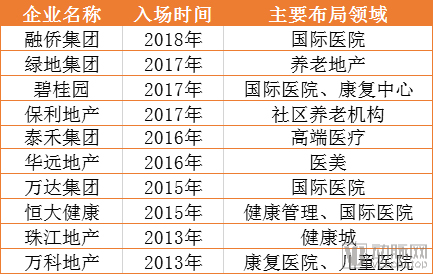
(Timeline and Key Focus Areas of Selected Leading Real Estate Developers’ Entry into the Healthcare Sector)
Among the nearly 40 real estate companies that have crossed over into the healthcare sector, there is a prevailing preference for asset-heavy models. Whether acquiring land independently or partnering with third parties to build hospitals, or establishing health nursing and elderly care centers either within residential developments or at separate locations, each business line requires substantial capital investment.
Looking back, the real estate developers’ grand entry did not end in a perfect outcome.
In August 2019, Lujing Holdings issued an announcement on the progress of its major asset restructuring, stating that RMB 31.748 million in equity transfer proceeds, along with liquidated damages arising from overdue payment, remained uncollected. This equity transfer payment pertained to the proceeds from Lujing Holdings’ divestiture of its medical assets.
This year, Evergrande Health changed its name, replacing “Health” with “Automobile,” while Wanda quietly sold off the land plot in Guangzhou that it had previously acquired for hospital construction.
Within the medical community, these are merely the visible clues; other real estate developers that have crossed over into healthcare remain largely silent.
Next, this article will take Evergrande and Wanda, the two companies with the largest investments in the healthcare sector, as examples to closely examine their businesses and models.
In 2015, Evergrande Health was already listed on the Main Board of the Hong Kong Stock Exchange.
Evergrande Health is a comprehensive, large-scale health industry group that leverages the development and construction of Health & Wellness Valley projects as its platform and adopts a membership-based service model to provide multi-tiered medical care, age-inclusive wellness services, high-precision health management, and diversified elderly care solutions.
Its most significant business initiative is “Evergrande Health Valley,” which aims to create large-scale, high-end health and elderly care bases in China by integrating premium hospital and nursing home resources both domestically and internationally. To date, 23 such Health Valleys have been established across China. Drawing on the experiences of global large-scale senior living communities such as Sun City in the United States, Albertina in Germany, Kohoku New Town in Japan, and Humanitas Living Concept in the Netherlands, these facilities provide comprehensive medical services for elderly users, including professional nursing, day care, and rehabilitation therapy.
In addition to establishing elderly care and wellness bases, Evergrande Health has also made significant strides in the “three medical” sectors.
In the healthcare sector, Evergrande Health has partnered with medical institutions both domestically and internationally to jointly establish a high-end medical service system. This system features a multi-tiered, hierarchical healthcare framework led by premium international hospitals, supported by local Henghe Medical platforms and renowned domestic Grade A tertiary hospitals, and grounded in community hospitals.
On the hospital front, Evergrande Health invested in and established Boao Evergrande International Hospital (the only affiliated hospital of Brigham and Women’s Hospital in China), integrating domestic and international resources to operate under the “Brigham-style” model and provide global healthcare services, including treatment for breast cancer and other conditions.
Leveraging the policy and resource advantages of the Pilot Zone, we utilize the Boao Public Bonded Pharmaceutical Warehouse to introduce new anti-tumor drugs that have been approved internationally but are not yet listed in China, and develop personalized treatment plans for patients. We fully integrate high-quality domestic medical resources and have formed alliances with renowned medical institutions, including Fudan University Shanghai Cancer Center, the First Affiliated Hospital of Hainan Medical University, and Boao Stem Cell Hospital of China Stem Cell Group.
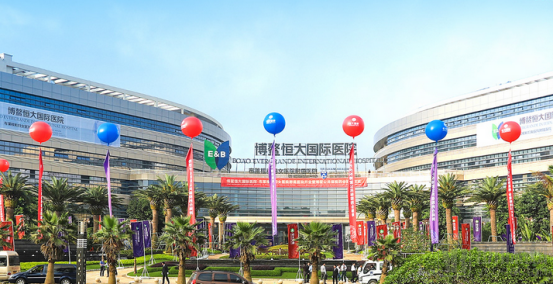
(The image shows Boao Evergrande International Hospital as displayed on the official website of Evergrande Health)
In addition, Evergrande Health is actively raising funds for the Sanya Evergrande Women’s and Children’s Hospital, a modern tertiary-level specialized hospital dedicated to integrating medical care, preventive health services, and rehabilitation.
In the pharmaceutical sector, leveraging the Boao Public Bonded Pharmaceutical Warehouse and utilizing medical institutions within the Pilot Zone as endpoints, Evergrande Health has introduced a variety of specially approved drugs from internationally renowned originator pharmaceutical companies such as AstraZeneca (UK), Merck (Germany), Roche (Switzerland), and Novartis (Switzerland). This enables domestic patients to access cutting-edge, innovative, specially approved international medicines without leaving China.
Using physical spaces such as the Health & Wellness Valley as the foundational carrier, integrating “three-medical” resources, and continuously layering on all available resources—this is the essential model of Evergrande Health’s business layout.
These operations are all categorized under the Health Management Division within Evergrande Health. According to the 2019 annual report, Evergrande Health reported revenue of RMB 5.636 billion in 2019, a year-on-year increase of 79.88%. The substantial growth in the Health Management Division’s turnover was primarily driven by revenue from “Evergrande·Wellness Valley,” which rose from RMB 3.12442 billion in the same period of 2018 to RMB 4.94847 billion, representing an increase of 58.38%. In 2020, the new energy vehicle segment generated total revenue of RMB 660.5 million, mainly derived from sales of lithium batteries.
Looking ahead, Evergrande Health has ambitious plans:
In terms of health and wellness, at least 11 Wellness Valleys’ Four Major Parks, four large-scale medical-nursing complexes, and four residential apartments for sojourners will be opened to the public in 2020. Health and medical-nursing demonstration and experience centers will be established in multiple locations across China to promote the comprehensive implementation of the Wellness Valley’s distinctive health and wellness service system.
In terms of health management, we will further integrate high-quality domestic and international health management resources, draw on and introduce advanced international service models for chronic disease management and health diagnosis and treatment, and enhance the operational service capabilities of Yangshenggu. As “Evergrande·Yangshenggu” expands its presence across China, we will accelerate the optimization and implementation of highly precise health management services, establishing a leading brand for professional health management services in China.
In the elderly care sector, building on the National Wellness Valley project, we will further accelerate the nationwide rollout of Evergrande’s distinctive elderly care service system. In partnership with Japan’s Reiai Co., Ltd., the Xi’an Evergrande Nursing Home is expected to officially commence trial operations by the end of 2020, establishing the first benchmark project in elderly care. This pilot facility will serve as a model to drive the national expansion of institutional elderly care services. Leveraging Evergrande’s residential communities across China, we will further advance pilot programs for home-based and community-based elderly care, facilitating the comprehensive implementation of Evergrande Health’s specialized elderly care service system. Looking ahead, we will collaborate with multiple sectors, including finance, tourism, and the internet, to expand our membership base and deliver health services to a broader population.
Across its entire healthcare service network, Evergrande Health will also introduce a wider range of health and medical products, building a supply chain platform centered on local “Evergrande Wellness Valley” projects that integrates pharmaceuticals, medical devices, healthcare products, and wellness and elderly care offerings.
Evergrande is pursuing an ambitious health dream.
However, the cost of such ambitions is also evident. In 2018, Evergrande Health’s total borrowings stood at only RMB 14.9 billion; by 2019, this figure had surged to RMB 62.8 billion, representing a 4.2-fold year-on-year increase. As of December 31, 2019, Evergrande Health’s asset-liability ratio was 67.26%.
The image of Wanda’s high-profile entry into the big health industry seems like it was just yesterday.
In January 2016, Wanda Group and International Hospital Group (IHG) signed a cooperation agreement in Beijing and announced that Wanda would invest a total of RMB 15 billion to build three comprehensive international hospitals in Shanghai, Chengdu, and Qingdao, which would be operated and managed by IHG under the IHG brand.
Among them, Shanghai Yingci Wanda International Hospital will invest RMB 8 billion and have 1,000 beds; Chengdu Yingci Wanda International Hospital will invest RMB 5 billion and have 500 beds; Qingdao Yingci Wanda International Hospital will invest RMB 2 billion and have 200 beds.
At the time, this sum was considered a massive amount in the healthcare industry, representing the largest investment by a Chinese enterprise in the sector.
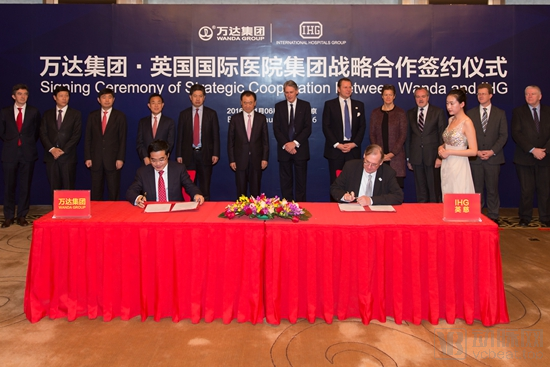
(The image shows the signing ceremony at that time)
Wang Jianlin, Chairman of Wanda Group, stated in a media interview: “The introduction of top-tier comprehensive international hospitals represents an innovation by Wanda in China. It not only meets the healthcare demands of high-net-worth individuals but also elevates the local medical standards to world-class levels, thereby driving the advancement of high-end healthcare in China.”
Since then, Wanda has continued to spend lavishly in the healthcare sector. In April 2017, Wanda Group signed a strategic cooperation memorandum with the Chengdu Municipal People’s Government, under which both parties agreed to invest RMB 70 billion to build a world-class healthcare industry hub.
On the evening of August 2, 2017, the news that Wanda had newly established a Health Group briefly became the headline for many media outlets. At that time, in addition to Wanda Group’s existing four major industrial groups (Wanda Commercial, Wanda Culture, Wanda Network, and Wanda Finance), a new entity, Wanda Health Industry Group Co., Ltd., was established, and the Medical Business Division was merged into the Health Group. Wang Shun was appointed as Vice President of Wanda Group Co., Ltd. and President of Wanda Health Industry Group.
In January 2019, at the annual conference held in Qingdao, Wang Jianlin, Chairman of Wanda Group, announced a comprehensive and formal entry into the health industry. He clarified that Wanda’s health sector would center on hospitals, integrating pharmaceuticals, elderly care and wellness, commercial operations, and training into a unified model to pioneer an innovative approach to the health industry.
In his annual conference report, Wang Jianlin outlined specific directions for Wanda’s strategic layout in the healthcare industry: by 2018, international hospitals under the Wanda Health brand would be fully operational in five cities, including Guangzhou and Chengdu, with construction commencing on at least three projects. The company aims to finalize the standard management contract template for individual international hospitals at the earliest opportunity, design world-class garden-style international hospitals that reflect the latest global research advancements, and establish smart hospitals.
Wang Jianlin stated that in recent years, Wanda has advanced its asset-light strategy by focusing on core competitive industries and adopting a divestment and streamlining approach for non-core sectors. However, Wanda remains committed to fully promoting emerging industries that are non-traditional, technology-intensive, and strategically identified. The big health industry is a key strategic sector for Wanda’s breakthrough efforts.
Wanda’s health ambitions are equally vast. However, in line with the Wanda Group’s broader shift toward an “asset-light” strategy, it has also embarked on a path of continuous divestitures.
On February 25, 2020, the Planning and Natural Resources Bureau of Guangzhou Development District offered the state-owned construction land use rights for Plot YH-A3-8 in Huangpu District through a listed bidding process, with time-limited bidding scheduled for March 27. The total land area of this parcel is 133,252 square meters, designated for medical and health facilities, transportation hubs, commercial uses compatible with other service facilities, and compatible with public parking lots. The starting bid price was RMB 1,546.83 million, equivalent to an approximate floor area price of RMB 3,464 per square meter.
The plot was acquired by Wanda Group at the reserve price on May 20, 2019. Its current re-listing for transfer signals that Wanda has returned the land.
In March 2020, Jiemian News reported that the position of President under Wanda Health Group had been vacant for a long time.
On January 1, 2020, financial writer Wu Xiaobo delivered his annual New Year’s Eve speech as usual. During the event, he remarked, “Looking at the big picture, a significant proportion of the substantial wealth accumulated in China over more than four decades of reform and opening-up is held by the generations born in the 1960s and 1970s. In the next decade or so, this cohort will enter their retirement years. Ten years from now, the elderly care industry will replace the real estate sector as the ‘number one mega-industry.’”
In February, with the compounding effects of factors such as the outbreak of the epidemic, the big health industry once again became the most prominent sector. Nearly all top-tier venture capital firms shifted their investment focus to the healthcare and medical sector, with the proportion of investments rising to over 35% at one point.
This means that real estate developers actually bet on the right track.
However, the lack of professional barriers, coupled with high entry thresholds, substantial capital requirements, and slow returns, may be areas where real estate developers struggle to adapt in the healthcare sector.
For the healthcare industry, starting by building hospitals with substantial capital investment and adopting an asset-heavy model can be risky. Without patience and the willingness to invest time, projects may fail before their ultimate business model is proven or disproven. Looking at world-renowned “real estate + healthcare” models such as Sun City retirement community in the U.S., the Texas Medical Center, and Dubai Healthcare City, theyTypically anchored by spatial carriers such as Health Cities, Medical Cities, and large-scale integrated elderly care communities, these initiatives drive the clustered development of the health industry, establishing highlands for both health services and clinical medicine. Without exception, they have all undergone extended periods of development, with some even being “century-old institutions.”
At the heart of the healthcare industry lies a fundamental need for patience and time.
Years later, looking back.
Great rivers and mighty streams, a surging tide.