

Shengzhe Medical: Pursuing Domestic Substitution in Minimally Invasive Energy Devices with an Academic Approach to Product Development

Saints Sages Surgical
Surgical Medical Device R&D and Production Manufacturer
895 Venture Camp is an innovation and entrepreneurship service brand created by Zhangjiang Hi-Tech (Stock Code: 600895). Guided by its original aspiration to focus on industries, optimize resources, and empower innovation, it leverages the joint support of partners in capital, technology, media, and other fields to build a robust entrepreneurial cluster.
Saints Sages Surgical is one of the high-quality projects in the Healthcare Special Session of Camp 895 (Season 9).
VCBeat has curated a series of in-depth features on high-quality healthcare projects from the 895 Venture Camp. We welcome you to follow our coverage. If you are interested in any of the projects featured, please feel free to contact us directly.
Dr. Hu Zhe, founder of Saints Sages Surgical, spent his extensive academic journey in Germany, from undergraduate studies through to his doctorate. His speech and demeanor occasionally reveal a German-style simplicity and rigor, blended with Chinese-style modesty and acuity, sparking considerable curiosity about the products developed by the innovative medical device company he leads.
On a wall outside Dr. Hu Zhe’s office hangs the animal testing protocol he designed for the ultrasonic scalpel in his company’s surgical product pipeline. The details are meticulously documented, specifying the instruments, dosages, and outcomes for every procedure performed on each experimental animal. Previously, Saints Sages Surgical entered into a multi-year strategic cooperation agreement with a well-known U.S. laboratory testing and research services provider. Based on systematic animal trial data, this partner will provide reliable evidence to support Saints Sages Surgical’s product development. Dr. Hu Zhe firmly believes that systematic testing is the only way to verify product reliability and also builds confidence for subsequent product market launch.
Prior to founding Saints Sages Surgical, Dr. Hu Zhe served as a Senior R&D Executive at a renowned multinational medical corporation, where he developed multiple products launched globally. The core technical team at Saints Sages Surgical is entirely composed of members from this same group.
Dr. Hu’s subsequent experience in sales and marketing operations led him to recognize the substantial market growth potential for surgical products in China, a sector long dominated by oligopolies. “As population aging intensifies, the gap between China and Western countries in metrics such as the proportion of consumables in surgical costs and the penetration rate of laparoscopic surgery is narrowing, which will further unleash domestic demand for surgical products,” he told VCBeat. Under the prolonged oligopolistic control, end-user prices for energy-based surgical products remain high, imposing a significant financial burden on hospitals and patients.
At Saints Sages Surgical, Dr. Hu Zhe is dedicated to leading his team in developing high-performance, cost-effective energy-based surgical products tailored to the Chinese market, leveraging methodologies honed through years of relevant R&D experience. At the core of this methodology, as Dr. Hu Zhe puts it, is “approaching product development with the rigor of academic research.” Saints Sages Surgical has made substantial investments in key testing equipment across the product lifecycle to ensure product reliability and stability.
Founded just two years ago, Saints Sages Surgical has successfully completed clinical trial enrollment for its first pipeline product, the SanAgile (SA01) Ultrasonic Cutting and Hemostasis System, which has garnered high recognition from numerous experts. Preclinical animal study data indicate that key performance metrics of the SA01, including intraoperative handling smoothness, hemostatic efficacy, and surgical smoke generation, are comparable to or even surpass those of currently mainstream products. In addition, several other product pipelines are under concurrent development.
Minimally invasive energy-based surgical instruments are hailed as a milestone in the history of surgery due to their advantages, including minimal trauma, reduced pain, and rapid recovery, and are recognized as one of the three mainstream trends in 21st-century medical development. Since George Kelling of Germany successfully developed the first laparoscope in 1901, minimally invasive energy-based surgery has remained in a period of vigorous growth. Currently, energy-based surgical devices mainly fall into two categories: those utilizing electrical energy and those utilizing mechanical energy.
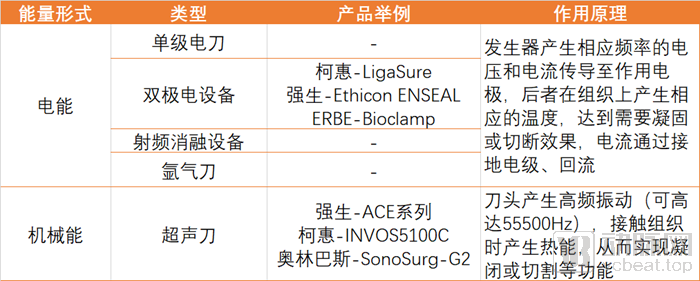
Dr. Hu Zhe told VCBeat that at present, an increasing variety of energy modalities, including radiofrequency, ultrasound, plasma, and laser, are being widely utilized in minimally invasive surgery. “By combining mechanical performance with energy delivery, energy-based devices have significantly enhanced surgical efficiency, safety, and reliability in modern minimally invasive procedures, while also reducing postoperative complications and the learning curve associated with these techniques,” he stated. He further indicated that, in addition to ultrasonic scalpels, Saints Sages Surgical is committed to developing a broader range of minimally invasive energy-based devices with independent intellectual property rights.
Intraoperative bleeding has long been a critical challenge in modern surgery. During the era when surgical instruments were rudimentary, surgeons employed cauterization to achieve hemostasis at surgical sites, giving rise to energy-based surgical technologies centered on the application of thermal energy. Experimental evidence demonstrates that thermal energy applied to human tissues at different temperatures can achieve diverse effects: at temperatures between 60°C and 80°C, heat primarily induces protein denaturation, such as coagulative necrosis, thereby sealing various vessels and achieving hemostasis; at temperatures above 90°C, thermal energy can be utilized for tissue cutting.
Taking the ultrasonic energy branch as an example, in 1992, Johnson & Johnson of the United States manufactured the HARMONIC SCALPEL, the world’s first ultrasonic scalpel applied in clinical practice. In 1997, the HARMONIC SCALPEL entered the Chinese market. To date, ultrasonic scalpels have evolved into one of the most widely used minimally invasive devices. In China, more than 90% of the ultrasonic scalpel market share is still occupied by Johnson & Johnson’s products, and domestic brands have yet to truly break into the market.
Given the significant advantages of ultrasonic scalpels over other cutting instruments, their gradual replacement of traditional surgical tools is becoming a trend, indicating immense potential market space. A review by VCBeat of service catalogs from medical institutions across various regions revealed that ultrasonic scalpel solutions have already been adopted for multiple diagnostic and therapeutic procedures in departments such as general surgery, urology, thoracic surgery, and obstetrics and gynecology.
Assuming an average configuration of 6 units per tertiary hospital, 2 units per secondary hospital, and 0.5 units per primary hospital, and based on the publicly tendered price of RMB 475,000 per unit, the domestic market size for the main consoles alone approaches RMB 15 billion. Regarding blade consumables, if each console in tertiary hospitals requires 60 blades annually, those in secondary hospitals require 40, and those in primary hospitals require 20, the market potential for blade consumables also nears RMB 10 billion. Even if domestically produced products are priced at 50% of imported counterparts, this sector remains a market worth tens of billions of yuan.
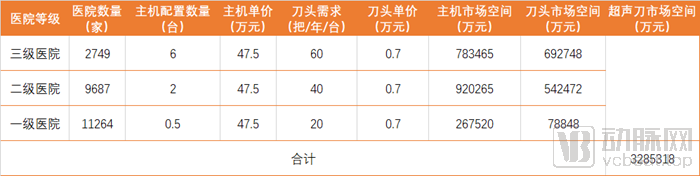
Estimation of the Domestic Ultrasonic Scalpel Market
Data Source: VCBeat, based on the National Health Commission’s “Statistical Bulletin on the Development of China’s Health and Healthcare Services in 2019,” combined with estimates from current market prices of products.
Furthermore, since 2018, Johnson & Johnson has vigorously promoted pilot programs for the "separate billing" policy in the Chinese market. This initiative not only alters market access and pricing rules but also unlocks greater potential in the high-end market segment. In China, disposable ultrasonic scalpel tips are primarily treated as costs and incorporated into the pricing of medical service items. To date, 20 provinces and municipalities across China, including Hebei, Tianjin, Shandong, and Jiangsu, have implemented separate billing policies. These policies allow designated disposable consumables to be billed separately to patients by healthcare institutions, in addition to the standard prices for medical services, thereby meeting the demands of certain high-end medical markets.
According to reports, Saints Sages Surgical plans to launch a multi-product portfolio tailored to different market segments, available for both single-use and reusable applications.
Dr. Hu told VCBeat that the medical industry differs from the internet sector; its inherent nature dictates that product design and iteration must be completed before market launch. For Saints Sages Surgical, product iterations must be finalized prior to clinical trials, with changes driven entirely by feedback from clinical key opinion leaders (KOLs). Although this process is arduous, shifting the validation phase significantly upstream is essential to ensuring product quality.
Furthermore, Dr. Hu Zhe believes that high-quality products are “designed,” not merely “manufactured.” This represents a significant shortcoming for most domestic medical device companies in China. Core technology serves as the foundation of a product; however, the same core technology can yield vastly different outcomes when entrusted to different teams. Moreover, breakthroughs in core technology and product engineering are entirely distinct endeavors. When designing products, the R&D team at Saints Sages Surgical must fully account for all critical factors related to product engineering. Imagine the disaster that would ensue if, after transitioning from R&D to production, it was discovered that mass-production processes were either prohibitively expensive or entirely unfeasible. “Comprehensive design” also reflects the strategy of shifting validation efforts upstream.
“The development cycle for innovative medical devices is relatively long, largely due to the iterative nature of the process,” said Dr. Hu Zhe. “Our products adhere to standards far exceeding industry or national requirements. Breakthroughs in performance margins and design redundancy are essential for Chinese-made devices to enter the international market, and they represent the product philosophy firmly upheld by all at Saints Sages Surgical.”
Writing Reference:
MedTech Home: Import substitution of high-value consumables is imperative, with immense potential in orthopedics, vascular intervention, dentistry, and other fields!
Medical Device Innovation Network: [Industry Research] A Brief Analysis of the Ultrasonic Scalpel Product Market
The Eighteen Arms of Surgery — Energy-Based Devices
Saints Sages Surgical Completes Tens of Millions in Pre-A Financing, Led by Northern Light Venture Capital