

How Meichuang Technology Leads the Healthcare Information Data Security Market Following the Implementation of Cybersecurity Level Protection 2.0
In 1985, Donna Haraway proposed her famous "A Cyborg Manifesto." She declared that technology and humans are merging into a new type of subject—the cyborg—where the human body is penetrated by technology and saturated with data, becoming an ultimate medium. This prophecy, imbued with posthumanist implications, is gradually becoming reality as data becomes an integral part of our bodies. However, this manifesto also highlights the importance of data security from another perspective.
Online appointment registration, online consultations, electronic medical records, and a series of other information systems designed to facilitate patient care are all applications of data in healthcare scenarios.
The 2017 Cybersecurity Law sounded the first alarm regarding cybersecurity issues for hospital IT departments, and the May 2019 release of the Classified Protection 2.0 standard further emphasized the importance of this security issue, imposing substantive construction requirements on the work of hospital IT departments.The development of cybersecurity and information security systems has become a critical task, comparable to the evaluation and grading of electronic medical records.
According to VCBeat’s analysis, the state’s formulation of information security regulations for the healthcare industry was not merely a precautionary measure; in fact, many hospitals frequently experience the following6 Major Issues:
1. The boundary between the internal and external networks is unclear, with a lack of isolation measures between them;
2. The operation of the hospital’s core HIS lacks effective security safeguards and audit mechanisms;
3. A hospital's information system is not an isolated system; it is at risk of hacker intrusions and cyberattacks;
4. In the absence of redundancy in equipment and network links, hospitals face the risk of business interruption in the event of a failure;
5. The hospital's portal website lacks necessary security measures, posing risks of SQL injection attacks and malware implantation;
6. Most hospitals have not deployed endpoint security management and auditing systems, allowing non-compliant endpoints to access the internal network at any time and making it impossible to trace the source in the event of an endpoint security incident.
In fact, as early as 2005, Hangzhou Meichuang Technology Co., Ltd. (hereinafter referred to as “Meichuang Technology”) recognized the importance of information security, and its four co-founders decided to establish the company by leveraging their expertise in the database field.
Wen Jianxia, Deputy General Manager of Meichuang Technology, shared with VCBeat the company’s 15-year journey as a leader in the market for medical information data security.
In its exchange with Wen Jianxia, VCBeat learned of Hangzhou Meichuang Technology Co., Ltd.’s profound technological accumulation. This not only lays a solid foundation for the company’s R&D efforts but also provides it with deep insights into industry demands.
In 2008, Meichuang Technology successfully transitioned from database consulting to product research and development, rapidly securing major clients such as Zhejiang Unicom and Ningbo Telecom.
When the telecommunications and financial sectors were at their peak, Hangzhou Meichuang Technology Co., Ltd. keenly recognized the information security needs of the healthcare industry. In 2009, the company strategically shifted its business focus to livelihood-related fields such as healthcare and social security. Adopting a pioneering approach, it embarked on exploring the sensitive data protection market, launching Version 1.0 of its Sensitive Data Protection product and hospital “anti-tongfang” (unauthorized prescription data aggregation) security solutions, which have since been widely adopted across the healthcare industry.
By 2014, Meichuang Technology had developed the industry’s first database bastion host and introduced a defense-in-depth Data-Centric Audit and Protection (DCAP) solution for sensitive data, operating from the inside out. Capital markets recognized the significant potential of this information security sector at that time, enabling Meichuang Technology to complete its Series A and Series B financing rounds in 2015 and 2016, respectively, with its commercialization pace accelerating dramatically during those two years.
After gaining favor from investors, Hangzhou Meichuang Technology Co., Ltd. deeply cultivated the Data-Centric Audit and Protection (DCAP) market for sensitive data. In 2017, the company was selected as one of China’s Top 50 Cybersecurity Enterprises.
In 2018, Hangzhou Meichuang Technology Co., Ltd. secured additional financing, solidifying its position as a leading enterprise in the field of medical data security. One year later, the company established a new business brand—the Data Business Center—to enhance the value of medical data and explore its practical applications, all while ensuring data security.
Reflecting on Meichuang Technology’s trend-responsive transformation and leaps in the field of information security, we can see its precise grasp of industry demands and its growth trajectory from a “pioneer” to an industry “leader.”
Speaking of transformation and growth, Wen Jianxia, a leading player in the field of data security within the healthcare information industry, stated thatMeichuang Technology's Core Strategy“Although the data security market is still in its early stages, it has certain entry barriers. The fundamental criterion is whether products meet user needs and resolve their pain points.”
Meanwhile, Wen Jianxia told VCBeat that policy advancements would serve as a catalyst for hospitals to adopt information security protection measures. The implementation of the Multi-Level Protection Scheme 2.0 (MLPS 2.0) in 2019 has accelerated the deployment of data security infrastructure by an increasing number of healthcare IT professionals.
Hangzhou Meichuang Technology Co., Ltd. has firmly seized every major market trend, providing four core product lines—data security, data management, disaster recovery and backup, and intelligent operations and maintenance—as well as comprehensive information security solutions tailored to the healthcare industry’s needs for data security, disaster recovery, and data management.
Taking the data security requirements segment of the healthcare information industry as an example, the product portfolio includes database firewalls, database water dams, data masking, database auditing, and Noah anti-ransomware solutions.
They have implemented the following features:
1. Defend against SQL injection attacks and vulnerability-based database attacks from external and internal access channels, strengthen security defenses at the database level, and resist external and internal threats;
2. Address the management deficiencies of traditional methods, prevent unauthorized access, theft, alteration, or destruction of data by illegal users, strengthen database access control, and comprehensively ensure account security;
3. Provide comprehensive support for database operations security management across application change and deployment, hazardous operation control, sensitive data classification and grading, misoperation prevention, misoperation recovery, operations audit, and work reporting, thereby meeting the requirements of internal controls for operations security and various laws and regulations (such as Classified Protection, SOX, PCI, and enterprise internal control regulations);
4. Implement protection of sensitive privacy data;
5. Assist users in generating compliance reports post-event and tracing the root causes of incidents, while strengthening the logging of network behaviors across internal and external databases to enhance data asset security.
Examining the solutions provided by Meichuang Technology in the information security sector, it is evident that, from front-end “firewall” protection to back-end auditing, the company has established a systematic, defense-in-depth architecture grounded in a holistic approach to data security.
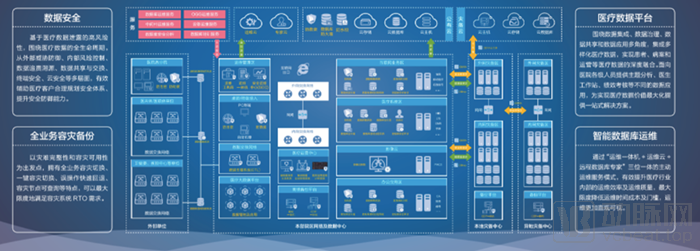
Meichuang Technology Data Security System
Specifically, the system'sPathway DevelopmentAs follows:
First, establish a security framework by leveraging interoperable security technologies and platform-based management tools. Further enhance data protection by implementing various technical measures—such as sensitive data loss prevention, internal risk control, data accountability and traceability, and secure information sharing and exchange—to ensure the availability, integrity, and confidentiality of data. Finally, adopt consistently robust security measures that complement each other in function and effect, thereby forming a dynamic information security protection system for the healthcare industry.
On the other hand, Hangzhou Meichuang Technology Co., Ltd. also provides corresponding solutions for disaster recovery and data management, including medical quality analysis and performance management platforms tailored for the healthcare industry, thereby offering information security support to hospitals and health commissions in optimizing medical resource allocation, ensuring regulatory compliance, and enhancing medical quality.
Currently, Meichuang Technology’s product solutions have been widely adopted by government ministries, state-owned banks, the State Grid Corporation of China, major ports, top 100 hospitals, and Fortune Global 500 companies.
When discussing the market size of data security, Wen Jianxia told VCBeat, “As fragmented medical data is gradually aggregated into today’s big data, its value is receiving increasing attention. In terms of form, data used to be dispersed, and so were the risks; however, as data becomes centralized, risks also begin to concentrate. Various factors have driven hospitals to start safeguarding their data.” The market size for data security is expected to grow.
Capital Precedes Solutions. From 2015, when investors began to recognize the potential of the data security market, to 2018, Hangzhou Meichuang Technology Co., Ltd. completed three rounds of financing in just three years. Amid the capital winter of 2020, the company secured a new round of financing exceeding RMB 150 million. This sector is gradually stirring up waves among investors.
However, to capture this market, it is essential to first clearly understand the needs of hospitals.
Ten years ago, hospitals focused on preventing their networks from being hacked, necessitating the deployment of firewalls. Today, however, risks are more centered on data. To prevent hospital data from being stolen, service providers must implement a series of protective measures tailored to different types of data. As methods of data theft continue to evolve, corporate data protection solutions will undergo continuous iteration. Judging by the maturity of products offered by leading enterprises, these companies have already established certain barriers to entry in this field.
Thus, although the data security market is substantial—with per-hospital contract values ranging from RMB 5 million to RMB 20 million, depending on hospital size—there are significant barriers to entry for new players. In contrast, companies with mature products in other industries hold a competitive advantage in entering this space. This is precisely one of the key reasons why Hangzhou Meichuang Technology Co., Ltd. has emerged as a leader in the information security market.