

Depression Research Institute Files for IPO After Building a Community Network for Over 60,000 Patients
“Can depression make you less attractive?” At first glance, this question may seem like a casual inquiry from someone concerned about their appearance. However, after the initial lightheartedness fades, it is hard to ignore the weighty subject at hand—depression.
According to data released by the World Health Organization (WHO), more than 350 million people worldwide suffer from depression, with the number of patients increasing by approximately 18% over the past decade. Currently, China has a population of 180 million individuals experiencing subclinical depressive symptoms, and the number of diagnosed depression patients has reached 95 million. Depression has become a nightmare for 100 million Chinese people.
“No one thinks I’m sick; they just think I’m overthinking.” For individuals with depression, the indifference and misunderstanding of others can be more daunting than the condition itself. In recent years, there has been a surge in high-profile incidents and celebrity cases related to depression, prompting many regions to gradually promote educational lectures and public awareness campaigns on the disorder. Nevertheless, online platforms still abound with sarcastic remarks and mockery directed at those suffering from depression.
When suffering goes ununderstood and cries for help go unanswered, many patients with depression choose to close off channels for seeking external assistance, thereby leading to countless tragedies. However, some patients proactively seek psychotherapy when confronting depression.
An Entrepreneurial Journey of a Patient with Depression
“My name is Ren Youbing, and I am the Director of the Depression Research Institute.”
In early 2018, Ren Ke received his diagnostic report at Beijing Anding Hospital. The terms “severe depression,” “moderate anxiety disorder,” and “serious suicidal tendencies” each struck a nerve, while the stigma of mental illness engulfed him like black paint. In this state, Ren Ke reached out to the doctor like a drowning person, only to receive a disappointing response.

Ren Ke, Founder of the Depression Research Institute
For psychiatrists at specialized mental health hospitals, depression is as common as the common cold in surgical outpatient clinics, yet recovery from it is not as swift. With tens of millions of depression patients across China, it is difficult for doctors to provide long-term, one-on-one psychological counseling and treatment. As a product manager at an internet company, Ren Ke experienced firsthand the challenges of depression treatment from the perspective of a patient.
After being diagnosed with depression, Ren Ke shared his psychological journey on social media in the form of a diary. Through these entries, he kept a clear count of the days he spent battling depression and the amount of care he received from friends during treatment. By the end of 2018, Ren Ke confirmed that he had made peace with depression and emerged from its dark shadow.
Unexpectedly, Ren Ke’s depression diary ultimately saved more than just herself. As the diary was updated, an increasing number of patients with depression left comments in the section to share their struggles. These words carried not only Ren Ke’s past but also served as a source of emotional reliance for others.
Thus, Ren Ke conceived the idea of establishing a community for individuals with depression—a sanctuary dedicated exclusively to patients. Starting in 2018, Ren Ke created depression-focused discussion groups on platforms such as Zhihu, Tieba, and Douban, gradually emerging as a key opinion leader (KOL) in the field of depression. In September 2018, leveraging the substantial fan base of the “Director Ren Has Issues” IP, the Depression Research Institute was founded.
Embrace the Internet to Provide Online Medical Services
Currently, China faces a significant shortage of medical resources for psychological and mental disorders.As of the end of 2017, across ChinaThere are approximately 20,000 psychiatrists and mental health professionals in China. Due to limited access to care and difficulties in finding suitable physicians, the patient consultation rate remains below 10%.. The large base of patients with depression, the lack of systematic treatment, and the unequal distribution of medical resources have resulted in most patients being unable to receive comprehensive, high-quality care.
Ren Ke believes that the treatment of depression is characterized by high per-customer transaction costs and long treatment cycles, making online depression management more convenient than offline therapy. Having previously served as a product manager at multiple internet companies, Ren Ke excels at developing product models based on user needs. After careful consideration, Ren Ke decided to adopt an internet-based operational model to provide services for patients with depression.
From a physician’s perspective, mental illnesses differ from other conditions in that they require clinicians to devote more time to listening and communicating with patients, clearly explaining the etiology of the disorder and the proposed treatment plan. Dr. Yang Yi, founder of Ankang Medical and advisor to the Depression Research Institute, believes that patients with depression need non-pharmacological interventions in addition to medication, a service that public hospitals are often ill-equipped to provide.
Depression Treatment Services Across Multiple Scenarios
Relying on its official WeChat account, the Depression Research Institute has launched paid knowledge courses and related e-commerce products, focusing on disease education, psychological counseling, and peer support among users., providing patients with a suite of solutions including health education content, rehabilitation courses, medication guides, and e-commerce products.
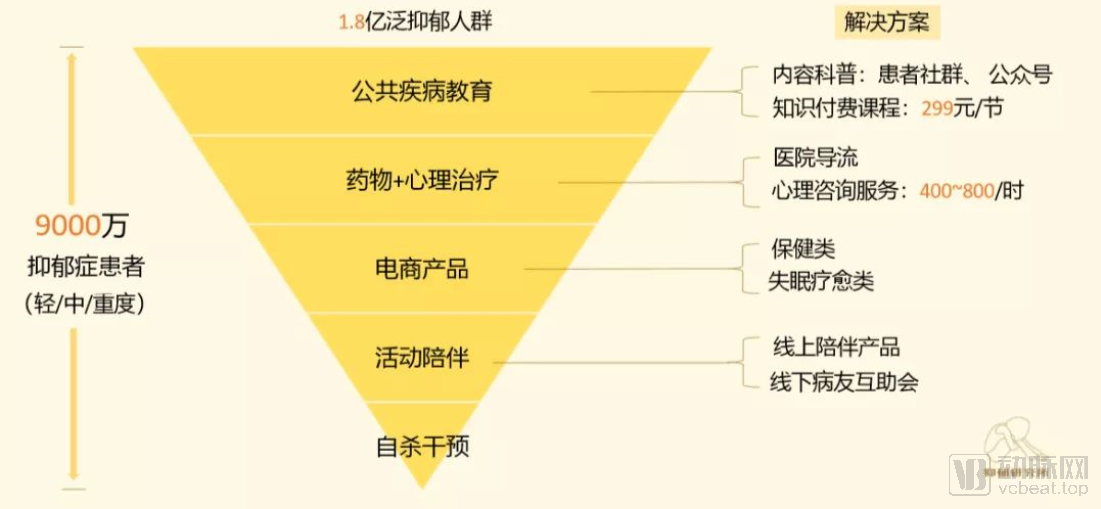
Business Composition of the Depression Research Institute
The Depression Research Institute’s “Self-Rating Scale for the General Depressed Population” is a criterion-referenced diagnostic assessment tool designed for individuals with broad-spectrum depression. It was developed primarily based on the Diagnostic and Statistical Manual of Mental Disorders (DSM-5) published by the American Psychiatric Association, and incorporates clinical experience from specialized psychiatric hospitals.
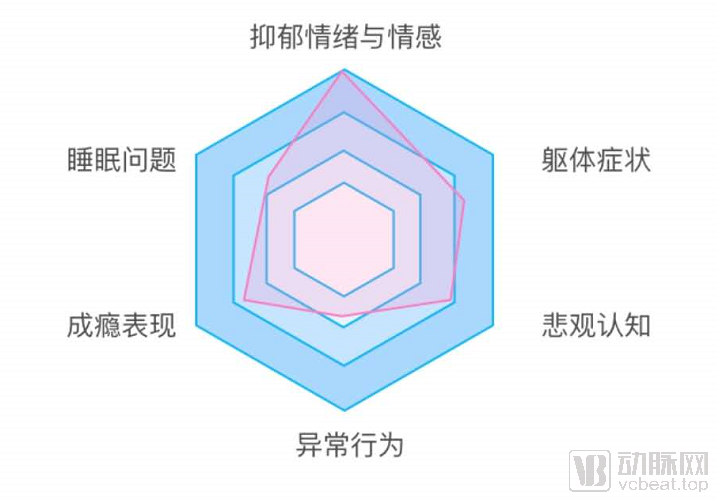
Six-Factor Analysis
For many patients with depression, professional cognitive behavioral therapy can be rather obscure in terms of understanding and application. Therefore, the Depression Institute has broken down these concepts into simpler, more accessible content products.Provide patients with educational content and paid knowledge courses.。
In terms of rehabilitation programs, the target audience is not limited to patients but may also include their family members. The curriculum primarily focuses on public education about depression, guidelines for seeking medical care, and medication guidance.
Currently, the treatment of patients with depression cannot rely solely on medication or psychological counseling; the two must complement each other. Patients can connect with professional psychological counselors through the Depression Research Institute and pay for psychological counseling services and physician companionship services.
For more rigorous pharmacotherapy, patients should take antidepressant medications under the guidance of professional physicians and undergo systematic evaluation and treatment at specialized psychiatric hospitals.Therefore, by establishing partnerships with professional medical institutions, the Depression Research Institute has addressed both the difficulty patients face in accessing medical care and the challenge hospitals encounter in patient acquisition.。
Through collaboration with e-commerce platforms, the Depression Institute’s online store offers stress-relief products to help patients alleviate mental pressure. The store’s main product offerings fall into four categories: over-the-counter health supplements primarily featuring oryzanol and melatonin; mood-soothing items such as aromatherapy products and diffuser stones; healing-oriented products including artworks and watercolor paintings; and psychology books.
Online, the Depression Research Institute has established patient support communities. Upon registration, patients are required to provide their basic information and medical history to staff members, who then assign them to communities with relevant characteristics based on their individual circumstances, thereby facilitating more effective communication among patients.
Only those who have endured suffering can truly understand pain. From the patient’s perspective, the Depression Research Institute has launched “Companion Program”。
The so-called "Companion Program" essentially organizes patients to support one another through critical periods via peer counseling, supplemented by occupational therapy to facilitate psychiatric rehabilitation. Patients can share their emotional fluctuations and experiences with depression on a daily basis, thereby maximizing empathy.
Offline, the Depression Research Institute organizes in-person patient support groups to provide comprehensive companionship and services for patients.
It is a race against time and life.
The suicide intervention services provided by the Depression Research Institute include a “Survival Kit” for every patient who joins the community. During registration, patients can provide their basic information and medical history. Staff members will then assign them to communities with specific attributes—such as “Postpartum Depression Group,” “Study-Abroad Depression Group,” or “Family Members of Depression Patients Group”—to facilitate safer and more efficient communication. The suicide intervention service has successfully rescued multiple depression patients from suicide attempts.
Currently, the content of the Depression Research Institute has attracted over a million followers, and more than 60,000 patients with depression have registered to join its patient community.
Solving the Patient Acquisition Challenge for Psychiatric Hospitals
On the supply side of China’s mental health sector, many hospitals and psychological counseling providers lack sufficient understanding of user scenarios, resulting in significant demand for specialized content on depression.
In December 2019, the Depression Research Institute publicly released the *Blue Book on Depression in China (2019)*, which provided a comprehensive analysis of depression from multiple perspectives, including symptoms, treatment, and market dynamics, thereby presenting a holistic view of the condition to the public. Upon its release, the report was reposted by more than 80 institutions and media platforms, including the Institute of Psychology of the Chinese Academy of Sciences, Southwest Jiaotong University, and the School of Psychology at Beijing Normal University.
Compared with public hospitals, private psychiatric specialty hospitals are at a disadvantage in terms of public credibility, resource availability, and patient acquisition. These institutions must spend substantial amounts annually on marketing and patient referral initiatives—such as outdoor advertising, ground promotions, and search engine bidding—but the results have been less than satisfactory.
Therefore, depression research institutes hold significant market potential in patient referral within hospitals. For patients requiring systematic treatment, these institutes refer them to specialized hospitals. This approach not only saves patients time and effort by eliminating the need to independently seek out treatment facilities, but also helps psychiatric outpatient clinics acquire patients with greater precision.
Currently, the Depression Research Institute has established a rigorously selected team of experts and forged partnerships with hundreds of psychiatrists and licensed psychological counselors, helping psychiatric hospitals in more than ten cities reduce costs and increase revenue.
Regarding future development, Ren Ke stated that the organization will continue to deepen its engagement in the mental health sector, advance psychoeducation for community-based patients, expand market operations, and achieve paid conversion and commercial monetization. Meanwhile, The Depression Institute will also explore business-to-business (B2B) opportunities by providing corporate services such as group counseling and employee mental health assessments.
The Depression Research Institute is currently conducting a Pre-A financing round, with the funds raised primarily allocated to content production and market operations.