

Qingying Huakang Secures Tens of Millions in Pre-A Funding, Leveraging 30 Years of Technical Expertise to Lead Precision Cerebrovascular Imaging
VCBeat (WeChat ID: vcbeat) has learned that Beijing Qingying Huakang Technology Co., Ltd. (“Qingying Huakang”), a leading enterprise in high-resolution magnetic resonance vessel wall imaging technology, recently announced the completion of its pre-A financing round worth tens of millions of yuan. This round was led by Bohe Angel Fund, with Tus-Star Venture Capital participating as a co-investor. It is reported that the funds raised will primarily be allocated to two areas.On one hand, Qingying Huakang will continue to strengthen product research and development to explore more solutions. On the other hand, the company will shift from passive to proactive sales strategies, further expanding its sales channels.
Dr. Hou Jian, Partner of the Mint Angel FundShared the investment rationale: “The first step in precision medicine is precise diagnosis, which requires strong technical support. For instance, high-resolution magnetic resonance cerebrovascular imaging demands interdisciplinary expertise in both medicine and engineering. Qingying Huakang possesses precisely such capabilities.”
In 2016, Tsinghua University and industry experts jointly established Qingying Huakang to commercialize research achievements from Tsinghua University’s Center for Biomedical Imaging Research, providing high-resolution magnetic resonance vessel wall imaging solutions for patients with cerebrovascular disease. With nearly 30 years of foundational expertise in technology development, pathological validation, clinical trials, and data accumulation, the Tsinghua University team has positioned Qingying Huakang at the forefront of high-resolution magnetic resonance technology worldwide.
Since its inception, Qingying Huakang has obtained certifications as a Beijing High-Tech Enterprise and a Zhongguancun High-Tech Enterprise, and has secured multiple invention and utility model patents. Currently, its products have been sold to more than 100 leading hospitals in China specializing in cerebrovascular diseases, facilitating the advancement of their scientific research and clinical practices.
As the AI healthcare sector enters the second half of its land-grab phase, why has Qingying Huakang secured additional funding amid a capital winter? VCBeat conducts exclusive interviews with Dr. Li Rui, Founder of Qingying Huakang, and Dr. Hou Jian, Partner at Bohe Angel Fund, to analyze the reasons behind Qingying Huakang’s appeal to investors from multiple perspectives.
As the famous quote from *Forrest Gump* goes, “Life is like a box of chocolates; you never know what you’re going to get.” Cerebrovascular diseases accumulate over many years, yet their onset occurs in an instant. The shock they bring far exceeds that of the chocolate whose flavor remains unknown until tasted.
2.5 million (new cases/year), 1.6 million (deaths/year), 12 seconds (onset rate), 21 seconds (mortality rate), and RMB 40 billion (annual medical costs) are the staggering figures associated with cerebrovascular disease in China, a major public health burden. Cerebrovascular disease has become one of the leading causes of death worldwide. Therefore, achieving precise diagnosis of cerebrovascular disease through imaging techniques has emerged as an urgent clinical challenge.
In clinical practice, imaging techniques such as carotid ultrasound, transcranial Doppler (TCD), magnetic resonance angiography (MRA), computed tomography angiography (CTA), and digital subtraction angiography (DSA) are routinely used to diagnose cerebrovascular diseases.
However, these technologies suffer from six major pain points:
1. Focuses solely on the lumen, without information on wall lesions (plaque morphology, composition, and function)
2. Image quality cannot be guaranteed
3. Lack of standardized imaging protocols
4. Lack of identification criteria for plaque composition and vulnerable plaques
5. Difficulties in Processing Large Volumes of Imaging Data
6. Insufficient Clinical Understanding of Vessel Wall Imaging and Room for Improvement in Clinical Application
These six major pain points directly reflect the value of precision stroke imaging in clinical applications.High-resolution magnetic resonance vessel wall imaging is undoubtedly a powerful tool for providing precise diagnosis, treatment decision-making, and prognosis assessment of cerebrovascular diseases in clinical practice.
Qingying Huakang integrates high-resolution magnetic resonance imaging (MRI) technology, specialized imaging sequences, dedicated high signal-to-noise ratio (SNR) imaging coils, artificial intelligence (AI) interpretation algorithms, and imaging workstations into a comprehensive solution. It provides hospitals with a one-stop precise imaging solution spanning from image acquisition to report generation, thereby standardizing the clinical application of high-resolution MRI and making it simpler and more efficient.
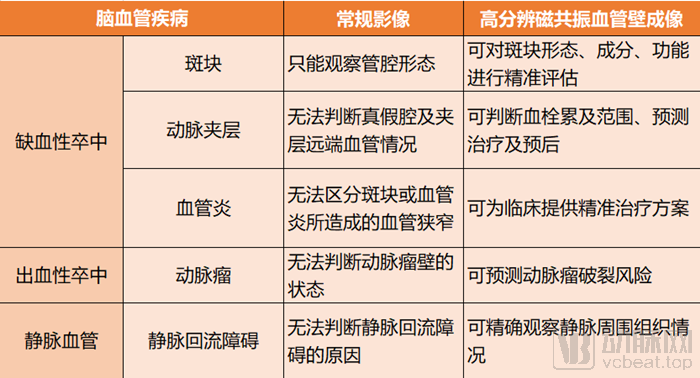
Application of High-Resolution Magnetic Resonance Vessel Wall Imaging in Cerebrovascular Diseases
“Innovation capability, self-sustaining revenue generation, and resources are our three major advantages in securing financing.”“Dr. Li Rui, founder of Qingying Huakang, stated. These three advantages are also the three key factors that have attracted capital interest in Qingying Huakang.”
Advantage 1: Innovation Capability. Qingying Huakang possesses end-to-end innovation capabilities spanning from imaging methodologies to clinical applications. This capability is reflected not only in the development of novel hardware, new imaging techniques, and advanced image processing algorithms, but also in the innovative application of these technologies across diverse clinical scenarios, generating evidence-based medical data that ultimately informs clinical practice guidelines. These innovation capabilities form the cornerstone of Qingying Huakang’s development.
Advantage 2: Self-sustaining capability. The technologies developed by Qingying Huakang are clinically oriented, ultimately applied in clinical settings, and derived from clinical practice, forming a complete closed loop. This has endowed the company with self-sustaining capabilities, which is a key factor enabling it to establish collaborations with over 100 hospitals. In addition, Qingying Huakang partners with manufacturers such as Philips, Siemens, and United Imaging, ensuring full compatibility with various 1.5T and 3.0T MRI systems from major domestic and international vendors.
Advantage 3: Resources. From its inception, Qingying Huakang has leveraged the Tsinghua University Biomedical Imaging Research Center to accumulate substantial resources, including collaborations with numerous medical imaging technology R&D institutions, scientific research and clinical partnerships with over 100 hospitals, cooperation with major medical imaging manufacturers, alliances with health checkup organizations and third-party imaging centers, and partnerships with emerging companies in medical imaging data and artificial intelligence. This has provided Qingying Huakang with broad development potential in technological R&D, clinical validation, and business models.
As Dr. Li Rui mentioned,Only through precise identification of the etiology can effective treatment of cerebrovascular diseases be achieved.Dr. Li Rui’s remarks highlight the current market demand for precision imaging and the vast market opportunity it represents.
Dr. Hou Jian, Partner at Mint Angel FundHe told VCBeat, “I believe Qingying Huakang is a potential leader in the niche field of medical imaging in China. Qingying Huakang’s products can improve the quality and speed of high-resolution MRI, enhance patient experience, and enable efficient utilization of healthcare resources; more importantly, they can extract in-depth information on cerebrovascular diseases, meeting the clinical need for precise diagnosis and treatment. Furthermore, its founding by scientists has endowed the company with a strong R&D DNA. Qingying Huakang has the opportunity to integrate scientific achievements from top-tier institutions, including the Tsinghua Center for Biomedical Imaging.”
Dr. Li Rui, Founder of Qingying HuakangIntroduction: “Qingying Huakang has currently completed its high-resolution vascular wall imaging screening protocol and precision 4D blood flow imaging solution. Moving forward, the company will further advance the implementation of precision imaging solutions for cardiac, neurological, and preclinical animal applications. Commercially, Qingying Huakang will gradually enhance its sales network, exploring more diversified business models starting from its initial B2B sales focus. We believe that Qingying Huakang’s advanced clinical solutions will bring disruptive changes to the clinical practice of medical imaging, generating substantial economic and social value.”
BOHE Angel Fund, established in 2015, is China’s first angel investment fund focused on global early-stage innovative R&D enterprises in the pharmaceutical and healthcare sectors. It is committed to building China’s premier platform for identifying, nurturing, and incubating early-stage biotechnology ventures and technology transfer projects.
A senior investment team, in collaboration with an international “think tank” of top-tier scientists, entrepreneurs, and business leaders, focuses on cutting-edge life science technologies urgently needed in the Chinese market, as well as the R&D of novel drugs targeting new mechanisms and targets in oncology, autoimmune diseases, and anti-infectives. The team also strategically invests in innovative precision medicine solutions, such as early disease screening and molecular imaging. By leveraging a deep understanding of the pathways and timelines for technology translation, the team helps enhance portfolio companies’ success rates and accelerate their growth.
Beijing’s Investment Brand That Best Understands Entrepreneurs. TusStar Venture Capital, founded in 2014 and headquartered in Beijing, focuses on high-tech, high-growth startups, with early-stage investments in sectors such as TMT, integrated circuits, big data, artificial intelligence (AI), 5G communications, Internet of Things (IoT), energy conservation and environmental protection, new energy, new materials, general health, advanced manufacturing, education, enterprise services, and mass consumer markets. Leveraging 24 years of experience in incubation and investment, the investment team is progressively refining its strategic layout toward financialization, specialization, internationalization, network integration, and cluster development. Its managed funds include angel fund-of-funds, market-oriented funds, and incubator funds, with total assets under management exceeding RMB 1 billion. The firm aims to consolidate superior resources for innovation and entrepreneurship services and build a robust ecosystem for innovation and startups.