

Yitu Healthcare's Dr. Cong Fang: Driving Clinical Decision Innovation with Data Intelligence
On August 28, the 5th Medical Marketing Annual Conference, hosted by Siqi—one of China’s largest pharmaceutical industry communities—was held in Shanghai. Recognized as one of the most significant industry events in recent years and hailed as the “barometer of pharmaceutical marketing,” this year’s conference attracted more than 2,000 professionals from global pharmaceutical companies, spanning fields such as marketing, medical affairs, commercialization, market access, and government affairs, to exchange insights on the current status and trends of the pharmaceutical industry.
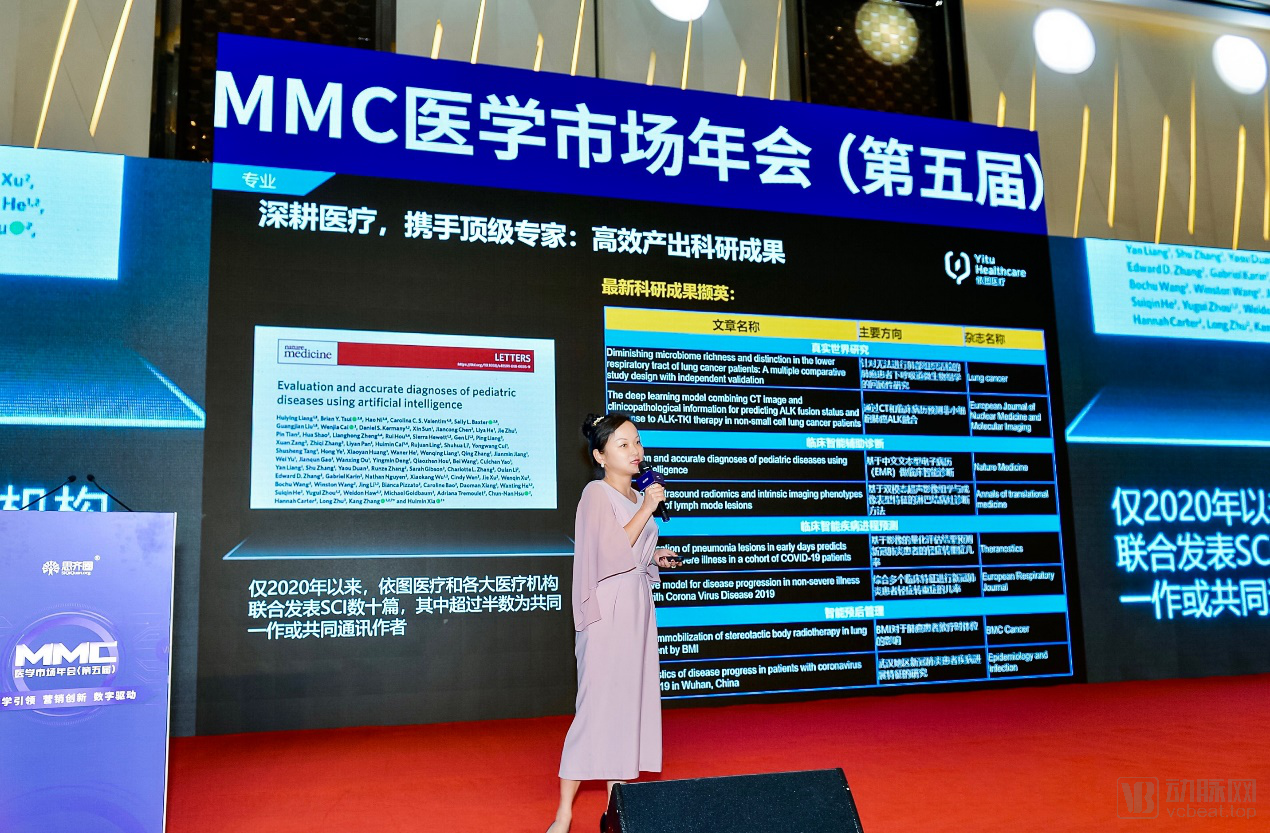
Dr. Fang Cong of Yitu Healthcare was invited to deliver a keynote address at the main forum of the conference, sharing with attendees insights on trends and practical case studies of data intelligence in driving the strategic layout of medical innovation.
In recent years, the pharmaceutical industry has undergone rapid and profound transformation. In this new landscape, Yitu Healthcare has keenly recognized that over the next 5–10 years, decision-making within the healthcare delivery chain—particularly decisions at the clinical core—will increasingly shift from experience-based to data-driven approaches.
However, it is highly challenging to leverage technical means to process massive volumes of heterogeneous and multi-source data into highly normalized, structured datasets. Each step—data de-identification, cleaning, transformation, transmission, and quality control—can be described as an “arduous trial.”
“To successfully ‘weather the storm,’ one must diligently strengthen their ‘internal capabilities,’” revealed Dr. Fang Cong. “Yitu Healthcare holds the industry’s highest-standard security system certifications and maintains rigorous data compliance processes. All data strictly adheres to institutional ethical review procedures, and the company possesses extensive practical experience in multiple areas, including data de-identification, data confidentiality, and data governance.”
Currently, Yitu Healthcare holds the Level 3 Certification for Classified Protection of Cybersecurity in China and is the first medical AI enterprise in China to obtain international certification for the ISO/IEC 27701:2019 Privacy Information Management System. It maintains a leading position in the industry in key core competencies, including CCRC (Information Security Service Qualification Certification), ISO series (Quality Management System Certification), and CMMI (Capability Maturity Model Integration).
Leveraging its robust core capabilities, Infervision Medical continues to achieve significant results in its pursuit of innovating decision-making pathways driven by data intelligence.
Taking the world’s first intelligent disease-specific database for lung cancer clinical research, jointly established by Yitu Healthcare and West China Hospital, as an example, the missing TNM staging information in nearly 30,000 sets of full-lifecycle data from lung cancer patients during the first phase severely hindered the subsequent utilization of medical data. The adoption of full-stack AI technology has significantly improved the completion rate of TNM staging, providing robust support for whole-course management and scientific research for lung cancer patients.
In July 2020, Yitu Healthcare collaborated with Nanfang Hospital to leverage data intelligence technologies in establishing a globally applicable risk scoring model for hepatocellular carcinoma (HCC). This is the world’s first HCC risk prediction scoring model for patients with chronic liver disease that spans multiple etiologies (including hepatitis B, hepatitis C, and non-viral liver diseases) and ethnicities (such as Asians and Westerners), holding significant importance for reducing the global mortality risk associated with liver cancer.
For the pharmaceutical industry, penetrating grassroots markets represents another significant trend. However, the strategy for addressing this market presents a classic “Hamlet” dilemma: while the population is vast, diagnostic and treatment capabilities remain weak. Moreover, pharmaceutical companies have traditionally centered their layouts on municipal-level central hospitals and above. How can grassroots medical institutions establish connections with diagnostic and treatment centers? Is the grassroots market merely a channel for patient referral, or is it the primary site of business activity? For enterprises, the question remains: To be, or not to be?
Beyond numerous traditional solutions, Yitu Healthcare has offered its own approach—empowering primary, secondary, and tertiary medical institutions with AI-based solutions to establish a three-tier triage collaboration system, thereby creating an integrated specialist intelligent diagnosis and treatment platform that combines screening, diagnosis, and therapy.
“This solution features both flexibility and openness,” revealed Dr. Fang Cong. “On the one hand, this model has achieved success across multiple cancer types, rare diseases, and chronic conditions, demonstrating considerable business flexibility. On the other hand, the platform boasts a high degree of openness; once established, it can attract various stakeholders—including companies specializing in advanced diagnostic and therapeutic technologies—to jointly build an open ecosystem.”
In Zhejiang, the intelligent platform for child growth and development, jointly built by Yitu Healthcare with multiple medical institutions including the Children’s Hospital of Zhejiang University School of Medicine and Shaoxing Maternal and Child Health Care Hospital, has overcome the most significant supply-side constraint: the shortage of high-level pediatric endocrinologists. Under the heavy pressure of the COVID-19 pandemic from January to July, just three primary care hospitals reported data on more than 2,000 pediatric patients with growth and development disorders to the Children’s Hospital of Zhejiang University School of Medicine. Additionally, an online screening campaign during the June 1st International Children’s Day period screened over 5,500 individuals within five days—a notable achievement for the relatively niche specialty of pediatric endocrinology.
On the Zhejiang Provincial Cancer Screening Platform, developed by Yitu Healthcare, artificial intelligence plays a significant role in various areas, including human-computer interaction, data quality control, and patient follow-up. Within just over two months of its launch, the platform screened more than 800,000 individuals across the province, enabling the early detection of numerous colorectal and lung cancer cases. According to project targets, the total number of individuals screened is expected to exceed 2.2 million for the full year.
In the future, Yitu Healthcare will continue to collaborate with its partners to drive continuous innovation, leveraging data intelligence technologies to transform clinical decision-making pathways and harnessing technological advancements to ensure that everyone has access to better healthcare.