

Yinchuan's Internet Healthcare Model: A Blueprint with 53 Internet Hospitals and 19 Policies
Recently, a heartwarming ad campaign has appeared in public spaces across Yinchuan: young white-collar workers, noodle shop owners, new mothers... Each busy figure copes with the fast-paced rhythm of daily life, neglecting their health until doctors on their smartphones alleviate their ailments.
This set of advertisements comes from Yinchuan Ping An Internet Hospital, a subsidiary of Ping An Good Doctor. The heartwarming short stories clearly convey two key messages: online consultations make healthcare more accessible, and medical insurance payments can be completed online. VCBeat believes this is a microcosm of how internet healthcare in Yinchuan is deepening user penetration and accelerating the cultivation of user habits.
As a pioneer in internet healthcare, Yinchuan has never ceased its efforts and recently introduced China’s first regulatory framework for online diagnosis and treatment services. Impacted by the pandemic, many regions across China have prioritized the development of internet healthcare. Seizing this opportunity, we have outlined Yinchuan’s developmental trajectory in internet healthcare to provide a reference for other regions.
Yinchuan began exploring internet-based healthcare in 2016, marking four years of development to date. According to publicly available data, by the end of January 2020, the total number of physicians with multi-site practice registrations in Yinchuan had reached 38,000. They had conducted over 18.17 million consultations for patients nationwide, including more than 3.97 million for patients from Ningxia and over 2.83 million for patients from Yinchuan.
By the end of 2019, Yinchuan’s permanent resident population stood at 2.29 million. Based on this figure, each resident in Yinchuan had, on average, conducted more than one consultation via internet hospitals. While this number may not appear high in isolation, given that healthcare is inherently a low-frequency need and cultivating user habits requires considerable time, achieving such a level of penetration is no small feat.
In the medical insurance sector, data released by Yinchuan at the end of 2018 showed that a total of 120,000 insured individuals had obtained the “Outpatient Major Disease Prescription Book,” among whom patients with hypertension and diabetes accounted for 34.1% of the total, i.e., 41,000 people.
In October 2019, Yinchuan’s medical insurance system began exploring the establishment of an online payment mechanism for outpatient treatment of serious diseases, starting with pilot programs for hypertension and diabetes. Since 2020, driven by medical insurance reimbursement policies and accelerated by the pandemic, patients with chronic diseases have shown a stronger willingness to use online healthcare services. According to Xinhua News Agency, in the first half of 2020, Yinchuan’s internet hospitals signed up 22,000 patients with hypertension and diabetes for online services, conducted 8,243 online consultations, delivered medications to patients’ homes 4,285 times, recorded a total online payment amount of RMB 929,000, and achieved nearly RMB 503,000 in medical insurance reimbursements.
Based on the number of insured individuals with hypertension and diabetes at the end of 2018, more than half of these patients have signed up with internet hospitals.
Given the aforementioned volumes of medical services and health insurance coverage, patients in Yinchuan have established a solid foundation for adopting internet-based healthcare habits, while health insurance reimbursement is further accelerating the shift of patient care to online platforms.
Yinchuan Ping An Internet Hospital has enabled medical insurance payments, marking the launch of online payments from personal outpatient accounts following its deep collaboration with the Yinchuan Social Insurance Center and its designation as a designated medical insurance institution. This service is not restricted by disease type and provides Yinchuan residents with one-stop services, including online consultations, prescription issuance, medical insurance payment, and home delivery of medications.
As of the end of June 2020, Ping An Good Doctor had reached a total of 346 million registered users and had provided 820 million consultations to users. The introduction of medical insurance payment services in Yinchuan will leverage its operational experience to more efficiently facilitate healthcare access for local patients. This also signifies that the cultivation of patient habits regarding medical insurance payments is expanding from chronic disease patients to a broader user base.
Policy serves as a key driver in advancing internet healthcare in Yinchuan. Since 2016, Yinchuan has issued 19 related supporting policies, establishing a relatively comprehensive institutional framework. We examine the formation path of this institutional system from three dimensions—guidance, regulation, and payment—in conjunction with the timeline of policy issuance.
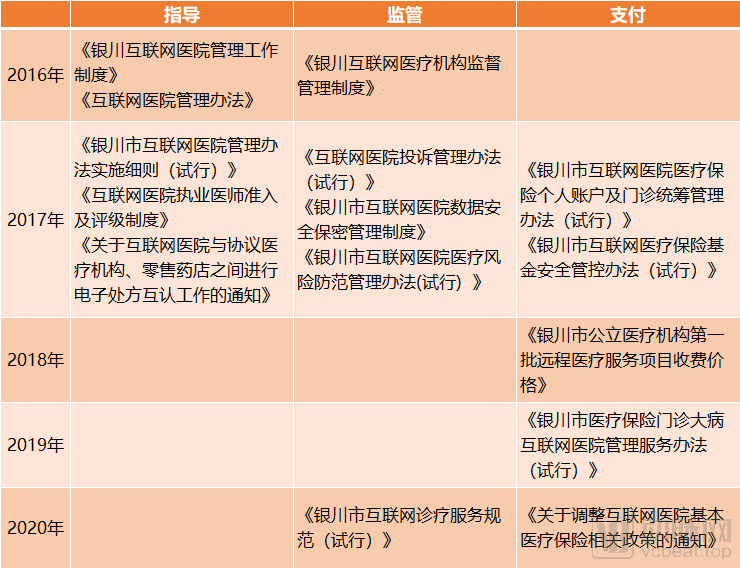
Key Policies on Internet Healthcare in Yinchuan; Sources: Yinchuan Municipal People's Government and Official Website of the Yinchuan Municipal Health Commission; Graphic by VCBeat
Guidance policies were established earliest, laying the foundation for the policy system.
Guidance-oriented policies primarily clarify access standards, work content, operational protocols, and regulatory authorities, providing direction for the application and establishment of internet hospitals as well as for internal hospital workflows, while also serving as a basis for subsequent regulatory efforts. These policies were formulated earliest, mainly during 2016–2017.
For example, the “Yinchuan Internet Hospital Management Work System (Trial)” provides detailed provisions on the internal operational content and processes of internet hospitals, covering five major areas: routine medical management, physician management, medical record management, pharmaceutical affairs management, and information security management. It specifies the work content and management procedures for various links, including online triage, online appointment scheduling, online follow-up visits, prescription review, antimicrobial drug management, and medication purchase and delivery. The document spans 73 pages and comprises more than 30,000 Chinese characters. Drawing on all aspects of offline hospital management and integrating the specific characteristics of internet hospitals, corresponding regulations have been formulated.
The “Yinchuan Internet Hospital Management Measures” stipulate the regulatory authorities for internet hospitals, the scope of medical services provided by medical institutions, and their corresponding liabilities; the “Detailed Implementation Rules for the Yinchuan Internet Hospital Management Measures (Trial)” provide detailed provisions on the operational models of internet hospitals, as well as the relevant application and approval procedures.
Physicians are the most critical stakeholders in healthcare delivery. Although the aforementioned policies all address physician-related matters, given their pivotal role, the “Access and Rating System for Licensed Physicians in Internet Hospitals” provides more detailed regulations on physician access and professional conduct. The document requires physicians to have at least five years of offline clinical experience and hold an intermediate professional title to ensure medical safety and quality. It also establishes a corresponding rating system and exit mechanism based on indicators such as consultation volume and consultation quality.
Overall, guidance-oriented policies have primarily addressed the question of “how to implement,” laying the foundation for the improvement of the policy framework.
Regulatory Policies Define Clear Red Lines to Safeguard Medical Quality
Regulatory policies primarily address complaint management, data security, and medical risk prevention for internet hospitals. Serving as a critical support to guidance-oriented policies, they focus on defining boundaries and establishing norms by clarifying prohibited activities. Consequently, these policies are typically issued concurrently with guidance-oriented policies. Examples include the Yinchuan Internet Medical Institution Supervision and Management System and the Measures for Complaint Management of Internet Hospitals (Trial).
In recent years, the application scenarios of internet-based healthcare have continuously evolved, giving rise to new types of complaints and reports during service delivery. To further standardize industry practices, the Yinchuan Internet Diagnosis and Treatment Service Specifications (Trial) were introduced in 2020, marking China’s first-ever regulatory framework for internet-based diagnosis and treatment services.
For instance, in response to the increasingly widespread application of artificial intelligence (AI) technologies in recent years, this document mandates that internet hospitals must use biometric identification technologies, such as facial recognition, to verify that consultations are conducted by the physicians themselves. However, AI and other technologies must not be used to completely replace physicians in diagnostic and treatment activities, including patient consultations, medical record documentation, and prescription issuance.
In response to the phenomenon where some internet hospitals link physicians’ prescriptions to drug sales, the document mandates that internet hospitals must not induce physicians’ prescribing behavior through drug profits, nor provide any disguised kickbacks to physicians in the form of points or promotional activities.
Regulatory guidelines clarify the bottom lines and red lines for internet-based healthcare, further safeguarding medical safety and quality, and promoting the healthy development of the industry.
Payment Policy: From Limited Pilot to Expanded Coverage, with a More Focused Range of Diseases
Payment policies primarily pertain to health insurance reimbursement, which requires a streamlined healthcare service delivery process as a foundation; therefore, their overall implementation occurred slightly later than that of the preceding two policy categories.
Yinchuan’s earliest policy on internet healthcare payment was formulated in 2017 and piloted exclusively among insured employees and residents within the three districts under municipal jurisdiction, with certain limits imposed on the annual payment cap of the pooled fund. However, no provisions were made at that time regarding reimbursable diseases.
In 2019, building on prior pilot initiatives, Yinchuan began exploring the establishment of an online payment system for medical expenses related to major outpatient diseases. The city issued the "Interim Measures for the Management and Service of Internet Hospitals for Major Outpatient Diseases under Yinchuan Medical Insurance," initially piloting the program with hypertension and diabetes.
In 2020, building on previous pilot experiences, the Yinchuan Municipal Healthcare Security Administration, the Yinchuan Municipal Health Commission, and the Yinchuan Municipal Finance Bureau jointly issued the "Notice on Adjusting Basic Medical Insurance Policies for Internet Hospitals." This notice expanded the scope of reimbursable conditions to eight diseases and extended coverage to all insured employees and residents across the city. The annual payment limit from the pooled fund was also increased compared to 2017. Furthermore, internet hospitals included in the basic medical insurance service agreement management were authorized to enable payments through personal accounts under basic medical insurance for general outpatient services.
From the overarching perspective of payment policies, the 2020 version synthesizes lessons learned from the two previous pilot programs and expands reimbursement coverage. It not only gradually increases the number of chronic diseases eligible for reimbursement but also fully addresses the needs of patients receiving general outpatient care.
Given the paramount importance of safeguarding the security of medical insurance funds, the policy framework for medical insurance has taken the longest time to evolve from pilot programs to a largely established form, compared to the other two categories of policies.
It is reported that after Yinchuan Ping An Internet Hospital enabled medical insurance payments, it specifically incorporated facial recognition technology into the identity verification process. This measure ensures that the individuals receiving services are consistent with the insured persons for medical insurance settlement, thereby implementing the requirements for real-name online medical consultation and settlement, and assisting in the strict control of medical practices and expense oversight.
Meanwhile, leveraging the extensive experience accumulated in the development of its previous internet hospital initiatives, Ping An Good Doctor utilizes its self-developed systems—including AI-assisted diagnosis and treatment, critical care monitoring, rational drug use monitoring, and medical quality control—to enhance patient consultation efficiency while enabling end-to-end monitoring of the entire diagnostic and treatment process, thereby safeguarding both medical safety and the security of medical insurance funds.
Synthesizing the above three policy areas, Yinchuan’s internet healthcare policy framework has become relatively comprehensive. An examination of the evolution of regulatory and medical insurance policies reveals a clearer developmental positioning, with the sector now entering a new phase of standardization.
Since embarking on the exploration of internet-based healthcare, Yinchuan has positioned the significance of industry development in two key aspects: On the industrial side, it aims to build a hub for the “Internet + Medical Health” industry, promote the growth of the broader medical and health sector, and make it an integral component of the local smart industry. On the service side, it focuses on introducing high-quality medical resources to support the implementation of tiered diagnosis and treatment, provide patients with greater convenience in accessing medical care, and reduce healthcare costs.
The Internet Healthcare Industry Cluster Has Basically Taken Shape
On the industrial front, as one of the second batch of pilot cities for smart city development in China, Yinchuan has focused on creating the “Yinchuan Model” of smart cities. This model is underpinned by business models, management frameworks, technical architectures, professional regulation, legislative safeguards, and reform-driven innovation, with the goals of enhancing management efficiency, providing convenient and beneficial services to the public, and fostering the growth of the smart industry.
As a key component of smart city development, Yinchuan has prioritized the “Internet Plus” strategy, leveraging the internet healthcare industry as a crucial driver to promote the clustered growth of its smart industry sectors. By establishing a national base for internet hospitals and a National Health and Medical Big Data Center, Yinchuan aims to anchor itself in Northwest China while extending its influence nationwide, thereby advancing the comprehensive development of the healthcare and wellness sector.
In 2016, Yinchuan’s first internet hospital opened; in March 2017, Yinchuan established China’s first internet hospital industrial base, with a number of well-known domestic internet hospitals signing agreements to settle in.
According to local media reports, as of June 2020, Yinchuan had introduced 80 internet healthcare companies and other big health enterprises, basically forming a cluster for the “Internet + Healthcare” industry. According to statistics from VCBeat based on public information, there were 53 internet hospitals in Yinchuan by the end of July 2020.
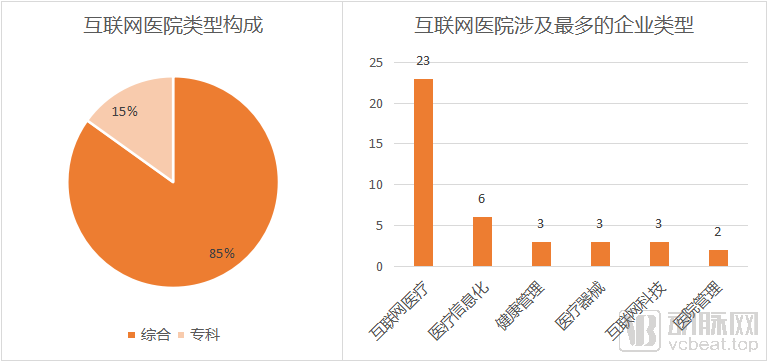
Overview of Yinchuan Internet Hospital; Data Sources: National Health Commission, Public Media Reports; Graphic by VCBeat
These internet hospitals are sponsored by various types of enterprises, primarily internet healthcare and medical informatics companies, as well as firms specializing in medical devices and hospital management. They include both comprehensive internet hospitals and specialty-focused ones, such as those for orthopedics, obstetrics, gynecology, and pediatrics, continuously delivering high-quality medical resources to local communities.
Six Major Service Categories Have Been Established
On the service side, Yinchuan’s original intention in developing internet healthcare was to introduce expert resources from Beijing, Shanghai, and Guangzhou, providing patients with services such as consultation appointments, remote consultations, and referrals. As exploration deepened and policies became clearer, the types of services gradually expanded. Currently, there are six main types of internet healthcare services in Yinchuan.
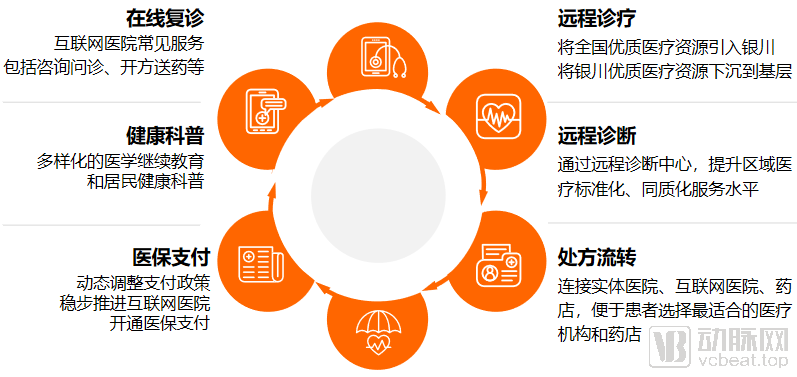
Major Service Types of Internet Healthcare in Yinchuan, Source: Public Information, Chart by VCBeat
Online follow-up consultations are a common service in internet healthcare, accompanied by related services such as online consultation, appointment scheduling, referral, and prescription fulfillment with medication delivery. These constitute the basic services offered by most internet hospitals.
In the realm of telemedicine, Yinchuan has explored the establishment of an “Internet + Remote Outpatient” service system covering three tiers across the city. It has launched a national expert remote outpatient service to channel high-quality medical resources from Beijing, Shanghai, and Guangzhou down to Yinchuan; established a Yinchuan municipal expert remote outpatient service to extend premium resources from local tertiary hospitals in Yinchuan to counties and districts; and created the Yinchuan Online Internet Outpatient Service to bring diagnostic and treatment capabilities from various hospitals in Yinchuan down to the grassroots level.
In the realm of remote diagnosis, Yinchuan has introduced third-party platforms to establish the Ningxia Electrophysiology Diagnostic Center and remote diagnostic centers in Yinchuan for medical imaging, ultrasound, fetal heart rate monitoring, sleep apnea monitoring, and pathology. By incorporating various remote diagnostic tests and examinations into these centers and gradually integrating healthcare institutions into a cloud-based management system, the region aims to enhance the standardization and homogenization of medical services.
Regarding prescription circulation, Yinchuan has established a prescription review and circulation platform to share pharmacist resources across the city. The platform conducts real-time online reviews of outpatient prescriptions from public hospitals, private hospitals, internet hospitals, primary healthcare institutions, and pharmacies throughout the city. Patients can choose to purchase medications through various channels, including their selected medical institution, the nearest pharmacy, the most affordable pharmacy, self-service medication dispensers, or third-party delivery services.
Regarding medical insurance, Yinchuan conducted two pilot programs for internet hospital reimbursement in 2017 and 2019, respectively. Currently, eight categories of major outpatient diseases are covered for reimbursement through internet consultations. Meanwhile, internet hospitals included under the basic medical insurance service agreement management can enable personal account payments for general outpatient services.
In terms of health science popularization, Yinchuan’s online science education and outreach platforms offer diverse continuing medical education (CME) training for healthcare professionals, as well as health literacy training for residents.
Therefore, Yinchuan has established a relatively comprehensive internet healthcare system that covers medical services, pharmaceuticals, and health insurance. The integration of these six service types not only introduces high-quality medical resources to the local area and supports tiered diagnosis and treatment, but also improves the utilization efficiency of local medical resources, thereby providing patients with greater convenience in accessing medical care.
Yinchuan has pursued an “industry + service” model in developing internet healthcare. Given the significant disparities across regions in economic development, industrial positioning, medical capabilities, and the pace of internet healthcare adoption, this model is difficult to replicate directly. However, specific measures can be adapted to local conditions and serve as reference points. Internet healthcare companies, particularly platform-based enterprises, can play a pivotal role in this process.
Platform-based enterprises often deploy internet hospitals across multiple regions, and their pharmaceutical supply chains must be established on a nationwide scale.
Taking Ping An Good Doctor as an example, by mid-August, 14 of its internet hospital projects signed with offline hospitals across various regions had been put into operation, actively integrating with local medical insurance payment systems. Among these, the local medical insurance payment systems in Dongguan, Guangdong Province, and Yinchuan, Ningxia Hui Autonomous Region, have already been connected.
Meanwhile, Ping An Good Doctor’s Pharmacy Cloud Service connects 111,000 pharmacies across China, and its central pharmaceutical warehousing service has been launched in 40 cities, including Guangzhou, Wuhan, Beijing, and Shanghai, establishing a drug supply system with extensive coverage and rapid delivery.
VCBeat believes that as Ping An Good Doctor builds its internet hospital in Yinchuan and launches services such as online consultations, medical insurance payments, and pharmaceutical delivery, it will be guided and regulated by local policies while integrating with the local industrial environment. When developing projects in other regions, the company can adapt and apply the Yinchuan model to local conditions. In this way, the replication and transfer of experience are realized through industry practice.
Since the onset of the pandemic, internet healthcare has entered a new peak of development. The regional development of internet healthcare requires local government departments to engage in institutional design and industrial planning, and more importantly, it necessitates that enterprises fully leverage their role as “facilitators.”