

Home-Based Aging-in-Place Modifications Unlock a Trillion-Yuan Market, Redefining Industry Imagination
In July 2020, nine ministries and commissions, including the Ministry of Civil Affairs, the National Development and Reform Commission, and the Ministry of Finance, jointly issued the “Guiding Opinions on Accelerating the Implementation of Home Adaptation Projects for the Elderly” (hereinafter referred to as the “Guiding Opinions”). The document requires that, by the end of 2020, home adaptation renovations be carried out for households with elderly individuals facing special difficulties through measures such as government subsidies. It also encourages regions with the necessary conditions to unlock and guide the potential demand for home adaptation renovations and home-based elderly care services, thereby fostering the growth of consumer markets for elderly care services, home-based care facilities, and senior products.
Age-friendly home modifications refer to the adjustment or renovation of living spaces in the homes of older adults, including passageways, bedrooms, kitchens, and bathrooms, as well as the configuration of furniture, installation of assistive devices, and implementation of detailed safety measures. These modifications are designed to facilitate mobility, bathing, toileting, and resting for older adults, alleviate difficulties in daily living caused by age-related physiological changes, prevent personal injuries, and enhance the safety and convenience of aging in place.
In fact, some developed countries established age-friendly design as a general rule and standard for ordinary residential construction years ago, requiring all housing to be built in accordance with these guidelines. For example, in Japan, handrails must be installed next to toilets, bathtubs, stairs, corridors, entryways, and outdoor steps in ordinary homes, while interior layouts are designed to facilitate wheelchair use. In practice, the cost of age-friendly renovations varies from hundreds to tens of thousands of yuan, depending on the scope and extent of the modifications. Products such as non-slip mats, bedside rails, shower chairs, and adjustable canes from brands specializing in elderly care typically cost around 150 yuan each. More complex modifications, such as converting squat toilets to sitting toilets or installing nursing beds and age-friendly furniture, add approximately 2,000 yuan per item.
“Guidance Opinions” establishes a recommended list of home aging-friendly renovation projects and elderly product configurations, focusing on construction renovations, facility equipment, and elderly product provisioning. In this list, aging-friendly renovations are categorized into seven types: floor modifications, door modifications, bedroom modifications, toilet and bathing facility modifications, kitchen equipment modifications, physical environment modifications, and elderly product configuration. The list includes eight basic renovation items, such as anti-slip treatment and level difference management, as well as 22 optional renovation items, including surface leveling and hardening, and handrail installation.
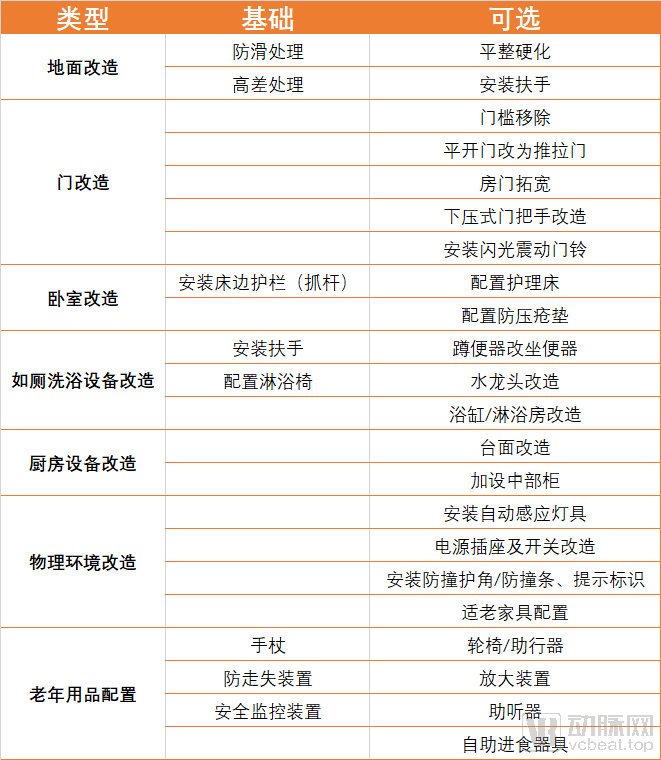
Furthermore, the "Guiding Opinions" mention under "Supportive Development Measures" that home-based age-friendly renovations should be integrated with information-based and smart home and community elderly care services. Efforts will be intensified to enhance the age-friendly design, development, and application of terminal devices for elderly care, as well as to increase the supply of high-quality elderly products and services. From this wording, we can infer that the new round of age-friendly renovations is no longer limited to purely architectural or physical space modifications; rather, it has become an integral component of smart elderly care services that leverage digital means to address aging-related challenges.
More importantly, with age-friendly home modifications serving as a bridge between traditional home-based elderly care and smart elderly care, more intelligent age-appropriate products will be able to enter the homes of older adults in the future, leveraging modern digital means to alleviate some of the challenges associated with aging. For instance, automatically sensor-activated lights, canes, anti-wandering devices, and safety monitoring systems mentioned in the "Guiding Opinions" have already achieved a certain degree of intelligence. VCBeat has learned that in certain cities, districts, and counties in the Yangtze River Delta region with relatively strong economic development, products such as smart canes and smart anti-wandering ID badges have been included in the lists of items for home-based age-friendly renovations.
After years of sporadic pilot programs, the “Guiding Opinions” were finally released, seen as a signal that home-based age-friendly renovation projects for the elderly population are set to “accelerate.”
As early as 2014, the Ministry of Housing and Urban-Rural Development and other relevant departments issued policy documents to promote barrier-free renovations in the homes of older adults and in public facilities within residential areas, prompting a number of cities to initiate related renovation efforts. According to incomplete statistics, more than 30 cities, districts, and counties across China have launched pilot programs for age-friendly home modifications. These initiatives primarily adopt a government procurement model, leveraging fiscal revenues and lottery public welfare funds, among other sources, to provide free age-friendly home modification services to households with older adults facing special difficulties, within prescribed budget limits. As a result, hundreds of thousands of elderly households have benefited from these measures.
Based on preliminary pilot programs, these cities typically select dozens to hundreds of eligible elderly households for age-friendly home modifications, with per-household cost standards ranging from several hundred yuan to nearly 10,000 yuan. VCBeat has observed that, due to variations in economic development levels across different cities, local authorities do not necessarily consider the income level of elderly individuals as a criterion for eligibility for home age-friendly modification benefits.
For example, in April 2019, the Hangzhou Civil Affairs Bureau and Finance Bureau jointly issued the "Implementation Plan for the Pilot Project of Home Adaptation for Elderly People in Difficulties in Hangzhou," launching a one-year pilot program for home adaptations for elderly individuals from disadvantaged households. The pilot was initially carried out in four districts: Shangcheng, Gongshu, Xihu, and Lin'an, with plans to implement adaptations in 50 households per district. The cost of adaptation per household was not to exceed 6,000 yuan, and priority was given to three functional improvements: handrails, piping, and anti-slip measures.
For example, in March 2020, the Shanghai Municipal Civil Affairs Bureau issued the "Notice on Launching Pilot Programs for Age-Friendly Home Modifications for the Elderly in Shanghai," which included local registered residents aged 60 and above from the first batch of six pilot sub-districts and those participating in the home care bed pilot program within the scope of age-friendly home modifications. During this pilot initiative, Shanghai introduced basic and personalized product service packages for elderly individuals to choose from, providing differentiated subsidies based on their financial status. The maximum subsidy per household was capped at 3,000 yuan.
In late July, the Shenzhen Municipal Civil Affairs Bureau will launch a pilot program for home adaptations to better suit the needs of the elderly. According to media reports, Shenzhen will select 450 households with elderly residents in districts such as Futian and Luohu. The pilot program will provide a subsidy of RMB 10,000 per household to carry out age-friendly renovations for families with Shenzhen-registered residents aged 60 or above. Priority will be given to households facing financial hardship, those with disabled members, and those with very elderly individuals.
According to data from the National Bureau of Statistics, by the end of 2019, China’s population aged 60 and above had reached 253.88 million, accounting for 18.1% of the total population. As the elderly population grows, so does their demand for diverse elderly care models, such as aging in place. Furthermore, the Fourth Sample Survey on the Living Conditions of Urban and Rural Elderly People in China indicates that over 90% of elderly individuals spend their later years at home or within their communities, with more than 60% of them residing in housing unsuitable for older adults.
Based on this information, we can make a rough estimate of the potential market size for age-friendly home modifications. Assuming that the 253.88 million people aged 60 and above as of the end of 2019 belong to 126.94 million households, and given that 90% of elderly individuals choose non-institutional care, with 60% of their homes being unsuitable for elderly living, there are approximately 68.5476 million households across China requiring basic age-friendly renovations. By adopting a median cost of RMB 5,000 per household for such modifications, the market size would exceed RMB 300 billion.
Home-based age-friendly renovation, serving as the “foot in the door” for home-based elderly care services to enter seniors’ households, has become a standardized, comprehensive elderly care service in developed countries with severe population aging. For example, under Japan’s Long-Term Care Insurance Act, home-based age-friendly renovation is one of the covered benefits entitled to insured individuals.
In contrast to the smart elderly care sector, which has gradually formed a scaled, vertical industry chain driven by policy support, the professional market for age-friendly home modifications remains in its early stages of development. Professor Zhou Yanmin from the School of Architecture at Tsinghua University points out that currently, whether among the general public, administrators, or relevant practitioners, there is a prevailing tendency to view such modifications merely as ordinary “home renovation projects.” This misconception has led to issues such as low industry recognition, consumer reluctance, and difficulties in implementing policy support, thereby constraining the development of the home-based age-friendly modification industry to some extent.
Professor Zhou Yanmin believes that the release of the Guiding Opinions signifies that China’s home-based aging-friendly renovation has officially transitioned from a pilot exploration phase to a period of widespread implementation. Although the domestic industrial ecosystem for home-based aging-friendly renovation had already begun to take shape alongside earlier pilot programs, with companies specializing in this field—such as Fushoukang, Anxin Elderly Care, Chenghejing, Yijia Elderly Care, and Yixiang Life—playing significant roles in introducing advanced international concepts, integrating industrial chain resources, and providing one-stop renovation services, it was not until February 2020, when the National Bureau of Statistics issued the Statistical Classification of the Elderly Care Industry (2020), that “aging-friendly and barrier-free residential renovations” were established as an independent category.
In China, home modifications for aging-friendly living are primarily undertaken as a side business by large renovation companies, while some small renovation teams also take on such projects, often lacking guaranteed professionalism. With strong support from national policies, a number of enterprises specializing in home-based aging-friendly renovation services have emerged across various regions in recent years. Among these enterprises are startups that initially targeted this sector, as well as companies expanding into or transitioning toward home-based aging-friendly renovations from fields such as interior decoration, community services, and institutional elderly care.
A review of the age-friendly renovation initiatives launched across various regions around 2017 reveals that architectural design firms remained the primary entities undertaking such projects. However, companies originally engaged in medical device R&D, distribution, and healthcare informatics also began to emerge, primarily by integrating supply chain resources to provide one-stop solutions.
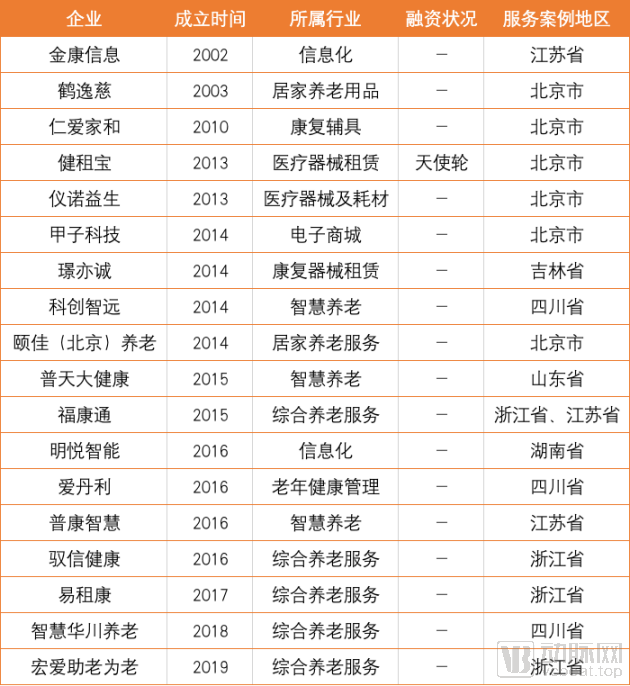
By further analyzing these emerging providers of age-friendly home modification services and their case studies, we have identified some early trends, hoping to offer reference for readers who have just entered or are preparing to enter this industry.
Based on an analysis of nearly 100 regional age-friendly renovation projects involving the aforementioned enterprises, we found that Fukangtong and Jinkang Information, both based in Nanjing, Jiangsu Province, secured the highest number of bids. These companies have established subsidiaries or branches radiating outward from their Nanjing headquarters to undertake local age-friendly renovation projects.
Fukangtong, established in December 2015 and incubated by the Internet of Things Research and Development Center of the Chinese Academy of Sciences, is a high-tech enterprise focused on smart health and elderly care. The company specializes in age-friendly design, renovation, and product development. By implementing modifications to age-friendly physical spaces, configuring age-friendly assistive devices, and installing intelligent safety monitoring systems, Fukangtong has been recognized as a national-level demonstration enterprise for smart health and elderly care. Its technical capabilities span software technology, medical care, and elderly nursing. The company has independently developed modern information technology platforms for elderly care, including the Health All-in-One Machine Information System, Vital Signs Detection System, Age-Friendly Renovation Information Service System, Home-Based Elderly Care Service Software, Elderly Capability Assessment Software, Sensory Rehabilitation Training System, Fukangtong Health Data Collection Workstation System, and the Fukangtong Smart Elderly Care Cloud Platform.
Specifically, Fukangtong’s age-friendly renovation solution comprises two components: age-friendly design and age-friendly renovation. The age-friendly renovation component consists of three modules: physical space modification (i.e., barrier-free adaptation), rehabilitation assistive device fitting (including rental of mobility aids, bathing aids, toileting aids, nursing supplies, rehabilitation equipment, health management devices, and daily living aids), and intelligent safety monitoring.
Public bidding data shows that since January 2019, Fukangtong has successively undertaken 40 local age-friendly renovation projects, making it the company with the largest number of such solutions provided in China. Jiangsu and Zhejiang are the regions where Fukangtong has carried out the most intensive age-friendly renovations. Since entering 2020, the pace of age-friendly renovations in this region has significantly accelerated. In particular, after the release of the "Guiding Opinions" in August 2020, Fukangtong secured 18 age-friendly renovation orders worth more than RMB 6 million.
Jinkang Information, established in 2002, is a wholly-owned subsidiary of Ankangtong, a benchmark enterprise in integrated elderly care operations in China. Ankangtong, in turn, is a wholly-owned subsidiary of Nanjing Xinjiekou Department Store Co., Ltd. (stock code: 600682.SH). Leveraging its independently operated smart elderly care command center, self-developed information management system platform, and professional online-to-offline service teams, Ankangtong integrates high-quality social resources to provide comprehensive elderly care services that integrate home-based, community-based, and institutional care for the senior population.
Over the past 20 years since its establishment, Ankangtong has expanded its operations to 20 provinces and municipalities, including Shanghai, Beijing, Chongqing, Tianjin, Jiangsu, Shandong, Zhejiang, and Anhui. As of early 2019, it had served over 17.23 million elderly users in China and had cumulatively established 66 smart elderly care command centers for local governments.
Leveraging the resource accumulation of its parent company, Jinkang Information has extensive experience in addressing the smart elderly care needs of local governments and has undertaken multiple projects involving home-based elderly care services and the development of smart elderly care platforms. Public bidding data indicates that Jinkang Information primarily provides age-friendly renovation services at the municipal, district, and sub-district levels within Jiangsu Province.
As a service provider specializing in smart elderly care, JinKang Information typically incorporates intelligent safety protection projects into its age-friendly renovation services, in addition to offering standard age-appropriate products. These projects include network access, data gateway integration, one-touch emergency call devices, motion sensors, door magnetic sensors, and smart positioning chest badges. Among these, the smart positioning chest badge connects directly to a mobile app, enabling family members to remotely receive location information for elderly individuals at risk of wandering.
Currently, the two leading domestic enterprises in age-friendly home modifications have joined forces in Nanjing to conduct individualized needs assessments for 206 elderly households registered in Xinjiekou, Xuanwumen, and Meiyuan Xincun subdistricts of Xuanwu District, as well as for 194 elderly households registered in Suojincun, Xiaolingwei, Xuanwu Lake, and Hongshan subdistricts. These assessments evaluate both the residential environments and the physical conditions of the elderly residents. Guided by the principles of safety and practicality tailored to each household’s housing situation, the age-friendly renovations primarily include the installation of barrier-free facilities for daily living and mobility, as well as the provision of various assistive devices. These measures aim to alleviate difficulties experienced by older adults due to age-related physiological decline, thereby effectively enhancing their sense of happiness, fulfillment, and security.
Age-friendly home modifications involve a wide variety of items, ranging from toilet grab bars and bedside handrails to lever-style door handles and anti-collision strips, as well as smart alarms for detecting water, electricity, and gas leaks and smart positioning badges. These products fall under diverse technical barriers and distinct sales channels, making it difficult for a single enterprise to provide comprehensive coverage. Consequently, some have attempted to leverage the internet to improve the efficiency of resource integration. This article introduces two companies, Jiazi Technology and Jianzubao, which launched age-friendly home modification services within Beijing in 2017 and 2019, respectively. Both have established online trading platforms for age-friendly products.
Jiazi Technology was officially launched in 2014. Its main products include a comprehensive suite of elderly care services, such as senior care information, e-commerce for elderly care services and products, operation systems for elderly care institutions, family-oriented emotional support services for seniors, and training for elderly care professionals. Jiazi Technology’s core business segments include the Jiazi Network, Jiazi Mall, the “Qinqingbao” Location-Based Mobile App, the WeChat Official Account for Chinese Seniors, and Japanese Care Worker Training.
In the realm of age-friendly home modifications, Jiazi Technology adheres to a service philosophy centered on safety, simplicity, comfort, and practicality. Upholding its mission of "respecting and honoring the elderly with a dedicated focus on senior services," the company strictly follows national standardized service protocols and incorporates thoughtful, human-centric design. Leveraging experience from age-friendly renovation projects across dozens of elderly care institutions in Beijing, Jiazi Technology has successfully carried out modifications for numerous economically disadvantaged families with disabled elderly members who met policy criteria following professional assessments, thereby ensuring that seniors receive proper care and support in their later years.
Jiazi Technology also serves as a service provider for age-friendly renovation projects in Fengtai District and Daxing District, Beijing. Its main services include age-friendly modifications to home environments, interior spaces, indoor facilities and equipment, smart indoor devices and systems, furniture and home decor, as well as the provision and functional introduction of key assistive devices for age-friendly adaptations.
Jianzubao was established in 2015. Its parent company is Kangfu Zhijia (Rehabilitation Home), and Jianzubao represents another strategically significant business venture for the latter, alongside its medical device retail, pharmaceutical retail, and internet hospital operations. At its inception, Jianzubao’s primary activities included leasing medical devices, as well as acquiring and reselling used medical devices, with its main market coverage focused on Beijing and Shanghai.
Data shows that, to date, Jianzubao’s primary sales channels have been third-party platforms such as Kangfu Zhijia (Rehabilitation Home), Dekai, Baixing.com, 58.com, Xianyu, Qingsong Kanghu (Qingsong Care), and Ermiao Zhaohu (Ermao Care), as well as offline elderly care institutions and pharmacies. In November 2016, Jianzubao launched an age-friendly home modification project in Beijing’s Xicheng District, an initiative the company regarded as a significant business expansion effort. By 2017, home age-friendly modifications had become a major source of profit for Jianzubao.
In China, the development of smart elderly care is in full swing. As home-based age-friendly adaptations expand from pilot programs to nationwide implementation, an increasing number of enterprises with experience in building smart elderly care platforms are extending their services to provide comprehensive solutions for home-based age-friendly renovations. Here, we present a brief overview of several smart elderly care companies that have undertaken regional age-friendly adaptation projects.
Founded in 2014, Kechuang Zhiyuan is a technology-driven enterprise primarily engaged in the software development, platform construction, and operation of various information-based platforms. Leveraging digital technologies, it integrates Internet and Internet of Things (IoT) applications into the smart home sector to provide comprehensive solutions for home-based elderly care and community services.
Previously, Kechuang Zhiyuan and China Telecom jointly established the Xiaoxingtong Home-Based Elderly Care Service Information Cloud Platform, which provides convenient, efficient, and high-quality home-based elderly care services in three major categories: daily living, health management, and safety monitoring, thereby creating a “nursing home without walls.”
Public information indicates that Kechuang Zhiyuan operates in Chengdu, Sichuan Province, and Beijing. Its primary business focus has been on building smart platforms and supplying hardware for home-based elderly care. In July 2019, Kechuang Zhiyuan was selected as a service provider for age-friendly home modifications for families with elderly individuals facing special difficulties in Qionglai City, Chengdu. In September of the same year, the company supplied smart wristband blood pressure monitors for age-friendly renovation projects in Wuhou District, Chengdu.
Putian Health leverages internet technologies to enhance the quality of home-based elderly care services, thereby establishing a diversified smart home-care service system. Its home-care solutions primarily facilitate the implementation of government-procured services, address the needs of seniors who rely on community- and home-based care, integrate elderly care resources, and create an online-offline integrated service model. The company provides elderly care services focused on health management, safety monitoring, convenient living, and emotional support, ensuring that seniors receive high-quality care.
In September 2019, Putian Health became a service provider for age-friendly home modifications for specific elderly households in Zhaoyuan City, Shandong Province. In addition, Putian Health provides home-based elderly care services and the construction and operation of comprehensive smart elderly care information platforms to multiple cities, districts, and counties across Shandong, Hainan, Hebei, Liaoning, and other provinces.
Suzhou Pukang Smart Elderly Care Industry Technology Co., Ltd. is a technology-driven innovative enterprise dedicated to the development of the smart elderly care industry. Its core business encompasses smart home-based elderly care services, publicly built and privately operated nursing home projects, day care center operations, long-term care insurance services, and age-friendly renovation projects. Pukang Smart has independently developed a domestically leading “Internet + Elderly Care” smart home-based care information platform and assembled a professional service team comprising thousands of members, thereby achieving a transformation from traditional operational models to internet-enabled informatization.
In August 2020, Pukang Smart became the provider of age-friendly home modification services for elderly households facing financial difficulties in Qidu Town, Wujiang District, Suzhou City. The company was required to complete the modifications for 43 elderly households within its jurisdiction by September 20, 2020. Prior to this, Pukang Smart had primarily focused on the development and maintenance of smart elderly care service platforms and home-based elderly care services.
Guided by the Information Center of the National Working Commission on Aging, Smart Huachuan is a model enterprise of “central-local” cooperation jointly established by China Hualu Group, a central state-owned enterprise, and Sichuan Investment Group. Smart Huachuan is committed to developing the elderly care big data industry and providing professional health and elderly care services through comprehensive smart elderly care solutions.
The company offers a comprehensive suite of online health and elderly care solutions, including integrated management of elderly care information, smart elderly care command centers, community-based home care, and integrated medical and elderly care solutions. Zhihui Huachuan is positioned to build a national big data platform for health and elderly care, establishing a nationwide internet service portal under the “integrated medical and elderly care” model. Meanwhile, through an online-offline integrated development model, it expands the operation of home-based, community-based, and institutional elderly care services, providing data sources and effective support for the big data platform.
Since January 2020, Smart Huachuan has successively become the service provider for home aging-friendly renovation projects for elderly families in financial difficulty in Xuzhou District of Yibin, Sichuan Province; Gong County of Yibin, Sichuan Province; and Jiawang District, Jiangsu Province.
An interviewee with years of experience in the home- and community-based elderly care industry told VCBeat that in recent years, the development of smart elderly care—a key component of smart city initiatives—has attracted major tech giants to enter the senior care sector. Intelligent elderly care infrastructure outside seniors’ homes has already been established to a relatively comprehensive degree. As age-friendly home modifications are rolled out nationwide, it is inevitable that smart elderly care platforms will extend into seniors’ households. If we can integrate smart elderly care platforms both inside and outside the home, leveraging intelligent, age-appropriate home fixtures and products to collect data on and interact with seniors’ health status and daily needs, then we may need to reshape our vision of what it means to “provide for the elderly.”
Writing Reference:
In-Depth Research | A ¥3 Trillion Market Awaits Exploration: Where Are the Opportunities and Breakthroughs for Age-Friendly Renovations?