

HuaKan Biotech Secures Tens of Millions of RMB in Series A Funding, Led by Beijing Shoufa Tianji Fund and DT Capital with Hyi Capital as Exclusive Financial Advisor

CytoNiche
3D Cell Technology Products and Services Provider
CytoNiche recently announced the completion of its Series A equity financing, raising tens of millions of RMB. The round was jointly invested by Beijing Shoufa Zhantian Ji Fund, DT Capital Partners, and an international industrial group. JoyCap Capital served as the exclusive financial advisor in this transaction.
Beijing Huakan Biotechnology Co., Ltd. (CytoNiche) was founded under the leadership of Professor Du Yanan’s research team from the School of Medicine at Tsinghua University, with Tsinghua University participating as a co-founder and shareholder. Its core technologies stem from the commercialization of scientific achievements at Tsinghua University. The company’s proprietary 3D FloTrix® product series represents a globally original, comprehensive solution for the large-scale culture and expansion of stem cells, as well as a globally innovative injectable therapeutic product for stem cell-based treatments.
The company currently operates a 1,000-square-meter R&D center and a 2,000-square-meter GMP-compliant production platform. Its proprietary technologies have secured more than 30 patents and been featured in over 30 international journal articles. Related technological products have been published in prestigious journals such as Nature Materials, PNAS, Nature Communications, and Biomaterials, and have received extensive coverage from domestic and international media. The company’s core technology projects were supported and applied under the 2017 National Key R&D Program of China, and also received project initiation support for disruptive technology research and development and achievement commercialization from Zhongguancun in 2019.
The company’s products have achieved GMP-compliant mass production and stable sales, while also obtaining relevant product quality inspection reports and medical device qualifications. Its core products are currently in the clinical registration application stage. The company has signed strategic cooperation agreements with multiple cell therapy IND license holders and new drug applicants to jointly promote the industrialization of cell therapy drugs.
The global stem cell market encompasses upstream and midstream activities, such as stem cell storage and preparation, as well as downstream clinical applications. According to a report by Transparency Market Research, the global stem cell market size is projected to reach $270.5 billion by the end of 2025, with a compound annual growth rate (CAGR) of 13.8% over the past eight years. Currently, there are 10 mesenchymal stem cell (MSC) products approved for marketing internationally. It has recently been reported that the U.S. FDA Advisory Committee voted 9-1 in favor of approving an MSC product for the treatment of refractory acute graft-versus-host disease (GVHD) in pediatric patients, with market approval expected by the end of this year. If approved, this would be the first mesenchymal stem cell product to receive FDA marketing authorization in the United States.
Currently, there are over 5,000 registered stem cell clinical research institutions worldwide, covering more than 140 types of diseases. Data shows that as of July 30, 2020, China had approved 119 institutions for filing of stem cell clinical research, and the National Medical Products Administration (NMPA) had accepted applications for 14 stem cell drug products. Among these, 12 stem cell drug products received Investigational New Drug (IND) approval to enter clinical trials (with 8 IND approvals granted in the first half of 2020). Furthermore, 77 stem cell clinical research projects were approved and filed by the National Health Commission, permitting them to conduct clinical studies. These figures indicate that China is entering a phase of rapid development in the research, development, and translation of new stem cell therapies.
However, whether for stem cell products marketed abroad or those used in clinical trials or research within China, their manufacturing processes largely rely on traditional two-dimensional (2D) manual culture. This 2D culture method suffers from inherent limitations, such as its inability to authentically mimic the three-dimensional (3D) growth environment of cells in vivo, as well as objective challenges including high labor costs, substantial space requirements, limited batch production capacity, and inconsistent quality between batches. Consequently, it fails to meet the demands for standardization, cell quality, and quantity required for the clinical translation of stem cells, thereby severely constraining the development of the novel stem cell drug industry.
CytoNiche’s independently developed, globally pioneering 3D FloTrix® automated expansion platform technology is specifically designed for large-scale stem cell production and manufacturing, providing a systematic and comprehensive solution. The 3D FloTrix® cell expansion process leverages its core patented product, the 3D FloTrix® Cell Expansion Kit (comprising 3D TableTrix® Cell Microcarriers and 3D FloTrix® Digest Lysis Buffer), along with CytoNiche’s proprietary 3D FloTrix® Bioreactor, to achieve large-scale expansion culture of mesenchymal stem cells. Compared to traditional manual 2D cell culture, this technology reduces space requirements by approximately 90%, labor costs by 90%, reagent and consumable usage by 50%, and time costs by 50%, thereby enabling customized, scalable, and intelligent cell production and manufacturing. Its key highlights are as follows:
I. 3D FloTrix® Scalable Expansion Process for Stem Cells
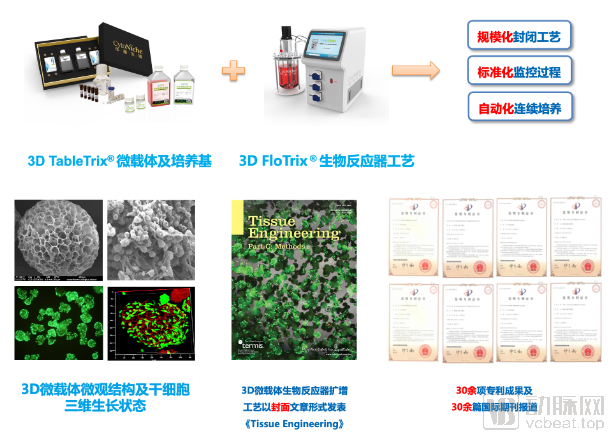
1. Original Chinese innovation with fully independent intellectual property rights, derived from technology transfer at Tsinghua University;
2. Pharmaceutical-grade 3D microcarriers produced under GMP conditions with precisely controllable physicochemical properties; 3D culture biomimetically simulates the in vivo microenvironment (e.g., hypoxia, perfusion).
3. Customized 3D expansion process and bioreactors for large-scale culture;
4. Rapid inoculation with stepwise feeding and in situ passaging via cell-bead transfer (eliminating the need for trypsin digestion), enabling closed-system continuous expansion and production;
5. Gentle cell harvesting via degradable microcarriers achieves complete stem cell recovery; no carrier residue remains after degradation, ensuring high cell viability;
6. Enables in situ liquid nitrogen cryopreservation of stem cells with microcarriers, facilitating the establishment of cell banks;
7. Achieve large-scale, standardized, and automated production, eliminating inter-batch quality variations, reducing production costs, with a single batch capacity reaching the 10¹² order of magnitude.
II. 3D FloTrix® Series Bioreactors
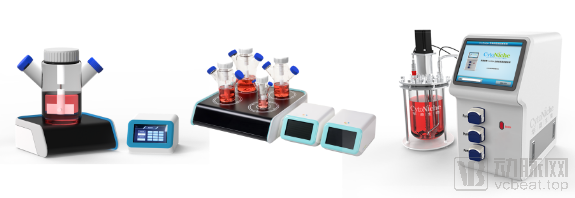
3D FloTrix® Series Bioreactors
1. Independently developed to reduce costs: The use of reusable glass reaction bottles capable of withstanding high-temperature, high-pressure autoclaving significantly reduces R&D expenses;
2. It enables exploratory experiments for pharmaceutical users to develop process conditions, meeting diverse experimental needs such as multi-parameter optimization and parallel validation; it also supports pilot-scale production validation for pharmaceutical users, with each batch capable of producing high-quality stem cell preparations at a scale exceeding hundreds of billions of units;
4. To address the issues of cumbersome procedures and high dependence on operator experience in traditional 2D culture, CytoNiche’s 3D FloTrix® series of bioreactors enable simple, rapid, and efficient expansion culture of stem cells, significantly reducing the expertise required from operators;
5. Process data is recordable and exportable, in compliance with relevant GMP requirements;
6. By equipping an optical glucose monitoring system and a 3D cell counting system, online monitoring of glucose concentration and cell count (including viability) in the bioreactor can be achieved.
By integrating the aforementioned products and processes, 3D microtissue engineering technology holds promise for achieving closed-loop 3D manufacturing of stem cells. Compared with traditional manual 2D stem cell culture, the efficient stem cell expansion process based on Microcarrier Sheets® saves labor, production space, and time in the manufacturing of novel stem cell therapeutics, while ensuring both cell quantity and quality.
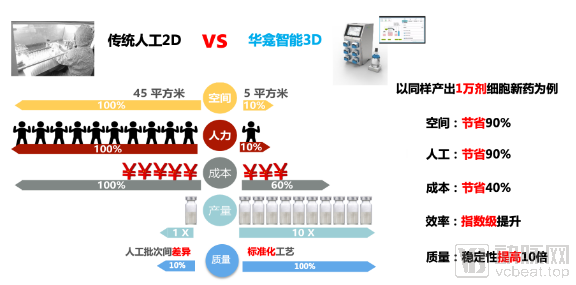
Advantages of the 3D FloTrix® Stem Cell Expansion Process Based on Microcarrier Sheets®
Professor Du Yanan, Co-founder & Chief Scientist of CytoNiche, stated that,CytoNiche’s mission is to revolutionize cell manufacturing processes and cell delivery methods in the cell therapy industry through proprietary technologies originated from Tsinghua University, thereby driving the rapid development of the emerging regenerative medicine sector. With strong support from all sectors of society, our team will continue to forge ahead, striving to ensure that stem cell therapies empowered by CytoNiche benefit patients as soon as possible.
Dr. Liu Wei, Co-founder & CEO of CytoNiche, stated,CytoNiche’s proprietary technology originates from the commercialization of research achievements at Tsinghua University, serving as a “core component” that addresses bottlenecks in large-scale manufacturing processes and drug development within the mid-to-downstream segments of the cell therapy industry. Established two years ago, the company has completed the critical transition from technology transfer to market industrialization, securing strong support from market capital and earning high recognition from experts and scholars across academia, research, and industry. Currently, we have signed strategic cooperation agreements with multiple enterprises holding Investigational New Drug (IND) approvals for cell therapies and those filing new drug applications, jointly advancing the industrialization of novel cell therapy drugs. In the next phase, the company will focus its strategic layout and development on platform construction, large-scale process development, and microtissue-based new drug R&D. CytoNiche is an ambitious young entrepreneurial team driven by vision; our goal is to develop disruptive, original Chinese core technologies and products that foster the robust growth of the global cell therapy industry and the broader biopharmaceutical sector.
Ms. Jiang Mingyue, the appointed representative of the executive partner of Beijing Shoufa Zhantian Ji Fund, statedCurrently, the global stem cell industry is experiencing rapid growth. However, within the midstream segment of the stem cell industrial chain, traditional manual operations are still predominantly used for stem cell culture. CytoNiche’s proprietary 3D microcarrier technology enables customized, large-scale, automated, and high-quality stem cell cultivation, addressing the pain points of low expansion efficiency and cumbersome operations in the midstream sector. This technology represents an essential step toward the industrialization of stem cell therapies. We also hold great confidence in CytoNiche’s founding team from the Department of Biomedical Engineering at Tsinghua University, whose eight years of dedicated efforts have culminated in this breakthrough. Tianji Fund’s investment in CytoNiche exemplifies Capital Science & Technology Development Group’s commitment to promoting the commercialization and translation of Beijing’s original innovations in high-end hard technologies. Looking ahead, Tianji Fund is committed to working closely with the company to overcome challenges and strive tirelessly to drive the vigorous development of stem cell therapy and regenerative medicine in Beijing.
Mr. Xu Qian, Partner at Detong Capital, stated,Cell and Gene Therapy (CGT) addresses certain disease challenges that traditional pharmaceuticals cannot, making it a key focus area for the DT Capital Partners healthcare investment team. Stem cell technology represents one of the most promising frontier fields for the future. Leveraging China’s extensive accumulation of prior clinical practice, this sector has the potential to become an area where China leads global industrial development. The technical team from Tsinghua University School of Medicine has secured multiple domestic and international patents through long-term research and development. Their high-quality stem cell culture and manufacturing processes have reached maturity, enabling direct application in stem cell drug production through collaboration with stem cell R&D enterprises. DT Capital Partners seeks deep cooperation with Tsinghua-affiliated startup teams at both the capital and business synergy levels. This partnership aims to accelerate the commercialization and industrialization of original innovative technological achievements, thereby contributing to alleviating patients’ suffering and promoting healthy living worldwide.
Mr. Liu Hao, Founding Partner and CEO of Haoyue Capital, statedHaoYue Capital is delighted to announce the successful collaboration with CytoNiche, a creator of disruptive technologies in the stem cell field. CytoNiche’s globally pioneering 3D microcarrier technology has resolved long-standing bottlenecks in the industrialization of the stem cell industry, specifically low culture efficiency and challenges in achieving stable mass production. Furthermore, as the components of CytoNiche’s 3D microcarriers are listed in pharmacopoeias and can be directly used in pharmaceutical formulations, along with added values such as in-situ cryopreservation, the application scope of this technology has been significantly expanded. It serves not only as consumables for stem cell culture but also has the potential to become a key component in stem cell therapies, thereby enhancing the stability, efficacy, and ease of use of stem cell drugs. This contributes comprehensively to the industrial development of stem cells.CytoNiche is an Series A project with independent intellectual property rights and global innovation, founded and led by a scientific research team from Tsinghua University. During its collaboration with CytoNiche, HaoYue Capital is committed to introducing patient capital that deeply recognizes CytoNiche’s technology, as well as investors who can provide support for business development and resources. This includes facilitating investments from international industrial groups to jointly support CytoNiche’s growth. This marks the first early-stage transaction successfully completed by HaoYue Capital since the establishment of its Beijing office. HaoYue Capital looks forward to collaborating with more outstanding enterprises in the healthcare and medical sectors in the future.