

ITBT Sector Holds Great Promise, Poised to Spawn Next-Generation Biopharma Companies with Strong Self-Sustaining Capabilities
Morningside Ventures
Well-known early-stage venture capital institution
The rapid development of various computational technologies, such as big data and artificial intelligence, has driven a new wave of innovation in the healthcare industry. An increasing number of medical institutions and pharmaceutical companies are beginning to leverage AI for disease diagnosis and even drug discovery, leading to a surge in the emergence of medical AI enterprises.
AI-empowered healthcare can rapidly stimulate the development of the medical industry, breaking through many limitations in previous clinical or laboratory settings that were beyond human capacity. The integration of these two industries will inevitably attract strong interest from capital, with more and more investment institutions beginning to invest in the field of medical AI.
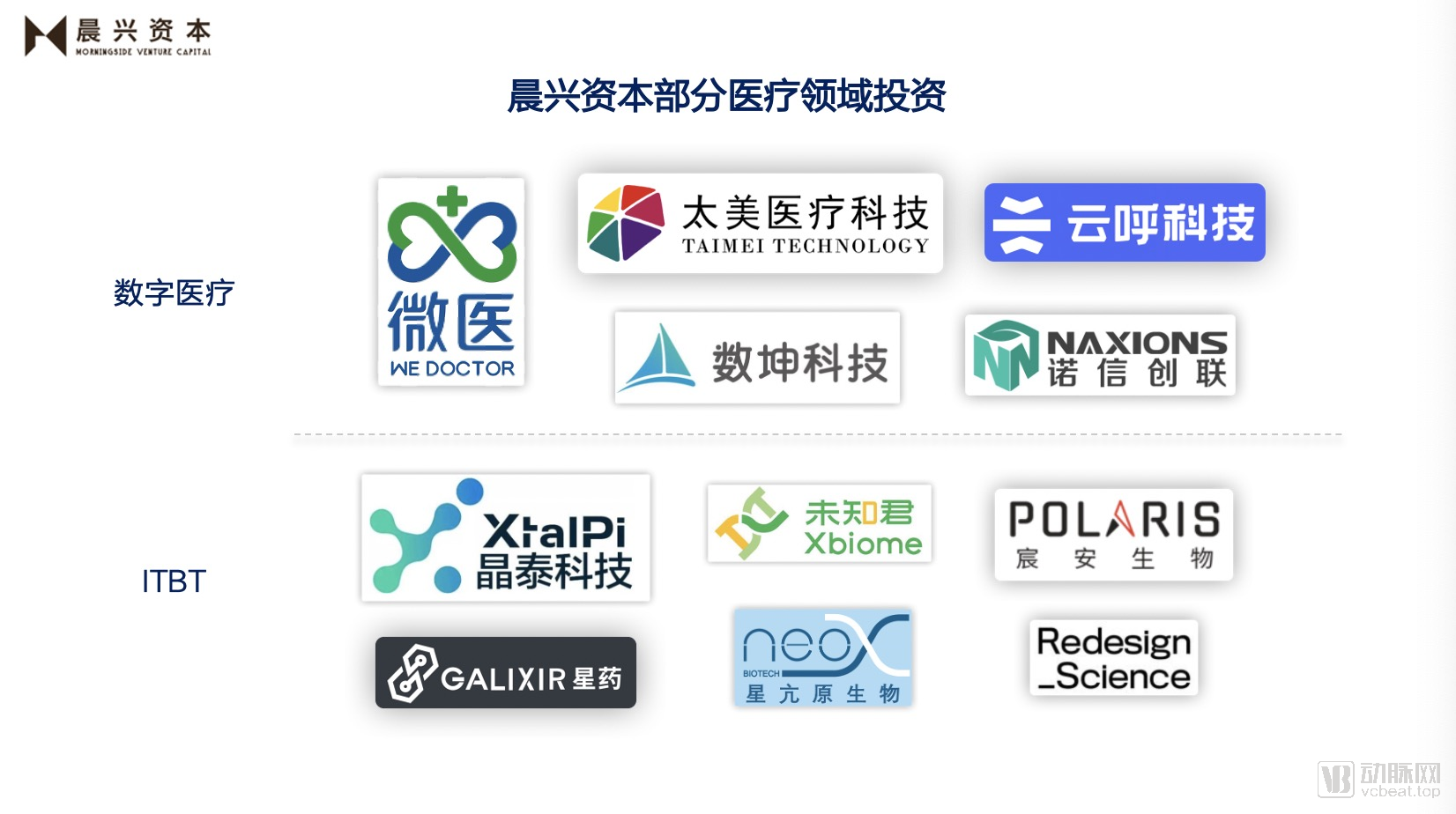
As a leading firm in the TMT sector, Morningside Ventures has invested inXiaomi, Kuaishou, Kingsoft Office, XPeng Motors, SenseTime...and other super unicorn companies. In the healthcare sector, Morningside Ventures has also begun to strategically focus its investments. Leveraging its expertise in TMT, Morningside invested early on inWeDoctor Group, and has successively expanded its presence in recent yearsTaimei Medical Technology, Shukun Technology, Yunhu Technology, Nuoxin Chuanglian, Chen'an Biologyleading companies in the field of digital healthcare. Morningside Ventures is also one of the earliest investment institutions in China to strategically position itself in the “AI-driven drug discovery” sector, having invested in companies such asXtalPi, xBiome, NeoX, Galixir, Redesign Scienceetc., while within Morningside Ventures, this field is referred to as “ITBT.”
As the first investment firm in China to propose the “ITBT” concept, how does Morningside Ventures view the development of this sector? How does it achieve precise strategic positioning within the ITBT industry? With these questions in mind, VCBeat (WeChat ID: vcbeat) conducted an exclusive interview with Jing Xutian, Vice President of Morningside Ventures.
Jing Xutian graduated from the University of Pennsylvania and previously served as a management consulting consultant at IMS Health, a U.S.-based consulting firm, where he advised leading global pharmaceutical companies and top-tier private equity firms. During his tenure in healthcare consulting, Jing identified numerous critical pain points facing Chinese healthcare enterprises that urgently needed resolution. He recognized that the integration of information technology with biotechnology and medical technology could lay a foundational basis for addressing these challenges. In 2016, Jing joined Morningside Ventures, aiming to leverage the power of information technology to help the pharmaceutical and healthcare industry accelerate the discovery of better and newer therapeutic solutions, while ensuring the orderly and efficient delivery of healthcare services.
As a venture capital firm focused on the TMT sector, Morningside Ventures approaches the biopharmaceutical industry from a perspective that differs from specialized funds dedicated to biomedical investments. TMT funds place greater emphasis on developments in information technology, particularly valuing opportunities where IT innovations can reshape industrial value chains.
Jing Xutian combined his professional background in biotechnology and work experience in medical consulting with Morningside Ventures’ investment expertise in the IT sector to propose the concept of “ITBT.” In “ITBT,”“IT” refers to information technology, and “BT” refers to biotechnology., especially biotechnology related to new drug development.
As early as 2017, Morningside Ventures recognized the development potential of the ITBT sector; in 2018, it established a dedicated investment track to provide timely financial support to strong enterprises in the ITBT field. In its subsequent strategic layout, Morningside Ventures successively invested in ITBT companies such as XtalPi, Unknown Biome, ChenAn Bio, XingKangYuan, Star Pharmaceutical Technology, and Redesign Science.
In 2017, when AI-powered medical imaging was at its peak, the ITBT sector was still in its early stages, with little consensus among investors. Jing Xutian combined his understanding of the pharmaceutical industry with the technical principles of AI and computing he had encountered at Morningside Ventures. Approaching from the perspective of IT technology development, he vaguely foresaw the sector’s immense potential for transformative change in the future.
The pharmaceutical industry is a $1.2 trillion market. Every new drug follows a certain cycle, from research and development and market launch to peak sales, patent expiration, and even replacement by newer products. Traditional investment opportunities in new drugs lie within this cycle.
In 2010, the average investment required to bring a new drug to market was $1 billion; by 2020, this figure had risen to $2 billion. In contrast, the peak sales of newly launched drugs have been declining year over year. With R&D costs continuing to climb while returns diminish, if new drug development is viewed as an investment, the average internal rate of return (IRR) has been decreasing annually.
Meanwhile, biology-related data has experienced explosive growth. The exponential decline in gene sequencing costs, the increasing throughput of various biological screening assays, and the continuous emergence of new observational techniques—such as next-generation mass spectrometry and cryo-electron microscopy—have all led to the generation of new data dimensions and a surge in data volume.
On the other hand, the cost of computing power has been decreasing year by year, deep learning algorithms continue to achieve breakthroughs, and there is a growing pool of bioinformatics talent with IT expertise.On one side, there is the continuous surge of information in new dimensions; on the other, increasingly powerful and rapid data analytics capabilities. The collision between these two forces is bound to yield novel outcomes.“Jing Xu Tian asserted.
The ITBT sector emerged against this backdrop,The two most significant impacts of ITBT on the pharmaceutical industry are as follows: first, it substantially enhances the efficiency of small-molecule novel drug discovery., by leveraging a multidisciplinary technical approach to rapidly identify the most suitable small-molecule compounds for high-potential target candidates housed in academic and research institutions—even protein targets whose structures have not yet been determined by scientists, thereby accelerating the commercial translation of human scientific achievements;No.The second category involves identifying novel therapeutic regimens through data-driven new drug discovery approaches within numerous emerging innovative treatment fields., such companies are characterized by their ability to establish analytical and interpretive capabilities for new-dimensional data and translate these insights into experimental applications.
Furthermore, Jing Xutian noted that in the current pharmaceutical industry, synergies among multiple drug products within a company’s R&D pipeline remain relatively limited, and the self-iterative pace of traditional new drug development is rather slow. Consequently, many large pharmaceutical companies expand their scale by acquiring innovative drug projects. For these large firms, economies of scale are truly realized in clinical trials, regulatory approval, and market access for sales, whereas the “winner-takes-all” effect is not pronounced on the R&D side.
However, ITBT companies have entered the field with new drug R&D engines.“IT” can support “BT” in independently iterating to develop better drugs., with continuous molecular prediction and activity validation,Self-iterating algorithmic engine enables faster and more accurate identification of candidate drugs, therefore, from a longer-term perspective, perhaps 10–20 years,New-generation pharmaceutical companies will exhibit more pronounced head-scale effects in drug discovery.。
“A company’s thorough understanding of the underlying technical principles is paramount and essential; secondly, they must possess the ability to deconstruct problems, clearly identifying which issues need to be addressed, what methods can be employed to solve them, and what their most effective approach is.” This was Jing Xutian’s response when asked how Morningside Ventures identifies promising ITBT projects.
“The founding team of any ITBT enterprise we invest in must consist of top-tier talent in the field. In addition to having high expectations for the team’s technical capabilities, Morningside Ventures also requires that the company possess a deep understanding of the industry, knowing how to use the ‘hammer’ (IT/AI) to find the right ‘nail.’ ITBT is a cross-disciplinary endeavor, and the founding team must have strong learning abilities, as well as sufficient patience and humility to accumulate knowledge and achieve compounding returns,” added Jing Xutian.
When Morningside Ventures identifies outstanding entrepreneurs in this field, it invests without hesitation. Jing Xutian first met Chen Hang, the founder of NeoX, just before heading to the airport at the end of a business trip. “Dr. Chen shared their vision of leveraging computational chemistry and artificial intelligence for immunotherapy R&D. This was in 2018, when applying IT/AI methods to new drug development was not yet a market consensus, but it happened to be precisely the issue I had been contemplating. Thus, we hit it off immediately. After our meeting, I began preparing the investment committee materials while waiting for my flight at the airport,” recalled Jing Xutian. When Morningside Ventures invested in XtalPi, the Chinese New Year holiday was approaching. Due to its strong conviction in XtalPi, the Morningside team headed straight to Shenzhen to meet with the XtalPi team upon returning from a business trip in Boston. Shortly after the Spring Festival, during a period when the company was not actively raising funds, Morningside completed an additional round of investment in the company.
Morningside Ventures also demonstrates long-term patience and a willingness to continue increasing its investments in selected ITBT portfolio companies. In subsequent financing rounds for several ITBT companies backed by Morningside, such as Xing Kang Yuan and Unknown Biotech, Morningside participated with oversubscribed allocations. Jing Xutian stated, “In sectors where we hold strong conviction, even if they have not yet gained broad market recognition, we are willing to double down on our bets as companies validate their milestone achievements, helping them move toward a clearer and more promising future in the marketplace.”
Morningside Ventures believes that the ITBT sector is a marathon, but once successful, it will make enormous contributions to human society. The road is arduous and long; in this challenging journey, investors need sufficient patience and conviction, while entrepreneurs require a long-term vision and the ability to delay gratification. We believe that in the next 10 to 20 years, humanity will discover the optimal pathway for systematic new drug discovery, greatly invigorating the pharmaceutical industry and providing the most robust support for disease recovery and life extension.