

MDLIVE Files for IPO: A Pioneer in U.S. Telehealth with 40 Million Users and Over $100M Raised

MDLive
Telemedicine Platform Operator
How Should Internet Healthcare Companies Develop? Currently, there is no mature development model for reference, and relevant policies are still being introduced and refined. Most internet healthcare companies remain in an exploratory phase. Although there are slight differences in the policy environments at home and abroad, the development history of MDLive, one of the leading telemedicine companies in the United States, still offers valuable insights for the development of domestic internet healthcare companies.
MDLIVE, founded in 2006, is a provider dedicated to delivering telehealth services. Its service delivery model is largely similar to that in China, facilitating patient consultations via voice, video, and email. The company offers 24/7 services covering medical treatment, dermatological diagnosis, psychotherapy, and psychiatric care.
With over 40 million paying members, this figure is particularly impressive relative to the U.S. population of more than 300 million. How did MDLIVE grow from its origins in Sunrise, Florida, into a nationwide telehealth provider?
Capital has shaped the development of MDLIVE, and the story of former Apple CEO John Sculley renaming the company serves as a telling footnote. Today’s renowned MDLIVE was known as MDLIVECARE in early 2011. As an investor, Sculley called founder Randy Parker one day in 2011 and demanded that “Care” be removed from the company name. Parker, who was skiing atop a mountain in Colorado at the time, reluctantly agreed. By the time he reached the bottom of the slope, Sculley called again to inform him that he had already spent $200,000 to acquire the domain name MDLIVE.COM.
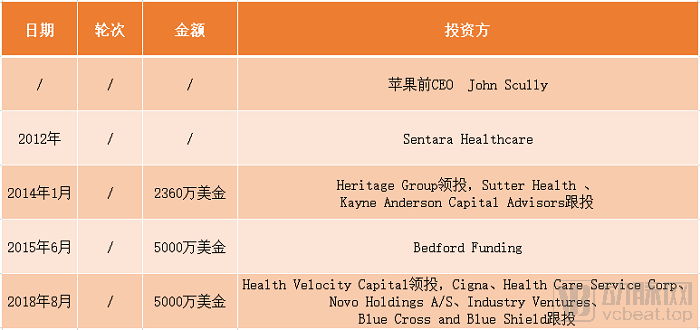
Capital support has enabled MDLIVE to develop very smoothly. In addition to the financing currently disclosed, MDLIVE also received other investments in its early stages, such as personal investment from former Apple CEO John Sculley, and inIn 2012, it partnered with Sentara Healthcare, a top-tier U.S. healthcare system, which also received the initial equity stake.However, it remains unclear whether the transaction was conducted in cash or through equivalent services.
What is certain is that through this transaction, MDLIVE has gained access to substantial resources from Sentara Healthcare. Established in 1888, the Sentara system comprises 10 acute-care hospitals, as well as various advanced imaging centers, assisted living facilities, home health and hospice agencies, and up to 100 points of care.Sentara boasts as many as 3,680 medical professionals and 618 healthcare workers.At that time, MDLIVE had already established partnerships with numerous pharmacies in China, enabling users to obtain medications from offline pharmacies using electronic prescriptions. Randy Parker once stated, “Our partnership with Sentara allows us to create a model for remote access to healthcare systems across China in the future.”
MDLive is also continuously expanding its customer base by forging partnerships with insurance companies, employee assistance programs (EAPs), and health organizations. For instance, in April 2013, it partnered with Cigna, the fifth-largest insurer in the United States, to provide online consultation services to select users. This collaboration significantly reduced the wait time for what were previously in-person visits to just 11 minutes and enabled access to the service across multiple devices. At the time, Cigna announced that it would fully roll out MDLive’s services in 2014.
Capital optimistic about the development of telemedicine, inIn January 2014, it received an injection of $23.6 million.The financing round was led by Heritage Group, a venture capital firm focused on the healthcare sector, with participation from Sutter Health and Kayne Anderson Capital Advisors. MDLIVE stated that the funds would be primarily used to build a robust cloud-based healthcare system and to launch a second medical opinion service for patients.
After securing the funding,MDLIVE rapidly acquired Breakthrough Behavioral in November of the same year.This acquisition enabled MDLIVE to absorb its competitor, thereby solidifying its market position. In the process, MDLIVE gained access to the acquired company’s original network of healthcare providers and robust clinical tools. The deal also brought under MDLIVE’s umbrella coverage in up to 10 states and a membership base of as many as 5 million individuals.
The development of internet healthcare is essential to the layout of pharmacies. However, MDLIVE itself is not adept at this; theyChose to partner with Walgreens, the largest retail pharmacy chain in the United States. The two parties reached an initial cooperation agreement in December 2014., allowing Walgreens users to be matched with MDLIVE physicians via mobile devices, initially limited to California and Michigan, with plans to extend the service to Illinois residents by the end of 2015. In 2015, the partnership accelerated, as Walgreens directed nearly 2 million daily online visitors to MDLIVE. That November, the collaboration expanded to 25 U.S. states, enabling MDLIVE to enter the national market.
MDLIVE’s offline pharmacy network and its continuously expanding base of commercial clients have made it a favorite among investors.In June 2015, MDLIVE completed a new round of financing, with the $50 million in funding provided by Bedford Funding.Its primary purpose is to help MDLIVE expand its market more rapidly and reach a broader consumer base.
As the market continues to expand, in order to fill the talent gap,In March 2016, MDLIVE partnered with the Centura Health system.This collaboration primarily aims to enable patients in Colorado and Kansas to access physician-provided services online.Centura Health System itself has more than 6,000 affiliated physicians and operates 17 hospitals and 14 mobile surgical centers., the partnership has also injected fresh talent into MDLIVE, bolstering its medical and nursing resources.
MDLive, which is developing steadily, inIn August 2018, it secured a new round of $50 million in financing.This round of financing was led by Health Velocity Capital, with participation from Cigna, Health Care Service Corp, Novo Holdings A/S, Industry Ventures, and Blue Cross and Blue Shield. MDLIVE, which has been maintaining strong momentum, inIt was announced in August 2020 that the plan is to achieve a public listing early next year.
In the U.S. market, Teladoc, which went public in 2015, is currently the only listed telemedicine company. The current CEO of MDLIVE appears to be well aware of the gap between the two companies, pointing out that,Teladoc’s 2020 revenue is expected to reach $990 million, while MDLIVE’s 2020 revenue is projected to hit $120 million.Although a certain gap remains between the two parties, MDLIVE does not seem to be without opportunities.
As a telemedicine service provider, the greatest driving force stems from the inability of offline services to meet people’s growing demand for personalized care. MDLIVE is clearly well aware of this. Throughout its development, while continuously collaborating with overburdened healthcare systems and insurance companies, it has also actively engaged in social initiatives, providing services to those in need. By offering free services, MDLIVE not only shapes its corporate image but also reaches more potential users.
Three cases are available for reference in the context of social incidents.
One initiative is to provide assistance to users affected by natural disasters. In August 2017, the United States was hit by Hurricane Harvey, the strongest hurricane since 2005, causing $180 billion in property damage. During the period when Hurricane Harvey made landfall (August 25 to September 25), MDLIVE announced that it would offer free consultation services to affected areas, allowing users in Texas and Louisiana’s Gulf Coast cities to access telephone or video consultations at no cost. This was not the first time MDLIVE had provided such services; it had offered similar support during Hurricane Matthew in 2016.
Second, in February 2018, a mass shooting occurred at Marjory Stoneman Douglas High School in Florida, United States, leaving 17 people dead and 14 injured. This incident had a profound impact on local families and students. In response, MDLIVE immediately announced the provision of free online behavioral health counseling services to local students, aiming to help affected individuals cope with grief and fear. With the support of MDLIVE’s behavioral health experts, the psychological and behavioral well-being of the students showed significant improvement.
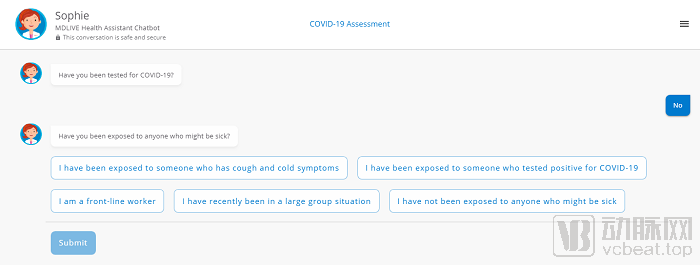
Third, during this year’s COVID-19 pandemic, MDLIVE launched free online assessment reports, allowing users to generate corresponding evaluation results by selecting from a set of options. Although modest, this initiative helped bolster its popularity. Moreover, telemedicine platforms experienced rapid growth during the pandemic. MDLIVE’s response to the public health emergency offers valuable lessons for companies in China. Its ability to provide the aforementioned healthcare and behavioral health treatment services is closely tied to MDLIVE’s own operational strengths.
Expand the number of board-certified physicians, increase indications, and continuously upgrade service tools
As a core component of MDLIVE’s strength, its proprietary physician network is of significant importance. Through collaborations with healthcare systems, MDLIVE continuously expands its access to medical resources and injects fresh talent into its provider base. This process has been ongoing; while the company’s official website allows physicians to register, MDLIVE maintains relatively stringent eligibility criteria for its physician network.
Most of its physicians have over 15 years of experience, andMDLive adopts NCQA and URAC accreditation for physicians.Simply put, holding a medical license does not necessarily mean one is board-certified, but being board-certified invariably requires holding a medical license. Board certification raises the entry threshold for physicians and provides users with higher-quality services. In addition to board certification,MDLive also provides training from the American Telemedicine Association for its online physicians,Ensure the correctness of the operation.
In the process of providing remote treatment services, MDLIVE has achieved mutual benefits for users, employers, payers, hospitals, physician practice groups, and related care organizations.Through systems compliant with HIPAA and PHI protocols, physicians can collect and share clinical data from patients’ medical records, laboratory results, and in-home biometric devices to conduct real-time risk assessments, health consultations, diagnoses, and treatments.
While continuously expanding its roster of physicians and therapists, MDLIVE has also broadened its range of indications, evolving from initial medical consultations to now covering various fields such as medical diagnosis, dermatology, and behavioral health. As early asFollowing the acquisition of Breakthrough Behavioral in 2014, it expanded its capabilities in mental and behavioral health care. In May 2016, it announced the addition of telemedicine treatment for urinary tract infections (UTIs) targeting female patients aged 18 to 65.
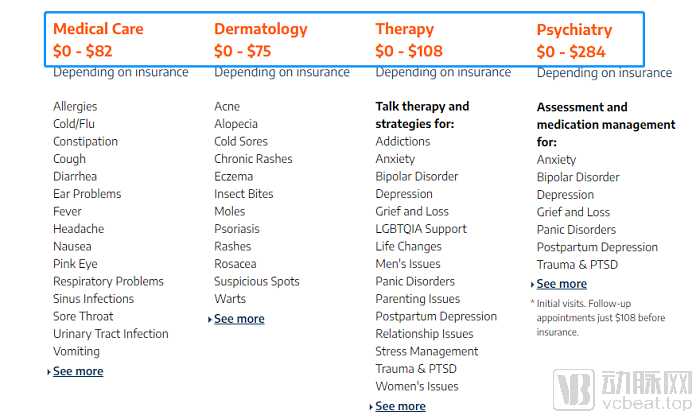
In November 2017, MDLIVE launched dermatology-related services through a partnership with Iagnosis, a company deeply entrenched in the field of dermatology.Users simply need to take photos of affected areas, such as their hair, skin, or nails, to receive a diagnosis and treatment plan through Iagnosis’s network of dermatologists. By continuously expanding its range of indications, MDLive now offers treatment for more than 50 conditions. Treatment costs vary by condition but are ultimately determined by the user’s insurance coverage. Furthermore, MDLive’s pricing is more competitive compared to in-person appointments with doctors or therapists.
In exploring indications, MDLive is also engaging in critical reflection. For instance, what types of medical conditions are suitable for internet-based telemedicine? Does the existence of internet-based telemedicine exacerbate user anxiety? How can user privacy be better protected?
MDLive primarily targets non-emergency conditions, while also helping users who require emergency care to be referred to the appropriate treatment facilities during the diagnostic process. Some users exhibit excessive anxiety over minor pain due to health-related concerns. Although engaging with these individuals could generate higher revenue, it is extremely challenging to accurately identify this population and provide them with behavioral health treatment. MDLive hopes to address these issues in the future.
In April 2017, MDLIVE faced a class-action lawsuit alleging that it had disclosed patient information to unauthorized third parties. However, MDLIVE subsequently verified the security of its data, leading to the dismissal of the lawsuit. In early June, the plaintiffs voluntarily dismissed the case. The protection of private data remains a critical issue for practitioners in the internet healthcare industry to consider.
To better serve patients, MDLIVE has also attempted to upgrade its corresponding tools. Initially, MDLIVE integrated Skype, Microsoft’s video application for enterprise users, and Microsoft subsequently enabled support for the Surface Pro tablet and Windows Phone.
In 2016, MDLIVE launched an online behavioral health assessment tool., users only need to answer a series of questions. Within two to three minutes, evaluators can quickly gain insight into the user’s potential conditions, such as depression, anxiety, or stress, as well as their behavioral health status. This serves as a good starting point for individuals seeking to determine whether they should consult a therapist.
In December 2017, MDLIVE launched the intelligent chatbot Sophie., with the initial aim of simplifying the registration process for users through chat-based interactions, thereby enhancing user engagement and driving conversions. In later stages, they also plan to develop it into a fully-featured personal health assistant.In February 2019, MDLIVE announced the availability of asynchronous virtual visits.Users need only provide a text-based symptom log, and a physician will deliver an email treatment plan within two hours. For MDLive, this enhances convenience and quality of care while being cost-effective.
Certainly, during the patient consultation process, MDLive also records and preserves the entire session for future reference. As services continue to be integrated, MDLive’s user base has been steadily growing, currently reaching as high as 40 million users.
MDLIVE has undergone frequent changes in its board composition due to continuous fundraising efforts.Currently, the board members are primarily from the investor side, and the founder of MDLIVE is not on the board.Charles S. Jones, Chairman of the Board from Bedford Funding, focuses primarily on operational management and was named one of the top CEOs by Canada’s National Post in 2005.

Chairman of the Board and CEO Charles S. Jones
Board member Tiba Aynechi, from Novo Ventures, specializes in life sciences research and brings extensive experience in cross-regional and cross-border mergers and acquisitions as well as financing transactions. Martin Felsenthal, from Health Velocity Capital, has long been dedicated to the fields of innovative healthcare software and services. Howard Kern, CEO of Sentara, will undoubtedly facilitate deeper collaboration between MDLIVE and its parent group. Rock Morphis serves as General Manager of Heritage Group.
What makes Michelle Teichman particularly notable is that, according to disclosed information, she clearly does not come from the investor side. Prior to joining MDLIVE’s board of directors, she spent 16 years at PeopleFluent, a company whose flagship product is a SaaS-based talent acquisition management application. Having been deeply involved in this area, she was likely brought on board for her expertise in recruitment.
Setting aside the board members, the more critical factor may be the core executive team, but the official website does not list a clear roster. A review of relevant information (with the earliest personnel appointment and dismissal news dating back to October 2012) reveals that ifIf the CEO’s tenure is regarded as a time marker, then personnel changes basically occurred around the time when the new CEO took office., with clearly defined time points:
I. Around 2014, MDLIVE founder Randy Parker recruited talent and expanded his team; II. In November 2016, Scott Decker replaced the former CEO; III. In January 2018, new CEO Rich Berner assumed office; IV. In March 2020, Charles S. Jones became the new CEO.
One of the more interesting segments was,Almost every new CEO chooses to appoint a new Chief Operating Officer.This may stem from a divergence in operational management philosophies between the new CEO and the former COO. The former Chief Operating Officer is typically unable to escape the fate of being laid off.
Randy Parker, the first CEO, is the founder of MDLIVE., he graduated from New York University with a major in marketing management. He has over 30 years of experience in healthcare and related fields. During his tenure, he made strategic talent placements in sales and operations. In October 2012, he appointed Brian Dudzik as Vice President of Sales, responsible for business development in health plans and hospital payment solutions.
Before securing its first publicly disclosed round of financing, he successively appointed several executives to lead sales and operations between June and December 2013. For instance, Gregory Strauss was appointed Vice President of Enterprise Sales Solutions, Leslie Courtney as Senior Vice President, and Susan Mihojevich as Vice President of Partner Development. Notably, he initially appointed Gregory Swayne as Chief Operating Officer (COO), but soon removed him from the position and replaced him with Malinda McFarlane. This remains the only instance of a COO being dismissed during the tenure of the original CEO.
The second round of personnel appointments began in May 2016.At this time, MDLIVE is actively expanding its new business initiatives, such as launching telehealth services for UTIs (urinary tract infections). In May, MDLIVE appointed Larry Gleit as General Manager of Behavioral Health and Tom Barone as the new Chief Operating Officer. In July, it appointed Sylvan Waller as Chief Medical Officer and Dr. Sanjay Patil as Executive Vice President and General Manager of Health System Strategic Transformation.
The climax of this round of personnel changes isIn November 2016, Scott Decker was appointed as the new CEO.The former CEO assumed the responsibilities of Chief Business Development Officer, and his public appearances subsequently became rare. Regarding Scott Decker, it is worth noting that he led the startup HealthSparq to grow into a major company serving 70 health plans and 70 million Americans over a four-year period. Former CEO Randy Parker stated, “We believe he is the right person to lead MDLIVE into its next phase.” During his tenure, the only notable appointment announced was in 2017, when Dr. Richard Gilbert was named the new President of the Medical Group.
The third round of personnel changes began with the appointment of a new CEO.In January 2018, Rich Berner assumed the role of new CEO.He has 13 years of experience in leveraging technology to improve and manage population health while reducing costs. In February, MDLIVE appointed Dr. Lyle Berkowitz as Chief Medical Officer and Vice President. In April, Michael Farrell was appointed Vice President and General Manager of Hospital and Health System Business. A year later, the original Chief Operating Officer departed, and MDLIVE appointed Dan Monahan as Chief Financial Officer and Chief Operating Officer. In May, Mindy Heintskill was appointed Chief Marketing Officer, and Kristen Lalowski was appointed Chief Product Officer.
The fourth round of personnel changes was closely linked to the progression of the pandemic.First, in January 2020, they appointed Cynthia McIntyre as the new Chief Revenue Officer. Subsequently, MDLIVE announced its decision to appoint a new executive team to combat COVID-19.New CEO Charles S. Jones Takes the Helm.Prior to this, he had served as Chairman of the Board of MDLIVE for three years. Joining him in their respective appointments were Chief Financial Officer Christopher Shirley and Chief Operating Officer Andy Copilevitz. In June, they appointed Cynthia Zelis as the new Chief Medical Officer.
In the changes to the executive team, rapid adjustments and follow-through are evident. Almost every new CEO appoints their own corresponding team upon taking office to better address the challenges MDLIVE faces in its development. The position of Chief Operating Officer appears to be one that each incoming CEO consistently considers changing. How to optimize operations seems to be an ongoing exploration for this long-established company.
During the collaboration between MDLIVE and Cigna, Cigna, the fifth-largest insurer in the United States, conducted a study that performed a comparative analysis of 20,000 Cigna members who used MDLIVE and 20,000 who did not. The results showed:
Total Healthcare Costs: Total healthcare costs for telemedicine users were 17% lower than those for non-telemedicine users.
Emergency Department Visits: Compared with non-telehealth users, telehealth users had a net 36% reduction in emergency department utilization per 1,000 individuals.
Generic Prescriptions: Telehealth users had a 45% higher rate of non-generic drug use compared to non-telehealth users.
In terms of customer satisfaction, MDLIVE also received a high rating of 81.1. In fact, as telemedicine is being promoted, the entire healthcare industry is gradually shifting from passive diagnosis and treatment to proactive health management.
As in China, relevant policies in the United States are also influencing the development of telemedicine.
In 2014, the NIH estimated that 43.6 million adults aged 18 and older in the United States had some form of mental illness.“The Affordable Care Act” has also provided high-quality healthcare services to the population since 2014, including expanding coverage for mental health and substance use disorder services, requiring market entities to cover these services as part of the essential health benefits category under the “Healthcare Law.”
Further restrictions on telemedicine were lifted in 2017.Regulatory, payment, and supplier environments have all become better aligned with consumer demands. The new CMS initiative in the United States is also supporting the development of telemedicine, enhancing healthcare accessibility while improving quality and reducing costs.
In 2020, as the COVID-19 pandemic progressed, private health insurance companies further adapted their policies to allow physicians to receive reimbursement for telemedicine services.At the federal level, the Centers for Medicare & Medicaid Services has removed certain barriers to telehealth access, including reimbursement for home-based telehealth visits.However, barriers persist across states; currently, only eight states have waived licensing requirements for physicians to practice in multiple jurisdictions.
Although policies remain imperfect, the development of telemedicine has become an irreversible trend. After all, in the 21st century, with such advanced technology, it is truly paradoxical that consulting a physician remains so inconvenient and expensive.