

Ali Health Refocuses on Medical Services with Rebranding to 'YiLu' App

AliHealth
Medical and Health Services Network Service Provider
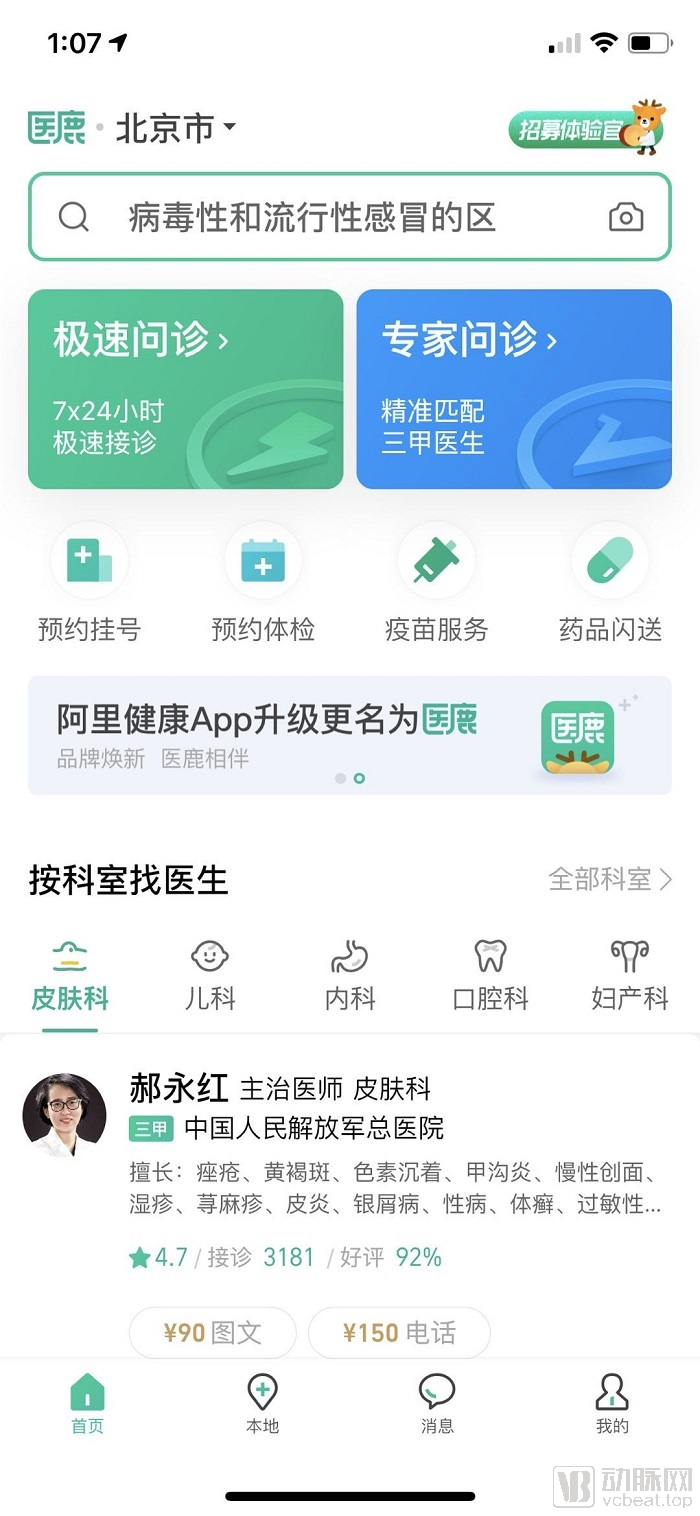
This September, users of the AliHealth app have gradually noticed its upgrade and rebranding. Launched under the name “Yilu” (a homophone for “all the way healthy”), it aims to provide personalized health services to users.Compared to the previous version, the new “Yilu” App features a cleaner and more focused interface, consolidating medical services onto the homepage.The homepage header features a medical and health search bar. When users search for symptoms or health-related needs, it will display relevant professional health knowledge, specialist physicians proficient in diagnosing and treating such conditions, and nearby hospital departments available for appointment registration.
This renaming is by no means a simple rebranding upgrade; behind the name change lies an implicit reflection of the post-pandemic era,AliHealth’s strategy to channel the momentum accumulated in the medical services sector into focused efforts through new platforms.
In the pharmaceutical industry, e-commerce models represented by AliHealth have experienced rapid growth in recent years. The abolition of the Class A, B, and C certification requirements has lowered the entry barrier for online pharmaceutical sales, while ongoing policy initiatives—such as the inclusion of internet-based medical services in national health insurance coverage and measures to facilitate the outflow of prescriptions from hospitals—are further driving the development of the pharmaceutical e-commerce model.
Looking at AliHealth’s business overall, the pharmaceutical e-commerce segment has assumed the role of a cash cow. On this foundation, it is only natural for AliHealth to deepen its service offerings and intensify its efforts in medical services. Thus,We have observed the latest moves by this internet giant—AliHealth began to concentrate its superior forces and resources on the “medical” end, further strengthening its efforts by iterating its long-operated app into the “Yilu” app, in order to meet user demands under the new normal of epidemic prevention and control.
Since the onset of the COVID-19 pandemic in 2020, AliHealth has taken frequent and significant actions. As early as the initial stages of the outbreak, to prevent cross-infection associated with in-person medical visits, many hospitals launched online consultation services. AliHealth actively participated in this initiative.As early as the evening of January 24, AliHealth launched a free online consultation service for residents in Hubei Province. Within just 24 hours of its launch, the service’s landing page recorded nearly 400,000 visitor accesses.Among them, the respiratory department, which is the most "in-demand," sees some physicians handling over 200 patient consultations per day on average. To alleviate the pressure on doctors, AliHealth subsequently launched a recruitment campaign for physicians through platforms such as Alipay and Mobile Taobao.
In March, the Global Multi-disciplinary COVID-19 Consultation (GMCC) platform, initiated by the Jack Ma Foundation, Alibaba Foundation, and AliHealth, was launched.As the primary platform for healthcare professionals to exchange anti-epidemic experiences and share treatment protocols during the pandemic, it has attracted nearly 10,000 doctors from approximately 120 countries and regions to join the online public welfare initiative against COVID-19. By July, its cumulative page views had reached tens of millions. Through the GMCC platform, AliHealth continues to aggregate top-tier medical expertise from around the world.
In May, AliHealth partnered with Xianghubao to launch the Renowned Doctors Channel.Zhang Wenhong, Zhi Xiuyi, Li Shoujun, and other renowned medical experts delivered live online sessions to disseminate health science knowledge, engaging with up to one million users. This platform has thus become a new stage for physicians to influence the public.
AliHealth is clearly not content with the status quo; instead, it has chosen to step out of its comfort zone in pharmaceutical sales and distribution, gradually ramping up its efforts in medical services, continuously exploring and experimenting as it seeks to tackle this formidable challenge.
The pandemic served merely as a catalyst for AliHealth’s push into medical services. A confluence of factors—including policy, the consumer environment, and user demand—is driving the expansion of AliHealth’s medical service layout.
China’s healthcare sector faces numerous challenges, including population aging, urbanization, and the high prevalence of chronic diseases. The traditional hospital- and disease-centered medical service model is clearly inadequate to meet people’s health needs. How to efficiently utilize physician resources has long been an area of exploration. As early as 2014, the Government Work Report first introduced the concept of a “tiered diagnosis and treatment system,” calling for the improvement of this system, strengthening the training of general practitioners, promoting multi-site practice by physicians, and enabling the public to access high-quality medical services closer to home.
Born from Western experience, family doctors serve as gatekeepers of residents' health, laying the foundation for implementing initial consultations at the primary care level and tiered diagnosis and treatment.Online consultations have, to a certain extent, helped alleviate the excessive burden on offline family doctors. Users can now address most of their health concerns without leaving home, leveraging the convenience of internet-based healthcare services.
Driven by the “Healthy China” initiative, public awareness of health has increased. In August this year, the Office of the Healthy China Action Promotion Committee released the 2020 Work Plan for Advancing the Healthy China Action, which outlined numerous measures to improve residents’ physical health and even extended to mental health. The plan calls for “pilot programs in selected regions to explore the use of internet technologies in delivering psychological services, such as depression prevention and treatment.” Both the heightened emphasis on health and the planning for tiered diagnosis and treatment require companies dedicated to “Internet + Healthcare,” such as AliHealth, to provide appropriate services that meet current demands.
The COVID-19 pandemic has largely driven the introduction of internet healthcare policies and promoted the development of internet healthcare. Taking internet hospitals as an example,In the first five months of 2020, the number of internet hospitals established already approached the total built in 2019, and this figure continues to rise.
In February this year, the National Health Commission successively issued the “Notice on Strengthening Information Technology Support for the Prevention and Control of Novel Coronavirus Pneumonia” and the “Notice on Providing Internet-based Diagnosis, Treatment, and Consultation Services during Epidemic Prevention and Control.”All parties are required to vigorously promote internet-based medical consultation services, fully demonstrating the high efficiency and low risk of internet platforms.
The integration of internet-based medical services into health insurance reimbursement has also been rapidly advanced during the pandemic. In 2019, the National Healthcare Security Administration issued the "Guiding Opinions on Improving Price and Health Insurance Reimbursement Policies for 'Internet+' Medical Services," establishing an overall framework for incorporating internet-based medical care into health insurance coverage. However, implementation varied across regions. In March, when the epidemic situation was severe, the National Healthcare Security Administration and the National Health Commission jointly released the "Guiding Opinions on Promoting 'Internet+' Health Insurance Services During the Prevention and Control of COVID-19."Explicitly stipulate that the costs of eligible “Internet+” medical services shall be included in the scope of medical insurance coverage.
These measures are not temporary. In late June, the General Office of the National Health Commission issued the "Notice on Doing a Good Job in Information Technology Support for Normalized Epidemic Prevention and Control,"Clearly promote the experience of online services during the pandemic, and emphasize the vigorous development of “Internet + Healthcare”.
Meanwhile, internet healthcare platforms within the industry have taken various actions. Among the listedTaking Ping An Good Doctor as an example, it rapidly integrated and enabled medical insurance services during the pandemic.By mid-August, Ping An Good Doctor had launched 14 internet hospital projects in partnership with offline hospitals. Among these, the internet hospitals in Hubei, Dongguan, Yinchuan, and other regions have been integrated into local medical insurance payment systems, providing residents with more convenient, efficient, and secure online medical services.JD Health even launched “JD Family Doctor” in August this year,It aims to supplement the service capacity of family doctors in the previous grassroots community model, addressing weaknesses while enhancing the efficiency of medical services.
Policy support is boosting the development of internet healthcare, and amidst frequent industry movements, AliHealth’s launch of the Yilu APP is clearly a strategic move in line with the trend.
but ultimately chose to focus on healthcare services,"In fact, it still depends on the surge in demand for online consultations during the pandemic, as well as the growing public acceptance of internet healthcare as epidemic prevention and control measures become normalized."Data reveal changes in consultation volumes during the pandemic.
According to Ping An Good Doctor's second-quarter financial report, during the peak of the pandemic,The number of registered users on the Ping An Good Doctor app is 10 times that of the pre-pandemic level, while the average daily number of consultations by new users is nine times higher than before the pandemic.JD Health has also previously released its user traffic data during the pandemic. JD Health launched its online consultation platform in 2017, and in January 2020, the platform recorded over 60,000 consultations in a single day. As the pandemic evolved,JD Health launched free consultation services across all specialties, with daily consultations exceeding 120,000.
As can be seen, the demand for online consultations surged dramatically during the pandemic. Meanwhile, under the new normal of epidemic prevention and control, users have begun to accept and recognize internet-based medical services. Taking AliHealth as an example,As early as the first day of the Lunar New Year, free clinic services targeted at Hubei Province were launched; within the first 24 hours, the cumulative number of unique visitors to the free clinic campaign page approached 400,000., undoubtedly also a full demonstration of the pandemic’s catalytic effect on the demand for online medical services.
One can only imagine the pressure faced by physicians during this process. In fact, during the first 24-hour online free clinic event, each physician handled an average of 114 consultations. In the busiest department, Respiratory Medicine, some physicians saw more than 200 patients on average. In light of this, AliHealth has intensified its efforts in medical services.Shift from a hospital-centric service model to a patient-centric service model., appears to be particularly important.
Behind the Yilu app lies AliHealth’s strength in medical services.
According to the "2020 Internet Doctor Ecosystem Report" released by AliHealth in August 2020,There are now 60,000 physicians active on the AliHealth Internet Hospital, covering all traditional medical specialties and spanning three generations of practitioners—senior, mid-career, and junior—with those born in the 1980s accounting for nearly 50%. These physicians hold an average educational attainment of a master’s degree and have 9–10 years of clinical experience.Physicians from 31 provinces, municipalities, and autonomous regions across China participated, with those from Guangdong, Zhejiang, Beijing, Shandong, and Jiangsu showing the most enthusiasm in joining the network.
The GMCC online academic exchange platform, the renowned physician channel launched through the collaboration between AliHealth and Xianghubao, and other initiatives all signify AliHealth’s substantial accumulation of medical resources. For AliHealth, it also possesses operational advantages, whileA physician’s operational capability is a true reflection of their core competitiveness.
AliHealth had already made numerous attempts during the pandemic, such as offering nucleic acid test appointment services and features like “medicine delivery without leaving home” and “express medication delivery.” With the launch of the Yilu app, users will experience even more functionalities. The new Yilu platform is centered around user needs. For example,Typically, daily searches are plagued by issues such as excessive advertising and inconsistent content quality. Yilu addresses these challenges by placing the search bar at the top of its new app interface, with health-related results powered by Quark Search’s intelligent information aggregation.
In addition to online consultations and intelligent search, Yilu also offersHealth Checkup & Vaccine Appointment, Express Medication Delivery...and other innovative internet-based healthcare services. Clearly, AliHealth’s robust capability in resource integration has enabledIt can integrate with numerous business segments such as Taobao, Alipay, UC, and Quark, ultimately leveraging AliHealth’s robust physician resources to fully capitalize on the advantages of Yilu (Medical Deer) and deliver “user-centric” medical services.