

GenePlus Files IPO Prospectus: Delivering an Integrated NGS Solution for Hospitals with Proprietary Sequencers

Gene+
Tumor Gene Testing Service Provider
In early 2015, the United States launched the Precision Medicine Initiative. This move sent shockwaves through the industry, propelling the rapid advancement of precision medicine, exemplified by next-generation sequencing (NGS) testing.
As one of the first precision medicine companies established in China amid the surge in the sector, Gene+ has focused on oncology genetic testing since April 2015, offering tumor NGS testing services with liquid biopsy ctDNA and large-panel assays as its entry points.
Dr. Yi Xin and Dr. Yang Ling, the two core founders of Gene+, have been deeply engaged in China’s genetic testing sector for many years, witnessing and participating throughout the entire development of the domestic NGS industry—from technology and product development to market promotion. Dr. Yi Xin is well-versed in scientific research and technological R&D in genomic medicine and translational medicine, as well as the application of high-throughput sequencing technologies in precision oncology. With over a decade of experience in R&D and clinical laboratory testing in the field of genetic health, Dr. Yang Ling has previously served as the head of BGI Health Division and possesses extensive expertise in clinical laboratory operations and corporate management.
“Oncology represents the most promising and largest market segment for genetic testing.” Dr. Yang Ling, President of Gene+, made this statement when discussing strategies for sector selection. Following the introduction of non-invasive prenatal testing (NIPT), which paved the way for the clinical application of next-generation sequencing (NGS) technology, oncology has emerged as another high-potential sector within this field, serving as an incubator for numerous leading companies and commercial opportunities. This was one of the key motivations behind Yi Xin and Dr. Yang Ling’s establishment of Gene+, with a focus on NGS-based oncology testing.
Over the past five years since its establishment, Gene+ has leveraged its high-throughput sequencing-based genetic testing platform and oncology big data service platform to build a comprehensive chain for cancer prevention and control. The company has developed four core business pillars: clinical testing, medical devices, technological collaborations, and early cancer screening. Its oncology genetic testing database has surpassed 170,000 records, and its clinical oncology testing products and services have been deployed in nearly 30 provinces and municipalities across China, providing professional services to more than 100,000 cancer patients.
In 2016, the company decided to establish a presence in the domestic genetic testing platform sector, initiating the development and regulatory submission of its own branded Chinese-made sequencers along with supporting reagents and software.
With foreign sequencers dominating the market and holding the vast majority of its share, why did Gene+ take the risk of choosing domestically produced sequencers? Dr. Yi Xin, CEO of Gene+, stated, “From a technical perspective, although domestically produced sequencers face significant technical challenges and require substantial cost investments, we are optimistic about their immense potential. Possessing core technologies will enable us to secure a favorable position in future competition. From a business standpoint, once the sequencer obtains registration certification from the National Medical Products Administration (NMPA), Gene+ will have a complete suite of equipment for NGS testing, thereby facilitating better collaboration with hospitals.”
Gene+ has developed two sequencers, the Gene+Seq-2000 and Gene+Seq-200, which are better suited for application scenarios involving tumor liquid biopsy products.
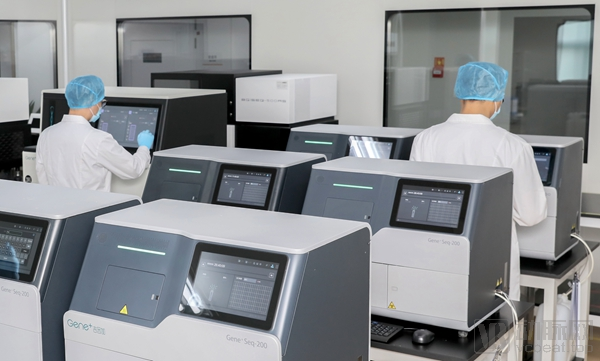
Gene+’s proprietary sequencers, Gene+Seq-2000 and Gene+Seq-200
Dr. Yi Xin stated, “The abundance of tumor gene mutations in blood is extremely low, imposing higher demands on the overall performance of sequencers and representing the highest standard for the application of gene sequencing technology.” Therefore, Gene+ has implemented a series of detailed optimizations and modifications to MGI’s sequencers, enabling them to meet the practical requirements of tumor liquid biopsy applications.
In addition to advanced technologies such as the core DNBSEQ technology and the four-channel optical detection system, which enhance the accuracy of variant detection, the availability of two chip specifications provides greater flexibility in throughput for this series of sequencers, meeting the needs of diverse application scenarios. Furthermore, Gene+’s ten optimizations for oncology applications make the Gene+Seq-2000 and Gene+Seq-200 more precise, efficient, and rapid, while also supporting multi-omics testing applications.
In August 2019, the National Medical Products Administration (NMPA) approved the Gene+Seq-2000 and Gene+Seq-200 gene sequencers for production and market launch. In December of the same year, Gene+’s lung cancer genetic testing kit also received marketing approval. Coupled with the Gene+Oncobox companion software, which had obtained certification earlier that year, Gene+ achieved full certification across its three core product lines—sequencers, test kits, and software—thereby establishing the necessary conditions for comprehensive promotion, deployment, and clinical application in hospitals nationwide.
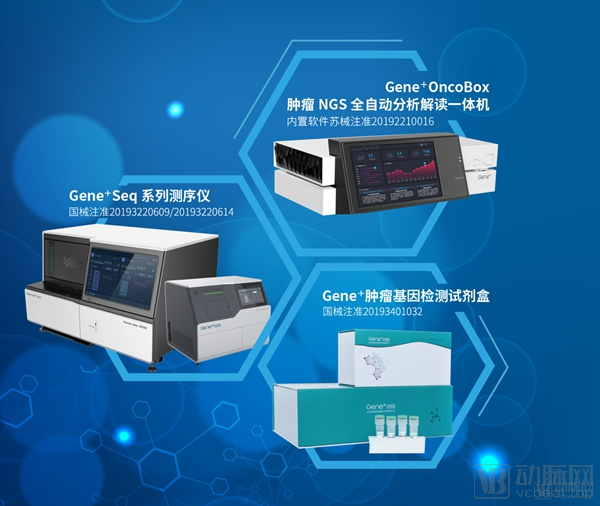
Complete certification for the sequencer, reagent kits, and software
With Gene+ having completed its full-industry-chain layout in precision oncology and secured all three essential certifications for sequencers, test kits, and software, the company’s core team has been continually contemplating how to stand out in the market among the numerous domestic tumor NGS testing enterprises.
Gene+’s core team has observed a phenomenon: many hospitals have purchased sequencers but are unable to independently conduct next-generation sequencing (NGS) testing in-house due to factors such as immature experimental techniques, complex operations, and difficulties in data analysis. Even when experiments are completed within the hospital, the lack of bioinformatics analysis and report interpretation capabilities necessitates sending the data back to third-party testing institutions for analysis.
As the population of cancer patients grows, the penetration rates of targeted therapies and immunotherapies rise, and the application of next-generation sequencing (NGS) testing continues to expand, hospitals—particularly specialized oncology hospitals and large tertiary Grade A hospitals—are increasingly seeking to conduct in-house tumor NGS testing.
Based on its self-developed sequencers, Gene+ has launched the Oncobox, an all-in-one automated analysis and interpretation system for tumor NGS. Designed specifically for tumor NGS laboratories, this device connects directly to the sequencer to read raw sequencing data, accurately analyze and interpret the clinical significance of variants, and automatically generate user-friendly interpretation reports in offline mode, thereby enabling one-click bioinformatics analysis, interpretation, and personalized report generation.
Leveraging Oncobox and its proprietary domestic sequencers, the company’s integrated end-to-end NGS solution has been successfully deployed in more than ten hospitals across China, including Sun Yat-sen University Cancer Center, Henan Cancer Hospital, West China Hospital, and Zhejiang Cancer Hospital.
Yi Xin stated that, compared with the LDT outsource model, conducting NGS testing in-house yields more standardized and secure results with greater timeliness, while also mitigating the risk of sample data leakage. Integrated end-to-end solutions are expected to become the mainstream approach for NGS testing in large tertiary Grade A hospitals in the future.
According to Gene+, automation and intelligence represent the future development trends of integrated, end-to-end NGS solutions. Moving forward, the company will incorporate additional control software into this solution to achieve seamless automation across the entire workflow. In terms of intelligence, different departments have varying requirements for the presentation of test results. Oncobox can expand its application functionalities as needed to rapidly meet diverse customer demands.
Currently, Gene+ has established a business layout in which two major platforms (domestic NGS testing platform and big data platform) support four core business segments (clinical testing, medical devices, scientific collaboration, and early cancer screening).
In the realm of clinical testing, Gene+ has launched the Onco series of pan-cancer, full-course clinical testing products. Centered on the practical needs of tumor clinical diagnosis and treatment, these products provide a comprehensive analysis of tumors from multiple dimensions, including DNA, RNA, viruses, and immunity. Currently, Gene+ has established medical laboratories in Beijing, Suzhou, and Shenzhen, providing professional tumor gene clinical testing services to more than 400 key hospitals across China.
In the medical device sector, Gene+ leverages its comprehensive certification for sequencers, reagent kits, and software to facilitate the adoption of its integrated tumor NGS solutions in hospital pathology departments, clinical laboratories, and precision medicine centers. This strategy accelerates the establishment of standards, clinical deployment, and widespread promotion of domestic sequencing platforms in oncology.
In the realm of technological collaboration, Gene+ leverages its clinical-grade NGS testing delivery system to partner with more than 20 renowned domestic and international pharmaceutical companies, including AstraZeneca, Roche, CStone Pharmaceuticals, InnoCare Pharma, and Hengrui Medicine. The company provides services such as testing for new drug clinical trials and biomarker research and development, while collaboratively advancing the development, regulatory approval, and market launch of personalized companion diagnostic kits.
In the field of early cancer screening, Gene+ has established an early screening technology system with independent intellectual property rights that simultaneously detects genomic variations and methylation levels. In October 2019, the company, in collaboration with Professor Zeng Qiang’s team from the Health Management Research Institute of the Chinese PLA General Hospital (301 Hospital), spearheaded the Pan-Cancer Early Detection Study in the Chinese Population (PREDICT, NCT04405557). Currently, 21 public hospital health examination centers, including Xiangya Hospital, Henan Provincial People’s Hospital, and Shenzhen People’s Hospital, have joined the project to conduct prospective studies on high-risk populations for six types of cancer with high incidence and high mortality rates. Moving forward, the company will continue to increase its R&D investment in early cancer screening and develop a multi-dimensional product portfolio.
The four core business segments complement each other and create synergies, helping Gene+ rapidly secure a favorable position in the industry. Going forward, the company will continue to deploy across the entire chain of cancer prevention and treatment, adhere to the strategy of domestic substitution to establish cost advantages, accelerate product registration and hospital adoption, and uphold an academically driven professional branding strategy to solidify its industry standing and become a leading enterprise in China’s tumor NGS testing sector.