

Alcon Reports $1.2 Billion in Half-Year Revenue Amid Pandemic Challenges

Alcon
Ophthalmic Pharmaceuticals and Medical Devices Manufacturer
Plunged into total darkness, one is overcome by helplessness and fear. The eyes, the windows to the soul, serve as the primary means of appreciating the myriad wonders of the world.
Alcon (Alcon) is the world's largest ophthalmic pharmaceutical and medical device company.Alcon is primarily engaged in the research and development of ophthalmic pharmaceuticals, surgical equipment for eye surgery, contact lenses, and related care products.Currently,Alcon has subsidiaries in 75 countries and regions worldwide, with15,000Multiple employees,5 R&D Center,14production facilities, with products sold throughout180Multiple countries and regions.
1974In [year], Alcon was founded byRobert D. AlexanderandCo-authored by William C. ConnerFounded, and byWilliamServing as the first president, with its headquarters in Geneva. Combining the first syllables of their surnames, the two named the company Alcon.

The Two Co-Founders of Alcon
Starting with ophthalmic drug development, expand into ophthalmic surgical instruments
1945Year,Robert D. AlexanderandWilliam C. ConnerTwo pharmacists jointly operate an ophthalmic pharmacy. In the early stages of its establishment,AlexanderandConnerDuring the day, prescriptions were filled at the pharmacy; at night, blenders and pressure cookers were used to develop sterile, injectable vitamins and oral products.
It is often said that Heaven rewards the diligent; this phrase, inAlexanderandConnervalidated on the human body. Through countless nights of continuous research and exploration accompanied by instruments,They have successfully developed two ophthalmic products and are set to launch them soon. The products include those for mild eye infectionsOphthalzin™ and for red, itchy eyesZincfrin®。
After the product was developed, Alcon quickly establishedDROP-TAINER®Patented the eye drop dispenser bottle, which has now become the standard for eye care products. Meanwhile, began expanding into overseas markets.1959In [Year], Alcon established an office in Canada, launching its international operations.
To accelerate the company's growth rate and enhance its brand awareness more rapidly.Alcon andORBIS International Through collaboration, it launched its patient assistance program to provide free medications to low-income glaucoma patients. Alcon has brought its eye care services and training for healthcare providers to underserved communities worldwide. This approach has not only bolstered Alcon’s reputation but also enhanced its brand visibility, and their partnership remains in place to this day.
1971In [year], Alcon was listed on the New York Stock Exchange, with sales of only3100ten thousand U.S. dollars.In the second year,Ed SchollmaierServed as President, during his tenure, Alcon's sales increased from3600increased to USD 10,00020hundred million US dollars, helping Alcon become the world's largest ophthalmic company.
1978In [Year], Nestlé acquired Alcon, providing ample capital to accelerate Alcon’s global growth and expand its manufacturing operations.
Ample funding accelerated the establishment of the Alcon Research Center.1982Year,William C. ConnerThe establishment of the research center has helped expand Alcon’s research into eye diseases and their treatment options. Additionally, to enhance its manufacturing capabilities for ophthalmic devices, Alcon has successively acquiredSharpointandCooperVision SurgicalTwo companies.
1990In [Year], Alcon established its Irvine Technology Center, embarking on its journey of researching and developing ophthalmic devices. Four years later, it developedAcrySof®Intraocular Lenses Have ObtainedFDAApproved.To this end, Alcon has specially developed an intraocular lens (IOL) (IOL) materials.
To expand its product line of retinal surgical instruments, Alcon has2000Acquired inSummit AutonomousandGrieshaberto enter the refractive laser market. Since then, it has successively acquiredWavelight AGandLenSx®LaserThe platform aims to expand its use forLASIKSurgical and cataract surgery product portfolio. Additionally,2012In [year], Alcon, through the acquisition ofEndure Medical SystemsEntering the microscope market has provided Alcon with leading ophthalmic surgical guidance technology.
 Product Information (Excluding Intraocular Lenses) (Partial)
2019In [year], Alcon acquiredPowerVisionto further develop intraocular lenses. While developing ophthalmic devices, Alcon has not ceased its pharmaceutical R&D efforts.
 R&D Drug Information (Partial)
Based on Alcon’s acquisition patterns, the companies it acquires are all aligned with its strategic layout for future R&D directions,This approach can significantly shorten the R&D cycle, enabling products to be developed and commercialized in the shortest possible time.
The pandemic has led to successive setbacks in the two core businesses of surgery and vision care.
Alcon’s global business is divided into two segments: Surgical and Vision Care.
InSurgical FieldAlcon researches, develops, manufactures, distributes, and sells ophthalmic products for cataract surgery, vitreoretinal surgery, refractive laser surgery, and glaucoma surgery. The surgical product portfolio also includes implants, consumables, and surgical equipment required for these procedures, supporting the end-to-end procedural needs of ophthalmologists.
AtVision Care, Alcon researches, develops, manufactures, distributes, and markets daily disposable, reusable, and color-enhancing contact lenses, as well as a comprehensive portfolio of eye care products, including solutions for dry eye and contact lens care, products for ocular allergies, and eye vitamins.
Surgery and Vision Care are the primary sources of revenue. This year, the pandemic has impacted global economic development. Alcon’s turnover has also been significantly affected, with declines in revenue from its two core business segments.
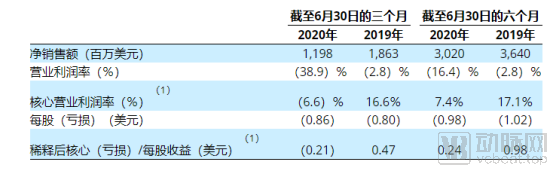
As of2020Year6Month30Second-quarter and first-half financial results.2020In the second quarter of the year, global sales were12hundred million U.S. dollars, a decrease compared to the same period last year in the reported financial statements36%, representing a decline on a constant currency basis34%。2020Diluted loss per share in the second quarter of the year was0.86USD, with a core diluted loss per share of0.21USD.
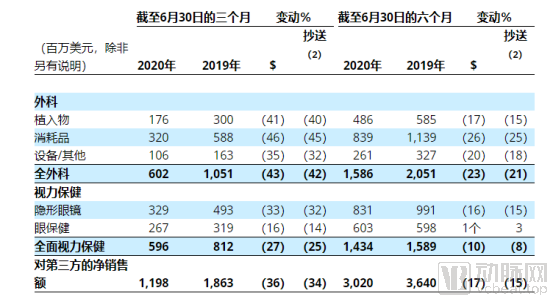
and2019Compared with the second quarter of the year, including implants, consumables, and devices/Net sales of other surgical procedures were6.02hundred million USD, with2019decreased compared to the second quarter of the year43% or42%. All categories were affected byCOVID-19The Impact of the Pandemic.
During the pandemic, the increased deployment of Alcon’s trifocal intraocular lenses in Japan and the United States acted as a cooling agent against the declining revenue trend. This intraocular lens, named PanOptix, is the first trifocal intraocular lens approved by the FDA.
Net sales of the vision care business were5.96hundred million U.S. dollars, including contact lenses and eye care products, with2019decreased compared to the second quarter of the year27%, or a decline on a constant currency basis25%. The primary reasons for the decline in sales were decreased demand and widespread closures of office facilities. Alcon rapidly launched aNovel Over-the-Counter Medications for Ocular AllergiesPataday, the launch of this drug has also helped to mitigate the decline in revenue to some extent.
Survey Shows: 70% of Users Are Willing to Accept High-Priced Innovative Lenses
In this context, Alcon has strengthened the implementation of its business continuity plan and developed new solutions to provide appropriate services to patients during the pandemic.Meanwhile, Alcon conducted two surveys during the pandemic to assess the resilience of its contact lens business and to gauge public perceptions of eye health.
According to a survey conducted by Alcon, although most contact lens wearers remain loyal to their current brands,75% of wearers would prefer researchers to upgrade their products. Moreover, more than70% of wearers are willing to accept innovative lenses at a higher price. This will be eye care professionals (ECP) a good opportunity to understand how eye care needs may have changed during the pandemic.
Another survey revealed that screen time increased during the pandemic, with the majority of this time spent looking at digital screens. This has led to a rise in the number of patients suffering from dry eye disease. In response to this trend, Alcon launchedSYSTANEin the Eye Drop SeriesSYSTANE HYDRATION。Systane ®Lubricating eye drops have been clinically proven to reduce the symptoms of dry eye and provide immediate, long-lasting protection for the eyes.
These two surveys demonstrate that Alcon has been consistently attuned to patient needs and implementing subsequent strategies accordingly—a practice worthy of emulation in China.Only through close engagement with patients and a deep understanding of their immediate needs can corporate development align with societal expectations.
According to official sources,Alcon'sPC-IOL(Presbyopia-correcting intraocular lenses) have captured in the U.S. market70%share,This growth has resulted in a slower decline in its surgical business compared to its healthcare segment.
WhyPC-IOLCan it grow rapidly?This is driven by the growing aging population, which has created demand in the U.S. market.In China, the issue of population aging is becoming increasingly severe. Currently, the domestic treatment for presbyopia involves imported trifocal intraocular lenses from Germany, with no domestically produced alternatives available.
The demand for intraocular lenses is high, and domestic substitution is expected to be achieved.
As is well known,High Demand for Consumables in Ophthalmic Surgery。
The intraocular lens industry in China is currently experiencing rapid development., with its price at300-1200or so, the intraocular lenses on the market are mainlyPMMARigid Intraocular Lenses and Spherical Intraocular Lenses. As consumer spending power rises, the market is likely to gradually shift toward the mid-to-high-end segment, with overall intraocular lens prices expected to rise steadily.
In recent years, the onset of myopia has been occurring at increasingly younger ages.2012To2018During the year, the myopia rate among primary school students increased.13%, which will drive rapid growth in the demand for intraocular lenses.
Although the current three giants in ophthalmology, Novartis and AlconAlcon, Johnson & Johnson Vision and Bausch + LombB<he company monopolizes the global market.80%market share of intraocular lenses. However, the development pace in China should not be overlooked,Aibonuo De, Baikang Medical, and others in China7Companies mainly produce3、4Rigid intraocular lenses currently dominate the market. With ongoing technological advancements, domestically produced alternatives are expected to achieve import substitution.Meanwhile, as a robust alternative to laser refractive surgery, intraocular lenses also point to a highly promising future development outlook.
This Year7In [month], Aierbo Nuode listed on the STAR Market, with its intraocular lenses accounting for its90%The above revenue share.
2015 To date, Aierbode’s products have been frequently selected for the “Bright Journey” medical aid program initiated by the Chinese government for Africa and Belt and Road Initiative countries, providing20 Bringing Light to Patients in Multiple Countries, Breaking the Status Quo of China’s Overseas Cataract Aid Projects Primarily Using Imported Intraocular Lenses.
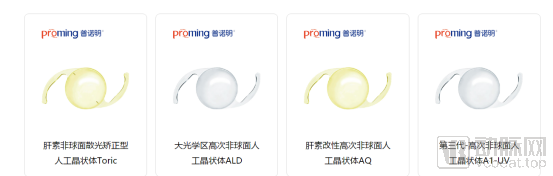
Aibonode's Intraocular Lens Products
“The road ahead is long and arduous.” China’s cardiovascular intervention sector has spent years on the journey toward domestic substitution, with dozens of companies and countless researchers dedicating their youth and passion to this field. In the end, all efforts have been worthwhile: this year, multiple companies in the cardiac intervention space went public, achieving domestic substitution.Dedicated to R&D of new products and understanding actual market demands, we will ultimately achieve domestic substitution of intraocular lenses.