

Tencent's Three Strategic Leaps in Digital Healthcare: Intelligence, Connectivity, and C2B Integration

Tencent
Internet Comprehensive Service Provider
In terms of connectivity, no company can replicate WeChat, a phenomenal product that has become deeply embedded in everyone’s daily life. Yet even a tech giant like Tencent has previously grappled with the challenges of “connecting” within the healthcare sector.
Tech giants never miss a trend. Each surge in emerging technologies—blockchain, artificial intelligence, the Internet of Things (IoT), and more—has inevitably drawn substantial capital investment from Tencent. Over the years, dozens of health-tech companies have accepted Tencent’s overtures. Its pieces are gradually filling the board, yet the overall situation remains unchanged. Although everyone, both within and outside the industry, can envision the endgame of intelligent connectivity in healthcare, no one knows the path to achieve it.
The underlying logic is straightforward: healthcare transformation cannot be driven by isolated technologies or point-to-point connections alone. Only large-scale, systematic changes can propel comprehensive reform in the healthcare sector, thereby enabling Tencent to deepen its involvement. In fact, the now-mature Tencent has long been awaiting a game-changer.
The Game Changer Is Not Unique.
The deadlock was first broken by the disruptive policies introduced by the National Healthcare Security Administration (NHSA). In November 2019, the national electronic medical insurance certificate system was launched, with pilot programs initiated in Hebei, Jilin, Heilongjiang, Shanghai, Fujian, Shandong, Guangdong, and other regions. The NHSA’s push for internet-based medical insurance payments has integrated third-party payment channels into the system, with Tencent serving as the largest payment entry point.
Leveraging this momentum, the Tencent Health mini-program integrated the Electronic Medical Insurance Certificate module and, through the Medical Health section of the WeChat Pay page (commonly known as the “WeChat 9-Grid”), accessed consumer markets with tools and services, making WeChat’s over 1 billion users a potential customer base for Tencent’s healthcare services.
However, acquiring and retaining C-end users through the WeChat entry point inevitably requires the intervention of B-end value-added services. At this juncture, the “pandemic” emerged as the second game-changer.
The high transmissibility of COVID-19 has prompted us to re-examine the role of internet hospitals and underscore the importance of building future smart public health defense systems. “The pandemic has also pressed the ‘fast-forward button’ on the development of smart healthcare,” said Tang Daosheng, Senior Executive Vice President of Tencent and President of the Cloud and Smart Industries Group, at the 2020 Tencent Global Digital Ecosystem Summit.
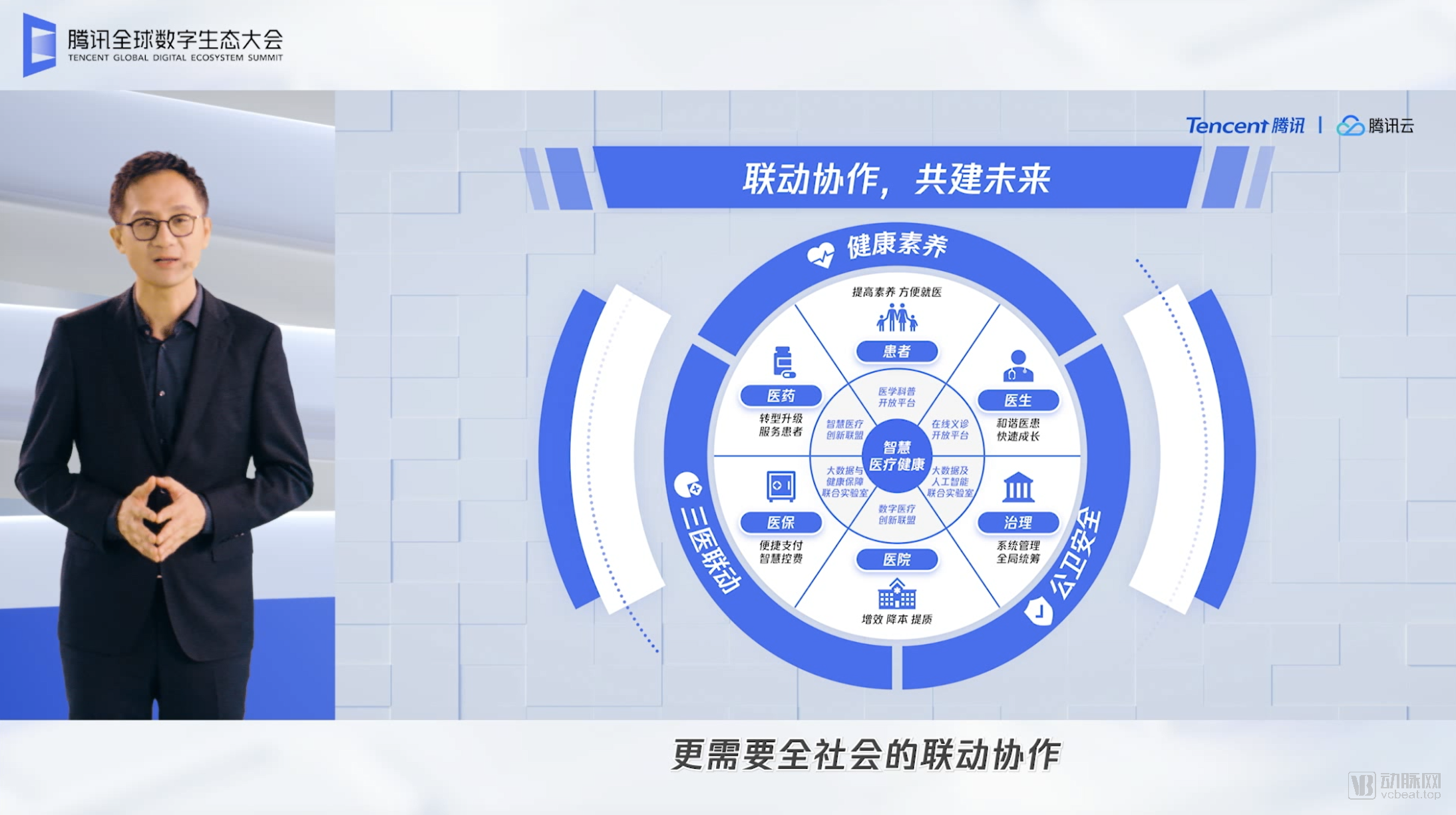
Tencent’s Overall Strategic Layout in the Healthcare Sector
Today, as we re-examine Tencent’s healthcare ecosystem, its C2B model has become sufficiently clear. With a dual-sided approach addressing both supply and demand, Tencent’s healthcare vision—centered on “intelligence” and “connectivity”—is gradually emerging from the haze.
“What we can do” and “what people need” are two critical considerations that internet companies must clearly address when entering the healthcare sector. From Tencent’s perspective, both questions revolve around “connectivity.”
Connecting patients with doctors is one of the most critical needs in healthcare. “Meituan knows what food delivery you prefer, but doctors do not truly understand your specific medical needs. This is because healthcare has traditionally been viewed as a simple transaction: I have a need, and the doctor provides a service,” said Wu Wenda, Vice President of Tencent Healthcare. “In the absence of an effectively operating family doctor system, the doctor-patient relationship remains fragmented. Our positioning is to help patients establish longer-term relationships with individual physicians, medical teams, community health centers, or hospitals. We aim to facilitate this connection and communication, and to enhance the capabilities of primary care physicians through technologies such as AI.”
Tencent Health, accessible via WeChat and its mini-program platform, can provide a solution to this issue. The existing Tencent Health platform already offers services such as finding doctors, online registration, and scheduling health checkups. With just a few taps on their mobile devices, patients can easily locate the physicians they need and establish long-term connections with them through WeChat’s tools.
However, at its core, Tencent’s service system in the era of internet hospitals is not particularly unique. Its success can be attributed largely to Tencent’s inherent connectivity capabilities. After all, only by connecting with a sufficient number of hospitals can patients avoid encountering obstacles when seeking medical care via their mobile devices.
In May 2020, VCBeat conducted a sampling survey on online appointment registration by randomly selecting a total of 72 hospitals of varying tiers from four provinces and municipalities: Chongqing, Beijing, Zhejiang, and Fujian. The data revealed that WeChat Official Accounts dominated among various access channels, followed by Alipay Life Accounts. Specifically, among the 47 hospitals that offered online appointment registration, 44 allowed patients to book appointments via WeChat Official Accounts, and 22 hospitals provided multiple appointment booking channels. Thus, it is evident that WeChat has become the primary entry point for patients to access medical services in the era of smart hospitals.
Internet companies entering the healthcare sector often fail due to excessive speed; they expand too rapidly, leaving them unable to sustain follow-up maintenance. Tencent, typically known for its swift and decisive actions, has slowed down in the healthcare arena. Looking back on the early days of “laying the groundwork” at the grassroots level, Dr. Wu Wenda reflected with some emotion: “Advancing grassroots healthcare is not something that can be achieved simply by leveraging WeChat or QQ. We have been proceeding county by county, city by city, and hospital by hospital, gradually improving the quality of primary care, steadily building mutual trust between grassroots patients and providers, and incrementally establishing a platform that connects healthcare services across all levels.”
Built upon this carefully constructed platform, the “Electronic Health Card” and “Electronic Medical Insurance Certificate” further migrate offline services to the internet, thereby strengthening patients’ reliance on WeChat and enabling “health management at your fingertips.”
"The Electronic Health Card" is one of the core components of healthcare digitalization, enabling functions such as cross-institutional medical record sharing and prescription circulation. Its primary purpose is to address convenience for the general public and ensure data standardization.
“The Electronic Medical Insurance Certificate” has broken down the most critical payment barrier in internet healthcare. If medical services were merely shifted from offline to online without the safety net of medical insurance, few patients would be willing to participate. Today, the Electronic Medical Insurance Certificate has been implemented across 31 provinces and municipalities, providing the foundational connectivity for the development of online businesses such as pharmaceutical e-commerce and internet hospitals.
Under the “Two Cards, One Platform” framework, Tencent has not only broken down information barriers between doctors and patients and streamlined payment processes among hospitals, patients, and medical insurance providers, but also likely promoted the rational allocation of medical resources, thereby optimizing healthcare supply. Furthermore, through “connectivity,” Tencent has rebuilt mutual trust between doctors and patients.
In most healthcare scenarios, it is difficult to simultaneously improve the quality of care, increase access to healthcare services, and reduce costs. This phenomenon is known as the “Impossible Trinity of Healthcare” model. However, this “trilemma” is not insurmountable; through technological iteration, all three vertices of the triangle have the potential to be enhanced concurrently.
Similarly, from the perspective of healthcare supply-side reform, Tencent is attempting to enhance the supply capacity of existing medical resources through two avenues: artificial intelligence and big data.
Tencent Tianyan Laboratory focuses on the hospital sector, leveraging medical big data to build “virtual doctors,” thereby enhancing primary healthcare capabilities and reducing the likelihood of misdiagnosis and missed diagnoses by physicians.
“It takes years for a physician to evolve from a novice into an expert, requiring extensive knowledge acquisition and refinement through years of clinical practice,” said Dr. Zheng Yefeng, Director of Tianyan Laboratory. “Therefore, we aim to simulate the training pathway of physicians by enabling AI algorithms to learn from top-tier doctors at Grade 3A hospitals, thereby achieving or approaching their level of expertise. These AI algorithms can then be deployed to primary care settings to assist physicians in clinical decision-making.”
Explainable disease prediction is another frontier being tackled by Tianyan Lab. Zheng Yefeng stated, “We aim to predict a patient’s risk of developing a specific disease within a defined future period, such as the next six months, based on their historical medical records. This is a time-series prediction problem.”
“This issue typically requires processing by deep neural networks such as LSTM. However, the major drawback of these methods is that the entire prediction process operates as a black box, lacking interpretability. The approach proposed by Tianyan Laboratory involves using a nonlinear network to compress patients’ diagnostic information into a fixed dimension, such as 512 dimensions, thereby generating a 512-dimensional vector for each medical visit. Subsequently, we employ a sparse linear combination model to aggregate data from multiple visits, ultimately achieving disease prediction with a certain degree of interpretability.”
Furthermore, Tianyan Laboratory is also attempting to break down data silos through federated learning. “In the stroke risk prediction project in Yichang, we have five partner hospitals. Some hospitals, or indeed most of them, may be unwilling to share their data for joint centralized training due to privacy concerns and institutional regulations. Therefore, we adopted a horizontal federated learning approach to aggregate all data for joint training while safeguarding user privacy. The results show that using horizontal federated learning for joint training improved accuracy by more than 10%–20%.”
In contrast, Tencent Hippo Lab focuses more on application-oriented directions, with its application scenarios extending from hospitals to consumer-facing (C-end) users and pharmaceutical companies.
“There are things that cannot be measured directly; you must find a way to measure them by accurately quantifying what can be measured. This is a fundamental principle of science.” This is the inspiration behind Tencent’s Hippo Lab, where “measurement” refers to the analysis of patient movement.
In daily life, there are numerous exercise-related diseases. The most prevalent conditions include Parkinson’s disease and stroke, while multiple sclerosis, cerebral palsy, scoliosis, heart disease, sports injuries, and fall-related conditions in the elderly also significantly impact the well-being of countless families. In China, the average expenditure for Parkinson’s patients accounts for 48% of household income. According to Dr. Fan Wei from Tencent Hippo Lab, these diseases share a common characteristic: their progression can be precisely measured through movement assessment, thereby providing objective standards for medication/treatment, efficacy evaluation, and drug development/therapeutic regimen design.
This is one of the current research directions of Tencent’s Hippocrates Lab: capturing patients’ movement data via video and smartphone sensors, collecting voice signals through smartphones, analyzing the information using artificial intelligence, and conducting a comprehensive assessment of patients’ conditions by combining AI analysis with expert ratings.
This means that patients with mobility impairments no longer need to make frequent hospital visits for follow-up care. By leveraging artificial intelligence to provide objective measurement standards, similar to blood pressure monitors, glucometers, and thermometers, physicians can manage patients’ conditions simply by interacting with them via mobile phones. This approach ensures that patients receive the most appropriate medications at optimal dosages, helps maintain their motor function, and reduces the burden on their families.
Beyond motion measurement, Hippo Lab is also leveraging AI to empower a broader range of chronic disease scenarios, with heart failure, psoriasis, and coronary heart disease as its key focus areas.
Few enterprises address medical challenges from the demand side. After all, reducing demand to cut costs does not seem like a typical corporate responsibility. However, as the ancient wisdom goes, “The superior physician prevents disease before it arises.” Preventing illness at its source—the patient level—is the fundamental solution to China’s healthcare dilemma. In fact, with the significant improvement in national economic standards, people are increasingly willing to invest time in learning about health knowledge to enhance their own disease prevention capabilities.
People are eager to access medical knowledge via the internet, while content creators are equally keen to produce such information. According to a survey by Tencent Insight, in recent years, China has seen over 40,000 self-media accounts focused on healthcare, with weekly readership exceeding one million and daily searches for health-related queries reaching 60 million. However, the vast amount of online medical content is of uneven quality; many non-professionals simply compile materials from unverified sources, thereby disseminating misleading information to the public.
On one hand, "rewritten" popular science content poses significant risks to public health. Some individuals, suffering from persistent low-grade fever, have relied solely on online information, self-diagnosed with terminal illnesses, and ultimately taken their own lives. Others have missed the optimal window for treatment due to misinformation. On the other hand, the phenomenon of "bad money driving out good" is evident: many professional physicians, striving to maintain their integrity, are reluctant to disseminate their expertise via the internet.
Under such circumstances, Tencent Medical Dictionary aims to reshape online medical science popularization by featuring authoritative physicians as authors, centering on cutting-edge knowledge, upholding professionalism as its core principle, and building on rational thinking, thereby making genuine medical knowledge accessible to the public and empowering individuals to take greater control of their health.
However, building an authoritative platform for medical science popularization is no easy task. To ensure the validity of the knowledge provided, it is essential to establish a comprehensive review and update system. In this regard, Tencent has made substantial investments without expecting immediate returns.
“Before the Spring Festival, we began dedicating significant manpower to keep abreast of relevant knowledge,” said Zhang Meng, Vice President of Tencent Healthcare. “Throughout the pandemic, we produced more than 2,000 pieces of popular science content, with readership increasing tenfold and total distribution across all platforms reaching tens of billions. To date, Tencent Medical Encyclopedia has partnered with over 5,000 professional physicians, covering 10,000 disease types and more than 85% of common diseases, and has established knowledge graphs encompassing the entire diagnosis and treatment process for individual chronic diseases such as cancer.”
Furthermore, Tencent Medipedia continues to innovate in both the content and format of its information. Historically, Medipedia has collaborated with internationally leading medical professional journal websites, government agencies, professional institutions, and distinguished experts with outstanding academic standing in their respective fields. In the post-pandemic era, Medipedia has invited renowned experts such as Professor Zhong Nanshan and Professor Li Lanjuan to join its platform. Meanwhile, its presentation formats have evolved from initial text-and-image articles to include videos and live streams.
Tencent Medical Encyclopedia has made substantial investments. Within the Tencent ecosystem, it functions more like a content “generator,” providing content support for applications such as WeChat Search, Tencent KanDian, Tencent News, and Tencent Video.
The shift occurred at the 2020 Tencent Global Digital Ecosystem Summit. Yesterday, Huang Lei, Vice President of Tencent Healthcare, announced the opening of the Tencent Yidian API, aiming to establish collaborations with various types of platforms, including search portals, content platforms, mobile applications, and smart hardware. These partnerships may help transform Yidian into a two-way open content platform.
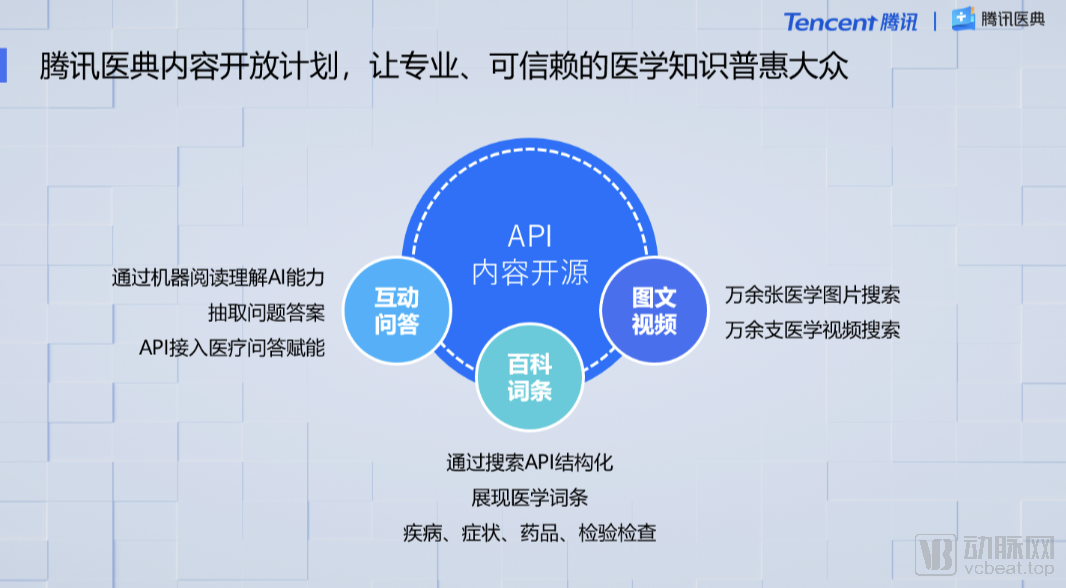
Tencent Medical Encyclopedia API Content Open Source
“We are pursuing a dual-track strategy: on one hand, Yi Dian will continue to make substantial efforts in promoting disease awareness by producing more themed content in the form of live streams and short videos. On the other hand, Yi Dian will place greater emphasis on content depth, including co-creating content with more academic experts. Of course, we will also open up our ecosystem further, inviting more partners to join us in content creation,” said Zhang Meng.
So, back to the beginning, why did Tencent develop a medical encyclopedia product centered on science popularization? Scarcity may be an important reason for Tencent to enter this field.
Technological innovation drives medical progress; likewise, society needs a platform to sustain these advancements and make them accessible to more patients. This is the original mission of Tencent Medical Dictionary.
Throughout the entire ecosystem conference, Tencent focused not only on building self-sustaining capacity for healthcare supply and demand; in the next phase, C2B will be the core theme of Tencent’s deeper engagement in the healthcare sector.
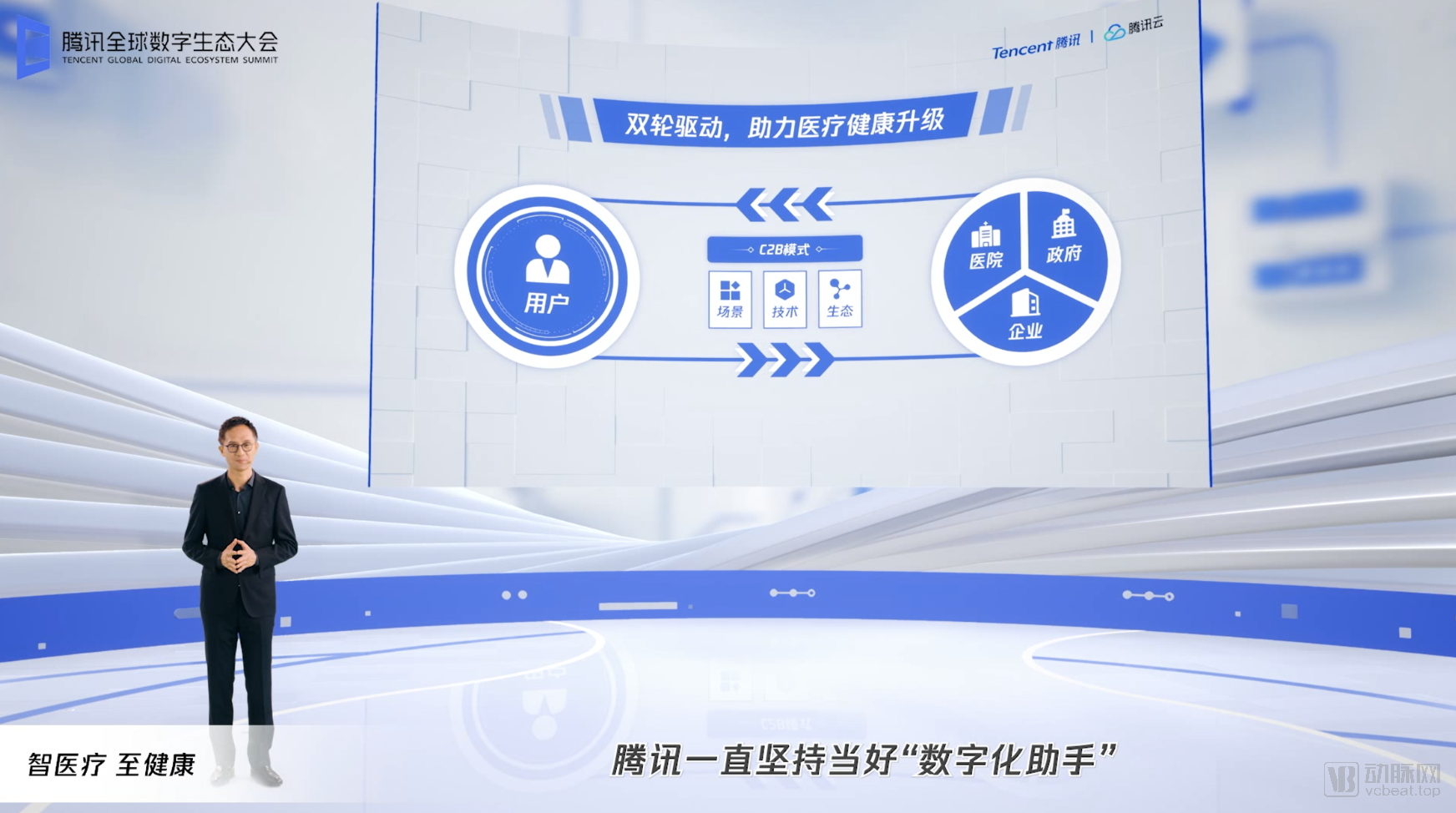
Tencent’s C2B Strategy
Related initiatives are already being advanced in tandem. Leveraging the connectivity and management capabilities of WeChat and WeCom, Tencent has embarked on digital management solutions for pharmaceutical companies, pharmacies, and internet hospitals. Building on its informational infrastructure layout, Tencent will support government agencies in administering and regulating medical insurance. Its core offerings encompass cloud PaaS platforms, medical insurance data middle platforms, DRG operational management, and “Internet + Medical Insurance” scenarios.
So, what will be the next step for Tencent Healthcare?
In retrospect, the core essence of Tencent’s “connectivity” strategy is to enhance the informatization capabilities of the healthcare system. It can be foreseen that as Tencent deepens its involvement in the medical sector, its connectivity capabilities will further facilitate the interconnectivity of the digital healthcare community. By delivering smart solutions through a collaborative ecosystem of intelligent healthcare, Tencent will drive the digital transformation of the healthcare industry.
Yet even Tencent cannot single-handedly fulfill the aforementioned mission. To drive transformation across the entire industry, Tencent requires the collaborative support of healthcare institutions, independent software vendors (ISVs), health IT providers, pharmaceutical and medical device companies, and financial investment firms.