

Rockefeller Foundation and ACCESS Health Release Landmark Report Highlighting WeDoctor and Other Chinese Digital Health Innovations in Global Pandemic Response
On September 9, the internationally renowned Rockefeller Foundation, in collaboration with ACCESS Health International (hereinafter referred to as “ACCESS Health”), released a research report titled “Digital Technology and Public Health Joining Forces to Combat the COVID-19 Pandemic: Bringing China’s Experience to the World.” The report comprehensively demonstrates the impact of digital technology across six categories of pandemic response measures. Twelve Chinese digital anti-pandemic cases from companies such as WeDoctor, Alibaba, and JD.com were selected as key examples of China’s use of digital health technologies to combat COVID-19, aiming to help countries worldwide enhance the effectiveness of their pandemic response strategies.
The application of digital technologies played a crucial role in China’s successful response to the COVID-19 pandemic. The report highlights how digital health companies leveraged their strengths during the initial outbreak control efforts in early 2020, detailing their responses across six key areas: rapid response, epidemiological research, diagnosis and treatment, supportive activities, long-term management, and integrated disease control systems. It further analyzes the profound impact of these measures.
As one of the earliest enterprises to leverage digital technology to open up an “aerial battlefield” in the fight against the epidemic, WeDoctor has been included as a representative case. The report provides a detailed introduction to the various solutions launched by WeDoctor to address healthcare needs such as professional information acquisition for the industry and the public, medical personnel collaboration, online consultations, chronic disease management, and grassroots epidemic prevention and control at different stages and in different scenarios of the anti-epidemic efforts.
At the outset of the outbreak, WeDoctor launched the “Real-Time Assistance Platform for COVID-19,” providing free online consultations and advisory services to residents in Wuhan and across China. This initiative helped triage patients, screen for mild cases, and reduce the risk of cross-infection during hospital visits. Subsequently, WeDoctor introduced additional services, including a “Psychological Support Zone,” a “Traditional Chinese Medicine Anti-Epidemic Platform,” and a “Global Anti-Epidemic Platform.” By the end of August, the Real-Time Assistance Platform for COVID-19 had delivered free services to 2.16 million individuals, with total page views exceeding 150 million and a peak daily user count of over 11 million. The Global Anti-Epidemic Platform was recommended by more than 170 Chinese embassies and consulates abroad, providing epidemic prevention services to 3.26 million people in over 220 countries and regions.
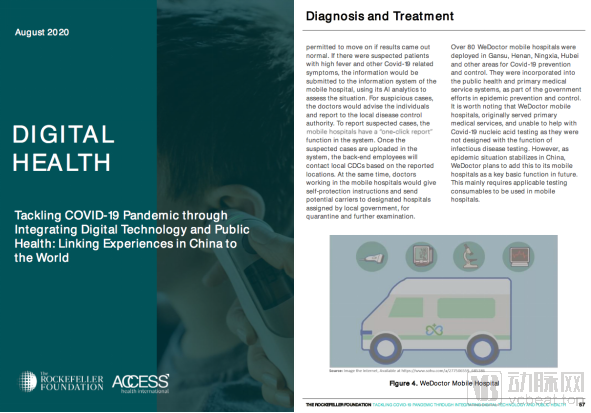
To address the follow-up consultation and medication procurement needs of patients with chronic diseases, WeDoctor Internet General Hospital provides online follow-up consultations and medication delivery services for patients with certain common and chronic conditions. Meanwhile, online medical insurance payment has been successively launched in Tianjin, Tai’an, Wuhan, Jinan, and other cities, enabling users to complete online follow-up consultations and purchase medications without leaving home, thereby enjoying one-stop healthcare services. This has brought about significant breakthroughs to the development of China’s digital health industry. Offline, the “WeDoctor Mobile Hospital,” equipped with a standardized diagnosis and treatment system covering 53 examination and test items across seven major categories and 100 diseases, has assisted various regions in carrying out efficient epidemic prevention and control efforts. Currently, more than 80 WeDoctor Mobile Hospitals are in service in Gansu, Henan, Ningxia, Hubei, and other provinces.
The report highlights that WeDoctor’s rapid response and efficient resource mobilization and coordination during the COVID-19 pandemic underscore the unique value of platform-based internet hospitals. WeDoctor has refined a digital platform encompassing medical care, pharmaceuticals, diagnostics, data, and insurance, driving the deep integration of healthcare service elements and perfecting a closed-loop service model. This has established a new health security service system, enabling swift and comprehensive utilization of its digital health platform to collaborate effectively with government bodies, medical institutions, and various partners during sudden crises, thereby enhancing service quality, efficiency, and user experience.
At the report launch event, the Rockefeller Foundation, in partnership with ACCESS Health and the Yale School of Public Health, hosted an online roundtable discussion. Prominent global opinion leaders, public health experts, researchers, and healthcare practitioners—including Dr. Soumya Swaminathan, Chief Scientist at the World Health Organization; Dr. Naveen Rao, Senior Vice President of the Rockefeller Foundation; Dr. Sten Vermund, Dean of the Yale School of Public Health; and Dr. William A. Haseltine, Chairman and President of ACCESS Health and Chair of the China-US Health Summit—jointly discussed how to expand the impact of “digital pandemic response” and leverage digital health solutions to enhance capacity for addressing global crises.
Deepali Khanna, Managing Director for Asia at the Rockefeller Foundation, stated, “Numerous pandemic response strategies highlight that integrating big data and digital health technologies into public health systems and emergency response systems is a critical task.” In the future, digital health will significantly facilitate and drive the digital transformation of the global health industry, better serving the health needs of populations worldwide.