

User Base Expansion and the New Surge of Internet Medical Services: Navigating the Next Wave of Challenges
On September 9, the National Health Commission held a press conference on typical cases of the development and application of national health informatization. Internet healthcare, as one of the important types of cases, was mentioned multiple times during the conference.
Mao Qun’an, Director of the Department of Planning and Information under the National Health Commission, stated at the conference that “Internet + Healthcare” offers the convenience of transcending time and space constraints. The National Health Commission will further leverage the advantages of “Internet+” to support routine epidemic prevention and control, deepen people-centered and benefit-oriented services, and enhance public satisfaction with medical care.
The ultimate beneficiaries of internet healthcare services are end-users (C-side). The industry deeply explores user needs and effectively meets them, with a large-scale user base supporting its sustained development, forming a virtuous cycle. Pandemic prevention and control efforts have collectively educated the market, ushering in a new wave of explosive growth for internet healthcare—a new starting point marked by both opportunities and challenges.
Driven by epidemic prevention and control measures, the volume of internet-based medical services has surged since the beginning of this year. At an aggregate level, as early as March, the National Health Commission disclosed that internet-based consultations at hospitals under its administration increased 17-fold compared to the same period last year during the epidemic. Some well-known third-party platforms saw a more than 20-fold increase in online consultation inquiries and a nearly 10-fold rise in prescription volumes.
From an individual perspective, a number of physical hospitals and internet healthcare companies have addressed the urgent needs of a large user base.
In Wuhan, the city hardest hit by the epidemic, Wuhan No. 1 Hospital launched its internet hospital on March 1. By May 8, the total number of online consultations had grown from dozens at launch to 31,243, with 9,445 prescriptions issued and 7,578 medication deliveries completed.
Similar data can be observed in other regions. Wang Jian’an, Party Secretary of the Second Affiliated Hospital of Zhejiang University School of Medicine (SAHZU), revealed at the recent 2020 National Conference on Smart Hospital Construction and Development that, building on three years of exploration, the number of online consultations at SAHZU Internet Hospital increased by 35-fold year-on-year in the first half of this year.
In addition, as a new entrant in the internet healthcare sector, Peking University Cancer Hospital launched its online consultation services this June. Within nearly one month, the daily volume of online consultations reached approximately 400 visits, accounting for about 30% of the offline outpatient volume.
Regarding internet healthcare enterprises, the semi-annual report recently released by Ping An Good Doctor shows that during the peak of the pandemic, the Ping An Good Doctor app recorded over 1.11 billion visits. The number of app registrations was ten times the pre-pandemic level, and the average daily number of consultations by new users was nine times the pre-pandemic figure. As of the end of June, the number of registered users on Ping An Good Doctor had reached 346 million.
“The growth in service volume and user numbers demonstrates that patients have personally experienced the tangible benefits of internet-based healthcare,” said Fu Hongqiao, Assistant Professor at the School of Public Health, Peking University, in an interview with VCBeat. “Particularly during the peak of the pandemic, when outpatient clinics were suspended, residential communities were under closed-off management, and access to in-person medical care was hindered, the value of internet-based healthcare was fully evident.”
Fu Hongqiao pointed out that during the pandemic prevention and control period, the overall scale and penetration rate of internet healthcare users reached a record high. Third-party internet healthcare platforms have reached an inflection point, while public hospitals are accelerating the launch of their online medical services.
He predicts that, in the long run, internet healthcare will differentially influence patients’ healthcare-seeking behaviors based on regional characteristics. In large and medium-sized cities with a high concentration of major hospitals, patients will gradually develop the habit of using online consultations as their preferred option for managing common and chronic conditions. In smaller cities and rural areas, an increasing number of patients will leverage internet healthcare platforms to access top-tier specialists nationwide for the diagnosis and treatment of complex and refractory diseases.
The generation of the aforementioned data is not attributable to chance factors; government agencies, healthcare institutions, and enterprises, as the primary stakeholders in the industry, have each implemented numerous measures from their respective perspectives to accelerate the cultivation of user habits.
Government Endorsement for the Industry
Since the outbreak of the pandemic, government authorities have rolled out policies on internet-based healthcare and medical insurance reimbursement in a phased and targeted manner. In February, the National Health Commission encouraged medical institutions across the country to launch online services to provide urgent support for epidemic prevention and control. In March, the National Healthcare Security Administration included internet-based healthcare services in the medical insurance coverage, addressing the need for prescription refills among patients with chronic diseases. In June, the National Health Commission called for the promotion of best practices in online services developed during the pandemic to support normalized epidemic prevention and control efforts.
This evolution signifies that policy support for internet healthcare is not merely a temporary measure during the pandemic, but rather underscores its role as a normalized component of the healthcare system.
During this process, government authorities accelerated relevant administrative approvals, particularly in Beijing, Shanghai, Tianjin, and other regions. Previously, Shanghai had approved only one internet hospital—Shanghai Shangying Internet Hospital—last year. However, during the pandemic this year, it approved more than 20 internet hospitals, with a number of entity-hospital-led internet hospitals rapidly enabling medical insurance payment services.
In addition to regulatory and approval frameworks, government departments have also taken concrete steps to facilitate the implementation of internet-based medical services. For instance, the National Health Commission (NHC) required all provinces and municipalities to compile links to local “Internet + Healthcare” services for centralized display by the NHC. This initiative prompted provinces and municipalities to systematically organize and integrate their local internet healthcare resources, and spurred the establishment of officially led internet healthcare platforms across various regions. Notable examples include the “Healthy Hubei” mini-program launched by the Hubei Provincial Health Commission and the comprehensive internet outpatient platform established by the Heilongjiang Provincial Health Commission, both of which were developed during this period.
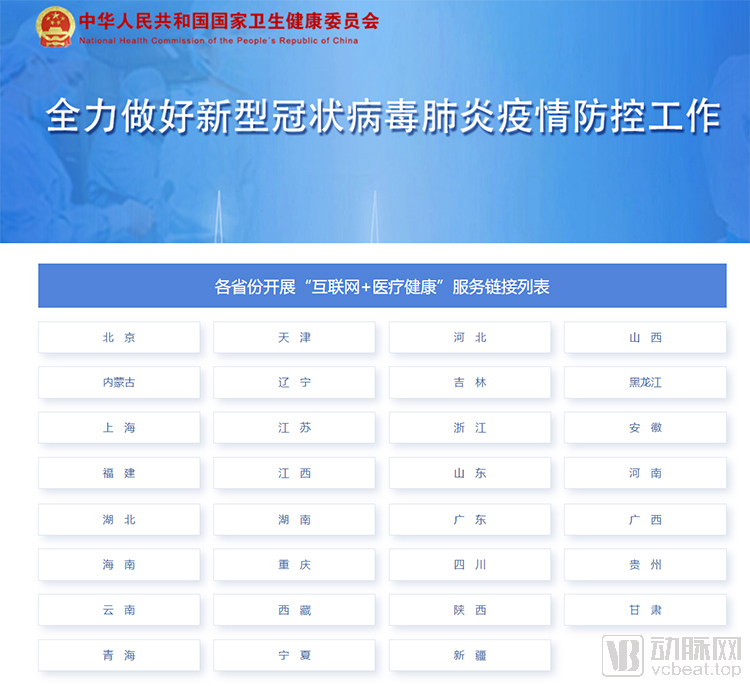
Centralized Display of Internet Healthcare Service Portals from Various Regions by the National Health Commission, Image Source: Official Website of the National Health Commission
“Government-backed initiatives serve primarily to endorse the industry,” said Fu Hongqiao. He believes that before focusing on cultivating user habits for internet healthcare, it is essential to first establish users’ trust in such services. “In the past, some users remained skeptical about internet healthcare—wondering whether the doctors were genuine or if the platforms were merely out to make a quick profit. Patients often had these concerns.”
In Fu Hongqiao’s view, government endorsement and vigorous promotion of internet healthcare can go a long way toward alleviating user concerns, enabling patients to seek medical care with confidence at licensed internet healthcare institutions.
Healthcare Institutions Increase Overall Patient Volume
Fu Hongqiao also pointed out that the accelerated development of online services by physical hospitals is one of the channels for cultivating user habits in internet healthcare. In particular, hospitals that launched online services earlier can provide patients with a better medical experience, as they had already enabled relevant services in the early stages.
Physical medical institutions are accelerating the development of internet hospitals, establishing online and offline service processes based on their own facilities, rapidly enabling health insurance payment services, and intensifying promotional efforts for their internet-based medical services to incentivize patients to shift toward online consultations. “This has increased the overall traffic volume for internet healthcare,” said Fu Hongqiao.
According to statistics from VCBeat’s Eggshell Research Institute in the “2020 Internet Hospital Report,” more than 200 new internet hospitals were established across China from January to June this year, of which over 160 were led by physical hospitals.
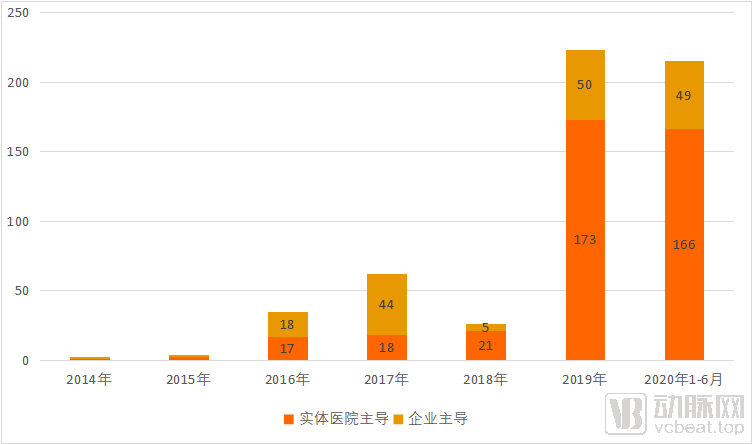
Changes in the Leading Parties of Internet Hospitals. Data sources: local health commissions, official hospital websites and WeChat accounts; chart by VCBeat.
According to Hubei Daily, as of June, 14 medical institutions in Wuhan had launched online diagnosis and treatment services. In addition, provinces and municipalities including Hunan, Chongqing, Jilin, and Shanxi have all launched their first or initial batch of internet hospitals this year, all of which are led by brick-and-mortar hospitals.
Physical hospitals primarily promote their online services through official WeChat accounts, in-hospital display boards, and physicians. Each physical hospital has its own offline service radius, with large hospitals having a broader reach. Therefore, every physical hospital can at least promote internet-based healthcare to patients within its own service radius.
Enterprises Deepen User Penetration Through Multi-Channel Strategies
As a key driver of innovation in the internet healthcare industry, enterprises play a direct role in cultivating user habits.
Internet-based medical services must rely on information systems as their foundational infrastructure. Leveraging years of accumulated technical expertise, internet healthcare companies can rapidly deploy online fever clinics and internet hospitals for physical hospitals, integrate with medical insurance payment systems, thereby accelerating service delivery and enhancing user experience.
During the pandemic, internet healthcare companies widely conducted free clinics to alleviate the pressure on offline diagnosis and treatment. Amidst an overall shortage of medical resources, Ping An Good Doctor relied on its in-house team of over 1,000 physicians and, assisted by AI medical technology, provided 24/7 online services. Other platforms also extensively recruited doctors to go online, effectively mitigating the surge in demand that had strained medical resources at the time.
Meanwhile, the company has opened its consultation services to online platforms spanning news media, mobile social networking, and lifestyle entertainment, thereby significantly expanding its channels for reaching users.
The enterprise operates with a flexible mechanism, enabling continuous adjustment and refinement of service offerings in response to the evolving stages of the pandemic. In the early phase, services such as epidemic maps, rumor debunking, science popularization, and online consultations were primarily provided to alleviate user anxiety. As the pandemic progressed, the focus shifted to addressing practical needs through online follow-up visits and medication shortage registration for patients with chronic diseases.
To address the limitations of offline medical consultations—where a single registration typically allows a patient to consult only one doctor for one specific condition—internet healthcare companies have integrated medical resources and launched membership-based products, such as family doctor services and chronic disease management programs. These offerings provide users with continuous and more comprehensive care, exemplified by Ping An Good Doctor’s “Private Doctor” service and Zhiyun Health’s “PLUS Membership.” Such products help sustain ongoing engagement between internet healthcare platforms and users, thereby further enhancing user stickiness.
Notably, internet healthcare companies such as Ping An Good Doctor have enabled medical insurance payments in multiple cities, truly integrating the entire online healthcare service process across pharmaceuticals, medical services, and insurance coverage.
Although only a small number of internet healthcare companies have gained access to medical insurance payments, this already demonstrates recognition by the largest payer in China’s healthcare system of the value offered by third-party platforms. Another phenomenon corroborates this recognition: although the urgency of epidemic prevention and control needs has diminished compared to several months ago, medical insurance systems continue to integrate with third-party platforms. For instance, Ping An Good Doctor’s internet hospital in Yinchuan recently enabled medical insurance payment services.
Another noticeable change is that advertisements for major internet healthcare platforms can now be seen in public spaces such as large screens in shopping malls, elevators in office buildings, subways, and bus stops.
“Companies such as Ping An Good Doctor and Haodf Online have increased their advertising investments in offline scenarios. This not only helps raise user awareness of internet healthcare but also fully demonstrates these companies’ continued optimism about market development,” said Fu Hongqiao.
As evidenced by the initiatives undertaken by the aforementioned stakeholders, cultivating user habits is a multidimensional, multi-layered, and interconnected process that spans from institutional design to market behavior, from online platforms to offline entities, and from technology delivery to service provision. Consequently, the growth in user base and the formation of user habits are inevitable outcomes.
As epidemic prevention and control become normalized, how to achieve further breakthroughs in expanding the user base and cultivating user habits has emerged as a new challenge for the industry during this outbreak. In Fu Hongqiao’s view, the solution simply revolves around enhancing patients’ healthcare experience.
For healthcare institutions and enterprises, it is essential to enhance user experience through the continuous optimization of products and services. “The accelerated launch of internet-based medical services by brick-and-mortar hospitals is indeed a positive development. However, some hospitals have failed to keep pace with service capacity, resulting in an inability to address patient needs in a timely manner. In other cases, systems were rushed to market, leading to issues such as inaccessible pages and consultation interfaces that are difficult to locate. These user experience pitfalls ultimately hinder the cultivation of user habits,” stated Fu Hongqiao.
He also noted that, given the non-standardized nature of internet-based medical services, the chat-style consultations offered by third-party platforms still fall short of users’ expectations for rigorous medical care. In some cases, physicians fail to engage in adequate communication with patients due to excessive workloads or limited experience, which can undermine patients’ sense of benefit and satisfaction.
Therefore, as the most direct service providers, healthcare institutions and enterprises need to continuously improve their products and services.
Fu Hongqiao observed that certain bottlenecks, which individual medical institutions and enterprises are unable to resolve on their own, require timely intervention by government authorities. For instance, Yinchuan recently issued the "Specifications for Internet Diagnosis and Treatment Services (Trial)," a series of regulatory measures designed to steer the sector from a laissez-faire approach toward standardized development, thereby enhancing patient satisfaction and their sense of benefit.
Although Beijing has vigorously promoted “Internet+” medical insurance services since the beginning of this year, the inability to currently support card-free payments has compromised payment convenience for patients. Furthermore, the payment standards for medical service fees have failed to effectively incentivize physicians, thereby adversely affecting the utilization rate of these services. Currently, Beijing is accelerating efforts to resolve issues such as the implementation of card-free payments.
Meanwhile, Fu Hongqiao believes that while government departments, medical institutions, and enterprises each exert their own efforts, industry organizations are needed to facilitate their connection, coordination, and vertical linkage. “For example, the Yinchuan Internet + Medical Health Association is currently preparing to establish a Doctor-Patient Dispute Mediation Center, creating a mediation mechanism to resolve doctor-patient disputes, thereby enhancing user experience.”
“No matter what, epidemic prevention and control is destined to become a milestone in the history of internet healthcare development in China,” said Fu Hongqiao. He stated that, leveraging this epidemic, internet healthcare is expected to transform our medical experience just as it has changed our daily necessities such as clothing, food, housing, and transportation.