

Paving the Way with COVID-19 and Reshaped by Capital: Is mNGS Set to Ride the Wave in 2026?
If the COVID-19 pandemic propelled any biotechnologies into the spotlight, nucleic acid testing would rank first, while metagenomic next-generation sequencing (mNGS) for pathogenic microorganisms would likely come in second.
In late December 2019, independent clinical laboratories such as CapitalBio, BGI Genomics, and Weiyuan Genetics successively received patient samples from Wuhan. Most of these patients had been hospitalized due to fever, showed no response to various antibiotic treatments, experienced worsening conditions requiring admission to the intensive care unit (ICU), and lacked an effective treatment plan at the time. Physicians recommended employing metagenomic next-generation sequencing (mNGS) technology to identify the pathogens in the clinical samples.
According to a paper later published in the Chinese Medical Journal, a joint research team from the Institute of Pathogen Biology at the Chinese Academy of Medical Sciences, China-Japan Friendship Hospital, Hubei Provincial Center for Disease Control and Prevention, Wuhan Jinyintan Hospital, Wuhan Central Hospital, and Vision Medicals collected clinical data and bronchoalveolar lavage samples from five patients with severe pneumonia at Wuhan Jinyintan Hospital. Through metagenomic next-generation sequencing (mNGS) analysis, they identified a previously unreported coronavirus whose nucleotide sequence shared 79% similarity with that of the SARS virus.
This discovery has laid a critical foundation for deciphering the SARS-CoV-2 genome, developing nucleic acid testing kits, and advancing COVID-19 vaccine development. mNGS refers to the direct high-throughput sequencing of infectious specimens. By aligning sequences against specialized microbial databases and employing intelligent algorithmic analysis, it identifies the species of suspected pathogenic microorganisms and provides comprehensive, in-depth report interpretation, thereby offering rapid and precise diagnostic evidence for complex and critical infections.
BGI Genomics, the first company in China to offer mNGS services externally, stated in its 2020 semi-annual financial report that its self-developed PMseq® high-throughput gene detection product for pathogenic microorganisms had completed testing on approximately 100,000 samples. The main sample types included plasma, cerebrospinal fluid, and respiratory specimens. According to estimates by senior industry practitioners cited by VCBeat, the total number of samples received by various mNGS development teams across China was projected to exceed 200,000 by the end of 2020.
As a new application direction of high-throughput gene sequencing, metagenomic next-generation sequencing (mNGS) began to transition gradually from research services to clinical applications around 2018. It attracted immediate attention from investment institutions, with new teams continuously entering the field. Its outstanding performance during the COVID-19 pandemic has further demonstrated the significant clinical value of mNGS. For mNGS development teams currently exploring commercialization pathways, this may represent a rare window of opportunity.
According to statistics from the VCBeat Orange Database, since 2016, seven domestic companies specializing in pathogen metagenomic testing have completed 17 rounds of financing, with over RMB 1 billion in venture capital invested in this emerging industry. In the past three quarters alone, there have been nine financing events in the mNGS sector.
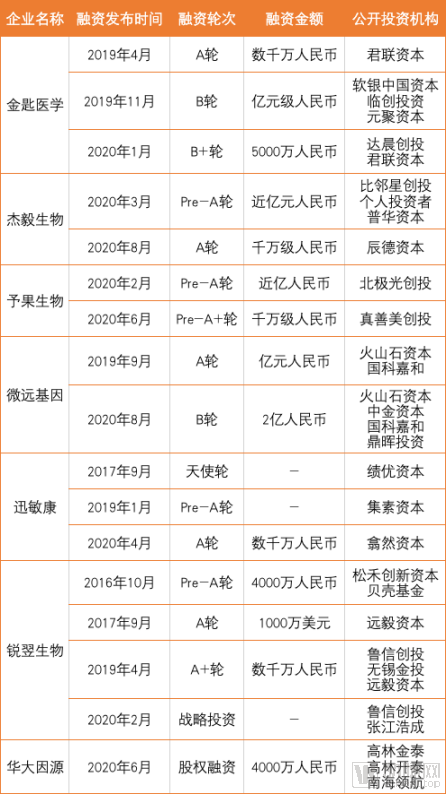
Financing Status of Various Companies (Data Compiled from Public Sources)
In October 2016, Sinovation Capital and Beike Fund completed their Pre-A round of financing for Ruiyi Biology, which can be regarded as the earliest capital injection received by an mNGS project. At that time, however, mNGS was merely one component of the personalized omics big data analysis solutions provided by Ruiyi Biology.
In fact, it was not until the completion of a new round of strategic financing in February this year that RayBiotech mentioned its mNGS testing product as an independent pipeline within its disease diagnostics business segment and stated for the first time that the funds would be used for clinical registration approval and market promotion of this product. Over the past three years, institutions such as Yuan Yi Capital, Luxin Venture Capital, Wuxi Financial Investment Group, and Zhangjiang Haocheng have successively invested in RayBiotech to position themselves in the mNGS sector. Among them, Yuan Yi Capital and Luxin Venture Capital have sequentially increased their capital injections to support RayBiotech.
The key turning point for the mNGS industry may have occurred in 2019. In that year, BGI Group integrated its mNGS technology team and product pipeline, establishing its controlled subsidiary, BGI Yuan Medical, which focuses on the research, development, and operation of complex infection control solutions using molecular diagnostic technologies.
BGI Genomics is the pioneer in applying mNGS technology in China, rapidly capturing a major share of the market within a few years through its flagship product, PMseq®. After becoming an independent entity, BGI Genomics accelerated performance optimization for PMseq® and its accompanying bioinformatics analysis pipeline, enhancing analytical efficiency and reducing turnaround time. It also upgraded the PMseq® bioinformatics workstations and related software for various sequencing platforms. While facilitating localized pathogen detection, the company completed the development of an international interpretation database and an automated report interpretation workflow. In 2020, BGI Genomics formally began its expansion into overseas markets, aiming to compete in the global mNGS market.
For an emerging industry, the benchmarking effect of moves by industry giants is self-evident. According to industry insiders, BGI Genomics rapidly completed two rounds of financing, with top-tier institutions such as Sequoia Capital and Lilly Asia Ventures all entering the fray. In April 2019, VCBeat exclusively disclosed that Legend Capital led the Series A financing for Jinshi Medical as the sole lead investor. This was a representative investment in the mNGS field; many investment firms and technical teams began to focus closely on the new opportunities arising from the integration of NGS technology with severe infection diagnosis only after this transaction was disclosed. From reports at the time, we can also observe the mutual probing between mNGS product teams and investment institutions during that phase.
Dr. Jiang Zhi, founder of Jinshi Medicine, once stated that after the company initiated its fundraising efforts, it attracted outreach from numerous leading institutions with strategic footprints in gene sequencing and medical diagnostics. Leveraging their professional expertise in genetic testing and diagnostics, these institutions keenly recognized the value of Jinshi Medicine. Regarding the ultimate decision to partner with Legend Capital, Dr. Jiang cited three key reasons: First, Legend Capital boasts a strong brand reputation and has established systematic investments across many segments of the healthcare industry; second, Legend Capital’s healthcare team possesses unique insights into both diagnostic reagents and genetic testing; and third, they aim to expand their strategic presence in this field.
Clearly, the mNGS field more than a year ago was still a blue ocean market.
Since 2020, prominent investment firms specializing in the healthcare sector—including Fortune Venture Capital, Proxima Ventures, Puhua Capital, Chende Capital, Volcanic Stone Capital, CAS Star, and CDH Investments—have actively entered the field. During this period, mNGS financing has exhibited two notable characteristics: exceptionally short intervals between funding rounds for invested projects, and a high frequency of closely spaced financing events.
From the perspective of disclosure timelines, the interval between Jinsi Medicine’s Series B and Series B+ financing rounds was no more than three months; Jieyi Biology completed its Pre-A and Series A rounds within five months; and Yuguobio announced its Pre-A and Pre-A+ financing within a six-month period. Given that companies do not necessarily make public announcements immediately upon closing equity transactions, the actual completion dates of these financings may have been earlier, with even shorter intervals between rounds. In February, Yuguobio and Ruiyi Biology sequentially announced their financing news; in August, Jieyi Biology and Weiyuan Biology followed suit. Weiyuan Biology’s Series B round raised as much as RMB 200 million, pushing capital attention in the mNGS sector to a peak.
An investor from a Series B funding institution for Weiyuan Gene told VCBeat that this investment was one of the more challenging deals in his career, due to intense competition among investment firms. “We ultimately managed to enter the deal, with some element of luck involved.” This investment firm is already well-known within China’s healthcare investment circle, and the investor himself has many years of deep expertise in pathogenic microbiology testing. Additionally, Ma Zili, a former investor at Northern Light Venture Capital, recalled that the decision to invest in Yugu Bio was made in a very short time. “Northern Light has extensive experience and has invested across all core sectors of NGS. After analyzing and comparing mNGS projects on the market, based on our recognition of the strength of Yugu’s Chinese and U.S. teams and the distinct advantages of its products, we issued a term sheet and provided bridge financing to secure the deal.”
Yuan Shuo, Investment Director at Qingtong Capital, analyzed that after several years of development, the mNGS industry has begun to differentiate, with leading companies emerging that hold significant advantages in technology, algorithms, data volume, distribution channels, and regulatory approval.
Furthermore, the introduction of the registration-based IPO system on the STAR Market and the ChiNext Board has provided clear exit pathways for innovative projects. Some institutions focusing on late-stage investments and willing to accept high valuations have become increasingly active. “With clear exit channels established and leading players emerging in industry development, institutions are more willing to bet on companies that have developed significant technological and market advantages. Essentially, this reflects a Pre-IPO investment logic,” Yuan Shuo told VCBeat.
VCBeat has learned that although investment institutions have accelerated their pace of deployment, the mNGS investment landscape remains a buyer’s market. Except for a very small number of leading projects that can select investors at relatively later stages, project sponsors are generally in a relatively passive position when it comes to investment decisions.
From the perspective of overall development, the mNGS industry is still in its infancy. On one hand, most practitioners have not been in the field for very long; some have only recently transitioned from other industries, and their understanding of pathogenic microorganisms as well as their clinical experience require further accumulation. On the other hand, clinicians’ awareness of mNGS is just beginning to take shape. “A clinical expert once described mNGS technology as opening a window for pathogen identification, simplifying diagnosis and revealing medical evidence that was previously unconsidered,” Ma Zili told VCBeat. He emphasized that clinicians and gene sequencing teams should work in close coordination to foster broader recognition of mNGS technology.
After leading Aurora’s investment in Yuguo Biotechnology’s Pre-A financing round, Ma Zili left Aurora to become the Chief Operating Officer (COO) of Yuguo Biotechnology. “Once clinicians recognize the advantages of new technologies, the technical team needs to collaborate with them to conduct more research, identify additional patterns in etiology, and continuously optimize the product.” This implies a need for sustained capital investment and data accumulation. Compared to NIPT and small-panel tumor sequencing products, mNGS still has a long way to go in terms of maturity, requiring the entire industry to devote itself to in-depth research and development.
In the relatively early stages, mNGS companies need to purchase equipment, develop products, and build technical teams. When purchasing gene sequencing platforms and reagents, whether choosing imported or domestically produced equipment, it involves an investment of millions of dollars. The early development of products requires repeated validation, and mNGS companies in the mid-to-lower segments of the gene sequencing industry chain have very limited bargaining power with upstream suppliers, making it difficult to control cost growth. Additionally, as an emerging industry, mature mNGS development talent is relatively scarce, and the establishment and training of technical teams also represent a significant investment.
By the mid-stage of the project, capital investment required for data accumulation and clinical trials increases sharply. According to Wang Jun, founder of Jieyi Biotechnology, unlike NIPT products, which have relatively concentrated application scenarios, and tumor NGS products, which face a lower ceiling on sample volume, mNGS covers a very broad range of sample types and accumulates data rapidly. Whether for interpreting sample data or conducting comparisons against standardized databases, the scale of data processing is substantial, resulting in correspondingly higher costs compared to the other two applications.
As mNGS projects enter a more mature phase, they will also face capital investment requirements for regulatory compliance and market promotion. It is understood that although there is still a long way to go for product registration and approval, regulators place great emphasis on the compliant application of mNGS technology in scientific research and clinical practice, and several leading projects are actively cooperating in the formulation of relevant technical standards for mNGS. A senior industry practitioner told VCBeat that since 2018, the National Institutes for Food and Drug Control (NIFDC), as the technical support department of the Center for Drug Evaluation (CDE) under the National Medical Products Administration (NMPA), has organized related enterprises to conduct joint research on mNGS reference materials for three consecutive years.
“Regulating new technologies and new products inevitably requires innovative rules,” said Ma Zili. “Such rules will inevitably become clearer through continuous interaction between enterprises and regulators, which is why participation from all parties has been very high.”
As a result, most companies in the industry are currently operating at a loss or barely breaking even. Except for a few listed companies that are profitable and able to raise funds in the secondary market, the majority of firms essentially require capital support to sustain their growth. “In fact, companies in the mNGS sector are generally engaged in long-term financing processes, reflecting a very strong overall demand for capital,” an industry practitioner told VCBeat.
Over the past two years, particularly since 2019, the growth rate of investment in China’s primary market has slowed, making overall fundraising significantly more challenging. Amidst this environment characterized by difficult access to capital, prolonged fundraising cycles, and stringent terms, many mNGS projects continue to face substantial funding gaps.
Capital does not enter an industry blindly; the clinical demand for newer and better infection detection methods is extremely strong.
First is policy promotion. In recent years, the state has paid increasing attention to the issue of antibiotic abuse. The National Health Commission has issued a series of notices on the rational use of antimicrobial drugs in recent years, requiring medical institutions at all levels to attach greater importance to the rational use of antimicrobial drugs, organize various types of training to enhance physicians’ and pharmacists’ knowledge regarding the rational use of these agents, and proposing that monitoring antimicrobial drug concentrations in patients is also an important measure for implementing their rational use.
Following the issuance of the Notice on Continuously Strengthening the Clinical Application Management of Antibacterial Drugs on March 29, 2019, the National Health Commission released a draft for comments of the Notice on Strengthening the Clinical Application Management of Antibacterial Drugs under the New Situation on June 8, 2020. The draft explicitly stated that the construction of clinical laboratories should be strengthened to improve microbiological testing capabilities, and that rapid diagnostic technologies should be actively explored to enhance the diagnostic efficiency of infectious diseases.
Furthermore, the National Health Commission issued the "Letter on Soliciting Opinions on Construction Standards for Centers for Disease Control and Prevention," which establishes construction standards for CDCs across six dimensions and specifies requirements for specialized laboratories, such as PCR and NGS laboratories, as well as the configuration of large quantities of IVD instruments and equipment. Additionally, the National Health Commission’s "Notice on Comprehensively Advancing the Construction of Community Hospitals" designates strengthening the capacity for early detection and reporting of infectious diseases as one of the primary tasks in community hospital development.
Secondly, as one of the leading causes of morbidity and mortality worldwide, infectious diseases have presented increasingly complex diagnostic and therapeutic challenges over the past decade. This is driven by the emergence of novel pathogens (such as Severe Acute Respiratory Syndrome [SARS], Middle East Respiratory Syndrome [MERS], Ebola virus, avian influenza, swine influenza, Zika virus, and SARS-CoV-2), the rising prevalence of drug-resistant microorganisms, and the growing population of immunocompromised hosts. In particular, severe infections are characterized by acute onset, rapid progression, and complex etiologies. Therefore, the timely identification of causative pathogens is critical, creating an urgent demand for highly efficient and precise infectious disease diagnostics.
However, current infection detection methods have significant limitations.
First, the cultivation cycle is long, and success is not guaranteed. In-hospital testing primarily employs mass spectrometry and PCR. Mass spectrometry requires prior culture, a process that often takes several days; many pathogens are difficult to culture, making failure common. While certain PCR assays can bypass culture, they are limited to small panels, detect only a narrow range of pathogens, and serve mainly to rule out infections.
Second, there is insufficient capability for functional indicator analysis. Infection detection requires virulence/pathogenicity analysis, resistance mechanism (genetic) analysis, and infection/colonization analysis. Only with the results of functional indicator analysis can medication be guided more precisely, avoiding practices such as empirical and exploratory drug use. However, current infection monitoring primarily conducts qualitative analysis, failing to achieve virulence/pathogenicity analysis or distinguish between colonizing bacteria and pathogenic bacteria.
Third, only a limited number of specific pathogens can be detected. Traditional gold-standard analytical methods are restricted to detecting predefined target pathogens and are unable to identify unknown ones. Furthermore, due to constraints in cost and technical principles, achieving broad-spectrum detection is challenging. It has been reported that the causative pathogens remain unidentified in approximately 40% of gastrointestinal infections, 50% of bloodstream infections (BSI), and over 50% of central nervous system (CNS) infections. Infectious diseases of unknown etiology, such as respiratory infections of undetermined cause, also account for a significant proportion of cases. Therefore, timely and effective diagnosis is essential for the control of infectious diseases.
mNGS technology can, to a certain extent, provide solutions to these drawbacks. On one hand, mNGS bypasses the culture step and proceeds directly to sequencing analysis, which not only saves time spent on cultivation but also avoids the risk of culture failure. On the other hand, due to its platform characteristics, mNGS technology can address the challenges of detecting unknown pathogens and achieving broad-spectrum coverage. If an effective method can be developed to distinguish human background sequences from true pathogens, next-generation sequencing holds promise for resolving issues related to the functional analysis of virulence and drug resistance markers. Zhong Jing, Vice President of Investment at Cathay Capital, has been dedicated to the research and application of mNGS technology since his doctoral studies. He told VCBeat that in recent years, with the market launch of domestically produced gene sequencers, the cost of mNGS applications has decreased rapidly. Furthermore, the continuous output of additional research findings has enhanced the practical utility of mNGS.
However, perhaps having witnessed the fierce competition in the genetic testing market, project teams have remained relatively calm despite favorable capital conditions and clear demand. From their perspective, many issues still need to be resolved before mNGS can be widely adopted in clinical practice. Typically, in the very early stages of project development, due to significant uncertainties, founding teams and investors are more likely to reach consensus and jointly drive product and business formation. As projects progress into later stages, the cost of entry for investors increases, leading them to seek quicker returns on capital.
Multiple mNGS projects have expressed their concerns to VCBeat. They worry that if the industry develops at an excessive speed, it may lead to distortions and create a bubble, with necessary product optimization efforts being overlooked, thereby hindering the healthy development of the sector. On a positive note, when asked about their recent activities, these mNGS projects, which have just secured significant funding, all highlighted their close engagement with clinicians. Leveraging their teams’ technical expertise, they are optimizing their products and striving to become effective tools for clinical practitioners.
Therefore, despite the tailwinds from the COVID-19 pandemic and capital-driven restructuring, whether mNGS can truly thrive must ultimately be answered by its clinical application scenarios.
References
Caixin Exclusive | Tracing the Origins of the Novel Coronavirus Through Gene Sequencing: When Was the Alarm Sounded?
A Discussion on mNGS in Light of BGI’s Announcement
BGI Genomics 2020 Semi-Annual Report