

LingVision Technology Files IPO Prospectus: Pioneering High-Speed Imaging Flow Cytometry for Thrombosis and Breast Cancer Detection
Cells are the basic units of the human body.
The advancement of modern medicine is closely intertwined with cellular science. As the medical community’s understanding of cells deepens, physicians have gained more profound insights into diseases, thereby pioneering innovative therapeutic approaches such as CAR-T and TCR-T cell therapies.
With the advancement of science, an increasing number of medical devices and instruments have been applied to cell analysis, such as fluorescence-based flow cytometry and image-based flow cytometry. However, these instruments exhibit certain limitations in cell analysis, including limited information acquisition and low detection throughput. Therefore, the development of high-speed, high-throughput flow cytometry technology is of significant importance.
High-speed cell detection has long been one of the most challenging tasks in fields such as biology and medicine. By enabling rapid imaging to screen vast numbers of cells, this technology facilitates the early detection of numerous diseases and biological processes, thereby buying valuable time for treatment. Consequently, high-speed cell detection continues to maintain strong momentum and vitality within the research community.
Currently, multiple innovative companies worldwide are making concerted efforts to advance ultra-high-speed flow cytometry imaging and analysis technology, which is characterized by comprehensive data acquisition, high speed, high resolution, and high throughput. Tianjin LingVision Technology Co., Ltd. (hereinafter referred to as “LingVision”) is one such company, holding a leading position in product development and commercialization.
LingShi Technology is the only team in China leveraging optoelectronic imaging, artificial intelligence, microfluidics, and image processing technologies for high-speed intelligent cell analysis. Through its independently developed technologies, it provides breakthrough imaging flow cytometers to address multiple needs in the fields of cell analysis and systems biology. Established with the support of the Tianjin Electronic Information Research Institute of Tsinghua University, LingShi Technology is committed to delivering intelligent services for cell analysis by utilizing optoelectronic imaging and AI technologies. It offers technical support and product services to various enterprises involved in life science cell detection and biopharmaceuticals.
It is reported that in the finals of the “2020 ‘Maker Guangdong’ Biopharmaceutical SME Innovation and Entrepreneurship Competition,” hosted by Guangdong Medical Valley, LingVision Technology achieved outstanding results with its ultra-high-speed flow cytometry imaging analyzer. Chen Hongqiang, CEO of LingVision Technology, stated, “Through this competition, we have connected with numerous entrepreneurs and investors in the healthcare industry, laying a solid foundation for future collaborations.”
Flow cytometers are devices for the automated analysis and sorting of cells, capable of rapidly measuring and analyzing biological, physical, and biochemical data and characteristics of cells. For example, flow cytometers can analyze cell surface markers, intracellular antigens, cell receptors, DNA and RNA content in tumor cells, and immune cell function.
Currently, in the traditional flow cytometry market, imported products hold a significant market share. Foreign companies such as Beckman and BD firmly dominate the domestic tertiary hospital market, while domestic brands are making continuous breakthroughs and extensively expanding their presence in secondary hospitals and other primary healthcare institutions.
Chen Hongqiang, CEO of LingShi Technology, stated, “The market potential for cell analysis is vast. The global market size for fluorescent cell analysis is projected to grow from $6.7 billion in 2018 to $14.5 billion in 2023, representing a compound annual growth rate (CAGR) of 16.9%. LingShi Technology’s ultra-high-speed flow cytometer features high throughput. In the future, beyond entering the traditional cell analysis market, it will more importantly tap into incremental demand markets valued at hundreds of billions or even trillions of yuan, thereby expanding into new application scenarios.”
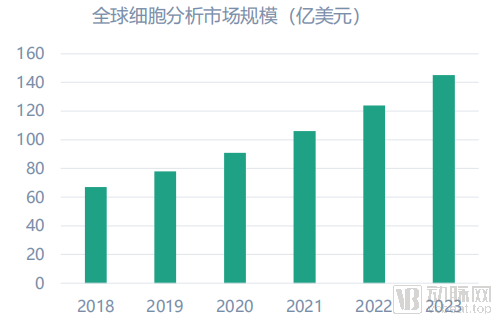
(Data source: Lingshi Technology)
According to reports, the ultra-high-speed flow cytometry imaging analyzer can detect any flowing liquid. For instance, in the medical field, this instrument can be applied in scenarios such as thrombosis screening, intraoperative detection of massive hemorrhage, cerebrospinal fluid cell imaging, breast cancer detection, and high-throughput biological experiments. Chen Hongqiang stated, “The ultra-high-speed flow cytometry imaging analyzer can detect and analyze any pathological conditions manifested at the cellular level. This is because the device scans all cells in the blood and compares them against the cell library established by Lingvision Technology, enabling the timely identification of diseased cells that are otherwise difficult to detect.”
Chen Hongqiang stated, “The ultra-high-speed flow cytometry imaging analyzer is an innovative detection technology. It does not replace any existing technology or product; rather, it adds a new detection modality to complement current methods and address their limitations.”
Currently, most detection technologies are unable to achieve high-throughput monitoring. For instance, image-based flow cytometry is limited by the performance of imaging sensors such as CMOS and CCD, restricting its cell screening rate to 1,000 cells per second and thus precluding large-scale cell analysis. In contrast, ultra-high-speed flow cytometric imaging analyzers leverage high-speed fiber-optic communication, microwave photonics, and optical signal processing technologies, integrated with biomedical techniques, to achieve a breakthrough in traditional cellular imaging speeds, increasing the throughput to 1 million cells per second.
Traditional flow cytometry techniques, such as fluorescence-based flow cytometric analysis, offer high detection accuracy but rely heavily on fluorescent staining. This results in relatively limited information acquisition and significant constraints. In contrast, ultra-high-speed imaging flow cytometers integrate flow cytometric detection with microscopic imaging, providing both statistical data on cell populations and images of individual cells, thereby delivering comprehensive information on cellular morphology, cellular structure, and subcellular signal distribution.
It is understood that Lingvision Technology has completed the industrial design and core system architecture of its products and is currently conducting cell analysis and detection in specific application scenarios. At present, Lingvision Technology is collaborating with Zhongnan Hospital of Wuhan University on clinical testing for leukemia, with Beijing Aerospace General Hospital on scanning and imaging detection of malignant tumors of the central nervous system, and with Peking University People’s Hospital on the detection of circulating tumor cells in breast cancer, histological cell classification, and drug experimentation. In addition, Lingvision Technology is engaged in testing collaborations and data processing with institutions such as the 302 Hospital, Beijing Anzhen Hospital, Beijing Tsinghua Changgung Hospital, and selected water quality laboratories.
Chen Hongqiang revealed, “The ultra-high-speed flow cytometry imaging analyzer is expected to obtain the medical device registration certificate between late 2021 and early 2022.”
Compared with other products, LingShi Technology’s ultra-high-speed flow cytometry imaging analyzer features the following advantages: high-resolution cellular images; non-toxic and non-destructive to cells, allowing analyzed cells to be used for subsequent analysis and research with multi-dimensional feature extraction; rapid and efficient analysis with high throughput, high sensitivity, and strong specificity, capable of measuring one million cells per second while reducing detection time to one-fourth; high accuracy in detecting early-stage diseases through blood, saliva, and urine samples, offering significant advantages in pharmacological research.
The LingVision Technology R&D team deserves much of the credit for enabling ultra-high-speed flow cytometry imaging analyzers to deliver these advantages. Chen Hongqiang believes, “LingVision Technology’s core competitiveness lies in its talent.” The core team members at LingVision Technology possess complementary expertise across multiple disciplines, including optoelectronics, information technology, and biomedical technology. Their strong synergy and collaborative spirit have endowed the company with robust capabilities in equipment development. For instance, Chen Hongqiang, CEO of LingVision Technology, previously served as a senior executive at a publicly listed company and founded a biological reagent company, accumulating extensive experience in business operations, project management, and market operations.
Chen Hongwei, founder of LingVision Technology, is a tenured professor, doctoral supervisor, and Assistant Dean in the Department of Electronic Engineering at Tsinghua University. His primary research areas include optoelectronic technology, integrated optoelectronic chips, and spectral information processing and sensing. Lei Cheng, co-founder of LingVision Technology, holds a Ph.D. from the Department of Electronic Engineering at Tsinghua University and serves as a Professor at the Industrial Research Institute of Wuhan University. With many years dedicated to the exploration and research of high-speed imaging technology and its applications, he has successfully pioneered the application of high-speed imaging systems in the biomedical and environmental fields, accumulating extensive experience in research and development as well as engineering practice.
After years of research and development, Lingvision Technology has achieved multiple world-leading technological breakthroughs in broadband adaptive light sources, multi-dimensional dispersion chips, all-optical compressed sampling, high-speed sheathless cell motion control, and high-speed, non-destructive cell sorting. These achievements have not only enhanced the core competitiveness of its ultra-high-speed flow cytometry imaging analyzer but also established formidable technical barriers, thereby safeguarding and facilitating the growth and expansion of Lingvision Technology.
In terms of application, LingVision Technology plans to initially focus on thrombus detection and drug sensitivity testing for breast cancer cells. The decision to prioritize the fields of thrombosis and breast cancer is driven by the large patient populations, urgent clinical needs, and strong recognition among clinicians of ultra-high-speed flow cytometry imaging analyzers. Once the product achieves rapid adoption and generates revenue, LingVision Technology will develop additional products to expand the deployment of its ultra-high-speed flow cytometry imaging analyzer into other niche sectors.
Currently, Lingshi Technology is conducting a new round of financing, with an amount of 20 million yuan, primarily for clinical trials, product assembly, and mass production.
About the 2020 Maker Guangdong · Biomedicine Special Competition
The 2020 “Maker Guangdong” Biopharmaceutical SME Innovation and Entrepreneurship Competition, guided by the Guangdong Provincial Department of Industry and Information Technology and the Guangdong Provincial Department of Finance, and hosted by Guangdong Medical Valley, focused on the biopharmaceutical sector. With over 100 project registrations, the competition comprised five online preliminary rounds and one offline specialized final round. Twelve high-quality projects were recommended to advance to the provincial semi-finals, all of which ranked within the top 10 in their respective Enterprise and Maker categories.
Guangdong Medical Valley is a service provider for medical industry clusters, specializing in investment and incubation within the biopharmaceutical and medical device sectors. Its first medical industrial park, located in Nansha, Guangzhou, is a key municipal project with a total gross floor area of 180,000 square meters. To date, it has attracted more than 180 enterprises, including two founded by academicians of the Chinese Academy of Sciences/Chinese Academy of Engineering and 13 selected for national-level major projects. Leading companies such as Edigene, Genetron Health, and Tiankoya have been introduced, covering various sub-sectors including biopharmaceuticals, gene editing, vaccines, immunotherapy, high-end medical devices, stem cells, and medical industry funds. The park is committed to building a world-class international innovation center for the medical industry.