

Microsoft Online Forum Highlights Digital Innovations in Lung Cancer Diagnosis and Treatment
The advancement of digital technologies is gradually driving transformation in the healthcare industry. In the course of transitioning toward digital diagnosis and treatment, pharmaceutical and medical device companies are converging with digital technology firms, seeking synergies between the two sectors, breaking down inter-industry barriers, and collaborating closely to ultimately achieve the digital transformation of diagnosis and treatment.
As a global leader in digitalization, Microsoft has continued to focus on digital innovation in the healthcare sector in recent years.
On June 8, 2020, Microsoft hosted the inaugural online forum titled “AI-Assisted Healthcare: Transformation and Breakthrough.” Attendees focused on three key topics: AI-driven digital technological innovations in the pharmaceutical industry, opportunities and market potential for digital innovation in pharmaceuticals, and challenges and solutions in applying digital technologies. From their respective perspectives, the panelists interpreted the current progress and future directions of digital transformation in the pharmaceutical industry.
On September 17, 2020, from 14:00 to 16:00, the exclusive online forum “AI-Powered Cardiac Care: Transformation and Breakthrough—Microsoft Empowering Digital Transformation in the Healthcare Industry” will be held again. This forum will focus on the digital transformation of diagnosis and treatment for lung cancer, once again joining forces with numerous distinguished experts from various specialized fields. Through a more open discussion format, it will explore new digital scenarios within the digitalized diagnostic and therapeutic pathways for lung cancer (see the end of this article for participation details).
“Every global technological wave has never left the life sciences industry behind,” said Tony Liu, IT Director at BMS, at a previous forum. “Just like electronic medical records and cloud technology, the pharmaceutical industry will eventually embrace the wave of digitalization.”
Many participants in the inaugural forum have already perceived the changes that digital transformation will bring to the healthcare industry. For instance, Dr. Gu Chengming, Medical Affairs Officer at Sanofi, stated that Sanofi is currently implementing a comprehensive, top-down digital transformation. This transformation is expected to drive significant changes primarily in two key areas: pharmaceutical marketing and the mining of medical evidence.
The digital transformation of the pharmaceutical industry cannot be achieved without collaborative synergy within the sector. Microsoft has consistently played a supportive role in this digital transition.
Regarding the current state of digitalization in the pharmaceutical industry, Keren Priyadarshini, General Manager of Microsoft’s Life Sciences and Healthcare sector for Asia Pacific, shared insights on Microsoft Cloud for Healthcare, the company’s first industry-specific cloud offering. Using the collaboration between Microsoft and Novartis as an example, she briefly introduced the application of digital approaches in innovative drug research and development.
He Lei, General Manager of the Healthcare Industry at Microsoft Greater China, added several points here. Microsoft’s platform can help users achieve data interoperability and connectivity, particularly enabling seamless integration of people, devices, data, and processes amid surging data volumes. As a technology company, Microsoft possesses deep expertise in natural language processing and deep learning, fostering the development of more refined applications. Furthermore, Microsoft maintains an open mindset, collaborating with ecosystem partners on its platform to build superior industry-specific solutions.
“In the fully digitalized society we are about to enter, Microsoft provides underlying platform capabilities and productivity capabilities.” Wei Qing, CTO of Microsoft China, distilled Microsoft’s empowerment of healthcare digitalization into this single sentence.
The theme of this forum stems from a dialogue between Johnson & Johnson and Microsoft.
Ms. Jennifer Yang, Head of Johnson & Johnson’s Lung Cancer Center in China, and Mr. Zhang Qiang, Director of Digital Transformation and AI Strategy for Microsoft Greater China, previously engaged in an open discussion on the development direction of digital transformation in healthcare in China, focusing on the digital diagnosis and treatment of lung cancer from their respective perspectives.
Johnson & Johnson is one of the most comprehensive and widely diversified healthcare companies in the world, with operations spanning three major sectors: medical devices, pharmaceuticals, and consumer health. From the establishment of the Johnson & Johnson Lung Cancer Initiative to the launch of the first Lung Cancer QuickFire Challenge in China by JLABS in 2019, and through a range of ETHICON thoracic surgical devices designed to meet patient needs, Johnson & Johnson has remained committed to advancing the prevention, interception, and treatment of lung cancer both in China and globally.
“We can already see the key pain points in the field of lung cancer. The main reason why lung cancer still ranks among the top cancers in terms of both incidence and mortality is that approximately 70% of patients are already at stage III or IV when diagnosed. At this stage, achieving a complete cure for patients remains difficult, even though we now have an increasing number of treatment options,” Jennifer explained to us.
Although Microsoft has not been active in the healthcare sector for long, it has always maintained close ties with the medical industry.
In the discussion, Zhang Qiang stated that as an enabler of digital transformation in the healthcare industry, Microsoft leverages its extensive experience and technological platform advantages to provide the pharmaceutical sector with optimal pathways for digital transformation, thereby facilitating a smooth transition. Microsoft’s strengths in digital tools and artificial intelligence are increasingly integrating with the healthcare and medical fields, delivering newer and better digital solutions to this sector.
At the conclusion of the dialogue, both parties reached a consensus to continue their collaboration by inviting more industry guests to discuss the development prospects of lung cancer diagnosis and treatment in China through an online forum. This agreement served as the impetus for the current forum. As a continuation of that earlier dialogue, this forum will further explore the digital transformation of lung cancer diagnosis and treatment, engaging with additional industry stakeholders to identify future trends in the sector.
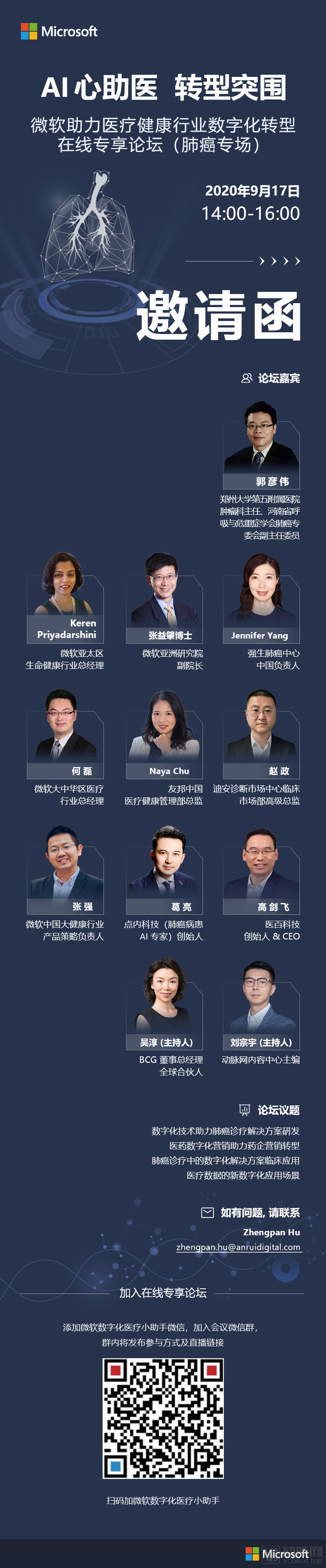
Forum Topics
• Module 1: Digital Technologies Empowering the R&D of Solutions for Lung Cancer Diagnosis and Treatment
Digital technologies are progressively permeating every aspect of lung cancer diagnosis and treatment solutions. Although pharmaceutical companies’ in-house digital R&D capabilities remain relatively weak, a large number of external partners and platforms are actively assisting them in achieving this end-to-end digital transformation.
• Module 2: Digital Pharmaceutical Marketing Facilitating Marketing Transformation for Pharmaceutical Companies
The adoption of digital marketing enables pharmaceutical companies to achieve superior promotional outcomes at lower costs, thereby sustaining their marketing capabilities even as gross margins are compressed. By leveraging physician academic profiles and communication channel preferences provided through digital marketing platforms, intelligent recommendations for remote engagement strategies and action plans can be generated to optimize marketing effectiveness.
• Module 3: Clinical Application of Digital Solutions in the Diagnosis and Treatment of Lung Cancer
Digital solutions have already permeated various scenarios in the clinical diagnosis and treatment of lung cancer. For instance, the emergence of Internet of Things (IoT) technology has integrated diverse data generated during clinical care, such as medical laboratory test results and patient vital signs, thereby upgrading the collection and storage of clinical data. Furthermore, the introduction of digital technologies into minimally invasive surgery has enhanced the precision and efficiency of minimally invasive treatments.
• Module 4: New Digital Application Scenarios for Healthcare Data
Technological advancements have led to more standardized and structured medical data. In-depth analysis of clinical research data, patient data, and medical laboratory test data transforms them into new knowledge and insights for the healthcare industry. The changes driven by big data are not only evident in the development of lung cancer diagnosis and treatment data but also permeate every aspect of the healthcare sector.
Participation Method:
Add the Microsoft Digital Health Assistant on WeChat to join the conference’s WeChat group, where participation instructions and the live-streaming link will be posted.

Scan the QR code to add Microsoft Digital Healthcare Assistant