2020 CDSS Industry Research Report: From Rating Compliance to Clinical Workflow Integration, the CDSS Sector Accelerates Toward Its Second Leap
In recent years, with the gradual improvement of informatization and intelligence in the healthcare industry, Clinical Decision Support Systems (CDSS) have received increasingly widespread attention.
Prior to 2018, the demand for Clinical Decision Support System (CDSS) products among healthcare institutions varied significantly. In 2018, the National Health Commission of China launched initiatives to further advance hospital informatization centered on electronic medical records (EMR), substantially increasing the mandatory demand for CDSS procurement and propelling the industry into a phase of explosive growth. During this period, CDSS-related companies worked simultaneously to refine their products to meet EMR grading requirements for healthcare institutions and to explore in-depth application scenarios, developing next-generation CDSS solutions to provide more precise support for clinical practice.
In this context, VCBeat has surveyed 15 companies involved in Clinical Decision Support Systems (CDSS). By integrating insights on the current stage of industry development, policy landscape, and market dynamics, VCBeat is releasing a CDSS Industry Report. This report analyzes commercialization progress, business models, and market potential, aiming to help enterprises, investment institutions, and healthcare organizations better observe development trends.
1. Policies on healthcare informatization lay the foundation for the CDSS industry, while grading policies bring about an industry turning point;
2. Hospital grading, IT system upgrades, and supplementation of primary healthcare resources have become the three major demands in the CDSS market;
3. Established IT enterprises, AI and big data companies, medical institutions, universities, and research institutes are all actively participating in the development of the CDSS industry, although their levels of engagement vary significantly;
4. The CDSS industry has entered the stage of large-scale product implementation, with an accelerated commercialization process; the free trial model is gradually phasing out of the market;
5. At present, large hospitals are the primary purchasers of CDSS products, while there is still room for expansion in the primary care market; from a regional perspective, the markets in central and western regions remain to be further developed;
6. As the integration of knowledge bases with artificial intelligence deepens, the scope of the Clinical Decision Support System (CDSS) concept is expanding, application scenarios are continuously increasing, and a new generation of CDSS is emerging. Quality control for single diseases and deep integration into Hospital Information Systems (HIS) represent two major development directions.
Clinical Decision Support Systems (CDSS) first emerged in the 1950s, initially known as medical expert systems, which aimed to simulate the capabilities of medical experts through computational methods. Over the subsequent 70 years, CDSS has undergone three developmental stages both domestically and internationally, with each stage bringing epoch-making innovations to the field.
In contrast, the adoption of Clinical Decision Support Systems (CDSS) in China started later. The year 1996 marked the inception of medical informatization in China. Over the past two decades, CDSS products have gradually evolved domestically to cater to diverse clinical scenarios and serve physicians at various levels.
2014 can be regarded as the second phase. Various factors jointly promoted the development of the medical IT sector, particularly in the subfields of automation and intelligent healthcare. There was a significant increase in enterprises focusing on the research and development of Clinical Decision Support Systems (CDSS), while existing medical informatics companies also increased their investments in the CDSS direction.
Since 2018, China’s clinical decision support system (CDSS) market has experienced a commercial boom. Two years on, dozens of companies now operate independent CDSS businesses or projects, having developed personalized CDSS products. Today, these solutions have been deployed in major hospitals and primary healthcare institutions, helping to address challenges such as physician shortages and varying levels of diagnostic proficiency.
Years of development experience essentially represent a process of continuous trial and error for enterprises. From the evolution of Clinical Decision Support Systems (CDSS), two critical factors driving industry advancement are the depth of integration with other clinical systems and the practical utility of the technology.
Policy Landscape: Rating Policies Propel the Industry into the Fast Lane
As an important branch of healthcare informatization, although there is no independent policy driving the development of CDSS, it has been mentioned in many informatization-related policies. VCBeat divides these policies into three levels: basic layer, technical layer and application layer. Among them, the application layer has played the biggest role in promoting the industry.
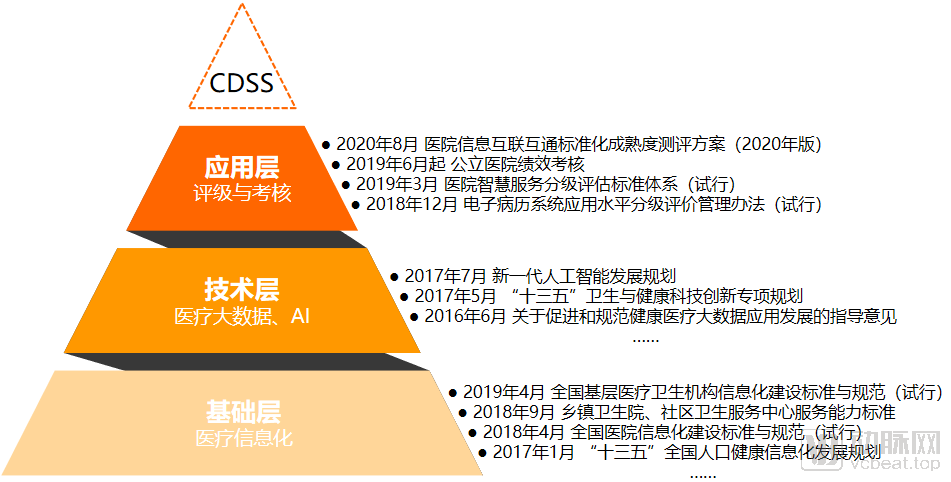
Policies Related to CDSS; Source: The Chinese Government Website and the Official Website of the National Health Commission; Graphic by VCBeat
Basic-Layer PoliciesPolicies related to healthcare informatization are the most numerous and were introduced earliest. Early healthcare informatization policies promoted the widespread application of information technology in medical institutions, progressing from Hospital Information Systems (HIS) to Clinical Information Systems (CIS). Among these, the extensive coverage of clinical information systems has laid a solid foundation for the implementation of Clinical Decision Support Systems (CDSS).
Technical-Level PoliciesThe focus is primarily on medical big data and AI. After long-term accumulation, medical data can be extensively applied in clinical practice, scientific research, and other fields; however, such data often suffer from fragmentation and low levels of structuring. With evolving awareness among hospitals and physicians regarding the value of data, coupled with the rise of big data and artificial intelligence technologies, more effective solutions have emerged for the intelligent processing and application of these data.
Application Layer PoliciesAlthough this level involves fewer policies and was introduced most recently compared to the previous two, it has driven the fastest implementation of CDSS products and exerted the most significant and direct impact on the industry. It primarily includes informatics grading and performance evaluation. Specifically, Electronic Medical Record (EMR) system grading, Smart Hospital grading, and Hospital Information Interconnectivity grading all impose specific requirements on CDSS applications.
Among the three rating programs, the Electronic Medical Record (EMR) grading system has the most extensive requirements for Clinical Decision Support Systems (CDSS). This is because EMRs play a significant role in improving healthcare service efficiency, ensuring medical quality and safety, enhancing patient experience, strengthening healthcare service supervision, and promoting the development of “Smart Hospitals.”
Market Demand: Rating, Information Technology Iteration, and Supplementing Primary Healthcare Resources
From the perspective of accreditation requirements and other hospital needs, tertiary hospitals had an urgent demand for Clinical Decision Support Systems (CDSS) before 2020; after 2020, demand in the primary care market and for specialty-specific CDSS further emerged.
Rating Requirements.In accordance with the National Health Commission’s requirements for electronic medical record (EMR) system grading, all tertiary hospitals were required to achieve a rating of Level 4 or higher by 2020. To avoid adverse impacts on hospital performance evaluations, achieving the mandated EMR grade has become the primary driver for public hospitals to procure Clinical Decision Support System (CDSS) solutions, representing the core market demand.
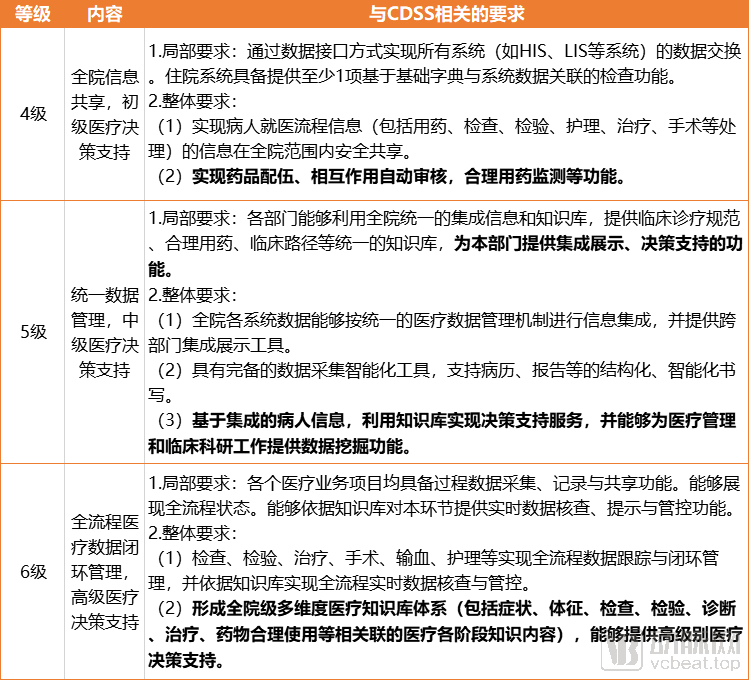
CDSS-Related Requirements in the “Administrative Measures for the Graded Evaluation of Electronic Medical Record System Application Levels (Trial)”
Source: National Health Commission; chart by VCBeat
In August 2020, at the main forum of the China Hospital Information Network Conference (CHINC), Hu Ruirong, Deputy Director of the Medical Administration and Hospital Management Bureau of the National Health Commission, disclosed that in 2019, a total of 7,870 hospitals participated in the electronic medical record (EMR) grading evaluation. Among them, 2,592 were tertiary hospitals, with a participation rate of 95.29%; 114 tertiary hospitals did not participate in the annual evaluation. There were 5,097 secondary hospitals and 181 other medical institutions participating in the evaluation.
The results show that in 2019, the national average rating for electronic medical records (EMR) was Level 2.08, with tertiary hospitals averaging Level 3.11 and secondary hospitals averaging Level 1.59. In 2018, the national average EMR rating was Level 1.74, with tertiary hospitals averaging Level 2.59 and secondary hospitals averaging Level 1.21. Both tertiary and secondary hospitals demonstrated year-on-year improvements and overall progress.
Although the application level of electronic medical records (EMRs) has improved year by year, some tertiary hospitals have yet to participate in the evaluation, and the average score of tertiary hospitals still falls short of the Level 4 requirement stipulated by policy. With more than half of 2020 already passed, the latest participation status and results are not yet available for statistical analysis. However, it is certain that, as a year designated for achieving phased objectives, hospitals that have not yet met the grading standards will make a final “sprint” in the remaining months.
Since 2021, tertiary hospitals have prioritized advancing their Electronic Medical Record (EMR) system ratings. Specifically regarding Clinical Decision Support Systems (CDSS), the focus has been on functional expansion and upgrades. In the absence of new policies mandating timelines for rating advancements, the urgency of CDSS demand among tertiary hospitals is expected to decelerate, with efforts increasingly concentrated on top-tier tertiary Grade A hospitals striving for higher-level EMR ratings.
Requirements for Iterative Upgrades in Information Technology.Approximately a decade ago, top-tier tertiary hospitals in China, such as the China-Japan Friendship Hospital, began implementing rational drug use systems to monitor the prescribing process. The supporting system for this workflow represents the precursor to today’s Clinical Decision Support System (CDSS) “disease knowledge base.”
Based on the tender documents published on the China Government Procurement Network, CDSS has currently evolved into seven major systems—namely, a disease knowledge base, an intelligent triage system, an outpatient physician decision support system, an inpatient physician decision support system, an inpatient nurse decision support system, a diagnostic examination and laboratory testing system, and a single-disease quality control system—thereby extending from pharmacy operations to cover the entire workflow of hospital clinical management.
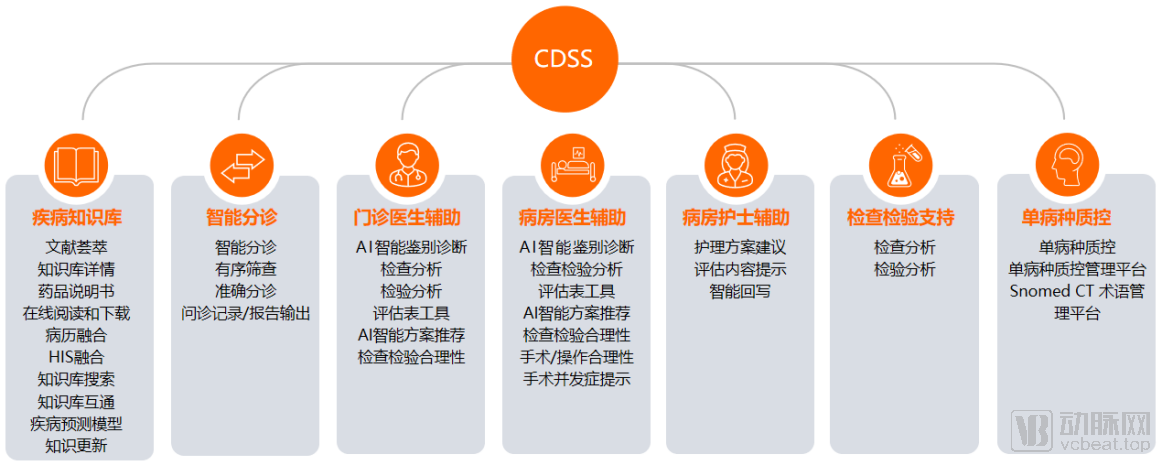
Major Systems Involved in the Procurement of CDSS Products by Tertiary Hospitals. Source: Bidding Documents from the Chinese Government Procurement Network; Chart by VCBeat Institute
Need to Supplement Primary Healthcare Resources.As the needs of tertiary hospitals evolve, the demand for clinical decision support systems (CDSS) in primary healthcare institutions is becoming increasingly apparent.
Driven by policies such as tiered diagnosis and treatment, the service capability requirements for township health centers, and the service capability requirements for community health centers, primary healthcare institutions have also begun to procure general practice versions of Clinical Decision Support System (CDSS) to promote the improvement of medical quality.
Within the tiered diagnosis and treatment system, the sixteen-character principle—“initial consultation at primary care institutions, two-way referrals, separate management of acute and chronic conditions, and coordination between upper- and lower-level hospitals”—implicitly reflects the requirements placed on China’s healthcare system regarding both informatization and clinical capabilities. However, the advancement of tiered diagnosis and treatment is severely hindered by issues such as a shortage of high-quality physicians, uneven distribution of medical resources, and inadequate informatization infrastructure at the primary care level. Against this backdrop, healthcare institutions are increasingly demanding medical artificial intelligence (AI) and Clinical Decision Support Systems (CDSS). The demand at the primary care level stems from an insufficient number of general practitioners and suboptimal clinical proficiency, while the standardization of clinical practice among junior physicians needs improvement. These numerous unresolved challenges have created substantial market opportunities for AI-enabled CDSS solutions.
Both the "Service Capability Standards for Township Health Centers (2018 Edition)" and the "Service Capability Standards for Community Health Service Centers (2018 Edition)," issued by the National Health Commission, include CDSS functionality as one of the criteria for an excellent rating.
Market Landscape: Four Types of Players Have Deployed CDSS to Varying Degrees
From the perspective of core business operations, there are currently four major entities deploying Clinical Decision Support System (CDSS) products in China: established health IT companies, AI and big data firms, internet and technology companies, as well as universities, hospitals, and research institutions. Due to differences in their core businesses, these four groups vary in their competitive advantages and levels of involvement in the CDSS market.
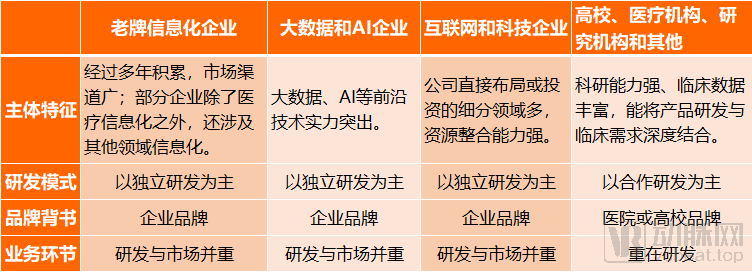
Comprehensive Comparison of Four Types of Stakeholders in CDSS Products. Source: Public information such as corporate official websites; graphic by VCBeat Institute
Established IT Enterprise.Most of these companies were established in the 1990s or the early 2000s, including listed firms such as Neusoft Corporation, Winning Health Technology Group, and Das Intellitech. We reviewed the annual reports of ten listed companies involved in Clinical Decision Support Systems (CDSS) and found that they began to recognize big data, artificial intelligence, and clinical decision-making as emerging technologies and trends starting in 2010. These enterprises have continuously monitored these developments and engaged in research, development, and practical implementation. Most of their related products entered trial or deployment phases after 2017.
AI and Big Data Enterprises.Most of these companies were established around 2014–2015. Their founding and R&D teams possess backgrounds in healthcare, big data, and artificial intelligence (AI), enabling a deep integration of these three domains to fully leverage AI’s role in Clinical Decision Support System (CDSS) products.
Internet and Technology Companies.Currently, Baidu, Alibaba, and Tencent (BAT) have all launched Clinical Decision Support System (CDSS) products, and iFlytek, which focuses on intelligent voice and artificial intelligence, has also entered the CDSS field. These entities often possess strong resource integration capabilities, supported by their core non-medical businesses, enabling them to extensively expand into other business areas.
Universities, medical institutions, research institutes, and others.Such entities possess strong research capabilities, abundant clinical data, and extensive academic literature. Hospitals, in particular, have a deeper understanding of clinical needs, enabling them to better align product development with actual requirements.
Driven by multiple factors including policy, market, and technology, the commercialization of Clinical Decision Support Systems (CDSS) is accelerating. Enterprises of various types are leveraging their respective strengths to establish distinctive product barriers and business models.
Market Size: General Practice Exceeds RMB 10 Billion, While Specialty Care Remains to Be Unleashed
Procurement of CDSS varies slightly depending on the specific needs and the purchasing entities. In most cases, CDSS is either procured directly by healthcare institutions with such needs or purchased by regional government agencies (such as the Health Commission) on their behalf, for shared use by healthcare institutions within the region or by member units of a particular medical consortium/medical community.
Government procurement for medical institutions typically occurs when there is high demand for Clinical Decision Support Systems (CDSS) within the region, and the government has the initiative to promote CDSS adoption to enhance the efficiency and quality of medical diagnosis and treatment in the area.
Roughly speaking, in 2019, more than 7,000 hospitals across China applied for electronic medical record (EMR) grading. Based on this figure, a preliminary estimate places the annual market size at approximately RMB 8 billion.
The market for general practice is relatively larger. If limited to the knowledge base query function, the bidding price for a single product ranges from approximately RMB 300,000 to 500,000. However, medical institutions typically require configurations that include clinical decision support, medication recommendations, and associated hardware products. Consequently, the average revenue per customer (ARPC) per institution amounts to around RMB 1 million.
According to statistics, Jiangsu Province has more than 90 districts and counties. Based on an average project procurement value of RMB 1 million per district/county, this represents a market worth RMB 100 million. However, in some core cities, the density of primary healthcare institutions will be significantly higher than that in ordinary cities.
Furthermore, private medical chains, in an effort to standardize clinical workflows and enhance operational efficiency through big data, are also attempting to procure general practice versions of CDSS. For instance, Dr. Lv Community Chain Clinics has purchased the CDSS product from Huimei Technology. Therefore, the overall estimated market size for general practice CDSS will exceed RMB 10 billion.
Specialty CDSS products are slightly more expensive than general practice products. According to bidding data compiled by VCBeat, their prices range from RMB 500,000 to RMB 3 million. However, the market size depends on the extent to which companies can develop application scenarios. If a single VTE product could be deployed in every hospital, the market for specialty CDSS in this specific scenario would approach the scale of rating-oriented CDSS.
Commercialization Progress: Free Trials Phase Out of the Market, with Revenue Generated Through Two Channels
The commercialization of Clinical Decision Support Systems (CDSS) involves five stages: market insight, product development, pilot implementation, commercial rollout, and iterative upgrades. In the early stages of CDSS industry development, free pilot implementations were conducted in healthcare institutions. As commercialization accelerates, free trials are gradually decreasing, with revenue primarily generated through two channels.
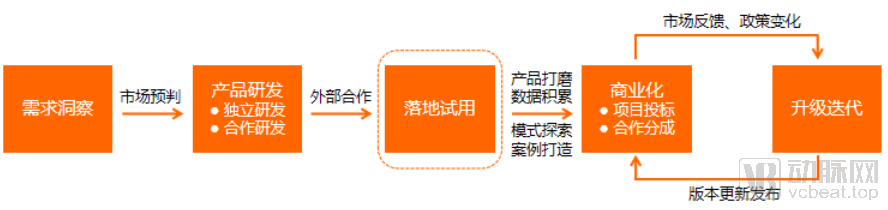
Commercialization Path of CDSS, Image Source: VCBeat
Market Insights.We reviewed the annual reports of ten publicly listed healthcare IT companies. Many of these enterprises discussed their forecasts regarding the application of artificial intelligence and big data in clinical informatics in their annual reports from 2010 to 2015. During this period, China’s healthcare IT sector experienced rapid development, with emerging technologies demonstrating strong growth momentum. Meanwhile, as the government promoted measures to deepen healthcare reform, such as tiered diagnosis and treatment, both tertiary hospitals and primary healthcare institutions urgently needed to further improve the efficiency of clinical diagnosis, treatment, and management operations.
Product R&D.Based on market insights, companies have begun targeted product development. Product development is conducted through either independent R&D or collaborative R&D, with independent R&D being the predominant approach.
Based on the current status of software copyright registrations for Clinical Decision Support Systems (CDSS), independent development is the approach adopted by most developers. Collaborative development primarily takes place among enterprises, medical institutions, and research organizations, with a particular emphasis on partnerships between enterprises and medical institutions.
Pilot implementation.Prior to 2018, most Clinical Decision Support Systems (CDSS) required free trial deployments at healthcare institutions. Following the widespread implementation of electronic medical record (EMR) grading in 2019, such projects gradually ceased offering free trials. This shift directly reflects changing demands from both supply and demand sides in the market. In the future, the trial deployment phase will weaken or even disappear as products and the market mature further; therefore, we use dashed lines to represent this step in the schematic diagram.
Commercialization.The commercialization pathways for Clinical Decision Support Systems (CDSS) fall into two categories: first, enterprises directly bid on projects based on specific requirements and charge the tendering party according to the contract amount; second, they collaborate with health IT vendors and charge these vendors for their services.
Pricing models are also divided into two types. One is a comprehensive procurement model that includes the CDSS system and after-sales service for a limited period. This approach is commonly adopted by large vendors, and major hospitals often choose it due to considerations of security and reliability. The other model involves free system deployment with annual service fees, which is typically offered by smaller vendors. While this option requires less initial capital investment for hospitals, it carries risks related to system maintenance and data security. Meanwhile, similar to traditional medical informatics products, payment can be made either in a lump sum or in installments.
Upgrading and Iteration.For CDSS, two primary factors determine its upgrades and iterations: first, the degree of alignment between the product and clinical needs, which represents the most direct demand; second, changes in policies, particularly those affecting the accreditation, rating, or performance evaluation of healthcare institutions.
Case Analysis: Corporate Product Barriers and Business Models Each Have Their Own Characteristics
From the perspective of specialized disciplines or specific disease types, the degree of commercialization varies among different types of Clinical Decision Support System (CDSS) products. General practice and hospital grading-oriented CDSS have already entered the commercialization stage, driven by diverse application scenarios and urgent hospital demands. Single-disease domains with relatively mature applications include venous thromboembolism (VTE), atrial fibrillation, and ophthalmology. In departments with numerous monitoring indicators, such as psychiatry, pediatrics, and intensive care units (ICU), some enterprises have already developed related products. Meanwhile, various tumor-oriented CDSS solutions are currently under development.
Among the numerous CDSS companies, we have selected Baidu Lingyi Zhihui, Huimei Technology, and Haisen Health as case studies for introduction. The business models of these three companies exhibit distinct characteristics within the CDSS field.
Baidu Lingyi Zhihui: Leveraging Evidence-Based AI Strengths for Extensive Collaboration to Jointly Empower Healthcare Institutions
Lingyi Zhihui is an AI healthcare brand powered by Baidu Brain technology. Upholding the vision of “empowering primary healthcare with evidence-based AI,” it has developed solutions covering the entire process of screening, diagnosis, and management, including intelligent screening, intelligent diagnosis and treatment, and intelligent family doctor services, serving all scenarios both within and outside hospitals.
As a key component of intelligent diagnosis and treatment solutions, Lingyi Zhihui CDSS has established its own distinctive features in terms of product technology framework, application scenarios, and market layout.
Pioneering an Evidence-Based AI Technology Framework for "Explainable" Decision SupportLingyi Zhihui, in collaboration with the People's Medical Publishing House, has jointly developed a professional, authoritative, and evidence-based medical knowledge system. Building on this foundation, we organically integrate AI technologies—such as medical natural language processing and medical knowledge computing—with evidence-based medical knowledge to deliver a suite of evidence-backed clinical decision support capabilities.
Tailored to diverse needs with “broad-coverage” application scenarios. By deploying its hospital-grade Clinical Decision Support System (CDSS) in top-tier hospitals and learning from their data, Lingyi Zhihui continuously enriches its professional and authoritative clinical expertise. This expertise is consolidated into knowledge bases and models, which are then delivered to primary healthcare institutions via its primary-care CDSS, thereby establishing a systematic channel for the downward dissemination of specialized medical knowledge and experience.
Expand Ecological Collaboration and Enlarge the Medical “Circle of Friends.” Leveraging Baidu’s resource advantages as China’s leading AI pioneer and its open, win-win mindset, Lingyi Zhihui has forged extensive collaborations within the medical sector, fostering mutual empowerment with its partners.
In terms of medical knowledge, Baidu signed a strategic cooperation agreement with the People's Medical Publishing House in September 2019; in terms of market promotion, Lingyi Zhihui has engaged in deep collaborations with dozens of leading national and local healthcare IT enterprises, including Neusoft and Yihui.
Next, the key strategic layout and iterative development of Lingyi Zhihui’s Clinical Decision Support System (CDSS) will primarily focus on two aspects: deepening integration with application scenarios for clients such as hospitals and Health Commissions, further promoting seamless integration with Electronic Medical Record (EMR) systems, and enhancing the scenario-based adaptation of decision support capabilities within clinical workflows; and closely aligning with healthcare policy directions, leveraging national policies such as “Smart Healthcare,” “Tiered Diagnosis and Treatment,” and “Strengthening Primary Care” as guiding principles and strategic levers to continuously enrich the implementation and application of artificial intelligence, big data, and other technologies in healthcare settings.
Huimei Technology: Quality Control Solutions Fully Meet Hospital Assessment and Management Requirements
Founded in 2015, Beijing Huimei Cloud Technology Co., Ltd. (hereinafter referred to as “Huimei Technology”) is a leading domestic provider of Clinical Decision Support Systems (CDSS). The company has delivered Dr. Mayson, an AI-powered quality control solution covering the entire healthcare process, to more than 120 large and medium-sized hospitals across China.
Huimei Technology has built an intelligent protective shield for medical quality and safety by integrating the PDCA closed-loop process management concept, helping more than 30 Grade A tertiary hospitals pass the national high-level electronic medical record assessment and the interoperability maturity evaluation.
Dr. Mayson’s quality control system adheres to national management requirements for single-disease quality control and performance assessment of tertiary hospitals, focusing on the quality of disease-specific diagnosis and treatment as well as medical record documentation. On one hand, Huimei Technology has developed a product line for process-oriented quality control by disease category, including the Single-Disease Quality Control (Reporting) System, the Hospital-based Intelligent VTE Prevention and Treatment System, the Atrial Fibrillation Risk Management System, the Perioperative Quality Control System, and the Tumor Chemotherapy Quality Control System.
On the other hand, Huimei Technology has refined a product line aimed at helping hospitals control costs, including medical record front-page quality control, in-process medical record quality control, semantic quality control of medical records, DRG grouping, and cost prediction.
To date, Dr. Mayson has achieved favorable clinical application outcomes.
Application research data published in the core journal Chinese Journal of Health Information Management, jointly conducted by Huimei Technology and partner hospitals, demonstrate that AI-based management of single-disease diagnosis and treatment processes significantly improves clinical standardization, with disease-specific quality indicator compliance rates exceeding 90% at partner hospitals. After implementing Huimei’s VTE Intelligent Prevention and Control System, a Grade A tertiary hospital in Beijing achieved hospital-wide, multi-node dynamic risk monitoring and early warning. Furthermore, the detection rate of moderate-to-high-risk VTE patients, the risk assessment rate, and the implementation rate of preventive measures all increased more than tenfold compared to baseline data.
Haisen Health: Combining Over a Decade of Practice, “Dual-Engine” CDSS Meets Diverse Scenarios
Haissen Health is a leading domestic provider of innovative smart healthcare services, specializing in the independent research and development and clinical application of medical big data, artificial intelligence, and internet-based medical products. It is a member enterprise of the Jiahua Meikang Group.
Leveraging the Jiahe Meikang Group’s decade-long accumulation in healthcare informatization, its first-mover advantages in medical big data, artificial intelligence, and internet healthcare, as well as practical experience gained from over 1,300 medical institutions, the company has utilized technologies such as natural language processing and machine learning to build a highly centralized and standardized data integration, governance, and service system—the Intelligent Medical Data Middle Platform. Building on this foundation, the company has developed a comprehensive ecosystem product matrix covering multiple application scenarios, including clinical diagnosis and treatment, research support, medical administration, and doctor-patient interaction services, thereby providing full-spectrum support for the needs of medical institutions at all levels.
Haishen Health’s core product, the Clinical Decision Support System (CDSS), is built upon an intelligent medical data middle platform. Leveraging a “dual-engine” approach that integrates hospitals’ best clinical practices and BMJ Best Practice guidelines, it provides intelligent decision support across the entire patient journey from consultation to treatment, representing a new generation of intelligent CDSS. Calculations indicate that the system achieves a clinical diagnostic accuracy rate of over 95% and can effectively reduce the misdiagnosis rate by more than 10%.
Currently, the product has been implemented in dozens of provinces across China and adopted by over 100 Grade A tertiary hospitals.
Amid the accelerating commercialization of Clinical Decision Support Systems (CDSS), how can market expansion be further advanced? We analyzed a sample of 75 sets of CDSS bidding and tendering data monitored from the China Government Procurement Network and various provincial government procurement websites. The data indicate that, compared with large hospitals in developed regions, the markets for medical institutions in central and western China and for primary healthcare institutions remain underdeveloped and hold significant potential for further exploitation. (Note: The data serve only as a sample and do not represent the full scope of CDSS implementation.)
Based on the overall trend observed in bidding samples, healthcare institutions in China began to prioritize the application of Clinical Decision Support Systems (CDSS) during 2014–2015. Demand started to rise gradually in 2017, and the number of projects experienced leapfrog growth in 2019, reaching a peak. Although the COVID-19 pandemic in 2020 disrupted routine activities across various sectors, leading to a decline in project numbers during the first six months, the long-term outlook remains positive. Enhancing healthcare quality through big data and intelligent technologies, as well as responding to public health emergencies such as the COVID-19 pandemic, necessitates the support of CDSS. Consequently, CDSS is expected to be implemented more extensively across a broader range of healthcare institutions.
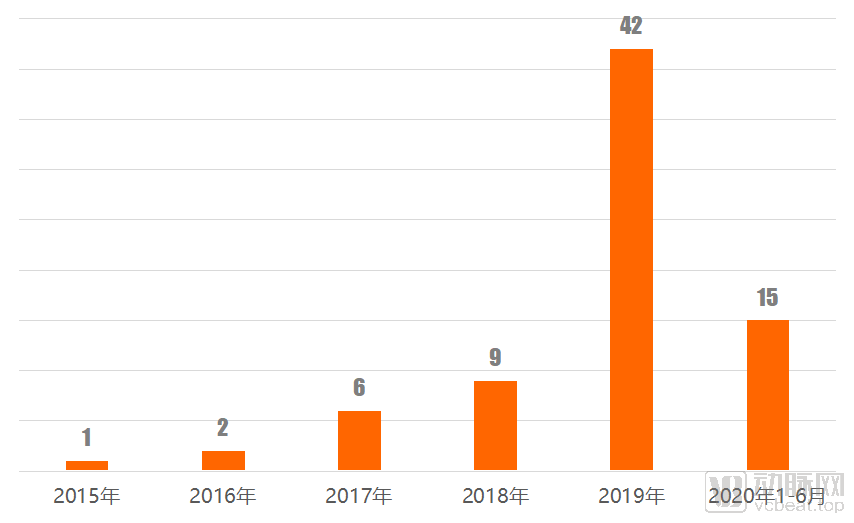
Year of CDSS Project Bid Award; Source: China Government Procurement Network, Provincial Government Procurement Networks; Chart by VCBeat
In terms of regional distribution, purchasers in the 75 data sets are most concentrated in Beijing, Fujian, Guangdong, and Jiangsu. This pattern is associated with factors such as local economic development, government health expenditure, and medical resource availability. Purchasers in central and western regions are relatively fewer, indicating that these areas still hold potential for market expansion.
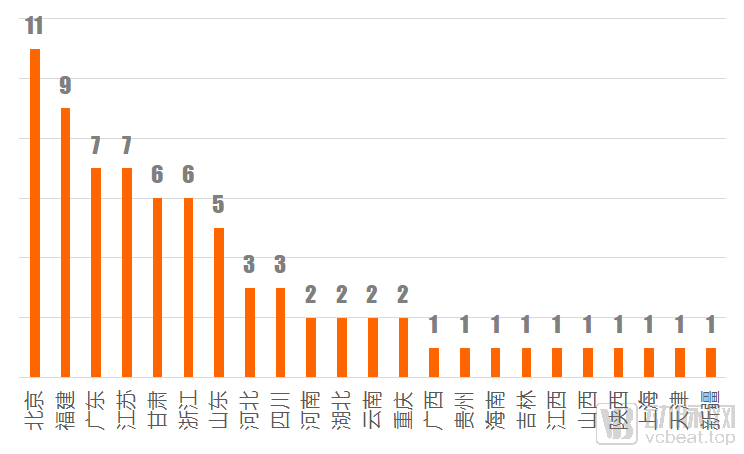
Regional Distribution of Procurement Entities in Winning Bid Projects
Source: China Government Procurement Network, provincial government procurement networks; chart by VCBeat
The sample data from this survey indicate that large hospitals are the primary purchasers of Clinical Decision Support Systems (CDSS) through tendering and procurement. Although CDSS can enhance the diagnostic and treatment capabilities of primary care physicians from an application objective perspective, there are relatively fewer CDSS procurement projects at the primary care level, suggesting significant room for further development.
As the integration between knowledge bases and artificial intelligence within Clinical Decision Support Systems (CDSS) deepens, the conceptual scope of these systems continues to expand. In particular, many enterprises have incorporated CDSS quality control functionalities into Electronic Medical Records (EMR) and Hospital Information Systems (HIS), replacing previous formalistic quality control with more substantive, content-rich quality assurance. Consequently, the application scenarios for CDSS are continually broadening. In this process, the advancement of knowledge bases and evidence-based AI will present both opportunities and challenges that determine the future development of CDSS itself.
Five Major Challenges Facing the Industry
For Clinical Decision Support Systems (CDSS), opportunities and challenges stem from the same sources. Internally, the immaturity of Natural Language Processing (NLP) technology, along with structural and content deficiencies in knowledge bases, are significant factors constraining industry development. Externally, the level of hospital informatization and the acceptance of CDSS by hospital information departments are key obstacles to product implementation. Overall, the current industry challenges can be summarized as follows:
First, the challenges facing knowledge bases: existing knowledge bases are insufficient in scale and have limited update speeds; constructing specialized knowledge bases is difficult, and there is a shortage of professionals with clinical reasoning capabilities.
Second, there is a lack of support for standardized information models: the inconsistency of system standards results in poor portability and difficulties in promotion and application;
Third, there is a lack of shared service models: Currently, mainstream Clinical Decision Support Systems (CDSS) are embedded as subsystems within Electronic Medical Records (EMR), such as clinical pathway systems and rational drug use systems. Whether they can accurately and sensitively capture user attention without disrupting user workflows is extremely critical;
Fourth, there is a lack of comprehensive decision support: There is insufficient support for post-discharge treatment efficacy evaluation and health education for patients. Patient information may be fragmented across multiple disparate information systems, with no single system providing a holistic view of the patient’s complete medical record.
5. Changing Demands for CDSS: Traditional Clinical Decision Support Systems (CDSS) primarily function as passive recipients of guidance, lacking clear pathways for consultations in complex and refractory cases. CDSS developed based on a single discipline can no longer meet clinical needs.
Two Major Development Directions for the New Generation of CDSS
At the application level, CDSS is by no means designed solely for rating purposes; from the current perspective, this technology mainly has two development directions.
One trend is continued in-depth development. Many health IT companies are currently expanding their offerings to focus on specific single diseases, which is a positive development. However, because quality control for single diseases is deeply integrated with clinical practice, the barriers to entry in this area are not easily overcome. To address this challenge, some companies have established dedicated medical teams to help hospital clinical departments better utilize Clinical Decision Support Systems (CDSS), aiming to achieve significant improvements in the management of multiple conditions, including venous thromboembolism (VTE), COVID-19, and sepsis.
The second approach leverages NLP technology to integrate CDSS into systems such as electronic medical records (EMR) for semantic quality control. Jiahhe Meikang serves as a prime example; the company embeds its CDSS as a plugin into EMR systems and workstations across various departments, enabling real-time quality control as physicians document patient encounters.
Relevant applications have gradually been integrated into the Hospital Information Systems (HIS) and Electronic Medical Record (EMR) systems provided by healthcare IT vendors. In other words, if healthcare enterprises can establish robust knowledge bases and integrate them with their existing information systems, quality control will shift from a solely retrospective approach to a combination of concurrent and retrospective quality control. Under such circumstances, patient safety will be further safeguarded.
In summary, as CDSS products evolve from merely meeting accreditation requirements to becoming increasingly integrated into clinical workflows, the industry will witness its second major growth leap.
The above constitutes the main content of the report. The table of contents is as follows. Scan the mini-program at the end of the article to read the full report for free:
I. Rating Policies Bring About a Turning Point for the CDSS Industry
1.1 Development History: From Continuous Trial and Error to Large-Scale Implementation
1.2 Current Policy Landscape: Rating Policies Propel the Industry into the Fast Lane
1.3 Market Demand: Ratings, IT System Upgrades, and Supplementing Primary Care Resources
1.4 Market Landscape: Four Types of Players Deploying CDSS to Varying Degrees
II. A Market Size Exceeding RMB 10 Billion, with Accelerated Commercialization
2.1 Market Size: General Practice Exceeds RMB 10 Billion, While Specialty Care Remains Untapped
2.2 Commercialization Process: Free Trials Fade from the Market, Revenue Generated Through Two Channels
2.3 Case Analysis: Corporate Product Barriers and Business Models Exhibit Distinct Characteristics
III. Hospitals in Central and Western Regions and the Primary Care Market Await Further Development
3.1 Time Dimension: Leapfrog Growth in 2019
3.2 Regional Dimension: The Central and Western Markets Await In-Depth Development
3.3 Healthcare Institution Dimension: Large Hospitals Are the Main Purchasing Force
3.4 Corporate Dimension: Established Players and Startups Share Equal Footing
IV. Investment and Financing Trends: The Agglomeration Effect Among Leading Enterprises Becomes Evident
V. Development Trends
5.1 Five Major Challenges Facing the Industry
5.2 Two Major Development Directions for the New Generation of CDSS