

AI-Powered Radiology Platform for Tracking COVID-19 Progression Submits IPO Filing
In recent years, artificial intelligence (AI) has played a significant role in the healthcare sector. Advanced computing and data analytics tools have enabled information sharing and diagnostic practices, while deepening the medical industry’s understanding of diseases and infections.
Since the outbreak of COVID-19 in early 2020, the world has been put on “pause.” To date, the number of confirmed cases worldwide has exceeded 27 million, posing significant challenges globally. Currently, driven by the urgent need to contain COVID-19, research institutions, government agencies, and enterprises around the world are increasingly turning their attention to AI technologies, committing to detecting the epidemic, improving clinical treatment standards, slowing infection trends, and developing treatment protocols to combat the COVID-19 pandemic.
In the field of medical imaging, the Athinoula A. Martinos Center for Biomedical Imaging at Massachusetts General Hospital leverages the NVIDIA DGX A100 AI system to accelerate model research. Each system is equipped with eight NVIDIA A100 Tensor Core GPUs, delivering 5 petaflops of AI performance. Subsequently, the NVIDIA Clara Deploy SDK is employed to compare severity scores of images acquired at different stages. Grounded in deep insights from the radiology domain, this approach better serves clinicians by facilitating patient disease monitoring and supporting treatment decision-making.
Radiological images often contain a wealth of information, yet they do not always enable physicians to make immediate clinical decisions. Therefore, when training and deploying AI models for COVID-19, researchers must leverage appropriate SDKs and tools to accelerate workflows. During the research process, researchers performed multiple segmentations and alignments of patient chest scans, assessing the severity of lung disease based on X-ray imaging. Meanwhile, radiological data were combined with other clinical variables to predict recovery outcomes in COVID-19 patients. Deep learning–based algorithms were developed to evaluate and score the severity of lung disease from chest X-rays. This approach offers reproducibility and scalability, allowing clinicians to continuously monitor chest X-ray findings in conjunction with vital signs, pulse oximetry data, blood test results, and other laboratory values. Finally, researchers at the center adopted the NVIDIA Clara Deploy SDK to compare AI-derived lung disease severity scores across images acquired at different stages, thereby helping clinicians track patient disease progression.
The severity-scoring AI was trained on public datasets. These datasets include over 150,000 chest X-ray images from Massachusetts General Hospital, as well as several hundred X-ray images from COVID-19-positive patients. The research team at Massachusetts General Hospital evaluated the severity-scoring AI using the NVIDIA Clara Deploy SDK. Beyond the pandemic, the team plans to expand the model’s application to a broader range of conditions, such as pulmonary edema and wet lung.
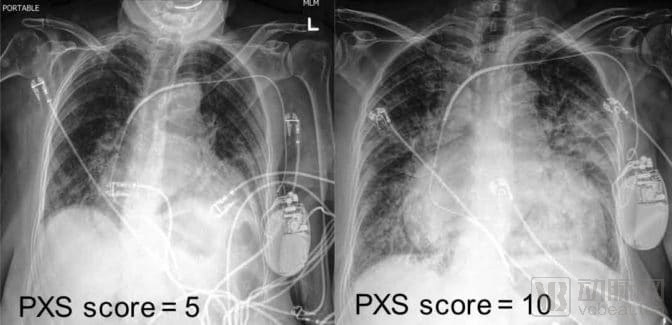
Comparing AI-based Pulmonary X-ray Severity (PXS) scores across images acquired at different stages can help clinicians track disease progression in patients.
(Image from a research paper published in Radiology: Artificial Intelligence, available for public access.)
The intelligent computing engine adopted by the team, NVIDIA Clara, was released by NVIDIA in 2018 and named in honor of Clara Barton, the founder of the American Red Cross. This platform combines NVIDIA GPU hardware with the NVIDIA Clara software development kit (SDK) to accelerate the training and inference of medical deep learning applications. The platform includes APIs for AI-assisted annotation of medical images, transfer learning toolkits, a medical model development environment, and tools for large-scale AI deployment. By leveraging NVIDIA Clara, data scientists and developers can access the necessary tools to accelerate future advancements in the medical field.
After two years of development, Clara has become NVIDIA’s comprehensive platform supporting scenarios such as medical imaging, genomics, and smart hospitals. By leveraging NVIDIA Clara, medical experts, data scientists, and AI application developers can access the tools needed to accelerate advancements in the medical field. Clara Medical Imaging is the component dedicated to medical imaging. Currently, NVIDIA Clara is collaborating with partners to optimize software tools, helping developers accelerate their R&D progress.
Not long ago, the latest version of Clara Medical Imaging was released, providing customers with more convenient tools for AI development and deployment in medical imaging. By adopting the latest version of Clara Medical Imaging, even medical practitioners unfamiliar with software development can quickly train their own AI models and deploy them in clinical workflows.
To learn more about NVIDIA Clara and how to rapidly train and deploy COVID-19 AI models in clinical workflows, please join the NVIDIA Medical Imaging Webinar!
From0to1, rapid training and deployment for the novel coronavirus are possible even without a background in software development (COVID-19) AI Model to Work Scenarios
September 24, 2:00 PM - 3:00 PM
Meng Zhang, Data Scientist at NVIDIA. Responsible for the design and research of GPU computing solutions for NVIDIA’s healthcare industry, including deep learning training and inference, as well as GPU-accelerated distributed parallel computing.
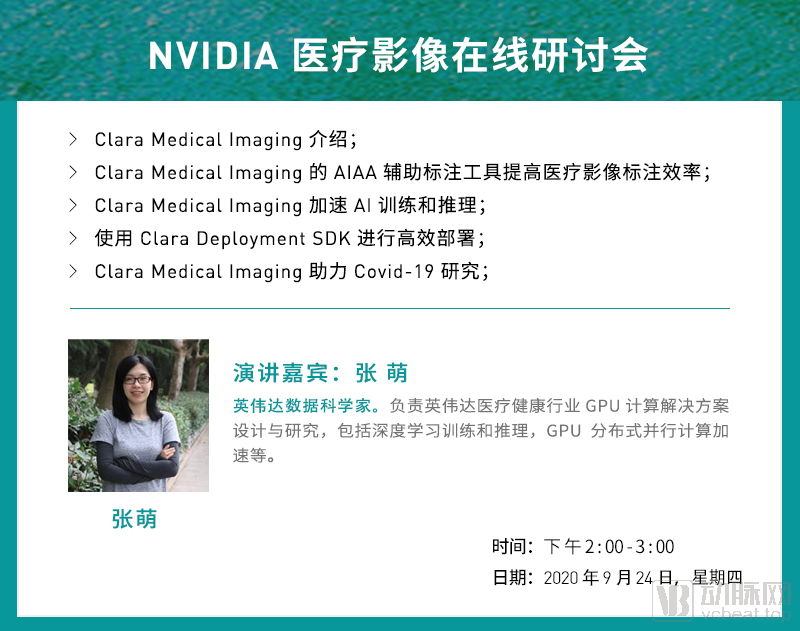
Click the registration link below to sign up for the NVIDIA Medical Imaging Online Webinar.