

Outset Medical Goes Public: At-Home Hemodialysis with Tablo System Becomes a Reality

Outset Medical
Manufacturer of Kidney Dialysis Equipment
VCBeat has learned that U.S. medical device manufacturer Outset Medical recently listed on the Nasdaq under the ticker symbol “OM.” On its debut trading day, Outset Medical priced its initial public offering of 8,951,111 shares of common stock at $27.00 per share, raising total net proceeds of $241.7 million after deducting underwriting discounts and commissions as well as offering expenses. The stock opened at $52 per share, representing a 92.56% increase over the offering price, and closed at $60.68 per share, up 124.74% from the offering price.
Nasdaq’s official Twitter stated that this is the company that has raised the highest amount of capital among all medical device and technology companies listed on Nasdaq since 2020.
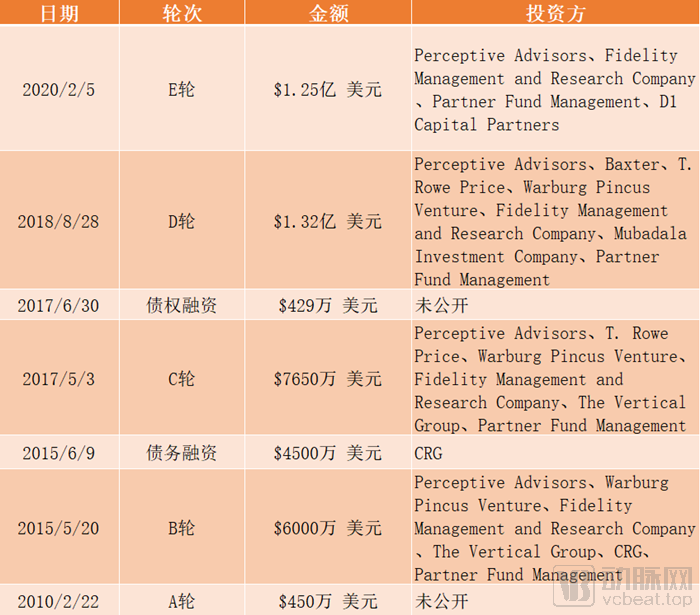
Outset Medical's Historical Financing Overview
Outset Medical, founded in 2003 and headquartered in San Jose, California, specializes in the research, development, and manufacturing of innovative products for kidney dialysis, providing patients with renal failure with a novel method for artificial blood purification. The company’s flagship product is the Tablo, a new dialysis system that has garnered significant attention since its initial launch in the U.S. market in 2015. Featuring integrated wireless connectivity and real-time purification capabilities, the system greatly simplifies the dialysis process. Moreover, it is more compact than traditional dialysis equipment, measuring just 35 inches in height.
This new dialysis system received FDA approval on March 31 of this year and, four months later, provided the first patient with Tablo home self-testing services. The changes brought by Outset Medical to hemodialysis systems are particularly significant in the post-pandemic era.
Enhance System Operability to Simplify Hemodialysis
“It looks different, but this is only the beginning.” This sentence appears on Tablo’s introductory interface.
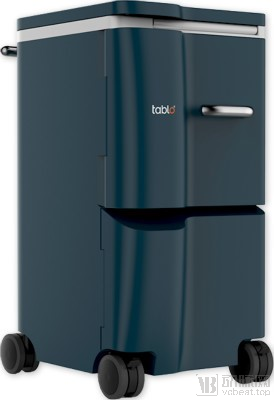
Tablo Hemodialysis System
Unlike traditional, bulky hemodialysis systems, Tablo resembles a wheeled suitcase. Measuring just 35 inches in height, it not only saves space but also enhances mobility for both patients and clinicians. To use a bold analogy, Tablo is akin to a mobile clinic on wheels, making hemodialysis an easy-to-manage procedure.
The Tablo’s departure from the appearance of traditional hemodialysis machines is only part of its breakthrough significance; its functionalities are even more innovative.
Conventional hemodialysis systems typically require the use of purified water to prevent substances such as metal ions, bacteria, and other microorganisms from entering the bloodstream.However, the Tablo system developed by Outset Medical can directly use tap water for hemodialysis, with real-time fluid purification during the dialysis process.This technological breakthrough eliminates the need for centralized water treatment equipment in hemodialysis systems, significantly enhancing hemodialysis efficiency while reducing associated costs.
Upon powering on the Tablo, users are greeted by its intuitive operating system. The Tablo’s OS features a touchscreen display that provides setup instructions and patient education through 3D animations and interactive dialogues, guiding users through system configuration.A simplified operating system that reduces the user learning curve to under a few hours.
With its automated sensors, wireless data transmission, and simple touchscreen interface, the Tablo feels more like an easy-to-use consumer product than a medical device.
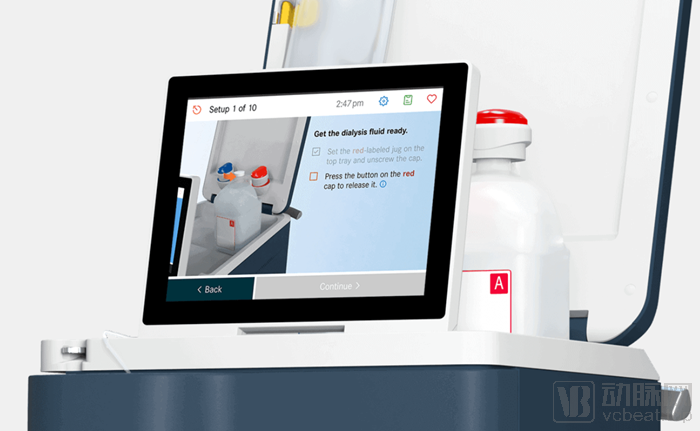
Tablo Operating System
Company CEO TriggSpeak“We are developing a patient application that transmits treatment data from Tablo to the cloud and delivers it back to the patient. Currently, patients receive no information about their treatment at all—for instance, whether all toxins have been removed in the correct proportions and quantities. Patients should have the right to know this information. Our goal is to provide patients with comprehensive information so they can take control of their own health.”
Based on this, Outset Medical has built “Tablo Cloud,” a unique remote diagnostics platform that seamlessly transmits treatment data to providers via bidirectional cloud communication, while also delivering support services. This enables patients and physicians to access data stored in the Tablo system anytime, anywhere.
The simplicity of the hardware and the establishment of cloud-based systems have made remote home dialysis possible. This all stems from Outset Medical’s insight into the pain points of the dialysis market.
For patients with kidney disease, hemodialysis is a cumbersome and costly process. It requires patients to visit a clinic two to three times per week, with each session lasting approximately five hours, resulting in significant expenses. However, if patients can operate the machine themselves, it will greatly eliminate the complexities of hemodialysis and reduce treatment costs. Moreover, the installation of Tablo consumables is extremely simple.
Clearly, the ultimate goal of Outset Medical’s simplified system is to enable patients to perform dialysis procedures themselves, allowing them to independently set up and monitor their treatment without relying on clinic staff.
As described on the Outset Medical website, “hemodialysis can be performed with just power and water,”Tablo is working to eliminate the cumbersome nature of hemodialysis by enhancing the interoperability of its system.
Innovation Through Teamwork
“The pandemic has placed greater strain on treatment centers, and Tablo will undoubtedly serve as a buffer to this challenge. It will enable more patients to undergo hemodialysis at home, granting them greater freedom and control over their lives,” said Dr. Kabaria, a nephrologist.
Although Tablo’s design philosophy is centered on the vision that “patients should be able to receive timely treatment at home whenever needed,” the strain on healthcare institutions and the surge in demand for home-based care during the pandemic have once again validated the correctness of its core concepts, such as “remote” and “home-based” care.
Outset Medical’s robust team background provides greater possibilities for the company in product research and development.
Trigg believes that the dialysis industry remains stuck at the level it was 30 years ago, with no genuine technological breakthroughs achieved over this prolonged period. These observations served as the starting point for the company’s innovations in hemodialysis systems.
Leslie Trigg, CEO of Outset Medical, holds a bachelor’s degree from Northwestern University and an MBA from the Haas School of Business at UC Berkeley, which have endowed her with unique insights into the hemodialysis market. Prior to joining Outset Medical, she served as Executive Vice President at Lutonix, a cardiovascular medical device company acquired by CR Bard, and held key positions at vascular closure company AccessClosure and FoxHollow Technologies.
Chief Medical Officer Michael Aragon holds a bachelor’s degree from Texas A&M University and a medical degree from the University of Texas Medical School. After 14 years in clinical practice, Dr. Aragon joined DFW Nephrology Consultants as a founding partner and president. He joined Outset Medical in September 2018 as Chief Medical Officer. He is board-certified in internal medicine and nephrology and completed his training at the University of Texas Health Science Center at Houston.
Moreover, Outset Medical boasts a robust team of scientific advisors, providing inexhaustible momentum for product research, development, and innovation.
Dr. Alvarez, Chief Technology and Innovation Advisor at Outset Medical, possesses a robust medical background. Currently, Dr. Alvarez serves as Chair of Nephrology at the Palo Alto Medical Foundation, part of Sutter Health. After earning his Ph.D. in Biophysics, he entered the pharmaceutical and medical device industries.
Dr. Alvarez previously served as an advisor to the Biodesign Program at Stanford University, dedicated to advancing industry improvements in the field of nephrology. Additionally, Dr. Alvarez has served as the Medical Director for Satellite Dialysis and Wellbound Home Dialysis, remaining active on medical policy committees while maintaining clinical practice.
Dr. Glenn Chertow is the Norman S. Coplon/Satellite Healthcare Professor and Chair of the Division of Nephrology at Stanford University School of Medicine. He also serves on the editorial boards of the Journal of the American Society of Nephrology (JASN) and the Clinical Journal of the American Society of Nephrology (CJASN).
Another Possibility
Fresenius’s 2019 annual report shows that approximately 4.3 million patients with chronic renal failure received treatment worldwide in 2019. Among these patients, about 3.5 million underwent dialysis therapy, with hemodialysis and peritoneal accounting for approximately 89% of the treatments.
In the future, as the population ages, the incidence of chronic diseases such as diabetes, hypertension, and obesity will rise, and these conditions can all potentially lead to kidney failure. The data above clearly demonstrate the strong growth potential behind hemodialysis.
“We aim to fundamentally disrupt the service model of dialysis, eliminating the need for patients to visit dialysis clinics altogether. Like diabetes, kidney disease requires complex management; only through innovative product design that simplifies processes can we deliver a superior consumer experience. A relentless focus on patient experience is at the very core of Tablo.”
Outset Medical’s IPO reveals another possibility in the field of hemodialysis.