

Exclusive | What Baidu Health Has Done in the Past Year: Brand Upgrades, Ecosystem Expansion, and Strategic Moves in Digital Healthcare
Since the beginning of this year, Baidu’s activities in the healthcare sector have once again come into the public spotlight.
Whether it was Baidu Health’s anti-epidemic initiatives launched at the beginning of the year during the pandemic, or the one-stop medical service solution for users unveiled at the Baidu World Conference in September—which included plans to onboard more public hospitals and provide end-to-end services ranging from health education to clinical consultation—these moves have undoubtedly attracted significant attention.
As is well known,In recent years, internet giants such as Alibaba, Tencent, JD.com, and Toutiao have made frequent moves in the healthcare sector.。Events in just this past month include: Alibaba Health’s app was rebranded as “Yilu” (Medical Deer), aiming to further strengthen its core competitiveness in physician quality and operational capabilities; Tencent Healthcare partnered with WeBank to establish a joint laboratory, exploring intelligent applications in the medical field; JD Health launched its first internet-based respiratory care center, intending to create a new online-plus-offline model for chronic disease management; and ByteDance announced the completion of its full acquisition of Baike Mingyi Wang, a medical science popularization platform, for hundreds of millions of yuan.
“All the ‘heroes’ have entered the arena, and competition is intensifying.”. For Baidu,By independently registering Baidu Health as a separate entity and expanding into internet hospitals, among other initiatives, the company has undoubtedly demonstrated clearer strategic thinking and plans in the healthcare sector.。
What has Baidu Health accomplished over the past year? What is the underlying logic behind its strategies, and what direction will it take in the future? In response to these questions, VCBeat conducted an exclusive interview with Yang Minglu, General Manager of Baidu Health and General Manager of Baidu Health Medical Encyclopedia.
To understand Baidu Health, one must first grasp Baidu and its position in the current era.
As the world’s largest Chinese-language search engine and a leading platform-based enterprise, Baidu was unrivaled during the PC internet era. When it listed on the NASDAQ in 2005, it created a U.S. market myth for Chinese concept stocks, with its share price surging 354% on the first day of trading. In the following years, Baidu enjoyed smooth sailing and at one point surpassed Tencent and Alibaba to become the most valuable Chinese internet company by market capitalization.
However, Baidu’s hesitancy in its transition to the mobile internet caused it to fall behind in the mobile ecosystem, forcing the company to devote substantial resources over the following years to catch up. AndWhat has driven this profound change is the proliferation of information silos created by countless apps in the wave of mobile internet, resulting in the gradual decline of PC-based search engines as the primary entry point to the internet.
As users’ information-seeking habits become increasingly fragmented across various apps, the challenge facing Baidu has become particularly urgent: how to retain users beyond search? Baidu’s answer is services. In other words,Baidu is transitioning from its past mission of “connecting people with information” to“"Connecting people, information, and services."
Guided by this approach, Baidu has taken measures to connect content creators with service developers, leveraging the massive traffic gateway of its search engine and underlying technologies such as AI, while utilizing features like mini-programs to deliver fast and efficient end-to-end services to users. In terms of business operations,Baidu has been deeply cultivating vertical industries, offering a broader range of products beyond information search in sectors such as healthcare and e-commerce.
Baidu adopts different implementation approaches tailored to the specific characteristics of each industry.According to a report by 36Kr, in sectors where Baidu has established strong advantages, such as real estate and automotive, the company has adopted a “white-label” model. This approach involves providing mini-program templates to enterprises, enabling them to build their own CRM systems and thereby retain user traffic generated from property and vehicle purchases. In highly digitized industries with mature solutions, such as express delivery, Baidu has chosen an “aggregation” model, using mini-programs to bring together providers like SF Express and YTO Express. Meanwhile, in strategically critical sectors such as healthcare, Baidu has opted for a “self-built” model, pursuing deep and heavy operational involvement.
It is against this backdrop that the strategic significance of Baidu Health has gradually become clear. “We can say that Baidu Health is a brand-new brand we officially launched in March, and it isBuilt on a comprehensive upgrade of the health vertical within Baidu Search. On one hand, we will adopt an industry-oriented mindset to deliver a complete service, thereby better connecting users with services and achieving online-offline integration. This also demonstrates Baidu’s firm commitment to making substantial investments in the healthcare sector.“Yang Minglu told VCBeat.”
Guided by this approach, Baidu Health has partnered with more than 1,000 public hospitals and 250,000 physicians (as of August 2020), establishing a content ecosystem centered on Baidu Health Medical Encyclopedia and a service ecosystem anchored by Baidu Health Ask-a-Doctor.
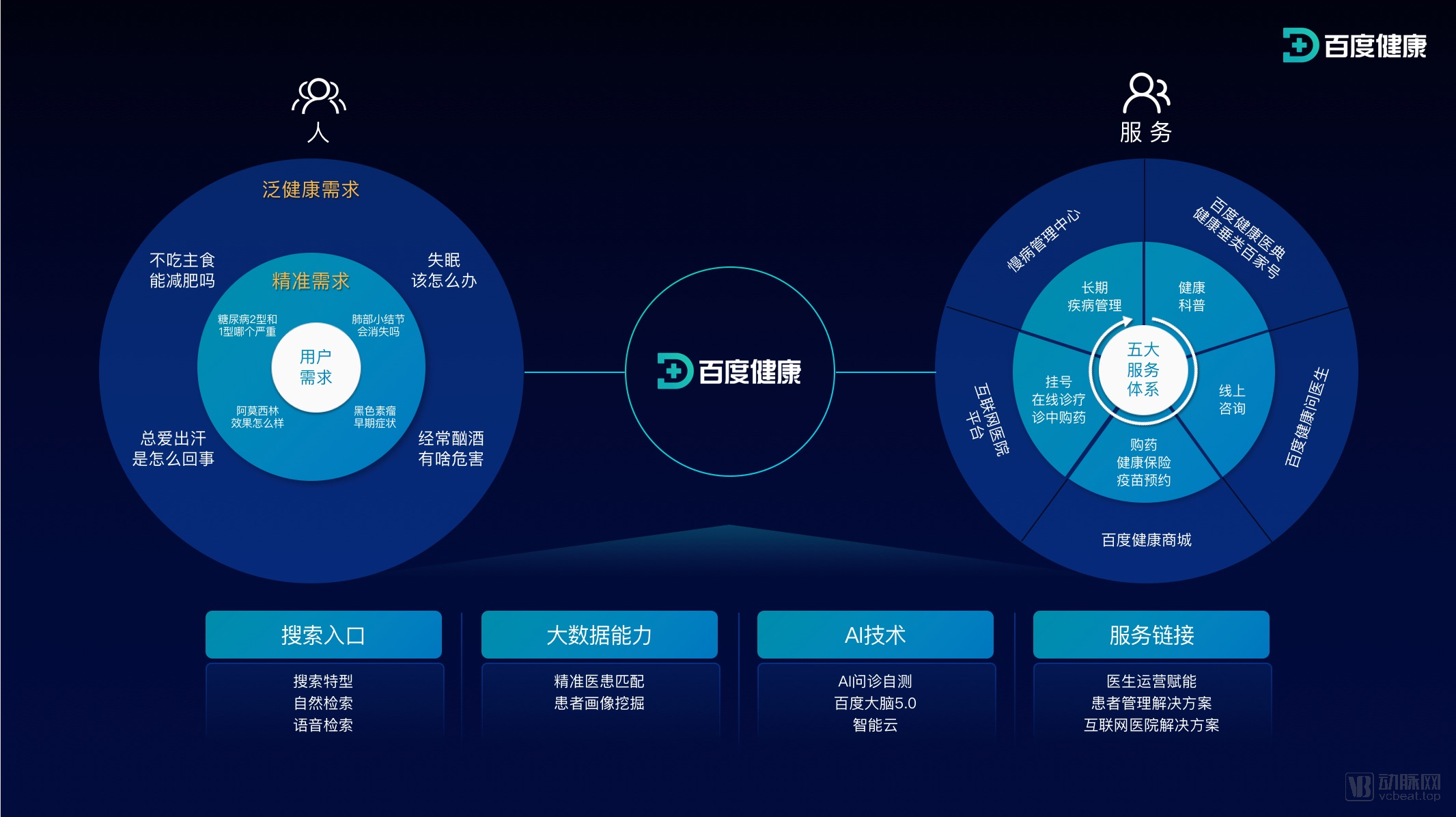
Prior to the official establishment of the Baidu Health brand, Baidu’s vertical health products and services were centered on information resources, including a vast amount of high-quality, authoritative popular science content. “Baidu has accumulated over ten years of experience in the healthcare sector,” said Yang Minglu. As a major internet gateway for health-related traffic across the web,The daily search volume for health-related content on Baidu has exceeded 200 million.
In addition to the massive traffic, Baidu has found that under the impact of the sudden outbreak of the novel coronavirus (COVID-19) this year,C-end users’ demand for health consultations, particularly internet-based medical services such as online consultations and appointment registration, is growing rapidly.. InRegarding the government (G-end) and business (B-end) sectors, national policies are gradually being relaxed. National ministries, local governments, and public hospitals are all actively embracing the Internet, striving to digitize high-quality offline medical and health resources.。
ExactlyBased on the demand and emphasis placed on internet healthcare by both supply and demand sides, Baidu has continuously responded to the public’s online health needs during the pandemic through iterative product updates. Meanwhile, Baidu conducted intensive internal discussions and comprehensively upgraded its existing vertical health search services, officially launching the new brand “Baidu Health” this March.
In the six months since the launch of its new brand, Baidu Health has been highly active.On March 13, the Baidu App released the “Baidu Health Online Healthcare Big Data Report,” which leveraged extensive big data analytics to illustrate the development trends and user characteristics of internet healthcare platforms during the pandemic. On April 4, Baidu Health organized an exchange session on epidemic prevention and control experiences between China and Ecuador. Academician Li Lanjuan, a member of the Baidu Health Medical Dictionary Expert Committee, shared China’s anti-epidemic experiences with officials from Ecuador’s Ministry of Public Health and other government departments.
On May 14, Baidu Health unveiled a comprehensive upgrade to its services. Users watching live streams can now click on a physician’s profile picture at any time to access that doctor’s dedicated consultation channel and initiate one-on-one consultations, thereby enabling seamless, one-stop access from live-streamed health education to professional medical advisory services. On July 2, Baidu Health officially launched the “Diabetes Center,” which has already attracted over 100 leading endocrinology experts to join the platform, working together to build an integrated online-offline platform for doctor-patient engagement...
“Behind Baidu Health’s rapid expansion lies the goal toAddressing Users' Needs for End-to-End Online Healthcare Services, and provide the corresponding services. WeWhat we are doing and will continue to do is to meet user needs with refined precision..” Yang Minglu stated that, in addition to expanding its services, Baidu Health will further leverage its content advantages to provide users with more authoritative, comprehensive, personalized, and precise content and information services.
Based on this,Baidu Health has established a content ecosystem centered on Baidu Health Medical Encyclopedia and a service ecosystem anchored by Baidu Health Ask-a-Doctor.。
Specifically, Baidu Health Medical Encyclopedia is an authoritative public welfare initiative for popularizing health knowledge launched by Baidu Health, which collaborates with top-tier medical resources both in China and abroad to co-create an authoritative platform for medical and health science communication.Leveraging big data on user needs, we deliver authoritative, accurate, comprehensive, and easy-to-understand, ad-free health science content through various formats—including text, videos, infographics, and Q&A—across Baidu’s entire platform, enabling users to conveniently access reliable health information.
As of September 2020,Baidu Health Medical Encyclopedia has partnered with over 800 top medical experts and more than 100 authoritative institutions across China., The expert panel consists entirely of academicians from the Chinese Academy of Sciences or the Chinese Academy of Engineering, leading academic experts, chairs of professional societies/associations or working groups, and lead scholars in the development of disease guidelines in China.
Notably, the content of Baidu Health Medical Encyclopedia is first analyzed on Baidu Search to identify the most pressing questions users have about these conditions. A framework is then developed around these questions and subjected to a rigorous three-round review and proofreading process with experts.“Producing content based on user needs helps align it more closely with their demands. In terms of content, besides being authoritative, it should also be easy to understand and read. Following this direction, we are continuously expanding the scope of our content production, including formats such as videos and illustrations.”Going forward, Baidu Health will also offer comprehensive content—including physical examinations and health insurance—to meet users’ needs for popular science education on health..” said Yang Minglu.
Another flagship product, Baidu Health Ask a Doctor, is a 24/7 online consultation service platform launched by Baidu Health., the specific method is to search for “Ask a Doctor” on Baidu, or search for “Baidu Health” via the Baidu app, and then access the mini-program to use this service.
As of now,Baidu Health Ask a Doctor: Over 100,000 licensed physicians from public hospitals are available online to answer user inquiries., in addition to doctors directly connected via Baidu Health, major online consultation platforms on the market, such as Ping An Good Doctor, Haodf Online, and JD Health, have all integrated with the Baidu Health Ask-a-Doctor platform, providing users with online medical consultation services that offer the broadest coverage and the most precise matching.Average response time: 2 minutes。
During the pandemic,Baidu Health’s “Ask a Doctor” service has provided over 100 million online medical consultations to users worldwide, with more than 850,000 daily consultations, establishing it as one of the largest online medical consultation platforms.。
“Throughout this process, we have found that Baidu Health can effectively meet a wide range of user needs, including appointment registration, online medication purchases, and access to its health e-commerce platform. Leveraging the Baidu Health mini-program, we are striving to provide users with comprehensive services,” stated Yang Minglu. She noted that Baidu Health has been actively expanding into new business areas over the past few months, and these efforts are likely to become even more intensive in the near future.
In addition to the two flagship products, Baidu Health Medical Encyclopedia and Baidu Health Ask a Doctor,Baidu Health has also expanded into new business lines, such as Baidu Health Live Streaming and Internet Hospitals.。
Taking live streaming as an example, the Baidu Health team identified a significant public demand for epidemic prevention knowledge during the outbreak and promptly established a live streaming team. By driving the development of live streaming products and capabilities within Baidu’s middle-platform infrastructure, and by collaborating with top-tier medical experts at hospitals externally, the team achieved point-to-point live streaming operations in the shortest possible time.
At the High-Level Forum on Global Anti-Epidemic Experience Exchange, held on May 13 under the guidance of the National Health Commission’s Talent Exchange and Service Center and hosted by Baidu Health Medical Encyclopedia, more than 20 top-tier authoritative medical experts from China were invited to join the Baidu Health live-streaming studio. They shared China’s anti-epidemic experiences with health agencies and experts from multiple overseas countries. Furthermore, during the pandemic, Baidu Health opened its “Anti-Epidemic Live Studio” to overseas audiences, inviting authoritative experts and frontline healthcare workers to help international users access epidemic prevention knowledge. Meanwhile, Baidu also made its live-streaming capabilities available to embassies of various countries abroad.
As of September, Baidu Health’s online live broadcasts had accumulated 150 million views, with the highest single-session viewership reaching 3.52 million.。
In the internet hospital business sector,Baidu established Yinchuan Baidu Health Internet Hospital Co., Ltd. on March 18, and obtained Baidu Health’s first internet hospital license in Hainan this May.。
Early July,Baidu Health Officially Launches “Diabetes Center,” Marking Its First Industry-Wide Introduction of a New Integrated Doctor-Patient Specialty Internet Hospital Model. This modelBy aggregating resources from leading domestic experts,Led by Professor Mu Yiming, Director of the Department of Endocrinology at the Chinese PLA General Hospital, Chairman of the 10th Committee of the Endocrinology Branch of the Chinese Medical Association, and President-Elect of the Endocrinologist Branch of the Chinese Medical Doctor Association, the expert team includesPartnering with Tangyouyun Health, we have established an integrated doctor-patient service platform that launches online consultation services for outpatient care. Additionally, we provide physicians with professional tools—including text-and-image messaging, video consultations, and monitoring capabilities—to facilitate continuous online tracking of patient conditions and enable real-time interaction with patients.。
Furthermore,Baidu Health Integrates the Entire Industry Chain for Diabetes Prevention and Treatment, through in-depth collaboration with renowned domestic pharmaceutical companies, insurance providers, and third-party health examination institutions, and under the guidance of authoritative experts, we provide patients with multidimensional services encompassing diet, exercise, monitoring, education, and medication management. We also develop practical self-management and treatment plans to foster patients’ autonomy in health protection and disease management.
Yang Minglu stated,Baidu Health Customizes Mini Programs for Public Hospitals, in addition to the routine online services for appointment scheduling, payment, and inquiry,Baidu Health partners with public hospitals, enabling direct interaction with hospital physicians within the Baidu ecosystem., enabling services such as online consultations, e-prescribing, and online appointment scheduling for examinations, thereby reducing unnecessary hospital visits by patients, improving physicians’ work efficiency and hospital operational efficiency, and thus helping public hospitals establish “hospital-without-walls” models.
“Baidu Health is dedicated to delivering a comprehensive, end-to-end health experience for users, spanning from content to services and from online to offline channels.。”
Not just Baidu; all major internet giants have already deployed their strategies in the healthcare sector.In terms of specific business models, the competition primarily revolves around medical science popularization, internet healthcare, pharmaceutical e-commerce, and smart healthcare.
In terms of medical science popularization,Baidu Health Medical Encyclopedia, Tencent Medical Encyclopedia, and Baike Mingyi Network (acquired by ByteDance) are the three flagship products. All three medical encyclopedia platforms collaborate with professional physicians and institutions to provide users with professional-grade medical content.
Why Are Industry Giants Focusing on Medical Content? There Are Three Main Reasons.
First, there is a high demand for health-related content.According to a survey by Penguin Intelligence, there are over 40,000 health and medical self-media accounts in China, with weekly readership exceeding one million, and daily search volume for health and medical issues reaching 60 million.
Second, the service conversion rate is relatively high.For users searching for health-related information and knowledge, many are already suffering from or may be at risk of developing relevant diseases. Consequently, this group has potential demand for follow-up medical services such as online consultations and pharmaceutical e-commerce. Therefore, by deeply cultivating medical content, platforms can not only enhance user stickiness and strengthen brand awareness through high-frequency content services but also facilitate the subsequent conversion of users into customers for medical services.
Third, health-related information is highly complex, and the content available on the market is rather chaotic.In the market, some companies engage in substantial “article-spinning” style popular science content to secure illegitimate gains, resulting in a mixed quality of health information available to the public. Coupled with the continuous iteration and updating of medical knowledge, it is difficult for users to find reliable medical content.For internet giants, ample capital, massive traffic entry points, and strong resource integration capabilities enable them to rapidly enter the field of professional medical content and achieve complementary advantages with their own ecosystem models.
Specifically, Baidu Health Medical Encyclopedia, Tencent Medical Encyclopedia, and Baike Mingyi NetworkThe three companies share similar product philosophies.For instance, regarding traffic entry points, none of the three companies directly channel traffic to their respective medical encyclopedia platforms; instead, they retain traffic within their original platforms: Baidu Health Medical Encyclopedia primarily acquires traffic through Baidu Search, Tencent Medical Dictionary obtains traffic via WeChat or QQ search entrances, and Baike Mingyi Network draws traffic from Jinri Toutiao (Toutiao) and Toutiao Search.
Whether the three companies’ products will develop distinct differentiation in the future will depend primarily on the respective ecosystems underpinning each product.。
Where the wind blows, the giants follow.
After a period of "quiet" in previous years, internet healthcare, impacted by the pandemic, has ushered in a new wave of growth.Internet healthcare, the most likely force to disrupt and reshape traditional medical practices, has once again been placed under high expectations.。
As three internet giants on par with BAT,Tencent and Alibaba entered the internet healthcare sector as early as during the first wave of its boom.
In 2014, Alibaba acquired a 54.3% stake in CITIC 21st Century for $170 million, primarily valuing the then-exclusive “Drug Supervision Code System” in China. Through a series of capital maneuvers, Ali Health (now renamed “Yilu”) secured the operational rights to Tmall Pharmacy and gained access to traffic entry points from Alibaba-affiliated products such as Alipay.After gradually establishing a firm foothold in the pharmaceutical e-commerce sector, it began to operate using the ecosystem-driven approach at which Alibaba excels.
Tencent also launched “WeChat Smart Hospital” in 2014, and through acquisitions, mergers, and investments, successively incorporated Dingxiang Yuan, WeDoctor, Zhuojian Technology, and Haodf Online into its ecosystem.It is worth noting that in 2018, Tencent’s Penguin Doctor merged with Almond Doctor to form Penguin Almond, signaling that Tencent, which had previously “watched from the sidelines” as an investor, was now stepping directly into the arena to participate in the broader healthcare and wellness landscape.。
After approximately six years of strategic positioning,Alibaba and Tencent have permeated nearly every aspect of the healthcare ecosystem, including appointment registration, consultations, post-diagnosis services, pharmaceutical e-commerce, and physician services.
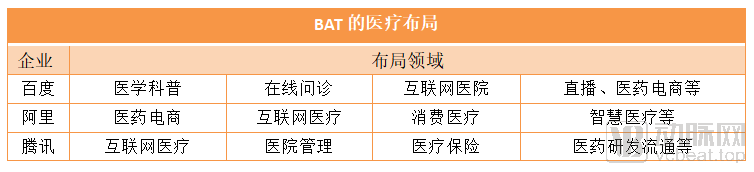
Despite the relaunch of an entirely new brand this year, it is not difficult to see from the foregoing discussion thatBaidu Health has established a differentiated pathway through its dual-ecosystem strategy of “content + services,” covering a range of healthcare-related functions including online consultations, prescription delivery, appointment scheduling, psychological counseling, and insurance.。
Particularly noteworthy is that, under its dual-ecosystem strategic layout, Baidu Health has achieved the capability to reach users across all scenarios and connect with them through the organic integration of content and services.. In other words,By leveraging content as a high-frequency entry point, Baidu Health can guide users to related services in the future.For example, after viewing high-quality content on diabetes, a user can directly consult with the doctor online and purchase medications.
Of course,It is worth noting that behind the booming internet healthcare industry, the challenges it faces remain highly prominent, particularly in terms of achieving a closed-loop business model, where existing internet healthcare companies are still in their early stages.。
Over the past decade-plus of development in internet healthcare, services such as free online appointment registration and low-ticket-price online consultations haveThe pure online model struggles to cover costs, and its growth potential is limited in the long run.. As forBuilding offline hospitals as the foundation for internet-based services turns it into a capital-intensive business.Finally, ifIf platforms rely solely on public hospitals to operate internet hospitals, they will inevitably face the scenario where these public hospitals eventually establish their own independent platforms.。
Therefore, even giants like BATJ,There is still a long way to go in the vast field of healthcare.
But regardless, BaiduThe strategic shift from “connecting people and information” to connecting “people, information, and services” has provided Baidu Health with greater potential for strategic expansion., and this may position Baidu Health as one of the key game-changers in the healthcare sector.
It is important to note that, unlike other industries, the healthcare sector demands greater patience, dedication, and sincerity. Only under the nurturing care of these “three hearts” can a company’s sapling take root, sprout leaves, and blossom in the healthcare field.