

Calm Files for IPO: The Unicorn Behind 80M+ Downloads in the Booming U.S. Sleep and Mindfulness Market

Calm
Meditation and Sleep Aid Software Developer
Data from mobile app analytics firm Sensor Tower shows that the top 10 meditation apps generated a combined total revenue of $195 million in 2019, representing a 52% year-on-year increase compared with 2018. Among them, Calm topped both the revenue and app download charts.
What Can Meditation Offer?
In Kelly McGonigal’s book The Willpower Instinct, it is mentioned:
Neuroscientists have found that if you regularly engage your brain in meditation, it not only becomes adept at meditating but also enhances your self-control, improving your ability to concentrate, manage stress, resist impulses, and develop self-awareness. Over time, your brain will transform into a well-tuned machine of willpower.
As an app that leverages the internet to provide users with meditation and sleep-aid services, Calm has amassed over 80 million downloads to date, along with 700,000 five-star user reviews.
The CEO Surrounded by Pressure
Calm was founded in 2012, headquartered in San Francisco, USA, and co-founded by Michael Acton Smith and Alex Tew.
As Co-Founder & CEO of Calm, Michael Acton Smith boasts an impressive resume and a successful career, having been appointed an Officer of the Order of the British Empire (OBE). Prior to founding Calm, he was the founder of Moshi, a children’s sleep aid brand, and developed the well-known children’s gaming franchise Moshi Monsters.
“I have always been passionate about innovative ideas and products, including founding new ventures.”
“Entrepreneurial life is full of fun, but it also comes with chaos, restlessness, and tension. As an entrepreneur, I am always troubled by missed opportunities and feel stressed about the future.”
“I feel like I’ve reached a tipping point; my enjoyment of work is gradually fading, and I’m frequently experiencing headaches. I think I urgently need to take a break.”
Faced with work-related stress, Michael Acton Smith chose to step away from his job and retreat to the mountains of Austria for a life of seclusion. It was during this period that he read extensively on meditation and learned how to regulate his mental state. Upon returning to London, he was no longer plagued by his previous anxiety and had rediscovered his passion for work.
In stark contrast, Alex Tew, the other co-founder and CEO of Calm, took a completely different path. In 2005, while still a university student, Tew created a website called the Million Dollar Homepage. He conceived it as a giant billboard comprising one million pixels, where businesses could purchase advertising space in basic units of 10x10 pixels at a price of $1 per pixel. Within just four months, nearly all the pixels were sold out, allowing Tew to easily earn one million dollars.
Technically speaking, the Million Dollar Homepage was a website that “anyone could have created,” yet few people at the time came up with the idea and put it into practice.
Subsequently, Alex Tew and his friends developed a more intriguing website—“Do Nothing for 2 Minutes.” As its name suggests, the site requires users to sit in front of their computers without touching the mouse or keyboard for two minutes. Within eight hours of its launch, the website attracted 20,000 visitors.
By 2012, many companies had chosen to develop technology to improve efficiency and make life more convenient, but Alex Tew took the opposite approach, using technology to help people find a sanctuary of calm in their busy lives. When “anxious” Michael Acton Smith met “rebellious” Alex Tew, Calm was born.
Initially, Calm existed as a website. A year after its founding, Calm joined the “mobile crowd” by launching an eponymous app, allowing users to access Calm anytime and anywhere via their smartphones.
Two Major Business Segments: Meditation and Sleep Aid
Calm is positioned as a mindfulness app designed to “improve users’ mental well-being, reduce stress, and aid sleep.” The majority of its users are meditation beginners, with women accounting for over 60% and most aged between 30 and 35. Its primary audio content revolves around two main themes: meditation and bedtime stories.
Meditation is Calm’s core product. Most meditation sessions offered in the app last 10–15 minutes and can help alleviate anxiety and reduce stress.
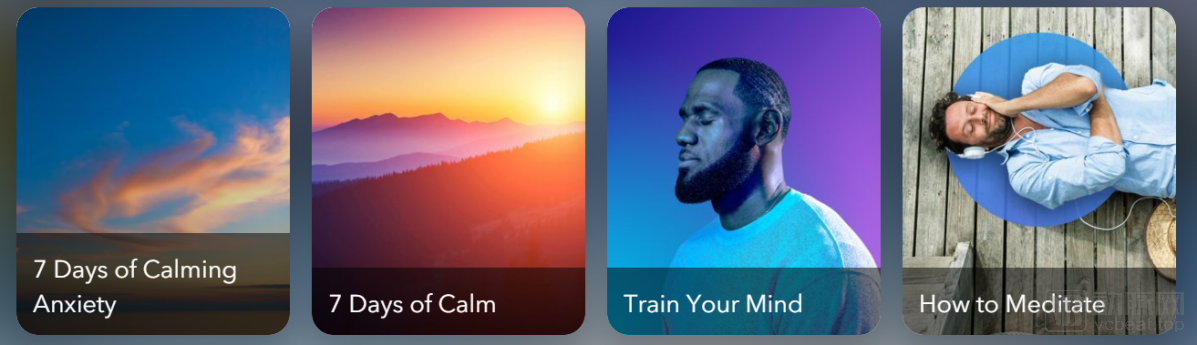
Selected Meditation Courses by Calm
Moshi, previously founded by Michael Acton Smith, initially focused on providing educational games for children before gradually transitioning to offering sleep aid services for kids.
To address the challenge of ensuring restful sleep for children, Moshi has adopted bedtime stories as its solution. Users can access long-term services by subscribing to the app’s content, and Moshi currently boasts over 100,000 subscribers. User feedback indicates that Moshi not only helps children fall asleep quickly but also caters to individuals across various age groups.
Bedtime stories are not exclusive to children.
According to data from the U.S. Centers for Disease Control and Prevention (CDC), one in four Americans suffers from sleep problems. In modern society, as work and life pressures continue to mount, there is a growing demand for anxiety relief and emotional management.
In December 2016, Calm expanded its platform services by introducing a new feature called “Sleep Stories.” Michael Acton Smith believed that most users of Calm sought primarily psychological relaxation and improved sleep quality; therefore, developing products specifically designed to help users achieve better sleep held significant value for both the company and its users.
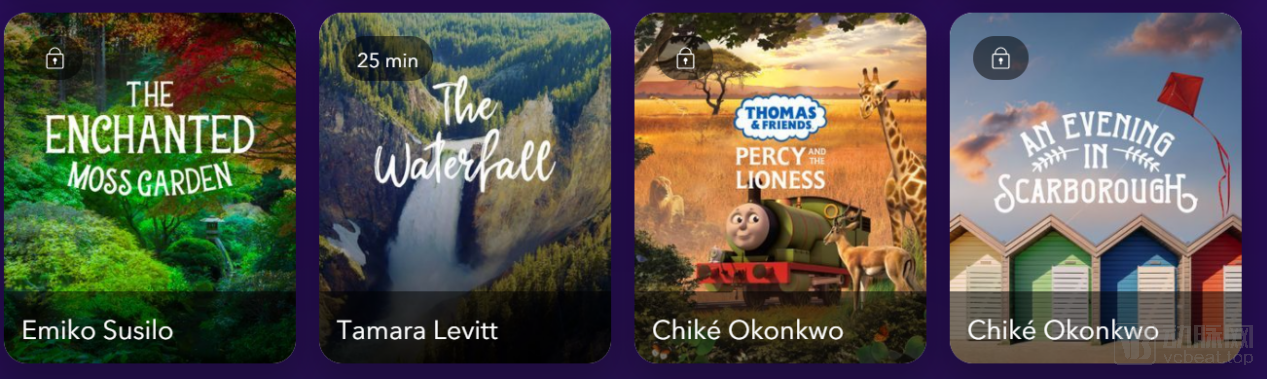
Selected Sleep Stories
Following the launch of this service, Calm saw a significant increase in both user registration and retention rates. Calm has also publicly stated that a large portion of its users treat the platform primarily as a sleep aid rather than a meditation app.
Enhancing User Experience with “a Billion” Tiny Details
As a direct-to-consumer product, Calm has gone to great lengths to optimize the user experience.
For any product, the first thing people notice is naturally its name. Calm—meaning “calmness”—allows users to grasp the app’s core functionality at first glance, while being simple, pleasant-sounding, and easy to remember.
Founder Alex Tew stated that although Calm is an app primarily focused on meditation, he deliberately avoided using the word “meditation” in its name, as it might lead some people to perceive it as a skill requiring professional training, thereby triggering resistance.
Calm’s meditation offerings focus on mindfulness-based practices, delivering proven, significant benefits in alleviating stress, anxiety, and depression, with the immediacy of its functional effects being readily apparent.
Meanwhile, the app regularly introduces new “10-Minute Meditation” sessions and Calm courses led by world-class meditation experts each month, thereby maintaining user engagement and ensuring retention rates.
Some of the narrators for Calm’s bedtime stories are quite distinguished—Danai Jekesai Gurira, the actress who starred in Black Panther; comedian and author Stephen Fry; and actress Bindi Irwin, who read An Australian Adventure, among others.
Celebrity fandom is a prominent psychological need among contemporary young people, with many looking to stars as emotional anchors and role models. Leveraging celebrities’ influence can help promote healthy lifestyle concepts and encourage users to adopt proper perspectives on sleep.
In terms of meditation courses, Calm offers a wide range of themes, with titles that clearly communicate the benefits of each course, thereby strengthening potential users’ purchase intent.
In addition, users can customize the app’s background and professional BGM on demand when using Calm, choosing from options such as a refreshing post-rain forest or a cozy red-clay stove, aiming to create an immersive experience.
Exploring the Development Trajectory of Unicorn Companies
Currently, Calm’s monetization relies primarily on subscription services rather than digital advertising for revenue generation. Users can download Calm for free via iTunes and major Android app stores.
After downloading the app, users can listen to selected content from the Seven-Step Relaxation Method for free. To access more comprehensive, high-quality meditation, music, and sleep-aid services, a paid subscription is required.
In 2014, Calm was priced at $4.99 for three months, $6.99 for six months, and $9.99 for one year.
Now, Calm’s content pricing has clearly been redesigned: $12.99 for a single month and $69.99 for an annual subscription. It is evident that most users will opt for the $69.99 annual plan, as it offers better value for money.
For enterprise clients, Calm’s pricing model has undergone some changes. Currently, Calm has established partnerships with numerous companies and schools, allowing their employees, teachers, and students to use the Calm app free of charge.
Since its founding in 2012, Calm has completed eight rounds of financing. The largest was its Series B round, closed in February 2019, which raised $88 million. At that time, Calm’s valuation reached $1 billion, making it the first unicorn company in the meditation sector.
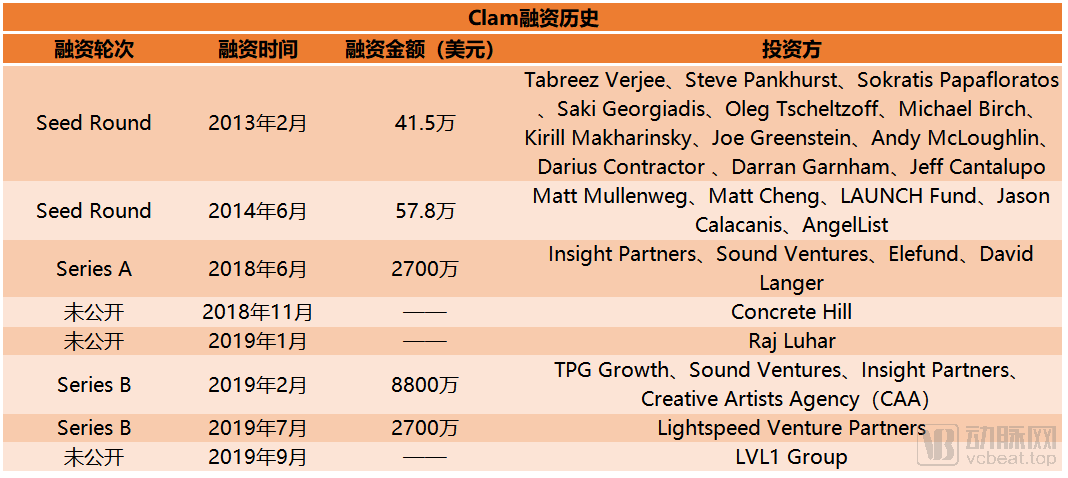
Although Calm’s core is a digital product, Calm is not limited to providing services to users online.
In March 2015, Calm and Penguin collaborated to release a book of the same name. The book quickly became a bestseller in the UK after its launch, and was subsequently translated into Chinese, German, French, and other languages, with sales in more than a dozen countries and regions.
In July 2017, Calm launched its first physical product, Sleep Mist, a blend of lavender extract and various plant-based essential oils. Coinciding with the launch, the Calm app added two new lavender-themed sleep stories. By combining aromatherapy with audio therapy, Sleep Mist differentiates itself from similar products on the market and offers enhanced support for improving sleep quality.
In November 2018, Calm publicly announced the completion of a $3 million equity financing round with XpresSpa Group (a chain of airport spas). Calm viewed this investment as a strategic move to expand its offline presence. The funds were primarily allocated to enhancing user awareness of the Calm app and the company’s retail products, while also helping Calm reach travelers and business commuters, thereby broadening its user base.
Meanwhile, Calm has established a partnership with American Airlines, through which the airline will offer Calm’s meditation and relaxation content via its in-flight entertainment system.
Michael Acton Smith stated, “Regarding our offline expansion, the avenues we can currently envision and execute include extending into retail stores, hotels, and publications. In the future, we may even purchase an island to develop it as a resort destination.”
Single-Function Meditation Apps Struggle to Adapt to the Chinese Market
In recent years, China's meditation market has also shown modest growth, with the emergence of related products such as Tide, Little Meditation, and HeartFlow Stress Relief.
However, compared to the United States, which has already produced unicorns, the anxiety economy with meditation as a solution has not been well localized in China.
Mindfulness is supported by neuroscientific experimental research; it has been secularized from religion and traditional culture, emphasizing practice and efficacy, and relies on individual agency to transform thoughts, mindsets, and circumstances. Nevertheless, it is undeniable that the mystique of Eastern religions remains a contributing factor to the popularity of meditation in the U.S. market.
Meanwhile, the influence of Silicon Valley titans has also spurred the emergence and development of meditation apps. Many Silicon Valley companies provide meditation facilities for their employees, and numerous leaders regularly engage in meditation practice.
However, in China, the public holds certain entrenched perceptions of meditation, often directly associating it with “sitting in meditation,” “zoning out,” or “chanting scriptures,” making it difficult to fully disentangle from religious connotations. This has, to some extent, hindered the development of meditation.
Furthermore, public awareness of mental health in China remains insufficient, with many individuals reluctant to pay for related services. Market perceptions of meditation have also rendered the “Copy to China” model unsustainable, leading to a hard landing.
Therefore, if meditation is to gain mainstream visibility in China, it must be presented in a product form that is scientific, integrated into daily life, and tailored to young people; associating it with mysticism and religion will make it difficult to achieve significant scale.
However, compared to the meditation market, China’s sleep market has performed better. Sleep-focused products such as Little Sleep and Snail Sleep have garnered positive user responses, with Little Sleep boasting nearly 100 million users across all platforms.
Zou Zou, founder of Little Sleep, believes that the sleep scenario is a space conducive to discussion, communication, emotional release, and sharing. With high user and social acceptance and attention, it can rapidly gather a user base, forming an entry point into a niche health ecosystem. Therefore, in her view, combining sleep with meditation represents an ideal product strategy.
Moreover, beyond meditation, people in China face a host of other practical issues—such as mood improvement, exam-related stress relief, and premarital anxiety—each representing a significant market opportunity.