

Tencent Yidian Charts a C2B Course in Digital Health: Empowering Patients and Industry Through Trusted Medical Content

Tencent
Internet Comprehensive Service Provider
Healthcare has long been a persistent pain point for internet companies.
In terms of scale, the healthcare market is vast and difficult to quantify, making it hard for any internet company to remain unmoved. However, in terms of depth, the medical knowledge system is intricate and complex, with a deep moat.
Therefore, acquiring stakes in healthcare enterprises through financing and mergers and acquisitions to gain a foothold in the healthcare sector became a common practice for internet companies in their early stages. As the internet industry entered its second half, leveraging the power of big data and AI to build proprietary healthcare ecosystems has become the focal point of competition among giants such as BAT. Throughout this process, most companies have focused primarily on the B2B segment.
Tencent, known for its social products, has adopted a distinctive approach to entering the healthcare sector. In its embrace of the industrial internet, healthcare has become a strategic stronghold for Tencent. At this year’s Tencent Global Digital Ecosystem Summit, Tang Daosheng, Senior Executive Vice President of Tencent and President of the Cloud and Smart Industries Group, outlined the company’s vision for comprehensively advancing its healthcare business through a C2B (Consumer-to-Business) model. On one hand, Tencent aims to empower individuals by integrating various health service components, including information access, appointment registration, online consultations, medication purchases, and payments. On the other hand, it seeks to support the smart transformation of governments, hospitals, medical institutions, and pharmaceutical companies, driving supply-side innovation through digital solutions.
From the consumer perspective, Tencent Healthcare’s most representative product is Tencent Medical Dictionary. For any large-scale system, information serves as the foundation for the efficient flow of resources, a principle that holds especially true in the healthcare sector. For a long time, information asymmetry between doctors and patients has been one of the root causes of numerous problems. It was against this backdrop that Tencent Medical Dictionary emerged.
After more than three years of development, Tencent Medical Encyclopedia has pioneered a new model of systematic medical science popularization, providing users with scientific guidance throughout the entire diagnosis and treatment process. Meanwhile, by building trust with users through high-quality content, it collaborates with B-side partners to integrate related services, extending its scope from information dissemination to service delivery.
During this year’s Tencent Global Digital Ecosystem Conference, VCBeat also held exclusive discussions with Zhang Meng and Huang Lei, Vice Presidents of Tencent Healthcare, to gain insights into the practical pathways and implementation outcomes of Tencent Healthcare’s C2B model.
Zhang Meng possesses a dual background in biochemistry and business administration. With years of deep expertise in the healthcare industry, he currently leads multiple digital health innovation projects at Tencent, targeting the general public, physicians, and pharmaceutical companies. By leveraging Tencent’s strengths in connectivity and technology, he facilitates greater synergy across various segments of the healthcare value chain, enhancing operational efficiency and collectively improving patient care capabilities.

Zhang Meng, Vice President of Tencent Healthcare
Huang Lei is primarily responsible for leading the Tencent Medical Encyclopedia team, including optimizing product experience, expanding professional popular science content, and exploring scenario-based content distribution and refined operational models across formats such as articles with images, short videos, and physician-led live streams. Meanwhile, he is establishing extensive internal and external strategic partnerships to advance the C2B model of Tencent Medical Encyclopedia into more complex and mature stages.
Q: Why has Tencent made the consumer sector the starting point for its healthcare development?
Zhang Meng: The consumer-facing (C-end) approach is demand-driven. At its core, Tencent aims to address the challenges ordinary people encounter in their daily healthcare experiences. However, it is important to distinguish that, as an internet company, we do not directly provide medical consultations or sell medications to the public. Instead, we leverage our strengths in connectivity and intelligence to minimize efficiency losses in information transmission and optimize healthcare processes. Our ultimate goal is to achieve the fundamental objective of “reducing the time and travel burdens for patients seeking medical care.” This represents our greatest vision and the rationale behind our entry point from the consumer side.
Q: “Reducing the time and travel burden for patients seeking medical care” may seem simple, but it actually requires systemic solutions. What efforts has Tencent made in this regard?
Zhang Meng: This question is somewhat broad. I would like to provide some examples to briefly describe our product ecosystem. Take Tencent Yidian, for instance, which is one of our key ToC initiatives. It aims to distinguish authoritative medical knowledge from the myriad of mixed-quality, cobbled-together health information available online, thereby delivering credible, clean, effective, and accessible medical science popularization to users. From the perspective of prevention and “preventive treatment,” we seek to improve overall public health levels and reduce medical insurance expenditures. Meanwhile, in the field of chronic diseases such as cancer, we provide comprehensive scientific education covering the entire diagnosis and treatment journey, helping patients and their families enhance their scientific understanding of diseases and self-management capabilities, make informed decisions, and improve treatment outcomes.
Furthermore, based on patient medication scenarios, digital transformation of pharmacies and pharmaceutical companies are two key areas of our strategic focus. Ultimately, the goal of both initiatives remains centered on serving end consumers (C-end). Through pharmacy digitization, we enable prescriptions that were previously confined within hospitals to flow outward, allowing patients to purchase medications conveniently near their homes.
There are many directions for digital transformation in pharmaceutical companies. One example is “Hu Xin Xiao Ai,” an AI-powered heart failure management platform jointly developed by Tencent and Novartis. Built on the WeChat Mini Program framework, the platform leverages artificial intelligence technologies to provide interactive features such as voice and image recognition, helping heart failure patients and their families manage the disease more conveniently and accurately. Its core functions include daily indicator monitoring, health status assessment, and personalized information services, addressing the unmet needs for long-term disease management among heart failure patients.
Q: Tencent has made significant efforts in the consumer market. Will consumers be its paying customers?
Zhang Meng: As emphasized by Dowson (Tang Daosheng, Senior Executive Vice President of Tencent and President of the Cloud and Smart Industries Group) at the Ecological Conference regarding the C2B strategy, Tencent’s strength lies in its user base. Specifically, by integrating content streams, information flows, and payment channels based on its users, and leveraging technology, scenarios, and ecosystem support, Tencent assists governments, hospitals, and manufacturers in their digital transformation and upgrading.
Much like the development of WeChat, Tencent Healthcare’s focus on the consumer side is to accumulate users, which essentially means building up Tencent’s core competitiveness. However, just as with our objective in creating the Medical Encyclopedia, in the healthcare sector, consumers are the recipients of our services but not necessarily the payers. As we explore ways to monetize user value, we will strive to safeguard users’ interests and remain true to our original mission.
Q: Tencent Yidian is a significant consumer-facing (to C) project for Tencent. With Tencent’s current Consumer-to-Business (C2B) strategy, will this product face revenue pressure?
Huang Lei: We have consistently made substantial investments in Yi Dian. However, revenue is not our primary consideration; rather, we aim to better meet user needs. The mission of Yi Dian is not to achieve significant financial returns, but to foster empowerment and build trust-based connections.
Therefore, Tencent Medical Encyclopedia must first uphold the belief of meeting user needs and delivering high-quality content. While a business model may emerge in the future, we do not currently treat it as a product aimed at generating commercial value.
Q: For a B2C product like this, the content of Tencent Medical Encyclopedia is crucial. How has the content of Tencent Medical Encyclopedia evolved from its inception to the present day?
Huang Lei: From the perspective of the current industry environment, regardless of content granularity, merely creating a knowledge base that aggregates high-quality medical content may allow users in this fast-paced era to search within it when needed, but it is difficult to achieve the effect of “popularization.” Therefore, we need to leverage the Medical Encyclopedia to transform the dissemination path of medical knowledge from passive reception by users to active engagement.
Huang Lei, Vice President of Tencent Healthcare
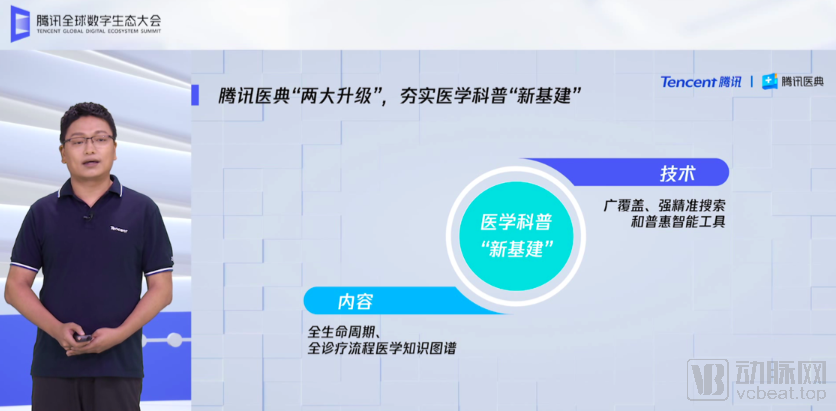
Since last year, Tencent Medical Dictionary has launched a series of content innovations and extended its content distribution channels beyond Tencent’s social ecosystem.
On one hand, we continue to publish content through platforms such as WeChat Official Accounts, while transforming complex medical knowledge into engaging, systematic illustrated features—for example, providing a chapter-by-chapter, entertaining overview of the entire breast cancer care journey.
On the other hand, we have also ventured into the short-video and live-streaming sectors, leveraging platforms such as Weishi and Kuaishou to transform Tencent Medical Dictionary’s static text-and-image knowledge into dynamic video streams. To date, Tencent Medical Dictionary has begun cultivating a portfolio of professional intellectual property (IP) to disseminate its medical knowledge, establishing a sizable matrix of video content output. Additionally, we have invited renowned experts and scholars, including Academicians Zhong Nanshan and Li Lanjuan, to conduct live broadcasts on topics related to the epidemic.
The impact of this transformation has been substantial. During the pandemic, Tencent Medical Encyclopedia produced over 2,000 pieces of popular science content, with readership increasing tenfold and total cross-platform distribution reaching tens of billions.
Q: At this year’s Eco-Connect Conference, Tencent Yidian officially launched its Content Openness Initiative, seeking partners through open-source collaboration. Does this signal a shift toward commercialization, thereby betraying Tencent’s original consumer-centric (to-C) mission?
Huang Lei: In fact, there is none. The open-sourcing of Tencent Medical Encyclopedia signifies that its content has reached a sufficient level of maturity, and implies that it should not be limited to providing consumer-facing health education; rather, it is capable of undertaking more platform-oriented responsibilities.
For Tencent Medical Dictionary itself, sharing content with partners via API means that the general public can access its popular science resources through more channels, which effectively expands the platform’s dissemination capacity.
By leveraging APIs and the integrated application of technologies such as big data and artificial intelligence, we aim to provide users with information that is desirable, accessible, and useful in specific scenarios, thereby delivering an interactive experience. For example, Tencent Medical Dictionary recently partnered with Douguo Cuisine, a food-focused app, to annotate nutritional content and dietary pairing recommendations for various ingredients within its recipes. Additionally, through collaborations with enterprises and leading apps, we provide health knowledge and training courses tailored for employees and workplace settings. This approach allows general medical knowledge to be combined with scenario-specific needs, achieving precise adaptation, fostering deep user engagement, and integrating seamlessly into healthy lifestyles.
Secondly, Tencent Medipedia also supports Tencent’s own internet healthcare capabilities. Built on open-source services, Tencent Medipedia has integrated functionalities such as online consultations, self-assessment tests, and drug information lookup, becoming one of the key access points for internet healthcare services. This enables it to better meet user demands for long-tail content and online services.
Furthermore, Tencent Medical Dictionary itself has deeply integrated medicine with AI technology to create user-friendly and practical science popularization tools, such as health checkup report interpretation based on optical character recognition (OCR) technology and posture assessment based on keypoint detection. These tools enable patients to complete self-assessments from the comfort of their homes. Through highly interactive and gamified design, these features enhance user engagement and retention.
Furthermore, we are collaborating with wearable device manufacturers and smart home solution providers to transform users’ daily health-related behaviors into insightful analytical results, enabling scientific health management. Through this model, we can apply our existing knowledge base on a broader scale and promote medical literacy among users, while our partners gain access to Tencent’s AI capabilities, thereby enhancing the competitiveness of their products.
Q: Beyond medical classics, the digital transformation of pharmacies was also a key topic at this conference. Why is Tencent looking to enter the pharmacy sector?
Zhang Meng: The rationale for entering the pharmacy sector should be considered from two perspectives. First, medication procurement has long been a cumbersome process for patients, particularly those with chronic conditions. Therefore, we aim to facilitate the circulation of electronic prescriptions, which aligns with a major industry trend. Additionally, we seek to enable 24-hour pharmacy operations to address urgent medication needs that may arise unexpectedly at night. To achieve these objectives, we cannot rely solely on manual labor; instead, Tencent’s approach is to empower the sector through “connectivity.”
Second, pharmacies. The driving force behind the digital transformation of pharmacies stems from policy reforms. In September, the balance in the individual medical insurance accounts was reduced, leading consumers to be more cautious when purchasing medications. Under these circumstances, to maintain profitability, pharmacies must leverage policy changes to capture the outpatient prescriptions flowing out from hospitals, which necessitates pharmaceutical companies to undergo digital transformation.
Q: How does Tencent help pharmaceutical companies undergo digital transformation?
Zhang Meng: After years of being impacted by various boundary-spanning online and offline business models, pharmacies must consider digitizing their physical stores and transforming them into smart offline terminals. This is where Tencent finds its entry point. Specifically, from the perspective of smart retail and smart health solutions, we aim to broaden the scope of platform services for pharmacies, enabling them to evolve from single-store operations to providing around-the-clock service.
Another aspect is expanding the business scenarios of pharmacies. In Europe and the United States, for example, the role of pharmacies has evolved from merely selling medications to becoming miniature testing centers. In light of China’s national conditions, we aim to transform pharmacies into offline health management platforms through mini-programs, membership systems, and various repurchase-based health management solutions, with Tencent providing support in this endeavor.
Throughout this process, we have witnessed numerous mature case studies, such as the third-party retail service collaboration between Neptune Star and Tencent. Specifically, we assisted offline pharmacies in undergoing e-commerce digital transformation, while analyzing redemption data from brick-and-mortar stores and consumer insights to provide Neptune Star with more targeted push notification services. This ultimately enabled a business model characterized by “offline service delivery, online traffic acquisition, and bidirectional O2O (Online-to-Offline) conversion.”
Through this model, we can not only help pharmacies transform their brick-and-mortar retail operations but also enable us to expand further into the new blue-ocean market of online pharmaceutical e-commerce.
Q: In 2019, Tencent and Novartis launched the “Hu Xin Xiao Ai” product. Will Tencent pursue more collaborative plans with pharmaceutical companies in the future?
Zhang Meng: In our collaboration with Novartis, Tencent primarily serves as a technology provider. By leveraging AI technologies and integrating our internet capabilities, we enable Novartis to remotely manage heart failure patients, particularly those with severe conditions.
China has gradually shifted from a disease burden dominated by infectious and acute conditions to one characterized primarily by chronic diseases, with a large population of patients suffering from hypertension, cancer, and metabolic disorders. However, a significant pain point in the current healthcare system is its continued focus on providing medical care within hospital settings. Due to resource constraints, there is a lack of effective means to reach patients for home-based self-care and rehabilitation, which substantially impacts treatment outcomes. Therefore, we aim to leverage cloud-based solutions to better connect patients with their attending physicians and nurses, ensuring that patients can access medical assistance when needed. Additionally, by analyzing patient behavior and vital signs, we can provide early warnings. Thus, this represents a case of technology empowering the digital transformation of pharmaceutical companies.
Certainly, we are also considering whether these foundational technical capabilities can be applied to other industries to address the needs of a broader user base. “Huixin Xiaoai” serves as an excellent case in point, as it effectively establishes deep connections among physicians, nurses, and heart failure patients. Building on this success, we will continue to explore win-win collaboration models with pharmaceutical companies, with many partnerships currently underway.
Q: After this period of exploration, what core capabilities has Tencent Healthcare accumulated?
Zhang Meng: We are still continuously seeking breakthroughs in our products. Overall, I believe that core capabilities can be broadly divided into three parts.
First, user engagement and content capabilities. Tencent Medical Dictionary currently possesses sufficient capabilities for content production and distribution, thereby ensuring strong user stickiness. This enables the development of internet healthcare services and facilitates the establishment of a C2B channel.
Second is our AI capability, or more broadly, our technological prowess. Whether it involves assisting physicians with patient consultations, analyzing patients’ vital signs, or conducting medical literature searches and data analysis, our AI capabilities are leveraged throughout these processes. We deliver greater precision and efficiency compared to other enterprises, which constitutes our competitive advantage.
Third is our understanding of users. With a broad business scope covering consumers, pharmacies, and pharmaceutical companies, we gain comprehensive insights into the ecosystem, enabling us to develop more effective and efficient business strategies.
As for the rest, they are but fleeting clouds; what truly endures constitutes the core competency.