

Domestic Genomic Sequencer Breakthrough: China's First Fourth-Generation Nanopore Sequencer QNome-9604 Disrupts the Global Sequencing Ecosystem
QitanTech
Gene Sequencing Technology R&D Provider
For a long time, the gene sequencer market has been monopolized by a few overseas giants. However, this situation has undergone subtle changes following the market entry and expansion of MGI’s independently developed next-generation gene sequencers, prompting people to consider how to choose between imported and domestically produced gene sequencers.
In fact, the counteroffensive of domestically produced sequencers began years ago. This is evident from the gradual emergence of three development models among Chinese-made sequencers: technology acquisition, OEM partnerships, and independent R&D. However, domestically produced sequencers based on OEM collaborations mostly serve specific genetic testing products; while they can be deployed rapidly, their market ceiling is relatively low. In contrast, the development cycle for independently developed gene sequencers is comparatively longer, allowing domestic developers to work diligently in a relatively tranquil environment.
Recently, VCBeat discovered that QitanTech has officially launched its first product, the QNome-9604, on its official website, marking it as the first of its kind to enter the market.
QitanTech was founded in September 2016. Its founding team possesses interdisciplinary expertise spanning protein engineering, microfluidic chip technology, and electrical signal acquisition and processing. Leveraging nanopore gene sequencing technology, the company has independently developed rapid, low-cost, and miniaturized fourth-generation gene sequencers along with supporting reagents. It is reported that the QNome-9604 represents a significant milestone achieved by QitanTech’s team after four years of dedicated research and development, with its functionality and stability undergoing continuous rapid optimization and iteration. In this article, we will attempt to analyze the new changes facing the gene sequencing industry from the perspective of the gene sequencer supply side.
Purchasers of gene sequencers include research laboratories, independent clinical laboratories, and healthcare institutions. Currently, due to the high cost and operational complexity of gene sequencers, centralized third-party testing has become the predominant implementation model. Statistics show that nearly 90% of China’s genetic testing market share is held by a dozen large independent clinical laboratories.
However, inspired by COVID-19 prevention and control measures, many hospitals have begun establishing in-house laboratories to meet the demand for nucleic acid testing. These hospitals may subsequently consider purchasing gene sequencers. According to information obtained by VCBeat from industry practitioners, the current installed base of gene sequencers in China’s hospital market is only around 800 units, with an average annual increase of approximately 100 units. Data disclosed by the Statistical Information Center of the National Health Commission shows that as of the end of March 2020, there were 1.009 million medical and health institutions nationwide, including 34,000 hospitals. Clearly, these medical and health institutions constitute a blue-ocean market yet to be tapped by gene sequencer manufacturers.
Over the past decade, multiple domestically produced second-generation gene sequencers from companies such as Berry Genomics, Annoroad Gene Technology, Genetron Health, and CapitalBio have successively received regulatory approval for market launch. However, the development of these products has served more as a countermeasure against instrument manufacturers that have long monopolized the upstream segment of the gene sequencing industry chain by repeatedly raising costs. The core logic reflected here is not the advancement of domestic gene sequencers, but rather the dominance of upstream giants.
In 2014, Da An Gene’s DA Proton was approved for market launch. Capable of delivering human genome, exome, or whole transcriptome data within hours, it offers faster turnaround than other sequencing technologies and fully meets the requirements for early, rapid, and low-cost non-invasive prenatal testing (NIPT). However, this product is based on a sequencer localized for production in China under license from Life Technologies.
In 2015, the product jointly developed by Berry Genomics and Illumina received regulatory approval for market launch. Leveraging Illumina’s licensed sequencing-by-synthesis (SBS) technology, the NextSeq CN500 ensures high data accuracy while processing up to 96 clinical NIPT samples in a single run. In 2017, the NextSeq 550AR, co-developed by Anoroad and Illumina, was approved for market launch. This desktop sequencer was independently researched, manufactured, application-developed, and registered for regulatory approval in China by Anoroad; however, its core technologies still rely on Illumina’s proprietary dual-channel “sequencing-by-synthesis (SBS)” and classic “reversible terminator” patents. The product developed through collaboration between Thermo Fisher Scientific and domestic sequencing service providers, namely BioelectronSeq 4000 by CapitalBio Technology, was launched in 2015.
Thus, it is evident that nearly all mainstream manufacturers of second-generation gene sequencers have previously licensed certain patents to domestic sequencing service providers for collaborative development. Industry insiders told VCBeat that this white-label development model offers relatively high efficiency; however, its drawback is that the white-label party cannot reap the innovation dividends from the original equipment manufacturer, leaving the product lacking in viability within a rapidly evolving technological landscape.
Gaorong Capital, the lead investor in QitanTech’s Series A financing round, told VCBeat that major overseas gene sequencer manufacturers have moved away from the traditional “printer and ink cartridge” sales model, opting instead for in-depth collaboration with ecosystem partners based on more comprehensive strategic considerations.
According to the project leader, taking Illumina as an example, the construction of the ecosystem has given rise to three main business models.
First, proactively explore new application scenarios, with original equipment manufacturer (OEM) production serving as one practical implementation of such scenarios. In January 2016, Illumina, together with the Bill & Melinda Gates Foundation and Bezos Expeditions, announced the establishment of Grail, aiming to identify technologies or products capable of early cancer screening through simple blood tests. Grail applied for an initial public offering on the NASDAQ in September 2020, followed by reports that Illumina planned to acquire Grail for $8 billion. In early 2017, Illumina and Bio-Rad jointly launched a single-cell genomic sequencing solution—the first next-generation sequencing (NGS) workflow for single-cell analysis—enabling researchers to gain deeper insights into the synergistic interactions of individual cells in terms of tissue function, disease progression, and treatment response.
Second, integration into hospital diagnostic and treatment workflows. For example, in November 2016, Illumina established a bioinformatics partnership with Mayo Clinic. The two parties planned to integrate existing services and software and adopt new innovative solutions to improve Mayo Clinic’s reporting workflow for genetic disease research. Illumina also leveraged this opportunity to develop informatics platforms and knowledge bases to enhance and automate genomic interpretation.
Third, cross-industry collaboration. In January 2017, Illumina announced partnerships with Philips and IBM. The former planned to integrate Illumina’s sequencing systems into its established IntelliSpace Genomics clinical informatics platform and coordinate marketing and sales solutions; the latter aimed to integrate Illumina’s BaseSpace with its Watson for Genomics, with the goal of standardizing and simplifying genomic data interpretation in tumor sequencing workflows.
The project leader speculates that, in the future, domestically produced gene sequencers will also adopt a development model characterized by deep collaboration with midstream service providers. On one hand, sequencer manufacturers need to engage in repeated communications with midstream service providers to identify requirements and directions for product iteration and upgrades. On the other hand, the self-reliant approach of attempting to handle everything in-house is not conducive to the long-term development of gene sequencing enterprises; building an ecosystem is a crucial business strategy.
“Amid the continuous expansion of both the scope and substance of gene sequencing services, domestic gene sequencer manufacturers may select differentiated application scenarios based on the technical characteristics of products across different generations.” This was how a project lead at Gaorong Capital explained VCBeat’s inquiries into market demand considerations for third-generation, and even fourth-generation, gene sequencers.
A Review of the History of Gene Sequencing: A Chronicle of Frontier Technologies Becoming New Essential NeedsSince its initial emergence in scientific research CRO services in 2006, gene sequencing has rapidly entered the clinical field on a large scale. While providing rich bioinformatics interpretation data, it has facilitated leapfrog progress in medical laboratory testing. During this period, mainstream gene sequencing technologies have undergone four iterations.
First-generation sequencing offers long read lengths and high accuracy, but its low throughput and high cost make it difficult to meet the data volume requirements of modern bioinformatics analysis models. Around 2010, second-generation gene sequencers developed by Illumina rapidly entered the market with their technical advantages of high throughput and high accuracy, driving a rapid decline in the cost of gene sequencing. It can be said that second-generation gene sequencers have played a pivotal role in the transition of gene sequencing from cutting-edge scientific research services to clinical applications.
Even so, second-generation sequencers are by no means a panacea. Their short read lengths and operational complexity prevent them from meeting the sequencing needs of complex samples in broader clinical scenarios. Consequently, third- and fourth-generation sequencing technologies, based on single-molecule fluorescence sequencing and single-molecule nanopore sequencing principles, have rapidly advanced. Their ultra-long read lengths and flexible, user-friendly features have reignited industry enthusiasm for genomic sequencing applications.
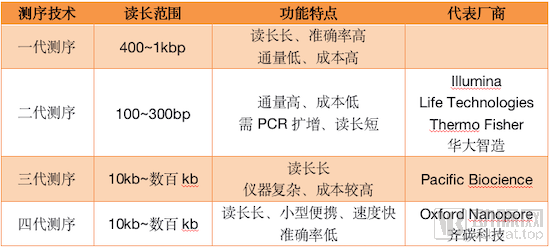
Comparison of Four Generations of Gene Sequencers
A project lead at Gaorong Capital pointed out that fourth-generation gene sequencers, leveraging ultra-long read lengths, can accurately sequence pathogens and other organisms, thereby avoiding errors introduced by fragment assembly. “In pathogenic microorganism sequencing, because mixtures often consist of different viral subtypes or hundreds to thousands of bacterial species with highly similar base fragments, next-generation sequencing (NGS) technologies often detect only the common fragments shared among multiple viruses or bacteria, making it difficult to accurately determine the specific viral or bacterial types. In contrast, long-read nanopore sequencing enables more precise classification and identification of pathogens.”
According to information published on the official website of QitanTech, the QNome-9604 adopts an innovative nanopore gene sequencing principle and performs gene sequencing based on electrical signals.In terms of technical specifications, the QNome-9604 sequencing system can generate 500 Mbp of data in 8 hours, achieving a medium-throughput level. It is suitable for rapid and flexible applications such as microbial detection and amplicon sequencing, while its detachable chip design reduces the cost per use.
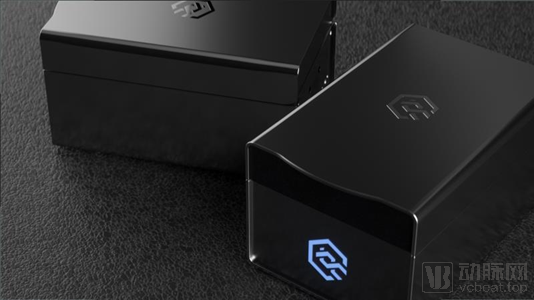
QitanTech QNome-9604 Sequencer
Furthermore,QNome-9604The accuracy is competitive, and the read length exceeds 150 kb, with longer reads being a hallmark of nanopore gene sequencing technology. VCBeat has learned thatAccompanying the launch of the sequencer are the compatible sequencing chip, QCell-3841, and the sequencing kit, Qeagen-8.
Industry practitioners interviewed by VCBeat also pointed out that, rather than simply replacing second-generation sequencers in existing settings, the more significant value of fourth-generation gene sequencers lies in leveraging their inherent advantages—greater flexibility, portability, and shorter turnaround times—to spawn new application scenarios. Examples include freeing scientific research from the confines of the laboratory and enabling rapid, visual at-home gene sequencing.
Rather than answering a binary, either-or question, we prefer to advocate for the continued prosperity of the current ecosystem of gene sequencing applications. Within this ecosystem, the emergence and growth of domestic brands are undoubtedly beneficial to the upstream, midstream, and downstream segments of the industry chain. VCBeat will continue to monitor the market performance of domestically produced sequencers.