

New Era Synergy: How Internet Healthcare and Primary Care Are Converging to Create Value
In 1965, Chairman Mao Zedong proposed the directive to “shift the focus of medical and health work to the rural areas.” On a foundation of extreme poverty and scarcity, China established a three-tier rural medical and health service network, characterized by the “barefoot doctors,” which provided relatively robust public health services and basic medical care to the rural population, then comprising the vast majority of China’s people. This achievement continues to be widely discussed and praised by many scholars to this day.
In the new era, President Xi Jinping proposed that “without universal health, there can be no comprehensive well-being,” accelerating the development of primary healthcare and adhering to Chinese approaches to address the global challenge of healthcare system reform. Within a relatively short period, China has established the world’s largest basic medical security network, focusing on resolving issues such as difficult and costly access to medical care and the equitable allocation of basic medical and health resources, thereby continuously advancing the process of building a moderately prosperous society in all respects.
Over the past few decades, primary healthcare has remained a focal point in the development of China’s healthcare system.
Amid population aging, urbanization, and a growing burden of chronic diseases, residents’ health awareness has significantly improved, with rising expectations for the quality of medical care. However, the current diagnostic and treatment capabilities, as well as equipment and infrastructure, in primary healthcare settings remain inadequate to meet patients’ health needs. This has resulted in scant patient visits at primary care institutions, while a large number of patients continue to seek care at major hospitals, leading to severe overcrowding and operational strain on these tertiary facilities.
The fundamental challenges facing primary healthcare stem from the uneven distribution of medical resources, weak infrastructure at the grassroots level, suboptimal diagnostic and treatment capabilities, and low public trust in primary care services.
In China, 47% of the population resides in grassroots areas, representing a massive demographic base. Currently, the landscape of grassroots medical institutions includes 15,000 county-level hospitals, 36,000 township health centers, 622,000 village clinics, 9,352 community health service centers, and 26,000 community health service stations, supported by a workforce of 3.978 million medical personnel.
This means that for the 600 million people in primary-level communities, there are fewer than four million healthcare professionals, a situation that is far from optimistic. Ensuring the health of such a large population places significant demands on the development of primary healthcare infrastructure.
Primary healthcare services form the foundation of the healthcare service network. Since the launch of the new round of healthcare reform in 2009, China has introduced a series of policies to strengthen the role of primary healthcare services, and government investment in primary healthcare institutions has increased tenfold.
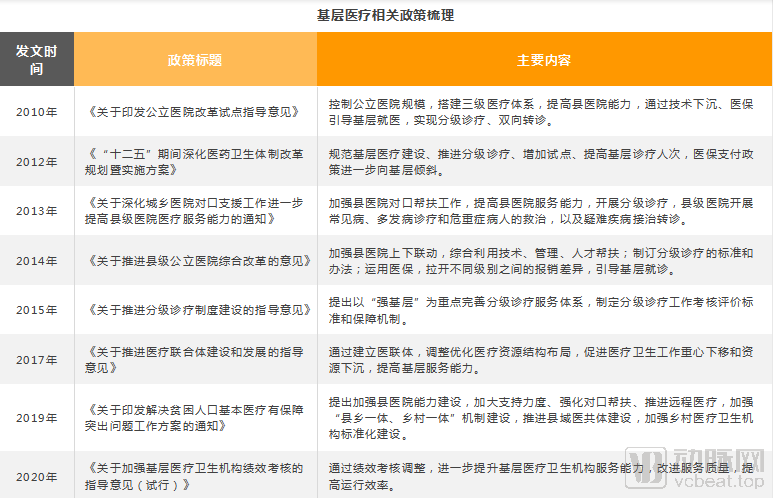
(Summarized from public sources; graphic by VCBeat)
Academician Hu Shoushou of the Chinese Academy of Engineering pointed out that China is undergoing an epidemiological transition characterized by “major chronic diseases plus emerging infectious diseases,” social development marked by “population aging plus urbanization,” and technological innovation driven by “big data plus the Internet.” Strengthening primary healthcare services is both a historical imperative and a strategic opportunity.
“Strengthening Primary Care” is a long-term and complex systematic project for implementing the new healthcare reform measures. In addition to increased national policy support, what other drivers can propel the development and construction of primary healthcare?
On September 16, the 2nd “Primary Healthcare + Internet Healthcare” Development Forum, themed “Breaking Through, Restructuring, and Connecting: Jointly Building a New Digital Future for Primary Healthcare,” was held in Guangzhou.
Liu Zhongliang, Executive President and Secretary-General of the China Medical Pharmaceutical Material Association; Wang Lijue, Vice President of the China Medical Pharmaceutical Material Association and Chairman of Akang Health; Liao Xinbo, Former Inspector of the Guangdong Provincial Health and Family Planning Commission; Zhang Jun, Senior Executive Vice President of WeDoctor Group; Li Weidong, Vice President of the China Medical Pharmaceutical Material Association, President of the Primary Healthcare (Yunnan) Branch, and Chairman of Dongjun Pharmaceutical; Sun Dongbo, Senior Partner at Zhongye Capital; and Tu Weiying, Deputy General Manager of the Research Department at CICC, along with other industry experts, scholars, entrepreneurs, and investors, gathered together to discuss strategies for the development of primary healthcare.
Liu Zhongliang, Executive President and Secretary-General of the China Medical Pharmaceutical Materials Association, pointed out that primary healthcare represents a vast market. A series of national policies reflect the high priority attached to primary healthcare and set forth new requirements for its development. Under the new circumstances, all stakeholders need to build consensus, strengthen collaboration and unity, jointly seize the historical opportunities presented by economic structural adjustment, and become a significant force driving the development of primary healthcare and the broader health industry.
Chairman Liu stated that the rapid development of the Internet is currently bringing profound changes to human production and daily life, while also presenting a series of new opportunities and challenges to human society. Effectively leveraging, developing, and governing “Internet Plus” within the big health industry, and working together to build a community with a shared future in cyberspace, is an important issue facing us all.
The COVID-19 pandemic has catalyzed the development of China’s internet healthcare market. During the outbreak, the volume of online consultations surged across the country, and new internet hospitals and online diagnostic and treatment services were rapidly launched. Since January this year, more than 100 internet hospitals have been approved or established and gone live. Meanwhile, medical insurance departments and healthcare institutions in many regions swiftly upgraded their information systems to enable online settlement. After two decades of development, internet healthcare in China has finally reached its “moment in the spotlight.”
Gu Jing, an expert in internet healthcare and a seasoned investor, stated that the rapid development of internet healthcare in the new era has, to some extent, served as a much-needed boost to strengthening primary care. The essence of internet healthcare lies in the reallocation of medical resources, the re-optimization of medical processes, and the reconstruction of the medical ecosystem. The vigorous growth of internet healthcare has brought significant development opportunities to primary healthcare.
In addition, Zhang Jun, Senior Executive Vice President of WeDoctor Group, shared insights on the role of internet hospitals in follow-up visits for chronic diseases during the post-pandemic phase. He emphasized that internet healthcare and primary care will become more closely integrated in the future.
Wang Lijue, Vice President of the China Medical Pharmaceutical Material Association and Chairman of Akang Health, pointed out that the continuous upgrading of patient-centric demand has become the fundamental driving force behind the transformation of the entire industry. In the new era, the value system of primary healthcare needs to be reshaped.
Amid the surge in internet healthcare, how can internet healthcare and primary care achieve deep integration? Wang Lijue, Vice President of the China Pharmaceutical Material Association and Chairman of Akang Health, interpreted and shared how Akang Health has supported the development of primary care by linking internet healthcare services, building a digital platform, and extending its pharmaceutical supply chain to grassroots levels, drawing on the company’s development path.
“Forty-seven percent of our country’s population lives in areas with limited access to medical care and pharmaceuticals. How can we connect the vast amount of grassroots-level data? As a new-type pharmaceutical distribution company, Akang has been committed to addressing medication accessibility at the grassroots level and improving the quality of primary healthcare services. We believe there are three core elements in strengthening grassroots connectivity: first, closely integrated medical consortia; second, digital platforms for primary healthcare; and third, the decentralization of supply chains,” said Wang Lijue.
Regardless of policy or market economics, primary healthcare holds significant promise. From a pharmaceutical perspective, the structural adjustment of drug distribution channels driven by prescription outflow has created new market growth points.
In 2019, the total size of the pharmaceutical market reached RMB 2 trillion. Wang Lijue believes that under the new trend of prescription outflow, three major new business models have emerged: First, new forms of internet healthcare, including B2C platforms such as Tmall, JD.com, and Pinduoduo, as well as O2O platforms like Meituan, Ele.me, and JD Daojia. Second, new retail in pharmacies, encompassing public domain strategies (B2C + O2O), private domain operations (mini-programs + member fission + live streaming), prescription outflow services (chronic disease management + disease-specific supply chains), and offline traffic conversion (medication ordering assistance + medical services). Third, new models in primary healthcare, including rural health communities, grassroots internet hospitals, cloud drug warehouses combined with rural cloud pharmacies, testing and inspection paired with commercial insurance, and chronic disease follow-up consultations plus referral services.
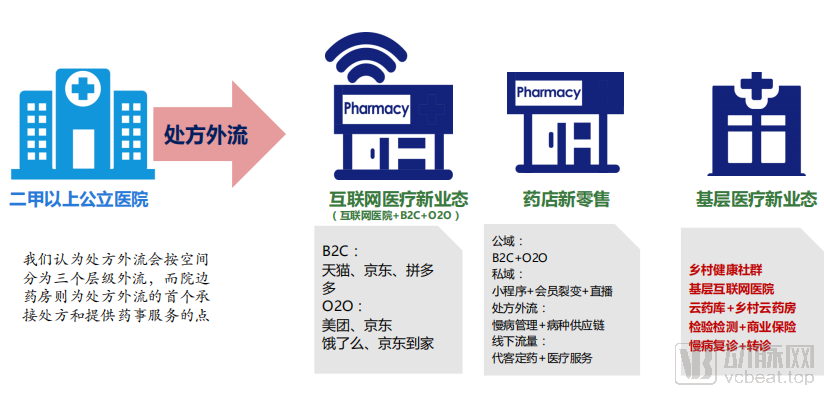
(Image shared by Mr. Wang Lijue, Vice President of the China Medical Pharmaceutical Material Association and Chairman of Akang Health)
“New business models in primary care require us to view primary healthcare through a new lens,” pointed out Wang Lijue.
Aikang Health, founded in 2005, is a novel pharmaceutical distribution company specializing in the circulation of medications for chronic diseases, critical illnesses, and rare diseases, while facilitating prescription outflow and the separation of prescribing from dispensing. Over the past 15 years, Aikang Health has expanded from its initial B2B pharmaceutical business to build an integrated supply chain system centered on specific disease types. This system combines Direct-to-Patient (DTP) services with Chronic Disease Care (CDC), integrates B2B and B2C models, and merges online and offline channels, gradually forming a closed-loop ecosystem encompassing “healthcare + disease management + pharmaceuticals + insurance.”
Building on 15 years of accumulated expertise and further exploring development opportunities in primary healthcare, Aikang Health has launched six cloud-based services—“Cloud Hospital, Cloud Pharmacy, Cloud Academy, Cloud Laboratory, Cloud Insurance, and Cloud Public Welfare”—to establish a digital service platform for primary healthcare.
Cloud Hospital is a primary care internet hospital platform, establishing a nationwide online platform for primary healthcare. It recommends licensed primary care physicians to provide services such as routine follow-up consultations and prescription issuance. Meanwhile, it builds a national primary care medical consortium, extending internet hospital services to rural frontline areas to facilitate local diagnosis and treatment without the need for patient referrals. On the day of the conference, the Akang Primary Care Chronic Disease Internet Hospital Platform was officially launched.
Cloud Pharmacy is a shared supply chain platform for primary healthcare. As an intelligent allocation platform centered on Cloud Pharmacy, it develops provincial, municipal, and county-level channels to establish a direct-from-manufacturer distribution system. It builds a rural Cloud Pharmacy network that intelligently matches the needs of patients in primary care settings with the supply chain platform, thereby enhancing service capabilities in primary healthcare. The platform also integrates laboratory testing services and medical devices.
Cloud Academy is a training and education platform for primary healthcare professionals. It leverages expert resources from the pharmaceutical industry to produce medical educational videos, with the pharmaceutical industry providing certain distribution support to help primary care physicians purchase learning resources on the education platform. Additionally, it offers certification training for primary care physicians.
Cloud Laboratory is a shared platform for primary-level inspection and testing that integrates medical laboratory service providers to form a medical testing supply chain. By coordinating with regional hospital laboratories and medical testing centers, it delivers the fastest and most convenient medical testing services to primary healthcare institutions.
Cloud Insurance is a chronic disease rehabilitation initiative under Healthy China, which collaborates with major domestic insurance companies to promote the development of insurance services tailored to primary healthcare settings, and establishes an integrated model combining basic medical insurance, commercial insurance, and chronic disease rehabilitation management.
Yun Gongyi is a public welfare platform for grassroots doctors, dedicated to caring for veteran village doctors and establishing the Rural Doctors Health Public Welfare Fund and the Grassroots Rural Cloud Pharmacy Construction Fund.
“We hope to leverage digital platforms for primary healthcare to drive the development of medical consortia, thereby integrating medical resources within the region and ensuring that patients can receive treatment for serious illnesses within their county and minor ailments within their village,” said Wang Lijue.
Currently, the development of these six cloud services has reached a significant scale, with coverage essentially completed across Guangdong Province. The next step is to expand nationwide and achieve greater penetration into more townships.
Wang Lijue shared with us that Aikang Health is preparing to establish an Aikang Cloud Pharmacy in a township with a population of over 50,000, aiming to integrate medication services across rural healthcare. By connecting rural clinics and rural pharmacies, Aikang Health seeks to extend its supply chain deep into grassroots markets. For pharmaceutical manufacturers, Aikang provides a robust platform to help ensure that their products are effectively retained, accessed, and managed within the prescription outflow system. This approach drives incremental growth through rational drug use and establishes a closed-loop data ecosystem.
He pointed out that Akang Health primarily serves as a “value connector,” linking upstream internet platforms to integrate medical resources and connecting downstream with the pharmaceutical industry to broaden industrial channels, optimize drug supply, and continuously enhance the self-sustainability of primary healthcare institutions.
On December 4, 2018, Akang Health launched the Healthy China Chronic Disease Rehabilitation Project. The core of this initiative is to ensure that chronic disease rehabilitation, follow-up consultations, and medication dispensing are all accessible at the primary care level. The project primarily offers five key services, including: chronic disease management and rehabilitation training; provision of a “super Grade-A tertiary hospital” standard pharmaceutical supply chain; facilitating convenient follow-up visits and chronic disease care for patients; reducing treatment costs; and alleviating the financial burden on patients.
Through training primary care physicians, establishing rural cloud pharmacies, assisting in the formation of local support groups for chronic disease patients, and building personal brands for doctors, the Chronic Disease Rehabilitation Project has enabled village clinics to retain chronic disease patients and significantly improved the quality of primary healthcare services.
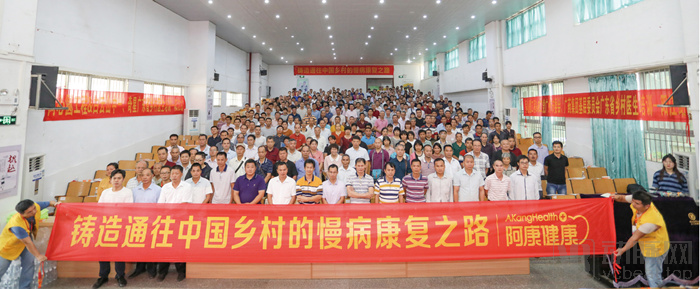
(Akang Health Chronic Disease Rehabilitation Project · Rural Doctor Training)
In just two years, the Chronic Disease Rehabilitation Project has yielded impressive results. Leveraging this initiative, Akang Health conducted 121 training sessions for primary care physicians, trained over 28,000 village doctors in Guangdong Province, established 12,000 rural cloud pharmacies, and reached a rural population of 50 million in the province. Furthermore, Akang Health has created 12,000 rural health community groups, with plans to exceed 500,000 such groups within two years, thereby reaching 200 million primary care patients with chronic diseases.
Behind the data, significant benefits have also been directly delivered to primary healthcare. The Chronic Disease Rehabilitation Project has not only strengthened the drug supply capacity of rural health clinics, making medical care more accessible, but also reduced intermediate links to lower drug prices. Furthermore, as a convenience-oriented service, it helps rural patients achieve better disease management and treatment outcomes.
Wang Lijue pointed out that the first phase of the Chronic Disease Rehabilitation Project has been successfully completed. At the meeting, Akang Health launched the second phase of the Chronic Disease Rehabilitation Project, aiming to train one million village doctors within three years (by the end of 2023), covering more than 90% of administrative villages nationwide and providing chronic disease rehabilitation services to 600 million rural residents. Meanwhile, the Rural Chronic Disease Pharmacy initiative aims to help 200,000 village doctors increase their monthly income by 2,000 yuan.
The third phase of the Chronic Disease Rehabilitation Engineering project is to complete the Five-Year Plan (concluding in 2025), achieving the basic establishment of a nationwide digital platform for primary healthcare, thereby facilitating convenience in medical consultations, medication access, and health insurance support at the primary care level.
Wang Lijue shared that the mission of the Chronic Disease Rehabilitation Engineering project is to build a terminal platform for millions of village doctors, establish a new retail channel for pharmaceuticals worth hundreds of billions, and tap into the trillion-yuan grassroots health market.
“Strengthening primary care is a return to the essence of treatment. Aikang Health’s mission is to build a pathway to health for rural China. We hope that, amidst the trend of prescription outflow and in the process of promoting the linkage and integration between the pharmaceutical industry, internet healthcare, and primary care, Aikang Health will develop a mature business model and forge a path that delivers both market and social value,” he stated.
Returning to the first question raised at the beginning, beyond the intensification of policy support, what other forces are needed to drive the development of primary healthcare? We believe that only when an increasing number of internet platforms, industrial players, and enterprises like Akang Health are willing to penetrate into the grassroots level, genuinely address the needs of primary care, and become builders of the primary healthcare system, will the development of primary healthcare continue to improve.