

Cubemagic VR: Revolutionizing Medical Education with Haptic-Enabled Virtual Reality Simulation
The shortage of healthcare personnel has long been a persistent issue.
According to the latest data from the National Bureau of Statistics, China’s healthcare workforce reached 12.928 million in 2019, including 10.154 million health technical personnel. Given China’s population of up to 1.4 billion, the pressure on healthcare providers to deliver medical services is immense.
Data from the National Bureau of Statistics further indicate that in 2018, China had 68 health technicians per 10,000 population,There are 29 registered nurses per 10,000 people.According to the WHO’s State of the World’s Nursing 2020 Report,The region with the highest average number of nurses per 10,000 people is the Americas, at 83.4. This is followed by Europe, at 79.3.Although two years have passed and the number of registered nurses per 10,000 people in China may have increased, we must acknowledge that there is still a certain gap between China and developed countries in terms of the average number of registered nurses per 10,000 people.
To alleviate the shortage of health personnel, particularly health technical professionals, China has maintained annual growth in medical program enrollment. According to the 2019 China Health Statistics Yearbook,In 2018, the number of students enrolled in medical programs at regular higher education institutions (including doctoral, master’s, undergraduate, and junior college levels) reached 855,229, while enrollment in medical programs at secondary vocational schools amounted to 389,999. In addition, the number of adult students enrolled in undergraduate and junior college medical programs was 555,750.The cumulative number of individuals across the three groups reached 1.8 million.
However, expanding enrollment in medical programs is merely the foundation; more importantly, it is essential to cultivate qualified healthcare technical professionals. Taking surgical procedures as an example, with the advancement of surgical techniques, it has become increasingly difficult to acquire specialized medical skills and techniques through traditional methods such as reviewing past video recordings during operations.
To gain an immersive experience of the surgical scene and interact with “patients” is precisely what virtual reality technology can achieve. Due to these features, virtual reality technology is gradually becoming a new force in the transformation of medical teaching models and a new option for medical training. AndFujian Xiamen Cube Illusion Technology Co., Ltd. (hereinafter referred to as “Xiamen Cube Illusion”) is precisely such a company engaged in virtual reality medical training.
Previously, we only mentioned the number of medical students enrolled in 2018; in fact, the total number of medical students on campus in 2018 far exceeded this figure.In 2018, the number of students enrolled in medical programs at regular higher education institutions was 3,050,131, while the total number of students enrolled in medical programs at secondary vocational schools was 1,209,161., excluding the number of adult undergraduate and junior college medical students enrolled in schools.
The number of medical students also signifies this vast market space. Currently,Xiamen Cube Illusion’s annual revenue continues to maintain a 50% growth rate., which also suffices to demonstrate the vast market potential for medical education and training. For Chen Qiang, CEO of Xiamen Cube Illusion, all this is largely the result of resource aggregation and integration.
Chen Qiang holds dual bachelor’s degrees in Economics and Engineering, as well as a Master of Science degree in Biochemistry and Molecular Biology. His interdisciplinary academic background, combined with his experience as Chief Technology Officer (CTO) at Crystal 3D Technologies in New Zealand, has enabled him to continuously explore and venture into new fields. Chen openly identifies as a serial entrepreneur, noting that his first company focused on 3D printing technology and was among the early adopters applying this technology to the medical sector.
With the development of virtual reality technology,As early as 2014, Chen Qiang led his company’s team in conducting exploratory efforts.Also in 2014, Fujian Water Cube 3D Digital Technology, founded by Chen Qiang, was established and later merged into Xiamen Cube Illusion in 2019. Initially, the team explored how virtual reality technology could be integrated with various industries and which sectors would be the most suitable partners. However, they soon decided to focus their breakthrough efforts on the medical field, where they had already accumulated substantial expertise.
Xiamen Cube Fantasy has assembled a team of up to 90 members, whose expertise extends beyond virtual reality software application design to encompass various algorithms and the development of haptic feedback hardware, among other areas. Currently, Cube Fantasy TechnologyHolds 3 invention patents, 3 utility model patents, and over 50 software copyright certificates for medical simulation technologies., with multiple patents currently in the public notice phase.
Virtual reality technology provides users with a unique immersive experience.Its 3D graphics can intuitively display anatomical structures. For physicians, this facilitates the observation and study of lesions, formulation of rational surgical pathways, preoperative simulation and planning, intraoperative guidance, and postoperative reconstruction—procedures that are unattainable with conventional surgery.
For medical students, the ability to independently learn each surgical step of a procedure through virtual reality technology offers a level of realism akin to being present in the operating room.Furthermore, it can comprehensively record, compare, analyze, and store operational data, enabling users to identify key issues in each virtual surgery through the stored data and improve their surgical skills through corrective actions.
Consider a scenario where you are wearing a VR headset and viewing a highly realistic virtual surgical environment. However, when you use a scalpel to touch the patient, you are actually touching only air in the real world, which significantly compromises the sense of realism. Conversely, if touching the patient in the virtual world corresponds to contacting a patient-like object in the physical realm, the realism is enhanced. Nevertheless, the challenge remains that you may not receive authentic haptic feedback from the patient.
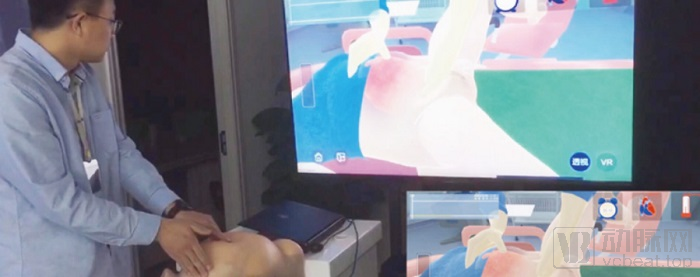
Chen Qiang illustrated this with examples. For instance, uterine massage is required in cases of postpartum hemorrhage. Following massage, the uterus may undergo changes in its physical state, transitioning from a softer to a firmer texture. Haptic feedback is essential during this process to provide trainees with a more realistic immersive experience. Furthermore, human organs may deform upon collision, necessitating real-time simulation rather than pre-rendered animations.
Based on this understanding,Xiamen Cube Fantasy does not rely solely on head-mounted displays such as HTC VIVE and Oculus Rift to design virtual reality medical training applications; instead, it has chosen to equip its VR applications with haptic feedback hardware, creating an immersive educational experience for medical students in training.By integrating haptic feedback devices, Xiamen Cube Fantasy creates a virtual environment that fuses visual and haptic sensations, enabling users to perform high-fidelity surgical simulations on target models. This allows them to master surgical procedures and standards, ultimately enhancing their practical operational skills.
For Chen Qiang, the greatest challenge in the field of virtual reality (VR) medical training does not stem from the technology itself, but from the specialized knowledge required in medicine. “It is relatively easy to create a simple demo, but developing a product that satisfies clinicians and convinces medical schools to purchase it is actually quite difficult.” While medical schools may not be overly sensitive to product pricing, they demand solutions that meet their core needs. This requires product developers to possess extensive medical expertise and deep engagement within the medical field.
Cube Mirage stated that its greatest strength lies in virtual reality simulation training for obstetrics and gynecology.Its obstetrics virtual reality training system has won numerous awards on multiple occasions. In collaboration with the Midwifery Department of Auckland University of Technology in New Zealand, it jointly developed the “New Zealand/International Version of the Virtual Simulation Training System for Midwifery,” targeting overseas users.Building on this foundation, they have continuously expanded their scope, extending into pediatrics, geriatric rehabilitation, and other fields.
Xiamen Cube Illusion has also built its ownMedical Virtual Cloud Platform: By hosting some of its simulation software on the cloud platform, it enables students to access and conduct training through the platform, while instructors can review student scores and training frequencies to identify existing issues.Xiamen Cube Illusion’s product portfolio is not limited to VR (Virtual Reality), but also includes AR (Augmented Reality), MR (Mixed Reality), and holographic 3D, among others.
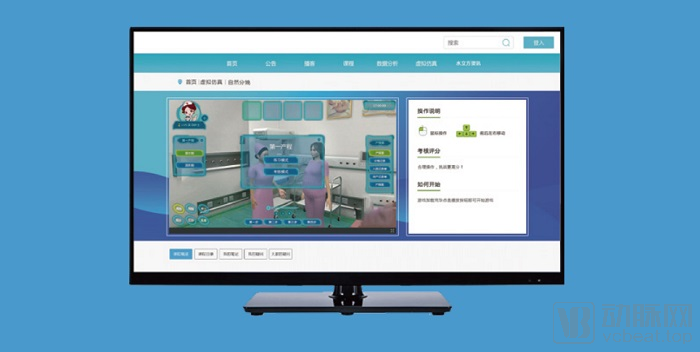
They primarily target medical schools and selected hospitals with specific needs for sales. Xiamen Cube Illusion has agents across China who also assist in product promotion and marketing. Currently, it offers one-time purchase services.Xiamen Cube Fantasy stated that after medical schools purchase certain types of medical training products, they also tend to acquire other medical training course offerings, which represent a key area for the company’s future growth efforts.
The medical field places significant emphasis on holistic integration. Xiamen Cube Fantasy stated that it is also continuously investing in the development of more medical training courses.They have established collaborations with nearly 70 medical schools across China, and are currently partnering with hospitals such as Peking Union Medical College Hospital. Due to the COVID-19 pandemic, Xiamen Cube Fantasy has also collaborated with multiple infectious disease hospitals to launch infectious disease teaching programs.
Xiamen Cube IllusionThe company has completed a RMB 20 million Pre-A round of financing and plans to raise RMB 50 million in its Series A round next year., plans to further expand production through financing, increase its patent portfolio, capture a broader market for medical education and training, and prepare for its future initial public offering.
Chen Qiang stated that it is difficult for medical students to directly perform surgeries on patients in the field of medicine. Virtual reality technology has changed this situation and solved problems such as the inability to observe the internal structures of the patient's body. Like airplane pilots, medical students need to undergo extensive medical training before actually performing operations.In the future, the materials and haptic feel of force-feedback devices still need to be improved and enhanced. More powerful GPUs are required to support real-time simulated feedback, and the precision of force feedback needs further refinement.
Chen Qiang believes that,The future will inevitably advance to the stage of MR (Mixed Reality), and it may be integrated with robotics.Previous simulators were unable to depict dynamic changes. However, modern robotics can now realistically simulate such variations. The development of patient robots abroad is ushering in new transformations in the field of medical training. In the future, the integration of robotics and virtual reality technology will truly benefit the medical training profession and humanity as a whole.