

Dr. Lei Wanyun, Chairman of China Enterprise Digitalization Alliance: Driving Digital Transformation with Cloud, AI, and 5G to Build an Intelligent Pharmaceutical and Healthcare Ecosystem
Every step forward in world civilization is closely linked to science and technology.
Historically, the steam engine facilitated mechanized production and sparked the First Industrial Revolution; the invention of the generator and the application of electricity ushered in the Second Industrial Revolution, driving labor division and mass production; the invention of computers and the advancement of informatization achieved production automation, inaugurating the Third Industrial Revolution; and Cyber-Physical Systems (CPS) will trigger the Fourth Industrial Revolution, ushering humanity into the era of intelligence.
Dr. Lei Wanyun, Chairman of the China Enterprise Digitalization Alliance, stated, “The new technological revolution has triggered industrial transformation, a trend evidenced from the First Industrial Revolution to the current Fourth Industrial Revolution. The Fourth Industrial Revolution is driving industrial transformation through shifts in technological paradigms. This process of industrial transformation is essentially one of digital transformation and the empowerment of various industries with new technologies, while its outcome will be a new economic paradigm evolving from the Internet of Everything to the Intelligence of Everything.”
The Fourth Industrial Revolution centers on digital transformation. How, then, can enterprises undertake this transformation? What challenges arise during the process, and how can they be addressed? From September 17 to 19, 2020, FanRuan, a leading company in the business intelligence (BI) sector, hosted the “Digital Innovation and Transformation – 2020 FanRuan Smart Data Conference” at the Paramita Hotel in Wuxi to explore the value that digitization brings to enterprises. The conference featured one main forum and more than ten parallel sub-forums, focusing on specific industries including finance, manufacturing, retail, public services, energy and chemicals, healthcare, and real estate, and invited nearly 1,000 companies to discuss the digital economy.
Dr. Lei Wanyun, a senior expert in enterprise cloud computing, attended this conference. Dr. Lei is a professor-level senior engineer, a member of the National Standardization Technical Committee for Integration Management of Industry and Information Technology, Chairman of the China Enterprise Digitalization Alliance, and a seasoned expert in the field of national electronic information technology. In recent years, Dr. Lei has been dedicated to research on enterprise cloud computing and digital transformation. He has authored several professional books, including Cloud Computing: Strategies and Practices for Enterprise Information Construction, Cloud Computing: Technologies, Platforms, and Application Cases, Industry 4.0: Concepts, Technologies, and Evolutionary Cases, and The Path to Digital Transformation Driven by Cloud + AI + 5G.
At the medical sub-forum, Dr. Lei Wanyun delivered a speech titled “Digital Transformation Driven by Cloud + AI + 5G: Building an Intelligent Ecosystem for the Pharmaceutical and Healthcare Industry.” VCBeat has compiled this article based on the content of his speech and subsequent interviews.

(Dr. Lei Wanyun is delivering a speech; image courtesy of FanRuan)
Core Viewpoints:
1. The Rise of the Digitalization Wave: Opportunities and Challenges in Corporate Digital Transformation
2. The Three Pillars of Enterprise Digital Transformation: Internal Vertical Integration, External Horizontal Integration, and End-to-End Integration.
3. The Four-Step Digitalization Framework: Digitalization Planning, Ecosystem Development and Governance, Establishment of a Digital Standard System, and Implementation of Key Digitalization Projects.
4. The primary approaches to digital transformation and implementation are the platform economy and platform models.
5. The platform economy and platform models require hybrid cloud, which is the optimal choice for digital transformation.
Amid the pandemic, traditional industries have struggled to survive, while the wave of digitalization has risen rapidly. Telemedicine, smart nursing, and medication-delivery robots— the digital economy is gradually permeating every aspect of people’s lives.
Amid the raging pandemic, the state proposed strengthening “new infrastructure.” New infrastructure refers to an infrastructure system guided by the new development philosophy, driven by technological innovation, centered on data, and based on information networks, designed to meet the needs of high-quality development by providing services such as digital transformation, intelligent upgrading, and integrated innovation. It primarily comprises information infrastructure, convergent infrastructure, and innovative infrastructure. Among these, information infrastructure includes communication networks such as 5G, the Internet of Things (IoT), the Industrial Internet, and satellite Internet; new technologies such as artificial intelligence, cloud computing, and blockchain; and computing resources such as data centers and intelligent computing centers.
Dr. Lei Wanyun stated, “These serve as both infrastructure and emerging industries, linking massive investment and demand on one end with a continuously upgrading, robust consumer market on the other, thereby acting as a new engine for China’s economic growth.”
In summary, 5G, cloud computing, and AI have become the three core components of new infrastructure. Dr. Lei Wanyun stated, “5G is the foundation of networking, cloud computing is the foundation of digitalization, and AI is the foundation of intelligence.” The integration of cloud computing, AI, and 5G enables the digital transformation and intelligent upgrading of traditional infrastructure and various industries into converged infrastructure.
Driven by scientific advancements, economic growth, and national initiatives, the wave of digitalization has arrived. Dr. Lei Wanyun stated, “Digital transformation will reshape the research and development and production processes of traditional manufacturing, gradually building a digital supply chain. Meanwhile, it will reduce transaction costs and improve efficiency. Ultimately, digital transformation will foster innovation within enterprises based on digital technologies.”
Currently, there is a broad consensus on the necessity of digital transformation; however, digitization has not yet fundamentally reshaped the pharmaceutical industry. Enterprises continue to encounter numerous pain points in their digital transformation journeys, such as the absence of high-level digital strategies, a lack of corporate culture supportive of digital transformation, shortages of digital talent, inadequate technical platforms, and insufficient system design capabilities.
In addition, the pharmaceutical and broader healthcare industry faces other pressures: the generic drug consistency evaluation and healthcare insurance reforms are exerting pricing pressure on mature products; China is gradually becoming a strategic hub for pharmaceutical companies, intensifying competitive pressures while the market continues to expand; biopharmaceutical enterprises have an increasing demand for talent; and pharmaceutical companies are positioning innovative drugs as the core of their future product portfolios, with the realization of value for innovative products being influenced by market access and healthcare insurance negotiations.
So, what outcomes will the digital transformation of enterprises in the healthcare sector achieve? What are the strategies for enterprise digital transformation? How should digital transformation be implemented?
The primary imperative is to understand what digital transformation entails.
Dr. Lei Wanyun stated, “Digital transformation through cloud adoption is a strategic concept for enterprises. Its essence lies in explicitly integrating data technologies and mathematical algorithms into business processes to form an intelligent closed loop, thereby making the entire production and operation process measurable, traceable, predictable, and replicable, and reshaping core competencies in quality, efficiency, and cost.”
Enterprise digital transformation is divided into three parts: digitalization of internal operational management, digitalization of external business models, and digitalization of industry platform ecosystems. Correspondingly, at the technical level, this involves achieving internal vertical integration of systems, external horizontal integration, and end-to-end integration on platforms.
Internal vertical integration within an enterprise requires the seamless connection of information across all internal processes, which also serves as the foundation for intelligent operations. For instance, integration across the entire product lifecycle encompasses research and development, animal studies, Phase III clinical trials, collaboration with Contract Research Organizations (CROs), regulatory submission and approval, post-market sales, and after-sales services. When all these stages are integrated into a single system, any issues arising in a specific link can be addressed promptly, thereby significantly enhancing management efficiency.
External horizontal integration is the realization of information integration across the industrial chain, where enterprises achieve consolidation through value chains and information networks. This facilitates seamless collaboration between enterprises, enabling the provision of real-time products and services. Horizontal integration promotes comprehensive end-to-end integration across R&D, production, sales, and experience management among enterprises. For example, when a pharmaceutical company requires a certain quantity of a specific raw material, relevant enterprises within the integrated system can submit quotations for the pharmaceutical company to select. Once the horizontal integration system is established, the cost of inter-enterprise cooperation will be significantly reduced.
End-to-end integration leverages hybrid cloud platforms to deliver more valuable products and services to customers, while simultaneously restructuring the value system across all segments of the industrial chain. For instance, a pharmaceutical company has integrated resources from various enterprises along its value chain to achieve comprehensive management and service coverage throughout the entire product lifecycle, including product design, manufacturing, logistics and distribution, and after-sales support.
Upon completing digital transformation, enterprises will achieve the following outcomes: Externally, by digitizing customer transaction processes, they will enhance user experience and improve customer satisfaction; internally, by digitizing and servicizing various business domains and bridging cross-domain information gaps, they will attain operational efficiency that leads the industry. “For example, the products provided by FanRuan represent a leading business intelligence solution in China.”
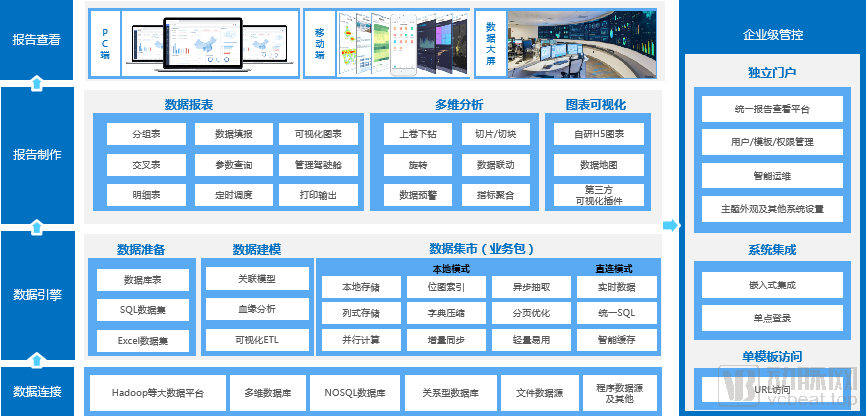
(FineBI Business Intelligence Solution: Enabling Internal and External Integration for Enterprises)
Dr. Lei Wanyun stated, “The primary approach to digital transformation and implementation lies in the platform economy and platform-based models. For industry leaders, it is essential to transform into industry-wide and socialized platforms, ultimately forming an ecosystem chain to maintain their leading position in the sector. For small and medium-sized enterprises (SMEs) within the industry, the goal should be to become specialized partners on these industry platforms, securing a vital role in the platform’s value chain and sustaining ecological collaboration.”
Platform economies and platform models require hybrid cloud, a full-stack cloud platform offering the most comprehensive services and a consistent experience. Deploying enterprise-grade internet architecture on hybrid cloud supports dynamic business requirements within digital ecosystems and enables governance and utilization of data across all domains, achieving network synergy among endpoints, edge, and cloud, as well as multi-cloud management.
Taking the EIHealth medical AI agent as an example, EIHealth is an intelligent agent platform that leverages Huawei Cloud’s advantages in AI and big data technologies to provide specialized AI R&D capabilities for three domains: genomics, medical imaging, and drug discovery. Innovative healthcare enterprises can rapidly initiate genomics research, clinical studies, and drug development by using EIHealth. The platform, powered by deep learning, offers distinct advantages. In terms of security, data is stored within the enterprise’s internal environment, and encryption algorithms can be configured to prevent information leaks. This eliminates the need for enterprises to develop their own AI platforms, and such inclusive AI based on a hybrid cloud architecture provides innovative companies with significant cost advantages.
Regarding the digitalization of enterprises in the pharmaceutical and broader healthcare industry, Dr. Lei Wanyun has proposed a “Four-Step Framework.” The first step is to conduct robust digital planning and enhance strategic digital management. The second involves building and governing an industry-wide digital ecosystem to strengthen healthcare companies’ digital leadership and execution capabilities. The third is to establish a standardized digital framework, ensuring seamless interconnectivity across end devices, edge computing, and cloud networks, thereby laying a solid foundation for business collaboration, data integration, and data sharing. The final step is to implement key digital projects, continuously iterate on them, and ensure a smooth transition to cloud-based infrastructure.
From a practical implementation perspective, digital transformation initiatives must be tailored to the specific circumstances of each enterprise, requiring different entry points for digital projects. For instance, organizations may begin by upgrading their integrated data centers and building an IT infrastructure IaaS (Infrastructure as a Service) cloud platform. Such an IaaS cloud platform can help enterprises break down data silos, integrate disparate data sources, and achieve data sharing.
Furthermore, enterprises need to standardize data to lay a solid foundation for big data applications. For instance, they should avoid assigning multiple meanings to a single metric. Enterprises must also implement digital identity authentication and application integration, while selecting secure and trustworthy platforms. Traditional ERP systems need to evolve into business PaaS (Platform as a Service) to enhance the ability to rapidly respond to business needs. Supply chain collaboration services should transition toward a C2B2B business model, fostering digital marketing capabilities. Ultimately, enterprises will progress from BI (Business Intelligence) to data science and AI, building an intelligent pharmaceutical and healthcare ecosystem.
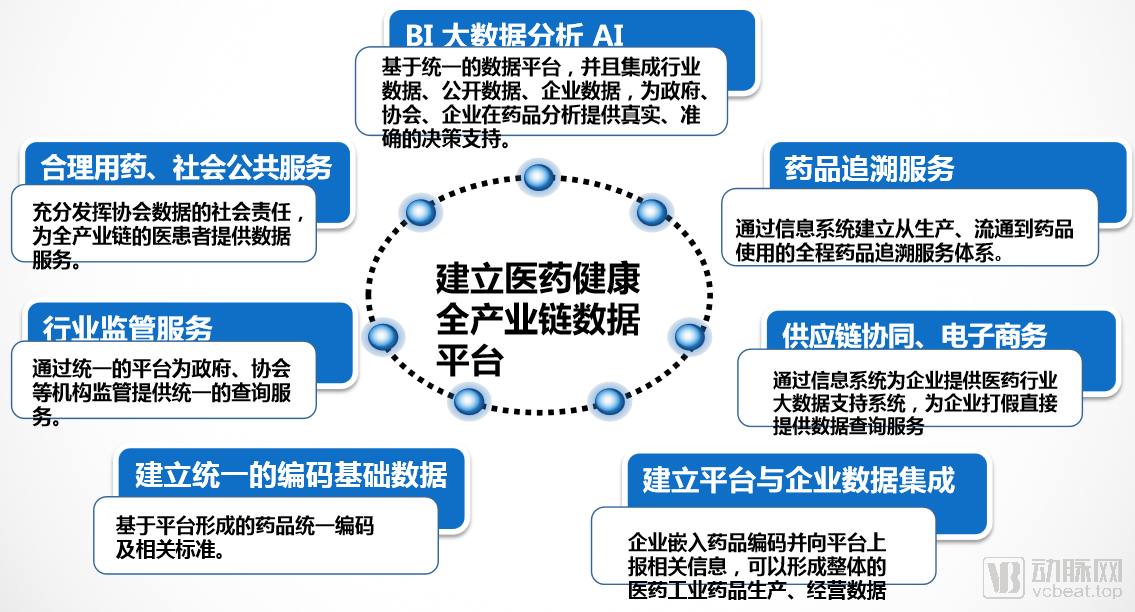
(Future Full-Chain Data Platform for the Pharmaceutical and Healthcare Industry)