

Ruijin Robotics Files for IPO: Can Its Single-Port GI Endoscopic Surgical Robot Become the Next 'Da Vinci'?
Under the 20-year patent monopoly held by the da Vinci Surgical System, Chinese-made surgical robots have remained largely submerged like an iceberg, with only a small fraction visible above the surface. With the expiration of the da Vinci patents, domestic surgical robots have emerged in large numbers, fostering a diverse and competitive landscape that stimulates continuous industry development. Ruijin Technology is one such player in this burgeoning field.
What sets Ruijin Technology apart is that its breakthroughs in surgical robots do not represent a continuation of traditional surgical robot technologies, but rather innovations in both concept and technology.
Mr. Xu Jiaming holds a Bachelor’s degree in Information Management and a Master’s degree in Financial Business Administration from The Chinese University of Hong Kong, as well as a Master’s degree in Finance from Tsinghua University. Currently serving as Investment Director at Eagle Eye Investment and as an investment advisor to multiple investment firms, Mr. Xu possesses a broad investment perspective. He is currently a Visiting Lecturer in the Financial Engineering program at HKU SPACE China Business College. Drawing on his prior investment experience and insights gathered from his former students, he has observed that China’s medical technology remains relatively underdeveloped, with medical devices being expensive, less advanced than overseas counterparts, and exhibiting very low penetration rates. Consequently, significant market opportunities remain, particularly in third- and fourth-tier cities and smaller regions.
Meanwhile, he learned that Associate Professor Guo Jiawei had developed an endoscopic surgical robot system for the digestive tract at the Department of Mechanical Engineering, The University of Hong Kong, and was preparing to initiate animal trials. He recognized that the technology was nearly mature; the robotic system required a smaller footprint than the da Vinci Surgical System, streamlined surgical procedures, reduced medical costs, and thus had the potential to benefit the broader public. With keen insight, Mr. Xu partnered with Professor Guo Jiawei, founder of Ruijin Technology, to drive the commercial development of the project and break through the industry’s technical barriers.

Professor Guo Jiawei (left) Mr. Xu Jiaming (right)
Professor Guo has over a decade of experience in the research and development of surgical robots. He graduated from the Department of Mechanical and Automation Engineering at The Chinese University of Hong Kong, where he participated in the development of China’s first Chinese calligraphy robot. He later pursued his Ph.D. at the Hamlyn Centre for Robotic Surgery at Imperial College London, specializing in mechanical endoscope control. As a Croucher Fellow, he furthered his studies at Harvard Medical School, focusing on magnetic resonance imaging (MRI)-guided surgical robots. During his tenure at The University of Hong Kong, he developed multiple prototypes of MRI-guided surgical robots, including the world’s first MRI-navigated robot for bilateral stereotactic neurosurgery.
To date, Professor Guo has been granted nine international patents and has co-authored 105 journal articles, conference papers, and book chapters in collaboration with over 40 clinical medical scholars and 80 engineering scholars. His team has also received awards at several top-tier international robotics conferences. Professor Guo’s research achievements have garnered significant attention, attracting coverage from dozens of media outlets on their R&D outcomes. Notably, the patented technology for hydraulically driven motors safe for use in MRI-guided surgical environments has been licensed to Ruijin Technology for the commercial development of components for MRI surgical robots.
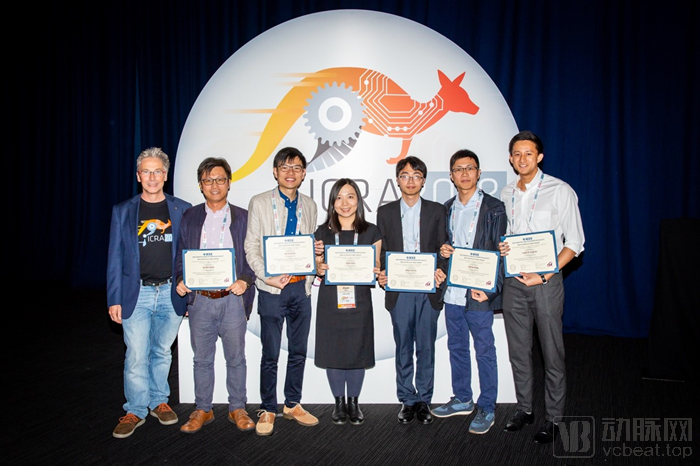
Best Conference Paper Award at the 2018 IEEE International Conference on Robotics and Automation
In recent years, Professor Guo has shifted his research focus to the field of endoscopic surgical robots. The endoscopic surgical robot system marks his first “return” project.
Reflecting on more than a decade of scientific research, Professor Guo remarked to VCBeat that his experience developing a calligraphy robot during his undergraduate studies became a key advantage in his technical accumulation: “Making a robot write calligraphy sounds simple, but in reality, it presents many challenges, as calligraphy requires dexterity and precise control of varying force levels, which is extremely difficult for robots.” The stroke outlining emphasized in calligraphy shares many similarities with the fine motor movements required by endoscopic surgical robots. Applying prior experience from calligraphy robots to endoscopic surgical robots will undoubtedly address current technological pain points.
The Past and Present of Robotic Systems for Gastrointestinal Endoscopic Surgery
As Mr. Xu Jiaming stated,Although the da Vinci Surgical System boasts a success rate as high as 99%, three major issues remain.:
First, the Da Vinci surgical robot is expensive, requiring substantial upfront investment, and its market share in China is lower than that in Europe and the United States;
Second, the da Vinci surgical robot utilizes technology from the 1980s; its bulky and heavy design makes it extremely difficult to operate in confined spaces, lacking the necessary dexterity and flexibility.
Third, as a typical laparoscopic surgical robot, it does not cover all lesion surgery fields, especially upper gastrointestinal surgery;
Pain Points Also Present Opportunities, Ruijin Technology has targeted this pain point by launching a transoral endoscopic surgical robot system for the gastrointestinal tract. Leveraging flexible robotic arms, the system enables minimally invasive, miniaturized, and precise interventions, thereby filling a market gap in the domain of Da Vinci surgical robots.
The gastrointestinal endoscopic surgical robot system developed by Professor Guo’s team has the followingFeatures and Advantages:
1.Adopts a multi-segment flexible continuum structure, structurally optimized the surgical environment for strictures following endoscopic submucosal dissection (ESD), enabling the robotic arm to be inserted into the instrument channel of the endoscope,Maintain a minimal profile (diameter <2.8mm) without compromising the required deployable force;
2.The telescopic range of the micro-robotic arm is adjustable, allowing for the attachment of different surgical instruments tailored to various procedural steps (such as tissue grasping and electrosurgical cutting), thereby enabling dexterous manipulation in confined spaces; furthermore, its diameter and overall dimensions can be customized according to the specific type of surgery, thus streamlining the design process.
3. This miniature robotic arm also features a detachable design similar to that of the da Vinci Surgical System, and it is intended for use as a single-use disposable consumable.Connects to the robotic drive unit via detachable modules, facilitating easy replacement and use;
4. Compared to traditional surgical robot systems,The compact controller of the micro-robotic arm requires no modifications to surgical workflow design, resulting in significantly lower upfront investment costs compared to traditional surgical robot systems;General hospitals, and even endoscopy centers, are suitable for such configuration, which plays a role in promoting the development of endoscopic surgery;
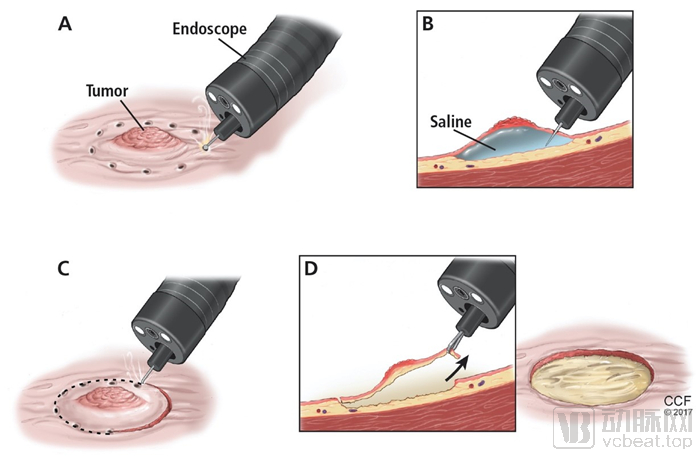
Endoscopic Submucosal Dissection (ESD)
It is evident that the research conducted by Professor Guo’s team on robotic systems for gastrointestinal endoscopic surgery has not only overcome numerous challenges unattainable with traditional surgical robots, but also filled the existing gap in the application of surgical robots in the upper gastrointestinal tract, thereby providing new inspiration for domestically produced surgical robots. The research project focuses on Endoscopic Submucosal Dissection (ESD) and single-incision surgery, which are diagnostic and therapeutic approaches for treating and preventing early-stage gastrointestinal cancers (esophageal, gastric, colonic, and rectal), thus offering new hope for cancer treatment in China.
The research team expects to initiate animal testing by the end of 2020 and prepare for human cadaver studies in the first half of 2021. Local hospitals and expert physicians in Hong Kong will provide guidance on these experiments. Additionally, Professor Guo’s research team will have access to laboratory equipment at the two major medical schools in Hong Kong, which will accelerate the experimental process and enhance the likelihood of success. Upon completion of the human cadaver studies, the team will begin pursuing regulatory approvals from the FDA, NMPA, and CE.
Currently, the project is advancing a new round of financing to continuously promote the research and development and implementation of products.
Broad Application Prospects Create Indispensable Significance
Against the backdrop of global population aging and a severe future shortage of healthcare professionals, intelligent medical robots will become the most critical solution to address the imbalance between supply and demand. Over the past four years, China’s medical robot market has grown more than tenfold.
According to estimates by the market consulting and research firm Markets and Markets, the global market size for medical robots is expected to exceed $22.1 billion by 2027, more than tripling from the $6.46 billion recorded in 2018. Surgical robots account for approximately 60% of this market. With the accelerating aging of the global population, surgical robots will capture an even larger market share.
In the more segmented market for endoscopic diagnostic and therapeutic devices, China is expected to maintain a compound annual growth rate (CAGR) of 10%–20% in the coming years. According to data from the “Research Report on Market Potential Analysis and Investment Opportunities in China’s Endoscopic Diagnostic and Therapeutic Device Industry (2019–2025),” the CAGR for digestive endoscopy consumables in China was 19.30% from 2007 to 2017. Based on a projected CAGR of 15% over the next three years, the market size for endoscopic diagnostic and therapeutic devices in China is expected to reach RMB 6 billion by 2022.
Currently, endoscopic technology in China is primarily used for examination and diagnosis, while the market for endoscopic surgery remains in its early stages of development. A significant proportion of clinical patients face long waiting times before receiving treatment, compounded by the increasingly prevalent incidence of gastrointestinal cancers in the country. Given the substantial RMB 6 billion foundation of the endoscopic diagnostic and therapeutic device market, the potential for mechanizing surgical procedures cannot be overlooked. The endoscopic surgical robot proposed by Professor Guo’s team offers lower setup costs compared to existing surgical robots on the market. Hospitals already equipped with endoscopic devices can achieve mechanization of endoscopic surgeries simply by adding a surgical robot controller. Beyond market development, this innovation will make a significant contribution to the advancement of healthcare in China.
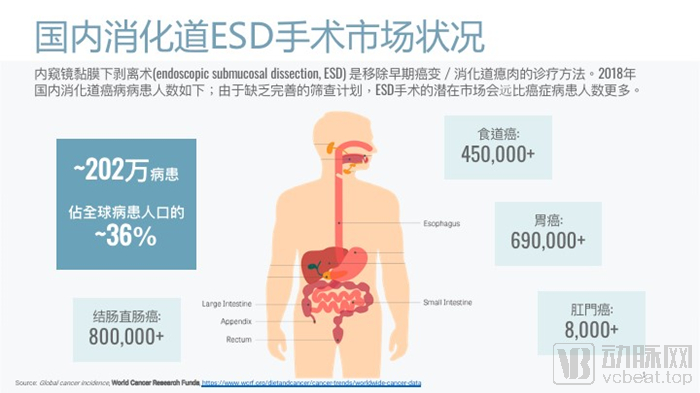
Market Status of Gastrointestinal ESD Procedures in China
From a technical perspective, the miniaturization of surgical robots and their transition from laparoscopic interventional therapy to endoscopic natural orifice transluminal intervention has become an inevitable trend.
Compared with da Vinci surgical robot-led systems, flexible surgical robots used in endoscopy present the greatest R&D challenges and require the highest dexterity of operating arms. Most companies are still in the R&D phase and remain far from industrialization; however, Professor Guo’s research team has achieved a breakthrough. Furthermore, the miniaturization of surgical robots is redefining mechanically miniaturized surgical tools, thereby promoting the development and procedural refinement of single-port surgery. This underscores the unique significance of the breakthroughs made by the research team in the field of surgical robotics.