

Shenshang Tech: Leveraging IT to Enable Home-Based Chronic Kidney Disease Management for 150 Million Patients in China
withSun Ying, Founder of Shenshang TechnologyBefore meeting him, he always carried a hint of mystery.
He rarely posts on WeChat Moments and never shares work-related updates. The images and texts he publishes often convey a sense of reflection and pursuit regarding life.
It is hard to imagine that he is an entrepreneur.
It was only after meeting him that I realized he simply keeps his personal life and work strictly separate. As an entrepreneur, Sun Ying possesses profound insights into the industry landscape, existing market pain points, and future development trends. Through our conversation, I gradually came to understand that the reflections on life he shares on his WeChat Moments are precisely the starting point of his entrepreneurial journey—regardingPatients with Chronic Kidney DiseaseThe Pursuit of Improved Quality of Life.
Shenshang Technology, an internet healthcare company dedicated to chronic kidney disease (CKD) management, aims to become a brake on the progression of CKD in patients.Its vision is to help patients with chronic kidney disease manage their condition effectively, extending life while improving quality of life.
Why Manage Chronic Kidney Disease?
“This wasn’t a decision we two founders made on a whim,” Sun Ying said with a smile. “Behind it lies both our passion and market demand.” Sun Ying introduced the other founder to VCBeat:David Zheng。
“David Zheng was born into a family of physicians, with many of his relatives working as doctors. He grew up within the compound of a hospital. His father is a specialist in nephrology. Consequently, influenced by his father, David has developed a profound understanding of patients with chronic kidney disease,” Sun Ying told VCBeat. After graduating from a prestigious overseas university, David pursued a career in the IT industry, working for many years at companies such as Nokia and BenQ. Even so, “in David’s subconscious, he had always wanted to work on something related to healthcare.”

Two founders of Shenshang Technology (Sun Ying on the left, David Zheng on the right)
Sun Ying and David Zheng met at Shanghai Jiehang Information Technology Co., Ltd., where both served as Vice Presidents. Shared sentiments and values allowed them to extend their friendship from the workplace into their personal lives. Recognizing each other as kindred spirits, they eventually became entrepreneurial partners, driven by a long-held passion deep within their hearts.
“China has now joined the ranks of aging societies, and chronic disease management represents a key trend for the future.” The two founders were initially driven by a commitment to focus on chronic kidney disease (CKD) management. However, what ultimately solidified their decision to launch a startup was their judgment and observation of the industry. “It began with insights and understanding of the sector, followed by a fortuitous alignment with our personal aspirations; these combined factors propelled us onto this entrepreneurial path.” A smile lit up Sun Ying’s face, as if she had been transported back to the very moment they decided to embark on this venture.
“The prevalence of kidney disease in China is 10.8%, which means that approximately 150 million Chinese people suffer from chronic kidney disease.”Sun Ying stated,The current state of healthcare in China is characterized by an “emergency-style” approach: patients seek hospital care only when they experience overt symptoms or noticeable lesions, prioritizing treatment over prevention.Insufficient public awareness in China regarding disease screening and rehabilitation therapy has caused many patients to miss the optimal window for treatment. Many individuals with chronic kidney disease (CKD) rapidly progress to end-stage renal disease (ESRD) due to late detection or poor chronic disease management, thereby embarking on the arduous journey of hemodialysis (HD).
“Regular hemodialysis not only severely affects patients’ quality of life but also imposes a significant financial burden on their families. This is also the case at the national level.” According to statistics, medical insurance expenditures for patients undergoing renal dialysis account for a substantial portion of national medical insurance spending.
How can this issue be resolved?—By raising patients’ awareness of early screening and early treatment for diseases? This is far from sufficient. In addition to patient-related factors, the scarcity of medical resources in China and the immaturity of chronic disease management models are also objective contributors to this situation.
The two founders believe that what they need to do is to observe and draw on the chronic disease management models of developed regions, and then create a localized chronic disease management model suitable for the Chinese population.
To this end, they conducted extensive and in-depth market research. Ultimately, they focused their attention on Taiwan. Taiwan’s chronic disease management model is relatively mature, with many noteworthy features. Although there remains a gap in the doctor-to-patient ratio compared to mainland China, there are substantial lessons to be learned.
Shenshang Technology has improved and optimized Taiwan’s chronic disease management model, leveraging the advantages of the internet to achieve localized application in mainland China.
Disease management systems are undeniably characterized by their professional rigor. To this end, ShenShang Technology has specially invitedProfessor Chen Hongjunto serve as the company’s Chief Medical Advisor, empowering KidneyShang Technology with professional expertise.
According to Sun Ying, Professor Chen Hongjun is a renowned expert in the field of nephrology. He serves not only as the Director of the Department of Nephrology at Kaohsiung Medical University in Taiwan and the Chairman of the Taiwanese Society of Nephrology, but also as the President of the Asian Society of Nephrology. Each year, no fewer than3000Human.
“Many of the design concepts behind Shenshang Technology’s CKD Management System are derived from Professor Chen Hongjun. We are deeply honored to have invited him to serve as our Chief Medical Advisor,” said Sun Ying enthusiastically.
“Early detection, early prevention, and early control” is the service philosophy of Shenshang Technology’s CKD Management System.
“Our goal is to manage chronic kidney disease (CKD) in stages I–IV. Since the progression of CKD is irreversible, we aim to progressively flatten the slope of disease deterioration, thereby slowing its advancement and ultimately achieving the objective of suppressing disease progression.”
According to the internationally recognized guidelines established by the National Kidney Foundation, chronic kidney disease is clinically classified into five stages based on the glomerular filtration rate (GFR).
“By Stage 5, the patient’s kidneys had essentially failed; his glomeruli had largely lost their filtration capacity, necessitating dialysis to sustain life and posing an imminent threat of death,” said Sun Ying. She noted that patients with Stage 5 chronic kidney disease endure significant suffering, with a “sharp decline in quality of life.”
Sun Ying told VCBeat, “If early screening, treatment, and management of kidney disease can be achieved, it is possible to delay disease progression, allowing patients to avoid dialysis for 15–20 years.“This not only enables patients to lead a more dignified and higher-quality life, but also alleviates the financial burden on both the state and individuals, which remains the original mission of Shangshen Technology.”
Shangshen Technology's CKD Management System is divided intoOut-of-Hospital ManagementandIn-Hospital ManagementTwo parts.
Out-of-Hospital ManagementData entry is primarily performed by patients via a mobile app, while physicians monitor the data to assess patient status. After entering their vital signs, patients receive health management tasks assigned by their attending physicians and engage in online consultations with them.
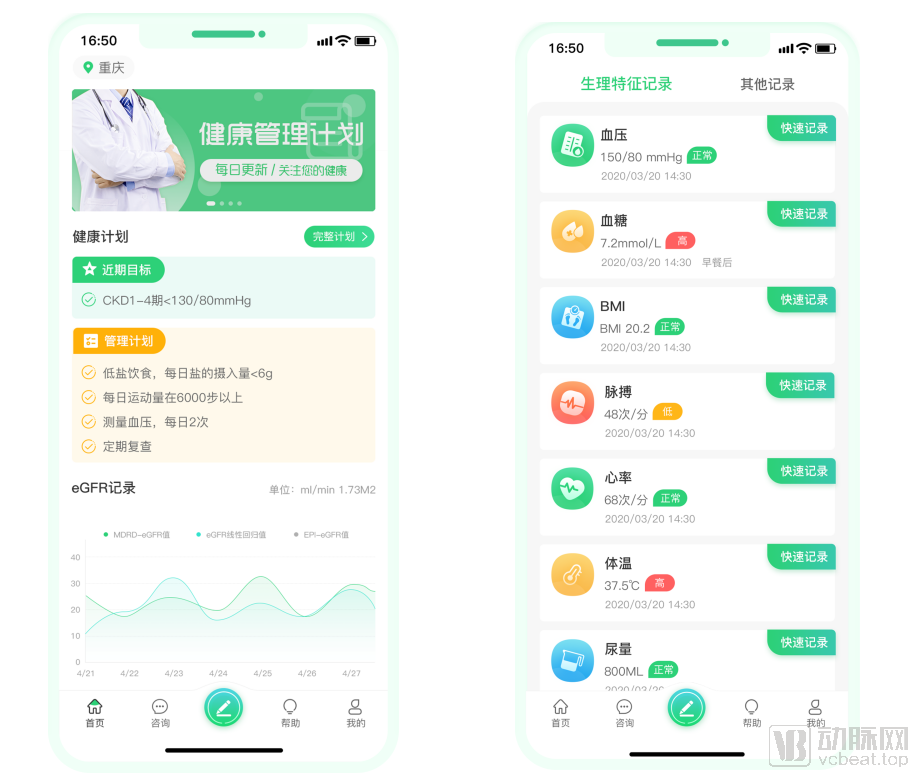
Shenshang Technology App Screenshots
The app effectively serves as a “personal nurse” for patients. It provides timely reminders for monitoring blood glucose, blood pressure, and other vital metrics, and encourages adherence to a low-salt diet, regular physical activity, and scheduled follow-up visits to the hospital. Furthermore, it delivers professional medical information tailored to the patient’s current stage of disease progression, helping them avoid the pitfalls of unverified “health tips” that often circulate widely in WeChat groups.
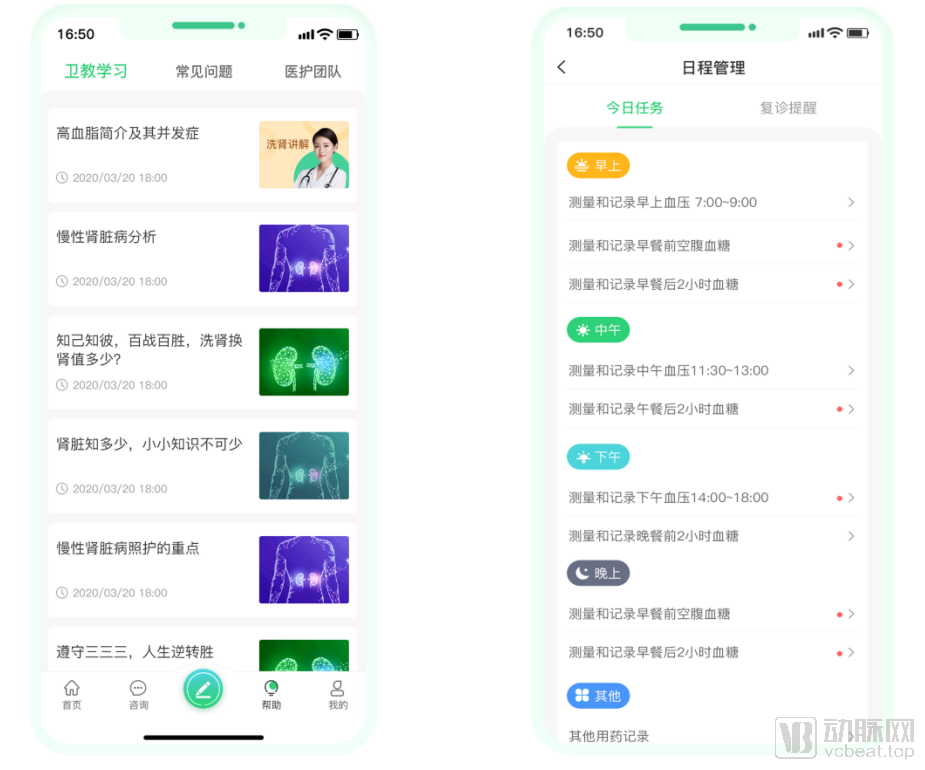
ShenShang Technology App Screenshots
In-Hospital ManagementPrimarily designed for physicians. Once out-of-hospital patient data is entered into the app, the in-hospital management system can monitor the data in real time, enabling doctors to keep abreast of changes in patients’ conditions at home, provide medical guidance, and assign corresponding health management tasks.
In addition, once a patient establishes a connection with their attending physician on the KidneyShang Technology CKD System, all of the patient’s treatment records are stored online in the hospital’s management system, which automatically generates an electronic medical record for the patient with a single click.
When patients visit the hospital for outpatient care, physicians can instantly access all historical physical examination data recorded at the hospital as well as vital signs data logged by the patients at home. Furthermore, doctors can view graphical cross-comparisons of various patient data, enabling them to formulate diagnosis and treatment plans quickly and accurately.
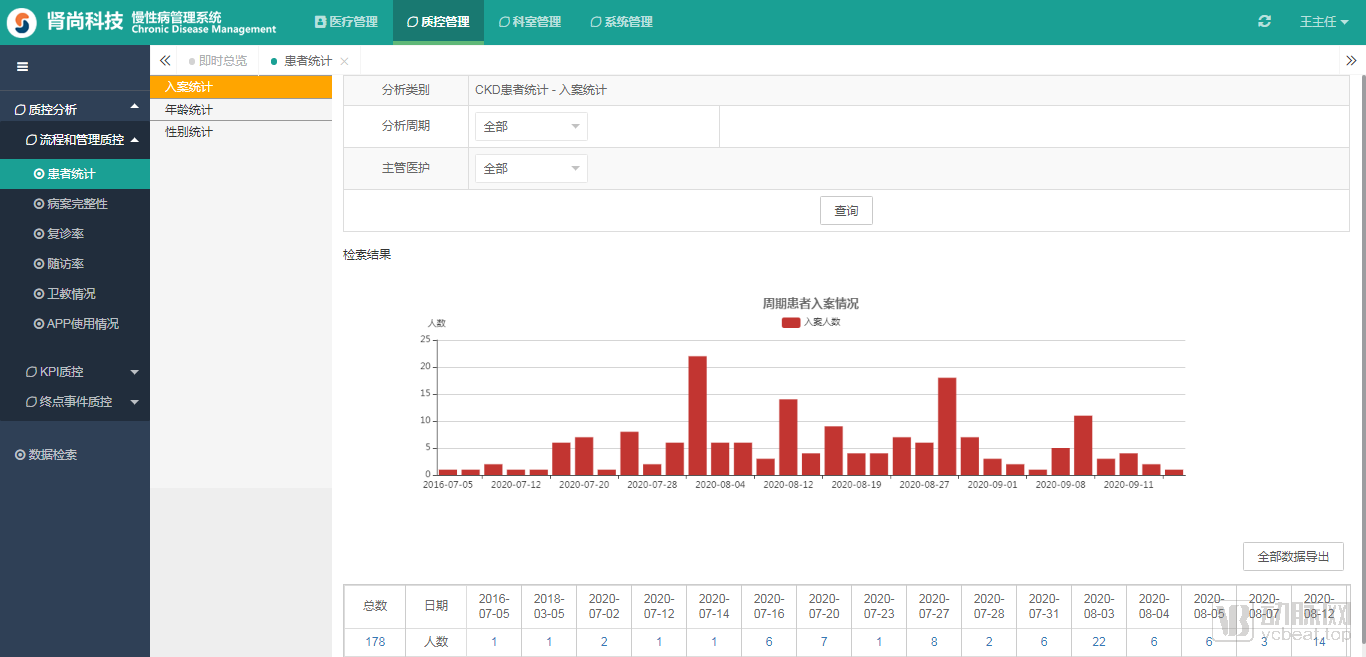
Shenshang Technology Hospital Interface Screenshot
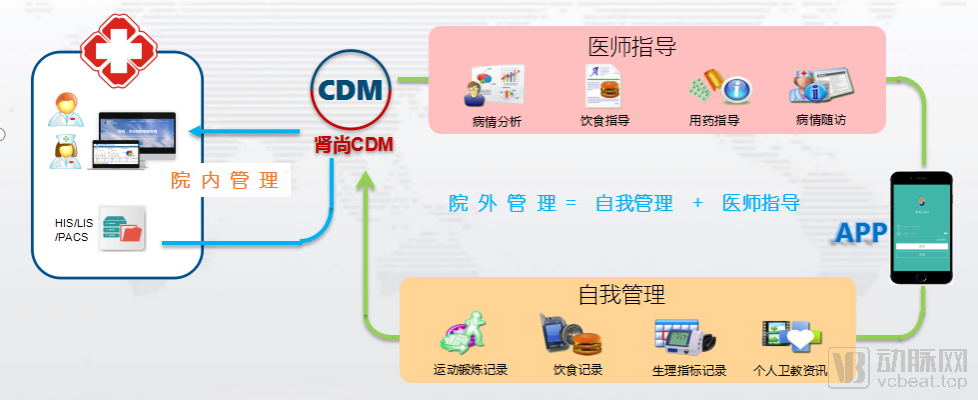
Overview of the Operational Model of Shenshang Technology's CKD Management System
For patients, the CKD management system from Shangshang Technology eliminates the need to carry bulky stacks of paper medical records when seeking medical care and medication, as was previously required.
For physicians, the CKD Management System developed by Shangshen Technology eliminates the hassle of repeatedly consulting paper medical records, thereby improving outpatient clinic efficiency;
From the hospital’s perspective, Shenshang Technology’s CKD Management System not only helps departments enhance the quality of patient care and strengthen patient loyalty to the hospital, but also provides a comprehensive, objective, and quantitative assessment of physicians’ quality control performance.
Data security is an issue that no information system can avoid.
“Some patients and hospitals have concerns about data security, which we fully understand. However, they can be completely at ease,” Sun Ying told VCBeat. The CKD Management System by Shenshang Technology does not retain patients’ medical record data. Instead, it uses specialized technical interfaces to enable direct data integration between the Shenshang Technology system and hospital management systems, with a “data-in-only, no-data-out” policy. When patients enter data via the app, the Shenshang Technology system directly imports the data into the database of the hospital’s information management system.
“The data port of Shenshang Technology serves more as a conduit. Our system itself does not retain any in-hospital patient data.”
In 2018, KidneyShang Technology partnered with Southwest Hospital of Chongqing (also known as the First Affiliated Hospital of Army Medical University). Sun Ying stated that Southwest Hospital of Chongqing is a military hospital, and its patient population has certain unique characteristics, leading to greater caution in considerations of data security. Prior to adopting KidneyShang Technology’s CKD system, Southwest Hospital of Chongqing conducted an extensive evaluation of the system over a prolonged period.
“Nowadays, our system has been in operation at Southwest Hospital for several years without any security incidents,” said Sun Ying. “Regarding data security, partner hospitals can have full confidence.”
Currently, the CKD system developed by Shenshang Technology has been deployed in more than 10 hospitals, including Southwest Hospital of Chongqing, the Second Affiliated Hospital of Chongqing Medical University, Puai Hospital Affiliated to Huazhong University of Science and Technology in Wuhan, the First Affiliated Hospital of Xiamen University, and Xi’an Daxing Hospital, with in-depth collaborations established with these institutions.
“Our system has been continuously optimized and upgraded, and we have now reached version 4.0,” Sun Ying told VCBeat. During the development of the CKD management system, they received substantial positive feedback from hospital experts, physicians, and patients, which helped uncover additional user needs in the chronic kidney disease (CKD) management space. “We have received favorable feedback both in terms of professional efficacy and patient experience. In the future, we will also explore more personalized services to provide ‘tailored’ solutions for hospitals and patients with specific needs.”
Currently, the chronic disease management market remains largely untapped. Companies like Shenshang Technology, which are dedicated exclusively to developing chronic kidney disease (CKD) management systems, are rare in China. Sun Ying told VCBeat, “Most current CKD management services are offered as ancillary operations by dialysis companies. However, such business models inevitably involve certain conflicts of interest.”
When asked whether there were plans to expand into other chronic disease areas beyond chronic kidney disease management, Sun Ying responded affirmatively. He noted that although chronic diseases vary slightly in terms of specific conditions, their overall management models and systems share many similarities; the key challenges lie in addressing professional and technical issues.
Sun Ying stated, “While ensuring effective management of chronic kidney disease, Shangshen Technology will further expand into other chronic disease management markets. Fields such as endocrinology, cardiology, oncology, and gastroenterology—falling within the scope of internal medicine chronic diseases—are all areas we will strive to develop in the future.”
To date, Shenshang Technology has completed tens of millions of RMB in angel financing. The company expects to launch a new round of fundraising by the end of this year or early next year to expand its network of partner hospitals, broaden the scope of its system services, and further develop and refine its management system.
“Next, we have two development goals. The first is to further mature our existing products, moving them in an increasingly specialized direction; the second is to replicate this chronic disease management model and expand it to cover more internal medicine chronic conditions.”