

GoodRx Soars 53.03% in IPO Debut: How a $450 Prescription Sparked an $800 Billion Market Disruption

GoodRx
Prescription Drug Search and Price Comparison Platform
On August 26, GoodRx Holdings (stock ticker: “GDRX”), an internet platform providing low-cost prescription drugs to users, filed for an initial public offering (IPO). GoodRx Holdings set its expected IPO price at $33 per share, planning to issue 34,615,384 shares. After deducting underwriting discounts and commissions as well as offering expenses, the company expected to raise net proceeds of $725 million. On September 23 (Eastern Time), GoodRx Holdings officially began trading on the stock market. Its opening price was $46, up 39.39% from the IPO price; its closing price was $50.50, up 53.03% from the IPO price. Based on the closing price of $50.50, its latest market capitalization stands at $19.39 billion.
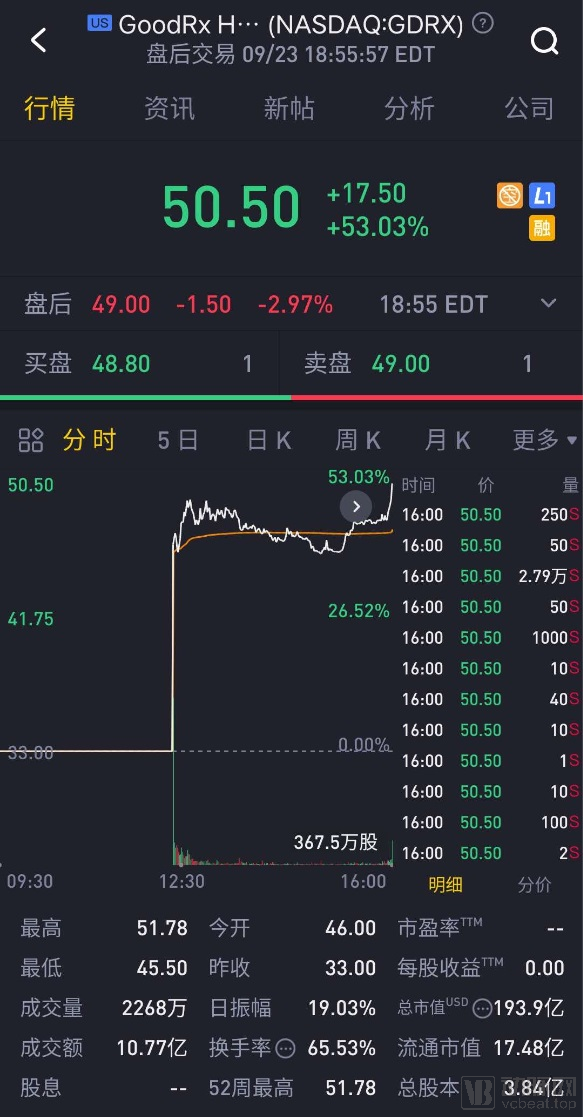
Figure source: Tiger Brokers
GoodRx, Inc. was incorporated in Delaware in September 2011. In September 2015, GoodRx Holdings, Inc. was established, under which GoodRx Intermediate Holdings, Inc. was set up. In October 2015, the first corporate restructuring took place, making GoodRx a subsidiary of GoodRx Holdings. In April 2017, the second corporate restructuring occurred, making GoodRx a subsidiary of GoodRx Intermediate Holdings. In this document, references to “GoodRx” denote GoodRx Holdings, Inc.
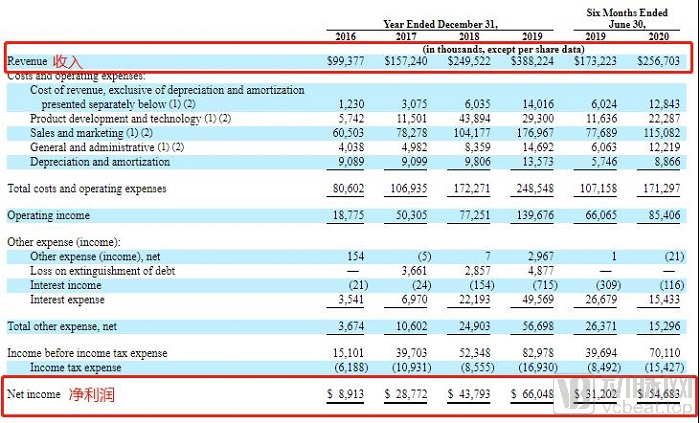
Unlike other internet healthcare platforms that use total user count as a reference metric, GoodRx has chosen to use monthly active users (MAU) as its reference metric.As of June 2020, the platform had 4.9 million monthly active users.The revenue generated by these users for GoodRx is also evident; as early as 2016, GoodRx achieved profitability, with its profits continuing to grow each year thereafter. Since 2016, GoodRx has maintained a compound annual growth rate (CAGR) of up to 57%.In 2019, its revenue reached $388 million, with a net profit of $66 million. During the first half of the year, when the epidemic situation in the United States was severe, its revenue amounted to $257 million, and its net profit reached $55 million.
That GoodRx founder Doug Hirsch and co-founder Trevor Bezdek had to devote themselves to building a prescription drug discount platform reflects the grim reality Americans are forced to confront:Existing premiums are rising, charges are becoming increasingly expensive, and the bill amounts that users need to pay are growing larger. However, patients are receiving fewer medical services.
Due to the complexity and opacity of the healthcare system, patients are often unclear about how much they should pay for treatment. High consultation fees and expensive prescription drug prices lead to approximately 30% of prescriptions being abandoned.Up to two-thirds of Americans avoid or delay purchasing prescription drugs due to high costs.
To address this issue, the founders of GoodRx created a prescription drug discount platform, which has gradually become a household healthcare tool for Americans.Through GoodRx, users have reduced their out-of-pocket costs for generic drugs by more than 70%. Its discount services are accepted at 70,000 pharmacies across the United States.
Initially, their approach was fairly straightforward: by negotiating with PBMs (Pharmacy Benefit Managers) that held strong bargaining power, they collected fees from the PBMs when users obtained low-cost prescription medications from pharmacies by using codes provided by GoodRx to fill their prescriptions. Simply put,For a prescription drug priced at $20, the pharmacy may receive $14, the PBM (Pharmacy Benefit Manager) takes $6, and GoodRx claims a portion of that $6.Low-priced prescription drugs have boosted pharmaceutical sales; although PBMs incur certain costs, they generate greater revenues.
This approach has also enabled GoodRx to accumulate a large user base. Building on this foundation, GoodRx has launched subscription products, includingGold, the first subscription product launched in 2017, costs users just $5.99 (individual) or $9.99 (family plan for five).you can enjoy more discounts than non-members.The second subscription product launched in 2018 was Kroger Savings, a collaborative offering with Kroger, the fourth-largest retailer in China. Users can access premium-tier services by paying $36 for an individual plan or $72 for a family plan covering six members.GoodRx stated that by the end of June 2020, the number of subscribers was 15 times that of late 2018, and first-year consumer spending on subscription products was approximately twice that of prescription products.
This user base also creates opportunities for collaboration with pharmaceutical manufacturers. Among GoodRx users, 20% are searching for brand-name drugs—patented medications that often come with significant restrictions and are frequently unaffordable for patients.GoodRx allows pharmaceutical manufacturers to integrate their own discount programs into the platform and promote their products to users.GoodRx reported that its product promotion revenue more than tripled in the first half of 2020 compared to the same period last year.
GoodRx’s smooth sailing has, in fact, been underpinned by its acquisition strategy.
As early as January 2017, it was revealed that GoodRx had acquired Iodine, stating that the actual merger took place in late 2016.Iodine offers both a website and a mobile app to help patients compare medications, engage in social interactions, and track medication side effects.The two parties began their collaboration as early as August 2016, focusing primarily on enhancing the medication purchasing experience for consumers. The acquisition of Iodine has undoubtedly brought significant benefits to GoodRx. Iodine’s accessible and in-depth content has helped consumers better understand medications and potential risks. Through this transaction, GoodRx is better positioned to assist consumers in making informed choices.
During its ongoing operations, GoodRx also uncovered another highly valuable data point: 20% of consumers searched for medications without a prescription.Consequently, GoodRx acquired HeyDoctor for $14.3 million in 2019 and launched the GoodRx Telehealth Marketplace in 2020, introducing third-party healthcare providers to deliver medical services to users.The pandemic has generated certain revenues for the medical service platform and also served as a new customer acquisition channel. More importantly, it has streamlined GoodRx’s end-to-end process of consultation, prescription issuance, and medication purchase.
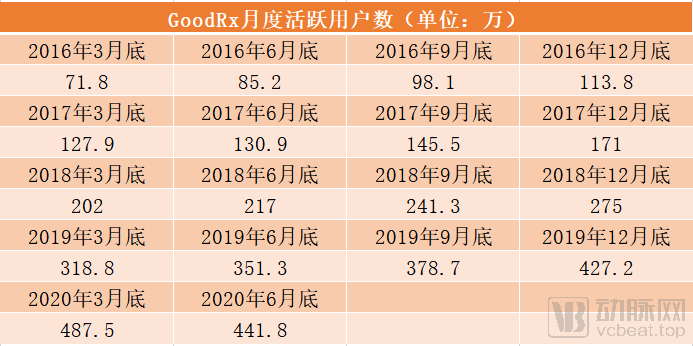
Due to the lack of an online mail-order service, its average monthly active users (defined as users who purchased discounted medications at least once during the month, excluding subscription members) declined in the United States during the pandemic.
According to its statistics, HeyDoctor conducted an average of over 1,000 consultations per day in the second quarter of 2020. Meanwhile, GoodRx Telehealth Marketplace, its third-party telehealth service provider, has facilitated more than 200,000 medical visits and tests since its launch.Following the consultation, more than 10% of HeyDoctor consumers filled their prescriptions at pharmacies using GoodRx codes.In fact, GoodRx is also deeply concerned that telehealth services may drag down its overall profit margins. Nevertheless, the company has no choice but to pursue this path.
On August 31 this year,GoodRx also acquired Scriptcycle for $60.1 million. Scriptcycle primarily serves retail pharmacy chains.Scripcycle specializes in prescription management services that are closely tied to GoodRx. Its close business ties and dedication to the prescription drug market have driven continuous capability expansion through acquisitions, a trend that is expected to continue in the future.
Perhaps we will have to return to the era before GoodRx was born. At that time, Douglas Hirsch was not yet the CEO of GoodRx.As a wage earner, he was outraged by the $450 price tag on his prescription medication. When he decided to leave that pharmacist and turn to other pharmacies, the world began to change.When he realized that prescription drug prices varied across pharmacies, and as he attempted to search online for price comparisons, the gates of wealth opened to him—because no such tool existed.
Douglas Hirsch, who joined the GoodRx board of directors in 2011 and began serving as Chief Executive Officer of GoodRx in 2015, holds a Bachelor’s degree in Political Science from Tufts University.He previously held positions at Facebook and Yahoo.From 2005 to 2008, he also served at DailyStrength, a healthcare-focused social networking company centered on support groups. Trevor Bezdek is a co-founder of GoodRx; he joined the board of directors in 2011 and has served as Co-CEO since 2015. He holds a Bachelor’s degree in Biological Sciences from Stanford University, and alsoCo-founded Bioware, a community for biologists and scientists to connect.
Douglas Hirsch and Trevor Bezdek, Experts in Internet Community Operations, after moving from complaints to serious research, they chose to use tools to address the problems facing this market. Ultimately, they expressed full confidence that over the past several years, GoodRx has saved U.S. users approximately $20 billion, while enabling more than 18 million people to access care they previously could not afford.
The backlash over the $450 price tag ultimately reshaped the entire market, allowing GoodRx to recognize its own value.They believe their solution targets a market worth up to $800 billion. This market includes a $524 billion prescription drug market, a $30 billion pharmaceutical solutions market, and a telemedicine market valued at up to $250 billion.
However, targeting a market is one thing; ultimately emerging as the leader in competition is another. Nevertheless, in the battle to secure affordable prescription drugs, they appear to have taken the lead, with millions of Americans already benefiting from the changes and gaining access to affordable healthcare services.