

Philips' AI-Powered Vision: Transforming Medical Imaging and Clinical Care

Philips Healthcare
Integrated service provider in healthcare, quality living, and lighting fields
It took Philips 100 years to grow from a lighting equipment manufacturer into a company with production lines covering mobile phones, televisions, healthcare, and other fields; however, it took only slightly more than a decade to streamline its increasingly complex operations, pursue targeted development, and focus on its core strengths.
Since 2014, Philips has further focused on the health technology sector. This year marked Philips’ official entry into the 6.0 era.
Today, Philips has positioned itself as one of the top five global health IT companies, with its innovative DNA driving this giant ship forward. In 2019, Philips invested €1.9 billion in research and development and held 64,500 patents worldwide. In terms of intelligent transformation, Philips has deployed 25% of its scientists to conduct more than 250 research projects related to AI and big data, making it one of the companies with the most patents in the field of AI healthcare.
Looking back at Philips’ transformation, every move it made carried a clear purpose. Now, in 2020, as we stand at the threshold of the next decade, Philips’ digital health strategy has become increasingly clear under the focus on innovation...
Within Philips’ digital strategy, AI is a critical technology; however, seamlessly integrating it into healthcare practice is far from simple.
At the 2nd China Medical Imaging AI Conference, Pan Yiqiong, General Manager of Healthcare Informatics Solutions for Philips Greater China, provided an accessible yet profound definition of AI’s role in healthcare. She stated: “The greatest value of artificial intelligence in the healthcare sector lies in shaping an intelligent, patient- and physician-friendly ecosystem.Therefore, product design that strictly adheres to the core mission of serving both physicians and patients is key to developing medical AI products. In recent years, the surge in artificial intelligence applications within the field of medical imaging has largely been driven by the vast volume of imaging data, a shortage of radiologists, heavy workloads, and the rapid growth of imaging department caseloads over the past decade. However, due to the complexity and diversity of clinical workflows across various departments, and with the exception of imaging data which follows the DICOM standard, the collection and extraction of clinical data in most other departments have not achieved structuring. Consequently, 76% of AI products have focused on the field of medical imaging. Among these, many products have failed to truly leverage the value of artificial intelligence.
Specifically, the limitations in the value of artificial intelligence stem from two aspects: first, AI products fail to genuinely meet the clinical needs of physicians; second, AI companies fail to satisfy the requirements for hospital management under the current environment.
To address the aforementioned two challenges, the integration of software and hardware is an inevitable path. In terms of division of labor, startups need to delve deeply into clinical practice to accurately understand physicians’ needs and develop point-solution AI application-level products, while platform companies should coordinate these applications and integrate them into hospital information systems, thereby serving as an app store. Philips has been deeply involved and strategically positioned in both areas.
Philips’ independently developed Nebula Advanced Imaging Workstation (ISP) serves clinical diagnostics, incorporating over 80 NMPA-cleared applications, including liver function analysis. Meanwhile, Philips is striving to fulfill its role as a platform by integrating more high-quality AI products.
“Starting this year, a growing number of AI companies will obtain certifications such as CE, FDA, and NMPA approvals. Many Grade A tertiary hospitals have successively deployed AI-assisted diagnostic systems or are testing their own AI algorithms. At this point, the challenge facing hospitals has shifted from ‘whether to deploy AI’ to ‘how to manage AI.’” This issue was raised by Dr. Zhou Zijie, Head of Intelligent Solutions and Chief Scientist at Philips China Imaging Lab, during the 2020 Philips Artificial Intelligence Summit.Therefore, Philips aims to seamlessly integrate AI algorithms into clinical departments, enabling physicians to utilize truly effective AI in an unobtrusive manner.
The Nebula AI Platform (ISAI), launched by Philips in 2020, can address the issues raised by Dr. Zhou Zijie. Philips has attempted to deploy various AI algorithms on the ISAI platform and seamlessly integrate them into Radiology Information Systems (RIS) and Picture Archiving and Communication Systems (PACS). In this process, each department can directly transmit imaging files to ISAI, which automatically recognizes the images and configures the corresponding AI algorithms. For instance, if a physician uploads a chest CT scan, the platform will automatically recommend suitable algorithms provided by relevant vendors, allowing the physician to select their preferred algorithm based on clinical needs. Meanwhile, hospitals no longer need to frequently deploy diverse AI workstations, as ISAI serves as the gateway and manager for AI applications.
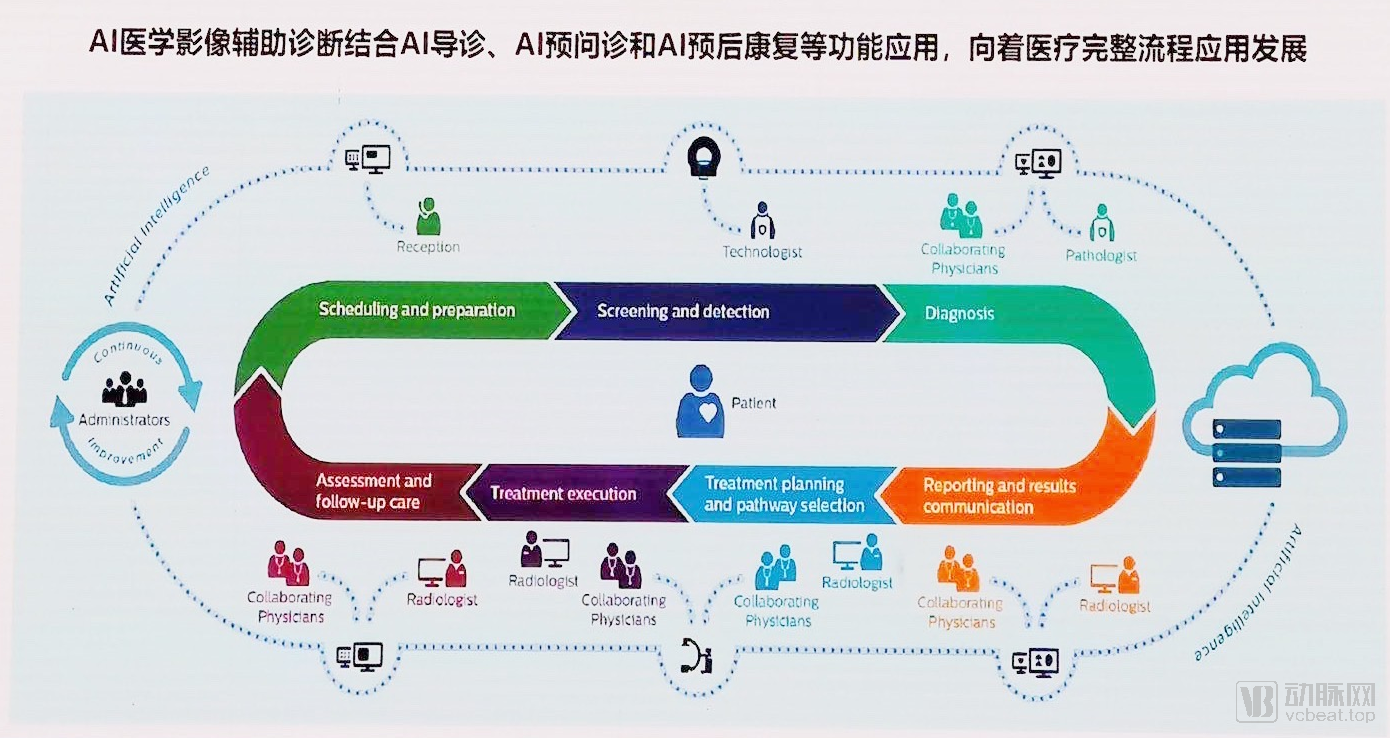
ISAI: AI Embedded Throughout the Entire Process, Facilitating a Closed-Loop Diagnosis and Treatment System
From a deeper procedural perspective, ISAI is not limited to providing management services for radiology departments. In fact, leveraging Philips’ leading hardware capabilities in CT, ultrasound, and MR, the platform breaks down the boundaries between image acquisition, reconstruction, transmission, analysis, and reporting. It intelligently integrates these stages into a unified workflow, seamlessly embedding artificial intelligence algorithms and applications throughout the entire process to form a closed loop. This can be regarded as an innovation in radiology department workflows, one that addresses the genuine needs of radiologists.
If Philips’ entry into AI in 2013 is regarded as the beginning of its AI 1.0 era, then the establishment of AI standards and the rapid expansion of healthcare application scenarios are propelling Philips into the AI 2.0 era starting this year.
In this era, Philips is no longer limited to the development of radiology software and platforms but has delved into the entire clinical workflow. Cardiovascular and cerebrovascular diseases, oncology, and critical care are all key areas of breakthrough for Philips at this stage.
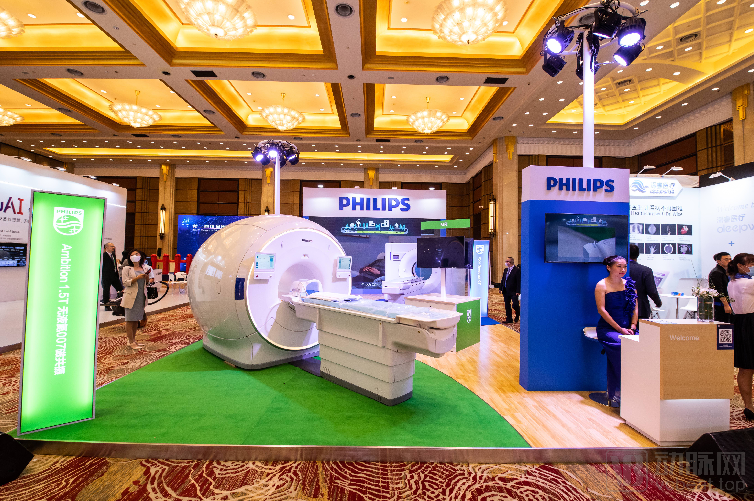
Philips Unveils Multiple New Products at the 2nd China Medical Imaging AI Conference
Oncology is one of the key focus areas for Philips.Leveraging single-site imaging equipment, Philips has developed numerous AI systems with embedded hardware.
Taking the Philips AI Breast intelligent navigation system as an example, this AI technology is integrated into the Philips Affiniti 70 and EPIQ series of intelligent ultrasound diagnostic systems. Combining ultra-high-definition image quality with human-centric intelligent applications, it provides robust decision support for healthcare professionals through intuitive navigational positioning. By leveraging magnetic field sensing and sensors embedded in the single-crystal linear array transducer, AI Breast achieves comprehensive tracking and full coverage during breast examinations, thereby efficiently reducing the rates of missed and misdiagnoses.
Bai Xianghui from the Philips China Innovation Center told VCBeat, “With the AI Breast product, ultrasound systems can determine the real-time position of the probe. During breast scans, many physicians are uncertain whether certain areas have been fully scanned. AI Breast provides real-time visualization to indicate which areas have been scanned and which have not.”
Nevertheless, there is still room for improvement. “The methods we currently employ are still predominantly based on convolutional neural networks (CNNs), with an emphasis on pattern recognition. The approach to judging local features in tumor images is quite similar to that used for processing pulmonary nodule imaging. However, in clinical practice, physicians do not rely solely on local image features for diagnosis; they also analyze the relationship between the lesion and the surrounding tissues,” stated Bai Xianghui. “Therefore, Philips is also exploring novel algorithms such as attention mechanisms to help AI automatically analyze the relationship between lesions and adjacent tissues.”
In the cardiology sector, Philips has also adopted a dual strategy of integrating hardware and software.
The Philips Navigator CT, released in 2020, is the first intelligent cardiac CT equipped with artificial intelligence technology. It leverages AI-assisted quality control to achieve efficient and standardized data acquisition. In practice, this CT system has reduced scan positioning operations by 66% and accelerated image reconstruction by 24%. Its built-in ARAD Intelligent Cardiac Engine can also identify abnormal heart rates with a single click.
Why Focus Innovation on the Heart? Philips Considers Two Factors: Addressing Needs and Breaking Through Technological Barriers.
“A key indication that ultra-high-end CT aims to address is cardiac imaging. Cardiac scanning places exceptionally high demands on equipment, and as more patients with heart disease present to radiology departments, we aim to achieve breakthroughs in cardiac examinations,” said Zhou Ning from Philips’ CT marketing department. “Furthermore, with the increase in data volume and patient numbers, the amount of information has grown substantially, while hospital human resources have not seen commensurate growth. This has created a significant supply–demand mismatch, and we therefore hope to help address this unmet need.”
Addressing these challenges, Philips has strengthened its hardware capabilities by integrating spectral control chips into its existing foundation of integrated detectors, single-stage water-cooled spectral X-ray tubes, and air-bearing technology. Simultaneously, the new equipment is empowered by AI. The combination of these advancements enables the CT scanner to record data from each patient scan, such as X-ray tube pressure and exposure time, to assist in scanning subsequent patients. This approach significantly extends the lifespan of the X-ray tube and provides a more stable data source for the CT system, thereby facilitating the analysis of cardiac data.
The final area where Philips is exerting its efforts lies in IT solutions for critical and severe care., including the latest two products:
Critical Care and Anesthesia Clinical Information Management Software, Version H (ICCA H) is a critical care clinical solution with in-depth clinical applications. By leveraging a structured database, it empowers discrete data, embeds standardized diagnostic and treatment logic, assists physicians in rapidly assessing patient conditions and conducting full-process quality control monitoring, optimizes critical care diagnostic workflows, and buys precious time for saving the lives of critically ill patients.
Philips IntelliVue Information Center iX Enterprise (PIIC iX Enterprise) is a powerful in-hospital monitoring system that connects up to 1,024 beds with Philips monitors and various bedside devices from other manufacturers, providing centralized display and alarm management. It enables cross-departmental interoperability, facilitating hospital-wide patient data access and allowing healthcare providers to view patient information anytime, anywhere. With one-click bed or department transfer, patient data automatically migrates with the patient, ensuring complete visibility of patient records from admission to discharge.
However, compared to the other two sectors, Philips’ applications in critical and emergency care still require further development. In the future, Philips will increasingly leverage artificial intelligence and Internet of Things (IoT) technologies to bring greater intelligence into hospital wards.
Despite Philips’ significant investments in healthcare and its development of a wide range of effective hardware and software solutions, the advancement of medical artificial intelligence (AI) requires collaborative efforts from multiple stakeholders. Philips firmly believes that the successful implementation and widespread adoption of medical AI depend on the joint participation of AI companies, healthcare institutions, and equipment and platform providers. Upholding the philosophy of “open” innovation, Philips collaborates with academia, innovation incubators, venture capital firms, startups, and clinical partners to drive the continuous development of local digital health ecosystems. By leveraging China’s vast digital ecosystem, these collective efforts aim to empower both patients and healthcare providers.
In the AI 2.0 era, Philips is not only developing its own AI solutions but also supporting innovative enterprises in their AI initiatives and empowering physicians to leverage AI, fostering comprehensive multi-party collaboration to jointly drive industry advancement.Over the years, it has developed its own proprietary model for industry advancement.
Dr. Zhou Zhenyu, Clinical and Technical Lead at Philips’ Greater China Integrated Solutions Center, told VCBeat: “Philips currently has more than 100 productized modules, but they still do not cover the full range of physicians’ needs. Therefore, we also hope to identify medical AI companies operating in specific clinical scenarios and collaborate with them to enhance our product portfolio.”
“To date, we have reviewed more than 1,100 AI companies, fewer than 300 of which are closely related to medical imaging equipment. We categorized these companies into radiology, radiation therapy, interventional procedures, and other segments. Ultimately, the number of companies that met our criteria was very limited, as we require their AI applications to be deployable in specific clinical scenarios that effectively address current pain points in clinical practice.”
Shukun Technology, a startup focused on cardiovascular AI, serves as a prime example. Shukun can reduce the time required for CT coronary angiography—from examination and interpretation to the generation of structured reports—by up to 80%, which will effectively enhance Philips’ “hardware-software integration” development strategy.
To help doctors better utilize AI for medical imaging research, Philips has launched the Nebula Exploration AI Platform ISD, which supports comprehensive multi-disciplinary research across anatomy, morphology, and radiomics.
Huai Xiaochen, Senior Scientist of Intelligent Solutions, told VCBeat, “Physicians often encounter various challenges in scientific research. For instance, traditional omics analysis methods require customers to independently perform feature selection after the feature extraction step. Feature selection and classifier development demand a certain foundation in statistics, an area in which many physicians are not experts. Therefore, we have preconfigured a series of commonly used classical machine learning models to assist physicians in radiomics research, significantly streamlining the workflow from segmentation to final model prediction and enabling them to rapidly complete a comprehensive analysis of omics features. With such a system and workflow in place, we can even help hospitals establish high-quality omics databases, facilitating clinical physicians in rapidly iterating their models.”
Amid the current AI industry winter, Philips’ responsibility and mission extend beyond its own development and implementation. With an integrated approach spanning medical imaging, cardiovascular and cerebrovascular care, oncology, and critical care, and driven by the dual engines of enterprise and physicians, Philips is sparing no effort to steer AI toward a better future.
At the recently held 2nd China Medical Imaging AI Conference, a team of physicians led by Professor Liu Shiyuan actively promoted the development of artificial intelligence and launched the initiative for building a radiological imaging database. Amid this growing trend, more physicians have joined the effort to advance AI applications.
Returning to Philips, this industry giant will continue to deepen the integration of digital innovation technologies with clinical medical insights, creating solutions driven by digital and artificial intelligence technologies. These solutions aim to assist healthcare professionals in providing more precise diagnostics, customized treatments, and more efficient medical services to patients across the pre-hospital, in-hospital, and post-hospital stages. Ultimately, this will help healthcare systems achieve the “Quadruple Aim” of value-based care: improving population health, enhancing patient experience, increasing healthcare provider satisfaction, and reducing care costs.