

Ping An Group Reinforces Its Position as a Leading Healthcare Enterprise Through an Integrated Medical Ecosystem Strategy
Ping An’s entry into the healthcare and medical sector was not a whim.
Faced with China’s RMB 16 trillion healthcare market over the next decade, severe supply-side contradictions caused by resource misallocation, and significant room for growth of commercial health insurance in medical payments, Ping An has ample rationale to enter the sector.
On September 22, at the Investor Open Day event held in Shenzhen, Ping An Insurance (Group) Company of China, Ltd. (hereinafter referred to as “Ping An Group”), Co-CEO Jessica Tan fully disclosed the company’s healthcare ecosystem strategy for the first time and announced that Ping An has become a leading healthcare enterprise.
The healthcare ecosystem strategy encompasses 12 subsidiary entities, including Ping An Good Doctor and Ping An Smart Healthcare. By firmly leveraging five key pillars—government, users, service providers, payers, and technology—it empowers all stakeholders. After 23 years of development, the strategy has officially taken shape and is positioned as one of Ping An Group’s long-term core strategies.
Specifically, within Ping An’s smart healthcare ecosystem serving the government sector, Ping An Good Doctor dominates the user base and online medical services, while Ping An Smart Healthcare commands the offline medical services segment. Ping An Life Insurance, Ping An Pension & Insurance, Ping An Medical Insurance Technology, and Ping An Health Insurance serve the payment side, with technical research support provided by entities such as the Ping An Medical Technology Research Institute. These companies’ businesses effectively complement one another, forming a synergistic matrix characterized by strategic alliances and cross-sector collaboration.
From a long-established insurer to an integrated financial services group, and now to a technology-driven personal finance and lifestyle services group, Ping An may have had only one core label at any given stage, but it has accumulated numerous sub-labels, with “healthcare enterprise” officially becoming one of them.
“Technology empowers finance, technology empowers ecosystems, and ecosystems feed back into finance”—this vision is becoming a reality.
In its 2019 annual report, Ping An Group explicitly clarified that it has more clearly defined “finance + technology” as its core business. Centered on this core business, Ping An Group has built five major ecosystems: financial services, healthcare, automotive services, real estate services, and smart cities. The ultimate goal of ecosystem development is to reinforce and support the core business.
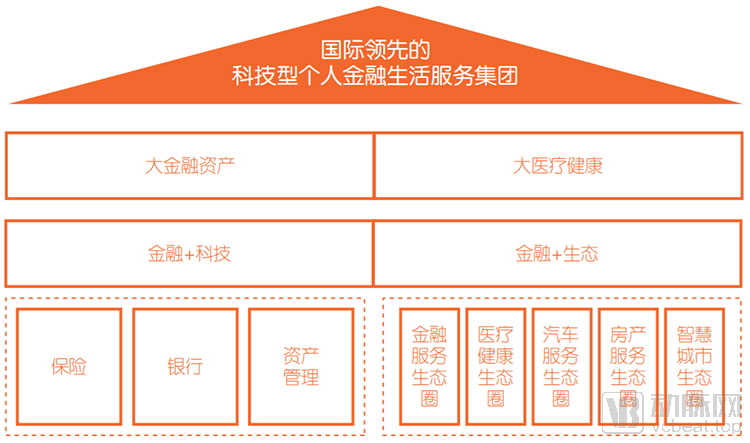
Composition of Ping An Group’s Ecosystem. Source: Ping An Group 2019 Annual Report
According to the data disclosed on Open Day, 15% to 20% of Ping An Group’s new financial customers annually come from its healthcare ecosystem. Financial customers who utilize services within the healthcare ecosystem hold an average of 3.1 contracts per customer, compared to 2.0 for those who do not. The assets under management (AUM) for financial customers using healthcare ecosystem services amount to approximately RMB 10,000 per customer, versus RMB 5,600 for non-users. Meanwhile, about 60% of financial customers require health-related products or services.
This also indicates that the healthcare ecosystem can not only secure a foothold in the RMB 16 trillion healthcare market but also generate significant internal synergies in terms of traffic, products, and services. The reinforcing effect of the healthcare ecosystem on core business operations is beginning to materialize.
The data reveals the underlying logic beneath the surface. Competition in the insurance market is intensifying, and customers are raising their expectations for insurance products and services. Particularly in the post-pandemic era, while people have heightened their awareness of protection and health, they also hold higher expectations for medical and healthcare services.
However, traditional insurance and financial products exhibit significant shortcomings in service models and sales channels. When insurers provide medical and health services to clients through third-party partnerships or limited in-house capabilities, they either struggle to control the quality and efficiency of third-party services or face constraints in available resources. Traditional marketing channels incur high customer acquisition costs; if insurers fail to fully uncover customer needs and offer diversified products to meet those needs, overall operational costs are further elevated.
Beyond the direct data evidence mentioned above, the healthcare ecosystem’s synergy with Ping An Group is further demonstrated by its self-built internet healthcare system, which enables broad and efficient customer service while ensuring the Group maintains full control over service content. Furthermore, increasing the average number of contracts per customer has driven stable growth in individual customer value, thereby reducing the Group’s overall operating costs.
Therefore, the high degree of synergy between the healthcare ecosystem—and indeed all five major ecosystems—and Ping An Group can be directly understood as a market-demand-driven approach to cost reduction and efficiency improvement.
If the healthcare ecosystem generates value in terms of cost reduction and efficiency improvement internally, then from an industry-wide perspective, it builds differentiated competitiveness for Ping An Group.
From the perspective of the insurance market, as China further opens up its insurance sector to foreign investment, foreign-funded insurance institutions have been entering the domestic market one after another. Data from the China Banking and Insurance Regulatory Commission (CBIRC) shows that foreign-funded insurance companies now account for approximately 27% of the total number of insurers in the industry. In addition, a number of new insurance companies with rapid growth and large premium scales have been established in recent years, including those with banking or internet backgrounds.
A diversified landscape entails more intense competition. As a leading enterprise, Ping An Group already enjoys inherent advantages in scale, yet it must still focus on broader and long-term strategic positioning. The medical ecosystem serves as a key approach for Ping An Group to integrate comprehensive resources across the healthcare industry.
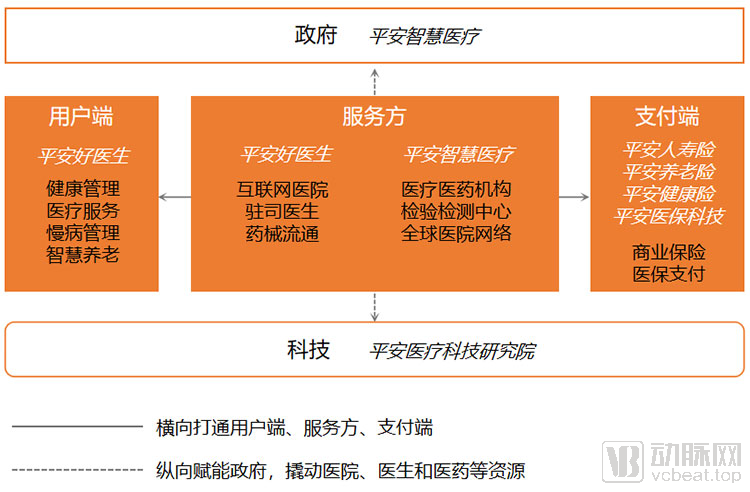
Ping An Group Leverages Its Healthcare Ecosystem to Integrate Comprehensive Medical and Health Resources
Horizontal dimension,Integrate the user side, service providers, and payment channels; specifically: capture user traffic to influence healthcare decision-making; empower service providers to generate product and service profits; and leverage long-arm management institutions on the payment side to impact users.
Specifically, on the user side, Ping An Good Doctor has accumulated 346 million users, with an average of 831,000 daily consultations. On the service provider side, Ping An Good Doctor has connected and empowered 110,000 offline pharmacies, establishing a vast offline service network. On the payment side, Ping An Life Insurance has 65 million life insurance customers, and Ping An Medical Insurance Technology’s smart medical insurance services have covered 200 cities.
Longitudinal dimension,Empowering the government to leverage core resources such as hospitals, physicians, and pharmaceuticals within the healthcare ecosystem; establishing competitive barriers by empowering all members of the ecosystem through technology.
Specifically, Ping An Smart Healthcare provides end-to-end solutions for regulatory authorities and the healthcare ecosystem, leveraging its “four-wheel” drive strategy to empower government clients and vertically integrate service delivery.
The “Four Pillars” refer to the management of healthcare institutions, physicians, diseases, and pharmaceuticals. Managing institutions empowers Health Commissions to implement smart governance; managing physicians leverages core smart hospital systems to help hospitals comprehensively enhance operational efficiency; managing diseases empowers public health systems to respond to epidemic emergencies and strengthens chronic disease management to improve overall population health; and managing pharmaceuticals utilizes smart solutions to facilitate drug research and development as well as medication management.
Currently, Ping An Smart Healthcare has connected and empowered 20,000 institutions and maintains a global hospital partnership network of over 1,000 hospitals.
The healthcare ecosystem not only integrates resources from various stakeholders but also creates more application scenarios. For instance, over the past few years, medical leasing companies have accumulated a network of more than 3,400 hospitals, primarily public ones. The current demand for these resources is digital transformation, specifically the establishment of internet hospitals, which Ping An Good Doctor can help them achieve.
Thus, Ping An Group is able to leverage its healthcare ecosystem to accumulate broader capabilities. Compared with traditional insurers, Ping An boasts high-traffic internet entry points, extensive government resources and service capabilities, and deep integration with pharmaceutical companies, thereby establishing formidable industry barriers and creating a unique competitive advantage.
Compared with internet companies aggressively entering the online healthcare sector, Ping An has introduced more “grounded” cutting-edge clinical technologies.
Several years ago, Ping An already recognized the importance of technological power and incorporated it into the group’s core strategy. Each year, Ping An Group allocates 1% of its operating revenue to the research and development of innovative technologies, with a significant portion directed toward its healthcare ecosystem. As a result, medical technology has become a vital component of the healthcare ecosystem and the entire group, with the Ping An Medical Technology Research Institute serving as the key entity driving technological empowerment.
Ping An Medical Technology Research Institute (hereinafter referred to as “Ping An Medical Technology”) has established data and knowledge as its core strengths since its establishment in 2018.
Furthermore, Ping An Medical Technology has ranked second globally in the number of medical technology patent applications and achieved top-tier results in six international medical imaging competitions.
Technological influence has long permeated every subsidiary entity within the healthcare ecosystem. For example:
Ping An Good Doctor leverages an AI-assisted diagnostic and treatment system to enhance physician efficiency; Ping An Smart Healthcare integrates AI into its chronic disease management platform, enabling intelligent patient follow-ups; and Ping An HealthTech empowers government healthcare insurance governance through advanced technologies such as AI, big data, and biometric recognition.
It is evident that in the research, development, and application of medical technology, Ping An has not only focused on its core business—namely, healthcare security solutions—but also delved deeply into clinical practice to directly address the diagnostic and treatment needs of physicians. Furthermore, the results indicate that Ping An has achieved a leading position in certain technological areas.
Therefore, compared with internet companies, Ping An Group is able to leverage medical technology to provide in-depth services to government healthcare systems and achieve extensive coverage of medical institutions. Backed by its insurance business, which has accumulated strengths over many years, Ping An also possesses unique advantages.
The healthcare industry is characterized by high professional barriers and a broad scope, with significant specialization gaps even among its various subsectors. Although many companies pursue diversified strategies and aim to integrate the entire industry chain, their overall positioning remains focused on specific niche areas or achieves only partial integration. These segments include upstream pharmaceuticals, medical devices, and distribution; midstream healthcare services; downstream insurance; and technology-enabling sectors such as healthcare big data and medical AI.
Major domestic corporations have adopted several models to cross over into the healthcare sector: for instance, they may invest in and facilitate connectivity to build out a healthcare ecosystem; leverage internet entry points and supply chain advantages to enter the healthcare market; or empower the healthcare sector by leveraging advanced technologies such as artificial intelligence (AI) and cloud computing.
Furthermore, on the international front, multinational corporations such as Siemens and Philips are also focusing on the healthcare sector. The difference lies in their emphasis: within the medical field, their primary focus is on in-hospital solutions, without directly providing medical services to patients; whereas their consumer health products targeting individual users are primarily designed for out-of-hospital settings.
Ping An Group’s healthcare ecosystem strategy seems to convey this stance: “An insurer that does not aspire to be a technology service provider for healthcare services is not a good one.”
This statement may seem convoluted at first glance, but it becomes clear when broken down: As an insurance company, Ping An has extended its service chain into the healthcare sector, thereby gaining new customer acquisition channels through medical services; as a technology company, Ping An offers not only IT products and online services but also has established a robust offline network; and as a healthcare provider, particularly in the realm of internet-based healthcare, Ping An leverages its comprehensive insurance system to serve as a payment guarantee in an industry where clear payers have yet to emerge.
Policies such as Healthy China 2030, internet healthcare, health insurance, and health management continue to bring benefits to the medical and healthcare industry. Ping An Group has seized these opportunities through its forward-looking business layout.
As the strategy for its healthcare ecosystem takes shape and is implemented, and as the positioning of its healthcare enterprises is firmly established, Ping An Group has forged a differentiated advantage in the industry through technology empowerment and business model innovation, building an insurmountable competitive moat. Its consistent alignment with emerging trends and proactive approach to transformation will continue to inject new vitality into this long-established insurance enterprise.