

Will SoYoung’s Internet Hospital Expansion Become a Blueprint for Consumer Healthcare Digitization?
The rapidly expanding army of internet hospitals has recently added another heavyweight name—So-Young Inc.
Over the past two years, establishing internet hospitals has ceased to be the exclusive domain of digital health companies; pharmaceutical firms, insurance providers, and medical device manufacturers have all entered the fray. Therefore, it is hardly surprising that SoYoung has joined the ranks of internet hospital operators. As a native digital platform, SoYoung has already leveraged the internet to build a distinctive content ecosystem, which it uses to drive monetization.
What Is SoYoung’s Motive in Securing an Internet Hospital License? To Provide Post-Procedure Follow-Up Consultations and Prescriptions for Medical Aesthetics? To Further Enhance Its Service Chain? By examining its license details and development strategy, it becomes clear that SoYoung does not intend to limit itself to the medical aesthetics sector.
On September 16, Chengdu So-Young Internet Hospital officially obtained its “Medical Institution Practice License.” In addition to plastic surgery, dermatology, and medical cosmetology—the specialties most closely associated with aesthetic medicine—its approved clinical departments also include stomatology, ophthalmology, obstetrics and gynecology, and traditional Chinese medicine, reflecting typical characteristics of consumer healthcare.
According to statistics from VCBeat’s Eggshell Research Institute in its report “Internet Hospitals 2020,” there were a total of 577 internet hospitals across China as of the end of June 2020. By hospital category, 70% were general hospitals, while specialized hospitals were fewer in number, with only 75. Since consumer healthcare is primarily concentrated in specialized fields and dominated by private medical institutions, we have focused our analysis on these data.
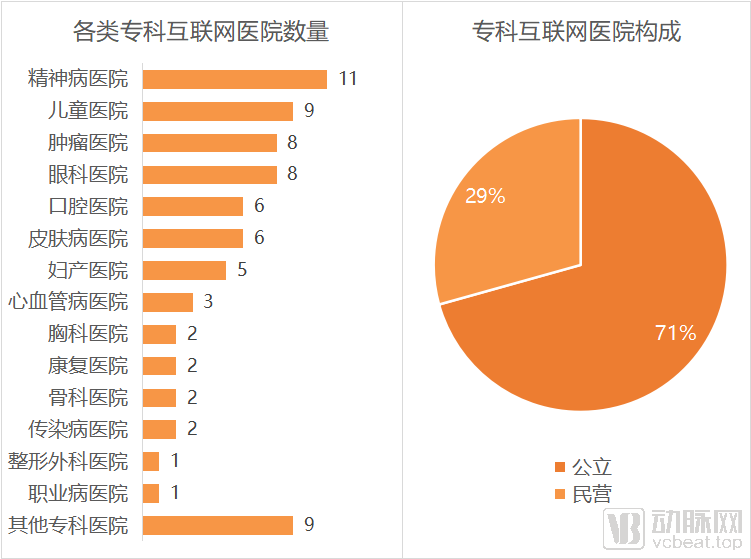
Composition of Specialized Internet Hospitals. Data sources: National Health Commission, local health commissions, and mainstream media reports; chart compiled by VCBeat.
As shown in the figure above, internet hospitals are most prevalent in specialties such as psychiatry, pediatrics, and oncology. Specialties with strong consumer demand, such as dentistry, dermatology, and obstetrics and gynecology, occupy a middle position. Due to the high costs associated with establishing an internet hospital, private hospitals face limited traffic channels and offline resources even after making the initial investment. This makes it difficult to achieve scalability and does not guarantee expected returns. Consequently, private hospitals account for only a small proportion of these specialized internet hospitals, while public hospitals represent a significant 71%.
Furthermore, in the consumer healthcare sector, there are numerous private medical institutions—particularly chain organizations—as well as a large number of primary hospitals, comprehensive outpatient departments, and clinics. However, certain provinces and municipalities impose specific requirements for internet hospital accreditation. For example, in Chongqing, internet hospitals are only being piloted at medical institutions classified as Level II or above. Consequently, some entities may be affected by similar policies and thus do not meet the eligibility criteria to apply for an internet hospital license.
In fact, given that public medical institutions handle a significantly higher volume of services than private ones, the latter have a much stronger incentive to acquire patients through internet-based healthcare services. Digitalization also presents a valuable opportunity for private healthcare providers to enhance their overall image and service efficiency. However, based on the analysis above, establishing self-operated internet hospitals is not the optimal choice.
Within the broader healthcare sector, a number of well-known internet medical platforms, such as WeDoctor and Haodafu, have emerged. Consequently, in the consumer healthcare segment, medical institutions and physicians can also join platforms with similar user demographics to deliver online medical services. In the past, there were virtually no large-scale platforms of this kind in the field. The emergence of SoYoung as a platform-based internet hospital is therefore timely.
First, as previously stated, private medical institutions have a stronger demand for digital transformation; however, due to factors such as cost and market entry barriers, building their own internet hospitals is not the optimal choice. Second, Chengdu So-Young Internet Hospital already boasts a foundation of 6.77 million monthly active users through the So-Young APP. Finally, So-Young has accumulated a large base of precise users in fields such as medical aesthetics and dentistry, who are predominantly female and align closely with the user demographics of other consumer-focused specialties. Therefore, supply and demand are well-matched.
In accordance with the provisions of the Administrative Measures for Internet Hospitals (Trial), internet hospitals may provide follow-up consultation services for patients with certain common and chronic diseases. Centered on prescription issuance during follow-up visits, most internet hospitals have established end-to-end services spanning from medical consultation to pharmaceutical delivery. These services include pre-consultation health education and psychological assessments; intra-consultation follow-up prescriptions, remote consultations, and remote monitoring; as well as post-consultation online follow-ups and medication guidance. Furthermore, membership-based products such as family doctor services and chronic disease management are already available, integrating these end-to-end services to better serve patients.
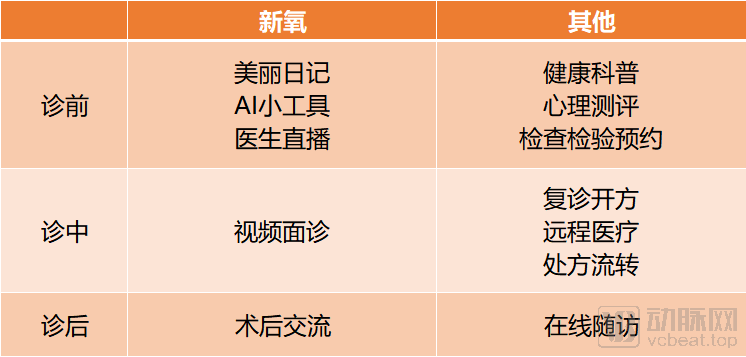
Comparison of Chengdu So-Young Internet Hospital Services with Common Services Offered by Other Internet Hospitals | Graphic by VCBeat
Previously, the SoYoung platform also covered pre-consultation, intra-consultation, and post-consultation services. During the pre-consultation phase, SoYoung facilitated user consumption decisions through products such as “Beauty Diaries” and various diagnostic mini-tools. During the consultation phase, SoYoung enabled direct doctor-patient communication via video consultations; however, as prescriptions could not be issued online, users requiring medication had to visit offline facilities. This stage primarily aimed to address patient inquiries and enhance mutual understanding between doctors and patients, with the ultimate goal of still promoting consumption decisions. In the post-consultation phase, users could engage in post-operative exchanges on the SoYoung platform.
It is evident that So-Young’s previous service offerings already shared many similarities with those of typical internet hospitals. However, its involvement in the consultation phase was previously limited. With the acquisition of an internet hospital license, So-Young can now more comprehensively integrate the entire patient journey—pre-consultation, during-consultation, and post-consultation—through follow-up visits and prescription services.
It is understood that Chengdu So-Young Internet Hospital will launch a 24/7 online outpatient service, enabling the issuance of electronic prescriptions and the online pre-ordering of diagnostic tests and examinations. This initiative aims to reduce the burden on patients from making repeated hospital visits, thereby providing consumers with higher-quality, more cost-effective services.
However, So-Young differs significantly from conventional internet hospitals. Compared with disease treatment, medical aesthetics and other consumer healthcare services involve higher consumption frequency and greater continuity. The platform can also conduct market education for users to facilitate consumption decisions, which in turn lay the foundation for subsequent services.
SoYoung has previously established a robust content ecosystem in the fields of medical aesthetics and dentistry. On the front end, 510,000 creators continuously generate diverse content. The middle platform provides targeted incentives for different user roles to stimulate the production of high-quality content. On the back end, doctors and key opinion leaders (KOLs) can directly reach users through SoYoung’s various marketing products.
As of the end of June this year, So-Young’s new media matrix comprised six WeChat official accounts, 16 Weibo accounts, and 15 video columns, with content covering medical aesthetics, skincare, fitness, cosmetics, and other fields.
The aforementioned content plays a pivotal role in shaping users’ consumption decisions, and the content ecosystem has become a hallmark of So-Young.
As internet hospitals expand their service offerings, So-Young is poised to replicate its content ecosystem—a “powerful tool”—across other initiatives, integrating additional platform information and resources to establish a distinctive healthcare service model.
Currently, internet hospitals are categorized into three major types: those led by physical hospitals and those jointly established by physical hospitals and enterprises. These two types are mostly standalone internet hospitals, with the advantage of having their own medical teams, but the disadvantages of high investment costs, limited resource integration capabilities, and limited operational capabilities. The other type is platform-based internet hospitals, which are mostly operated by enterprises relying on physical medical institutions.
Platform-based internet hospitals can onboard medical institutions and physicians, leveraging their operational and resource integration capabilities to empower these entities, drive precise patient referrals to offline physical facilities, and expand their service reach.
As a platform-based internet hospital, So-Young can also fully empower medical institutions and physicians.
Currently, SoYoung has launched corresponding initiatives to help medical institutions achieve digitalization of information and services. These include the online presentation of various details such as institutions, physicians, and procedures, as well as a range of services like online appointment scheduling, virtual Q&A, private messaging consultations, video consultations, live streaming, and post-operative care. Meanwhile, SoYoung categorizes medical institutions into e-commerce-oriented, content-driven, and social engagement-focused types, providing tailored solutions to help these institutions reduce operational complexities.
Once physicians are qualified to prescribe during follow-up consultations, So-Young can further help medical institutions expand their service offerings, service reach, and operational efficiency. Meanwhile, by leveraging technologies such as AI and big data, it enhances the matching between users and medical institutions, thereby improving user conversion rates.
Furthermore, internet hospitals can also deliver value to physicians. For instance, doctors can more selectively engage in consultations within their areas of expertise based on patients’ descriptions, thereby enhancing service quality and accumulating clinical experience. Meanwhile, thanks to the improved efficiency of online healthcare, physicians can expand their patient volume and maximize their personal brand and professional value.
Based on the above analysis, and in conjunction with SoYoung’s previously announced “One Vertical, One Horizontal” strategy—deepening its vertical integration in the medical aesthetics industry while horizontally expanding into a broader range of consumer healthcare categories—it is evident that SoYoung’s entry into the internet hospital sector marks the official beginning of its efforts to expand its service radius and venture into the consumer healthcare market.
Since the beginning of this year, driven by epidemic prevention and control needs and policies, there has been a surge in the number of internet hospitals and the volume of online medical services. As epidemic prevention and control becomes normalized, the trend toward digitalization of healthcare services continues. Public hospitals are positioned to provide public-welfare-oriented services, whereas enterprises must grapple with business model challenges. However, among the various internet hospitals currently led by enterprises, a mature business model has yet to emerge, with most deriving substantial revenue primarily from pharmaceutical sales.
As an internet-based medical aesthetics platform, So-Young has established a solid foundation in its field. Its integration with an internet hospital has further expanded its growth potential. Although Chengdu So-Young Internet Hospital is positioned within consumer healthcare—a sector with distinct characteristics—its future trajectory warrants close attention. Will it offer valuable insights for the business models of internet hospitals? Could it become a benchmark for the digital transformation of medical aesthetics platforms and consumer healthcare? These are questions worth anticipating.