MiniMed Sets IPO Price Range, Advances Toward $7.84B Valuation as Medtronic's Diabetes Unit Nears Nasdaq Debut

Medtronic
Medical Device Manufacturer
Recently (February 24), according to foreign media reports, MiniMed, the diabetes business under Medtronic, the world's leading medical device company, has achieved a key breakthrough in its IPO process. In an amendment to its filing with the U.S. Securities and Exchange Commission (SEC), MiniMed set a price range for its planned initial public offering (IPO).

Image Source: Latest Medical Device News on MassDevice
01
IPO Process Accelerates
Revenue Growth, Profit Pressure
On February 23, MiniMed officially finalized the pricing range for its IPO and plans to issue28 million sharesCommon Stock, Issue Price per Share Set at$25 to $28between. If calculated based on the upper limit of 28 USD, this IPOThe total amount raised will reach 784 million US dollars., corresponding to the overall valuation target of MiniMed will increase to$7.86 billion(Approximately RMB 54 billion)
Notably, this progress comes just nine months after Medtronic officially announced its decision to spin off its diabetes business in May 2025. It has been only two months since MiniMed submitted its Initial Public Offering (IPO) application to the SEC in December 2025. The company plans to list on the NASDAQ exchange under the stock symbol “MMED.”
Moreover, Medtronic's Chief Financial Officer Thierry Piéton stated in the Q3 earnings call in February 2026 that the spin-off of MiniMed is proceeding exactly as expected.IPO First, Then Equity Spin-offThe plan is proceeding steadily,Expected to officially complete the spin-off by the end of 2026According to this plan, six months after the completion of the IPO, Medtronic will implement a subsequent full spin-off, making MiniMed a truly independent publicly traded company.
The spin-off of MiniMed is not accidental but a continuation of Medtronic's business streamlining strategy over the past two years. Since 2023,Medtronic has successively divested its renal care business through the joint venture Mozarc Medical., exiting the ventilator business in 2024, and continuing to focus the business portfolio on high-growth, high-margin areas. As the smallest revenue segment of Medtronic, the spin-off of the diabetes business is both a strategic necessity and an opportunity to provide more flexible growth space for the business.
From the overall business of MiniMed, this business segment has clearly returned to a growth track in the recent quarters. According to the latest Q3 2026 earnings report (as of January 23, 2026),Diabetes business revenue increased by 8.3%, reaching 796 million US dollars, the international market is the main driver of its growth.
The recovery of its business is also inseparable from its own product innovation.780G Insulin Pump SystemAs an automated insulin delivery (AID) solution, it can automatically adjust insulin infusion every 5 minutes based on real-time sensor data, effectively stabilizing fluctuations in high and low blood sugar levels. This is Medtronic's latest generation AID system and also the core product of Medtronic's diabetes business, serving as a major revenue driver.
In February 2026, the system achieved several significant advancements:The combination of the Abbott-compatible 15-day Instinct sensor and the system previously received FDA approval for use in type 2 diabetes patients requiring insulin therapy; the FDA also approved the 780G system for use with ultra-rapid insulin Fiasp (Novo Nordisk) and Lyumjev (Lilly), further enhancing postprandial blood glucose control.
Meanwhile, the next-generation product pipeline is also accelerating. In February 2026, Medtronic submitted the next-generation MiniMed Flex (Series 8) insulin pump to the FDA. This product is significantly smaller in size compared to the 780G, allowing for more discreet wear, while remaining compatible with existing reservoirs and infusion sets, and can be used in conjunction with the Simplera Sync and Instinct sensors. Additionally, Medtronic has initiated a pivotal U.S. study for the Vivera third-generation automated insulin delivery algorithm and plans to submit the MiniMed Fit patch pump system to the FDA in the fall of 2026.
However, it is worth noting that although MiniMed has shown good momentum recently, it is still inA Phase of Accelerating Revenue Growth Alongside Profitability PressuresMiniMed has incurred net losses for three consecutive years, and how to turn losses into profits will be MiniMed's biggest challenge after the official spin-off.
02
Q3 Earnings Exceed Expectations
A Hundred Billion Market with Heroes Competing
As the spin-off of MiniMed proceeds methodically, Medtronic has recently delivered impressive results for its Q3 of 2026. On February 17, 2026, Medtronic's latest financial report showed that all its key metrics exceeded expectations, and its revenue growth...Reaching the highest level in 10 quarters。
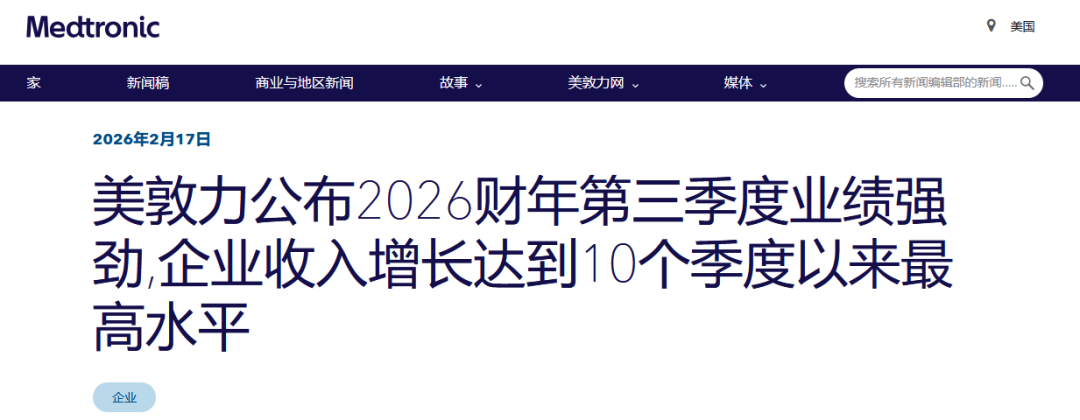
Image Source: Medtronic Official Website
The financial report shows that Medtronic Q3Global revenue reached 9 billion US dollars, an increase of 8.7% year-on-year,The highest growth rate in the past 10 quartersBy business segment, the cardiovascular business led the way with $34.57 billion, growing by 10.6%; neurology business revenue reached $25.58 billion, a year-on-year increase of 4.1%; medical surgical business revenue was $21.73 billion, up 4.9% year-on-year.
By contrast, although the diabetes business has seen some growth, it remains one of Medtronic's smaller business segments in terms of revenue and has minimal impact on overall revenue. However, as one of the chronic diseases with a high prevalence rate globally, diabetes represents a vast market with promising future prospects.
Globally, the continuous rise in obesity rates and the increasing number of people with diabetes have led to a growing demand for blood sugar control, further driving the expansion of the diabetes market. The diabetes medical device market is thus experiencing a period of rapid growth. According to publicly available data, the global diabetes medical device market sizeReached USD 42.3 billion in 2020 and is expected to exceed USD 100 billion by 2030.。
From the perspective of the competitive landscape, the global diabetes medical device market as a whole presentsOne Superpower, Multiple Strong PlayersThe pattern mainly includes multinational giants such as Abbott, Medtronic, and Dexcom. It is worth noting that the global diabetes medical device market exhibits obvious technology-driven characteristics: Continuous Glucose Monitoring (CGM) and Automated Insulin Delivery (AID) systems are rapidly replacing traditional blood glucose meters and insulin pens, becoming the fastest-growing细分赛道.
Abbott, as the global leader in the CGM market, has gained worldwide popularity with its FreeStyle Libre series.Moreover, leading companies in the U.S. CGM market, such as Dexcom, are also accelerating innovation and product iteration, which has intensified competition in the global diabetes medical device sector.
At the same time, the share of China's market in the global diabetes medical device market is also expanding further due to factors such as the accelerating aging population and the growing group of diabetes patients. According to data,The size of China's diabetes medical device market reached 20 billion yuan in 2024, and"The Fifteenth Five-Year Plan"It was also mentioned in the field of chronic disease management that, with policy support, chronic diseases are generally regarded as one of the regional markets with the most growth potential, and the growth rate of this sector will continue to accelerate in the future.
But it is worth noting that, currently, the diabetes medical device market in China stillLed by international brandsAbbott, Medtronic, and Roche have advantages in tertiary hospitals in first- and second-tier cities in China. However, local enterprises are catching up at an accelerated pace. Medical device companies such as Sinocare, Yuwell Medical, Microtech Medical, and SiBio have emerged in the diabetes field, achieving continuous breakthroughs in细分赛道 like insulin pumps and insulin injection pens.
After the spin-off, MiniMed will inevitably face pressure from medical device companies like Abbott. How will it perform in the future? We'll have to wait and see.
03
Conclusion
All in all, the spin-off of MiniMed is an inevitable result of Medtronic's strategic focus. After the spin-off, both Medtronic itself and MiniMed can focus more on their core businesses, thereby addressing the fierce market competition and the demands for a series of innovative R&D in their respective fields.
Editor-in-Chief |Kapok
Typesetting丨Xiyu
Statement:This article is for informational purposes only and does not represent the views of this platform. This article is not a recommendation for treatment plans, nor does it constitute investment advice. If the content involves issues related to the work, copyright, or other matters, please leave a message on this platform, and we will verify and address it promptly.

Cooperation, Contribution, Whitelisting
18323856316 (Same as WeChat)
Scan to join the reader group


Pharmaceutical Intelligence Medical Device