

JD Health Files for Hong Kong IPO with Over RMB 10 Billion Revenue and Sustained Profitability, Outlines Four Strategic Pillars for Future Growth
Similar to the scenario last year when it was spun off for independent operations and completed a massive $1 billion financing round, JD Health once again became the focus of attention last night—formally applying for a listing on the Main Board of the Hong Kong Stock Exchange, while disclosing annual revenue exceeding RMB 10 billion and continuously improving profit margins.
The value of internet-based healthcare has been prominently demonstrated this year, with internet hospitals and online medical services achieving qualitative breakthroughs.
And now, following the listing of Ping An Good Doctor, the internet healthcare sector is poised to welcome another company’s IPO.
Backed by internet giant JD.com and possessing inherent attributes of internet healthcare, JD Health’s business model and profitability are naturally the most closely watched aspects.
Revenue Continues to Grow, Reaching 8.8 Billion in Half a Year
As disclosed in the prospectus, JD Health’s revenues from 2017 to 2019 were RMB 5.6 billion, RMB 8.2 billion, and RMB 10.8 billion, respectively. In the first half of 2020, its revenue reached RMB 8.8 billion, representing a year-on-year increase of 76%. After excluding items such as changes in fair value and non-recurring gains and losses, its net profit margin stood at 3.0% in 2018 and 3.2% in 2019, rising to 4.2% in the first half of 2020, reflecting a continuous improvement in profitability.
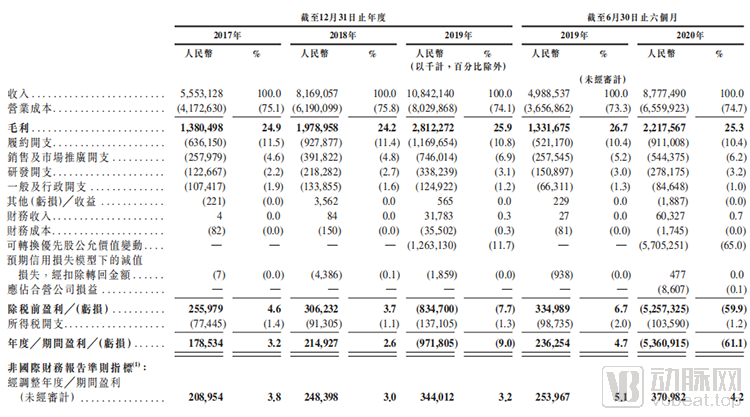
JD Health Financial Data, Source: Prospectus
Currently, the majority of JD Health’s revenue is derived from the sales of pharmaceuticals and health products. In 2017, 2018, 2019, and the six months ended June 30, 2020, product sales accounted for 88.4%, 88.8%, 87.0%, and 87.6% of total revenue, respectively.
In addition, JD Health also earns commissions, platform usage fees, and advertising revenue from third-party merchants on its online platform. Providing smart solutions to hospitals is also one of JD Health’s revenue sources.
Synergy Between Medical and Pharmaceutical Services
In terms of its business model, JD Health operates two major segments: retail pharmacy and online healthcare services. It connects users, pharmacies, pharmaceutical companies and health product suppliers, hospitals, medical professionals, and other healthcare stakeholders, with the aim of enhancing the efficiency and transparency of the healthcare value chain.
Specifically, the retail pharmacy business adopts three operational models: self-operated stores, online platforms, and an omnichannel layout; online medical and health services include internet hospital services and consumer healthcare services.
Internet hospital services mainly include online consultations and prescription renewals, chronic disease management, and family doctor services. Consumer healthcare services refer to users booking and paying for offline services online, such as physical examinations, medical aesthetics, dental care, vaccine appointments, and genetic testing.
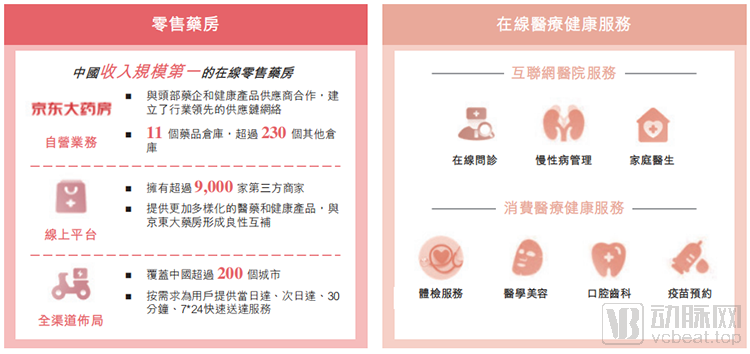
JD Health Business Model Diagram and Key Operating Data, Source: Prospectus
JD Health also leverages its technological infrastructure and capabilities to help hospitals establish internet hospital systems and internal digital infrastructure, providing digital intelligent healthcare solutions.
The strong synergy between the retail pharmacy business and online healthcare services has ultimately formed JD Health’s closed-loop system of “integrated medical and pharmaceutical services.”
Among the aforementioned businesses, the retail pharmacy segment and online healthcare services complement each other, forming a synergistic closed-loop business model across the healthcare value chain. The retail pharmacy business directs its user base to healthcare services for online consultations and prescription renewals.
Online medical and health services redirect user traffic back to retail pharmacy operations through offerings such as chronic disease management and family doctor services, driving sales of other health products, including supplements and medical devices. These two business lines reinforce each other, creating a virtuous cycle and a symbiotic ecosystem.
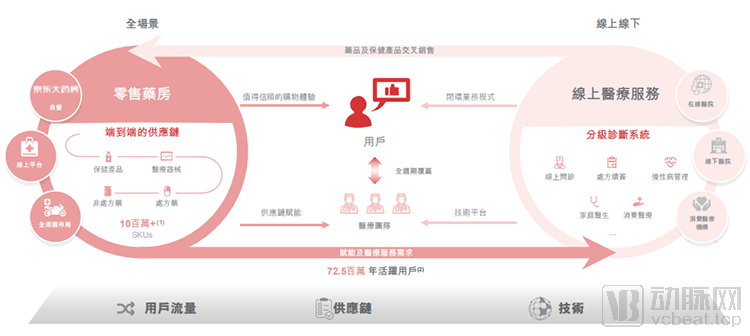
JD Health’s Business Cycle System, Source: Prospectus
In the operation of this virtuous cycle, JD Health has also achieved impressive operational metrics.
As of June 30, 2020, the online e-commerce platform hosted over 9,000 third-party merchants and had 72.5 million active users. The omnichannel layout was designed to meet users’ urgent medication needs; as of June 2020, JD Health could provide 24/7 same-day delivery, next-day delivery, and 30-minute delivery services to users in 200 cities across China.
According to a report by Frost & Sullivan, JD Health was China’s largest online healthcare platform and the country’s largest online retail pharmacy in 2019 by revenue.
As of September 20, 2020, the online healthcare service platform had enrolled more than 65,000 physicians. In addition, JD Health has jointly established 16 specialty centers, including cardiology and otolaryngology centers, with leading Chinese experts such as Hu Dayi and Han Demin. In the first half of 2020, JD Health handled an average of approximately 90,000 online consultations per day, nearly six times the volume recorded during the same period in 2019.
As of June 30, 2020, more than 150 million users had used JD Health’s platform to purchase pharmaceutical and health products or medical and healthcare services.
It took JD Health just over a year to go from its spin-off for independent operations last year to the formal submission of its IPO prospectus this year. However, a review of its development trajectory reveals that this milestone is the culmination of five years of prior accumulation.
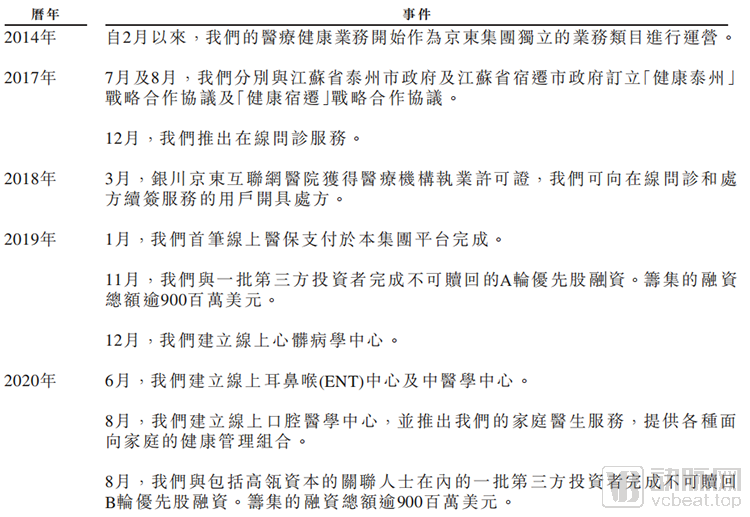
Key Milestones in JD Health’s Development, Source: Prospectus
In early 2014, JD.com began to venture into the healthcare sector. In July 2017, JD.com and Taizhou City signed a strategic cooperation agreement for “Healthy Taizhou.”
In December 2017, JD Health launched its online consultation service, marking its transition from pharmaceutical e-commerce into the internet healthcare sector, with the initial framework of a closed-loop “medical-pharmaceutical integration” system taking shape.
As can be seen from the chart above, the period from 2014 to 2019 was a time for JD Health to expand horizontally and solidify its business foundation.
In May 2019, JD Health was spun off to operate independently. Meanwhile, driven by its mission to “become the nation’s premier health steward,” JD Health entered a period of rapid growth.
In December 2019, the “JD Health Heart Center” was officially launched, becoming China’s “first national-level specialized medical center dedicated to cardiovascular health services with integrated online and offline care.” In August 2020, JD Health introduced its strategic product, “JD Family Doctor,” providing users with comprehensive family health service packages.
Consequently, the past year or so has marked a period of explosive growth for JD Health. The company has expanded from online consultation services to comprehensive health management, evolved from an independently operated entity into the third unicorn incubated by JD.com, and completed its “Internet + Healthcare” ecosystem layout starting from pharmaceutical e-commerce. This momentum stems precisely from the accumulation of the preceding five years.
During this period, JD Health also completed two rounds of substantial financing, garnering favor from star investment firms such as Hillhouse Capital, and setting a record with a single financing round exceeding $900 million.
In its prospectus, JD Health stated that its strategic plan is to strive to achieve the long-term goal of helping to optimize the allocation of medical resources and accelerate industry transformation. Specifically, it will be implemented in several aspects:
Expand the user base and enhance user engagement
including enhancing brand awareness, integrating online and offline services, and reaching and serving more users; focusing on improving user experience and achieving efficient platform user management, continuously expanding and deepening the products and services offered, optimizing service processes, and enhancing overall service quality; further strengthening supply chain capabilities to reinforce the value proposition to users; and developing data-driven personalized health products and services to continuously improve user stickiness.
Strengthening Supply Chain Capabilities for Pharmaceuticals and Health Products
JD Health will continue to consolidate its supply chain advantages and offer a broader range of pharmaceutical and health products for diverse scenarios—from common and chronic diseases to acute and critical conditions—to meet users’ comprehensive healthcare needs.
Meanwhile, we plan to further leverage the advantages of our omnichannel initiatives to meet user demands. We also intend to explore in-hospital distribution channels and deepen our collaboration with JD.com Group, strengthening fulfillment capabilities across China and enhancing specialized supply chain management to improve service capacity and operational efficiency.
Expanding Online Medical and Health Services
JD Health will expand its online healthcare services by offering diverse medical and health solutions, such as chronic disease management systems and family doctor services. It will introduce more professional and personalized healthcare services to users who purchase pharmaceutical and health products on its platform, providing them with full-cycle care. This strategy aims to further drive cross-selling of additional products through its retail pharmacy business.
JD Health will also establish more specialized departments and attract top-tier medical experts to strengthen its internet hospital services and expand specialty care offerings, thereby covering a broader range of therapeutic areas. The goal is to build a comprehensive tiered diagnosis and treatment system to meet users’ holistic healthcare needs.
Strengthen Technology-Enabled Solutions and Drive Continuous Innovation
JD Health aims to further refine its integrated online-offline tiered diagnosis and treatment system by keeping consultations and follow-ups for minor and common conditions online, while referring consultations and follow-ups for critical illnesses to offline specialists, thereby optimizing the allocation of medical resources and enhancing efficiency in the healthcare industry.
Meanwhile, we continue to provide intelligent solutions for offline hospitals and medical institutions to meet their specific needs and address broader healthcare scenarios. In addition, we will offer comprehensive digital solutions to offline hospitals, such as software, IoT systems, and integration platform solutions, to enhance the efficiency of daily operations including patient monitoring and management.
For business partners, JD Health will continue to develop digital infrastructure and AI-enabled solutions, empowering partners to deliver high-quality products and services through secure, responsive, and scalable infrastructure and applications.
Meanwhile, JD Health leverages its data analytics capabilities to generate reverse customization plans, providing partners with user demand analysis to enable them to tailor and improve products, thereby meeting users’ diverse and evolving needs.
"Going forward, JD Health will continue to explore other opportunities to empower upstream enterprises in the healthcare value chain."