

Ruijing Procurement Platform Achieves Over RMB 4 Billion in Transactions, Freeing Researchers from Reimbursement Burdens
The research reagent and consumables industry is rather chaotic. Traditionally, sales were conducted through a multi-tiered agency model, where markups at each level led to artificially inflated prices. Meanwhile, researchers, unable to verify supplier qualifications, frequently received counterfeit or gray-market products.
Unlike medical-grade reagents and consumables, the procurement of research-grade reagents and consumables has always been a weak link in the supervision by scientific research management departments, due to characteristics such as wide product variety, low volume per purchase, and high procurement frequency.
Since the introduction of the Central Eight-Point Regulation, university hospitals and research institutes have sought to standardize the procurement of reagents and consumables and impose stricter controls on purchasing personnel.
The Issues in the Research Reagents and Consumables Industry Need Urgent Resolution.
“The state will certainly continue to strengthen relevant regulations, and other issues in this field also need to be addressed.” Speaking of the original intention behind its establishment,Ren Jian, Founder and CEO of RuijingHe told VCBeat (WeChat ID: vcbeat) that he sensed a development opportunity as national policies were rolled out one after another.
Seizing the opportunity, targeting the right field, and taking immediate action. As a professor and doctoral supervisor at Sun Yat-sen University’s School of Life Sciences, Ren Jian was then exploring the field of bioinformatics. With his expertise in computer science, he resolved to develop a SaaS platform dedicated to helping researchers procure laboratory reagents and consumables.
In early 2014, after making up his mind, Ren Jian assembled a small team and commenced research and development work. Within less than six months, a software prototype was developed. At that time, Ren Jian was invited to serve as a jointly appointed professor at the Sun Yat-sen University Cancer Center, where he was responsible for building the bioinformatics platform.
In his tenure report, Ren Jian mentioned a project he was undertaking on the procurement management of research reagents and consumables. Xu Ruihua, then President of Sun Yat-sen University Cancer Center, keenly took note of this initiative.
As the hospital director, Xu Ruihua oversees all affairs, large and small, across the institution. He has been deeply troubled by issues arising in the procurement of research consumables but has yet to identify an appropriate solution. Ren Jian’s project caught his eye; he immediately expressed strong confidence in it and voiced his hope that the management software would be promoted and implemented throughout the hospital.
Thus, with the active support of the hospital director, Ren Jian’s project gained tangible practical demand for implementation.
To help Ren Jian advance the project more rapidly, President Xu Ruihua specially arranged for staff to collect all procurement requirements within the hospital and provide them to Ren Jian. Based on these prototypes, Ren Jian led his team in conducting targeted research and development.
In January 2015, the procurement platform was essentially established and began to be implemented in hospitals. Through successive rounds of iterative upgrades, the platform now meets the needs of at least 90% of its users.
The platform adopts“Front-Store, Back-Management”Pattern.
Ren Jian told VCBeat, “Our procurement platform is a vertical e-commerce site, similar to Taobao and JD.com, designed to facilitate purchases by researchers. Behind it lies a comprehensive compliance management system that covers the entire procurement process—from purchasing and approval to acceptance and financial settlement.”
In June 2015, the procurement management platform reached basic maturity.Sun Yat-sen University Cancer Center has formulated specific procurement management regulations, requiring that all research reagents, consumables, and research services across the hospital be procured through the designated platform.
The platform’s smooth operation in hospitals enabled Ren Jian to identify business opportunities.
“If we rely solely on in-house incubation, the platform’s influence will remain limited. It could very well end up as nothing more than a procurement management software for the hospital.” Ren Jian was clearly unwilling to stop there.
At the end of 2015, Ren Jian began seeking venture capital investors, exploring ways to commercialize the platform.In March 2016, Ruijing Company was established.The Ren Jian team secured its first round of investment, amounting to RMB 5 million, from a private equity firm. Subsequent developments proceeded relatively smoothly. Ren Jian believes that they accurately identified the market's pain points.
Following the company’s establishment, the immediate priority is to bolster its talent pool.
Given the similarities in management models between procurement platforms and vertical e-commerce platforms, Ruijing has recruited numerous employees with prior experience at major internet companies such as Alibaba and Meituan to bolster the platform’s operational management.
In selecting its management talent, Ruijing has further brought on board senior executives formerly with global corporations such as Procter & Gamble, HP, and Accenture, empowering the company’s development through strategic planning, internal management, and marketing initiatives. Some of these executives even participated as investors in the company’s Series B financing round, joining with capital, resources, and technology to provide strong support for Ruijing’s rapid transition from a startup to a formally structured enterprise.
The platform’s successful operation at Sun Yat-sen University Cancer Center has laid a solid foundation for Ruijing to expand into other hospitals. Building on this foothold, Ruijing has gradually extended its reach to neighboring hospitals and has been officially included in the Guangdong Provincial Government Procurement Platform.In 2019, the Ruijing Procurement Platform was selected as a typical case of modern hospital management in China.
After nearly4After years of development, the Ruijing Procurement Platform now serves users across China.18provinces. Represented by Sun Yat-sen University and its 10 affiliated hospitals, Southern Medical University, Jinan University, Guizhou Medical University, Wenzhou Medical University, Harbin Medical University, the First Affiliated Hospital of Zhengzhou University, Shanghai Ninth People’s Hospital, and Zhejiang Cancer Hospital100Multiple universities and hospitals have already used the platform for procurement.Over RMB 4 billionof scientific research reagents and consumables.
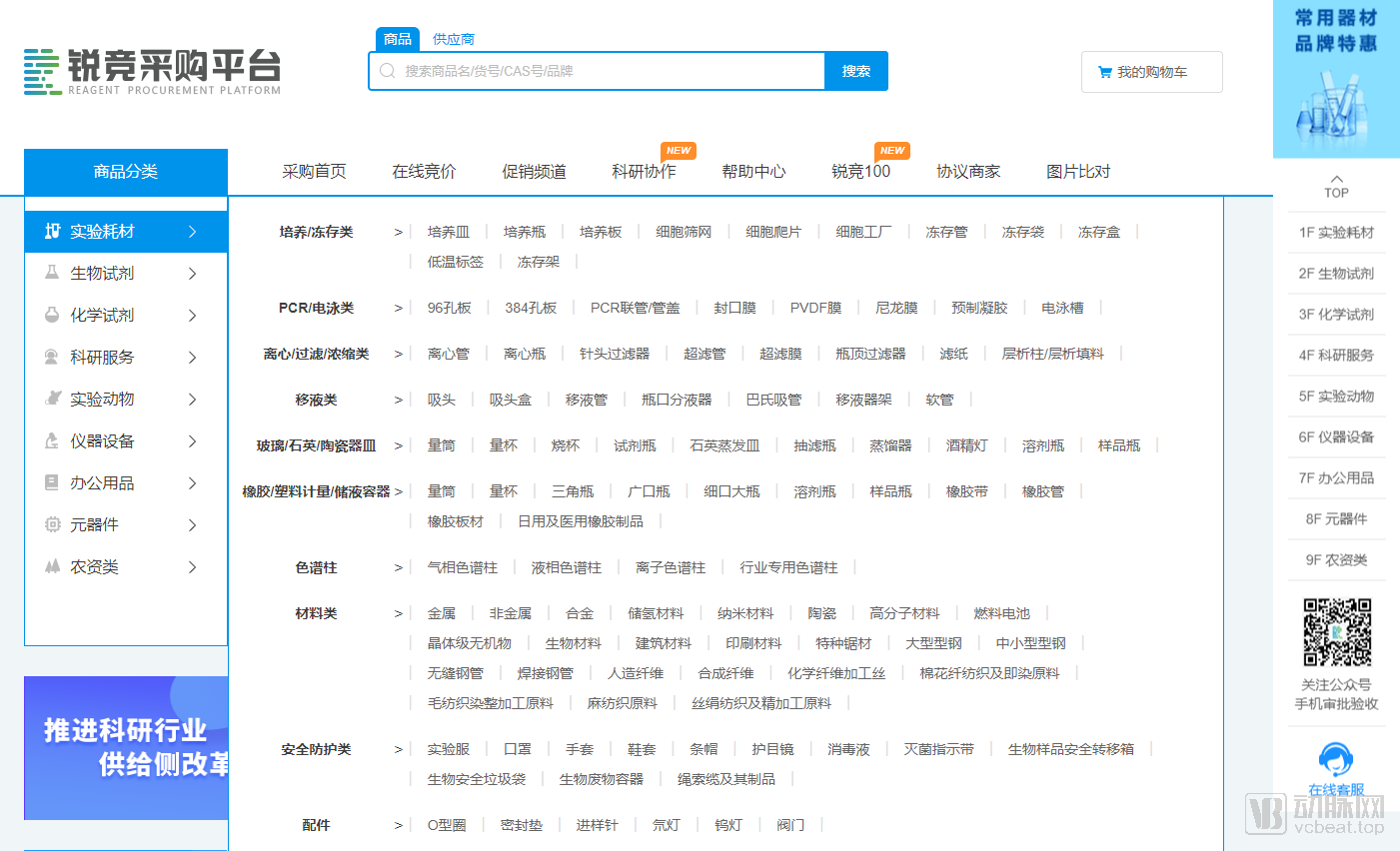
Screenshot of Ruijing Procurement Cloud Platform
The enormous demand has attracted a large number of suppliers. After rigorous qualification reviews to eliminate the inferior and retain the superior, there are already from across ChinaOver 10,000The supplier has joined the Ruijing Procurement Platform and listed products.Over 15 millionRelated products.Product categories include scientific research reagents and consumables, scientific research services, laboratory animals, office supplies, instruments and equipment, electronic components, and more.Ruijing aims to facilitate healthy competition among suppliers, enabling researchers to conveniently purchase high-quality, cost-effective reagents and consumables.
“Our platform has made the pricing mechanism for relevant products more transparent, eliminating the price fraud that some suppliers may have engaged in previously. Some suppliers told us that their profit margins on these products used to be around 30%, but now they are only about 15%. However, from another perspective, suppliers are not at a loss. By using the Ruijing Procurement Platform, they have reduced transaction costs to some extent and increased sales volume,” said Ren Jian.
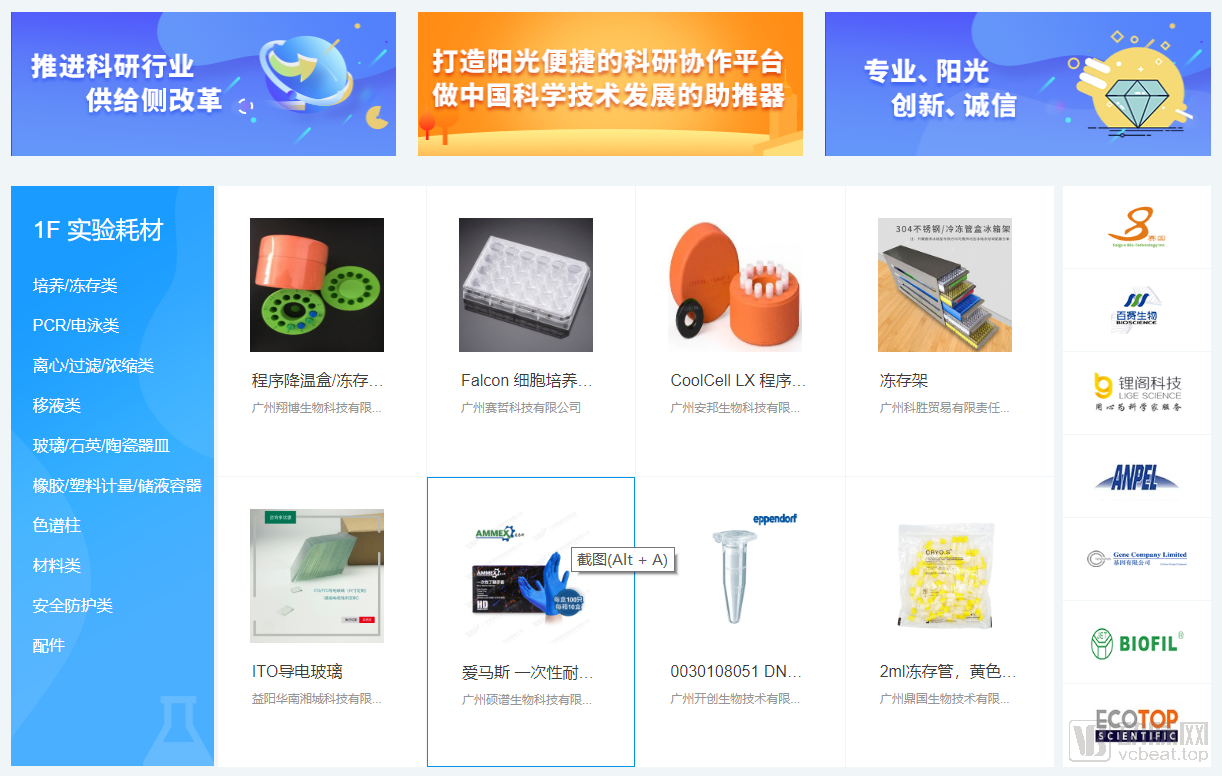
Screenshot of Ruijing Procurement Cloud Platform
Ruijing Procurement Platform has effectively reduced the procurement costs of scientific research consumables. However, the procurement platform is not the company's core. What sets Ruijing apart from its competitors is its backend management system.
In addition to opaque pricing mechanisms, traditional procurement methods for medical consumables often suffer from the following pain points:
1. The traditional approval process is cumbersome, requiring signatures and approvals from multiple responsible parties for each procurement; as a result, procurement personnel often take 6–9 months to complete the entire workflow from procurement and approval to reimbursement;
2. Due to the low volume and high frequency of purchases for scientific research consumables, researchers are required to frequently visit their respective finance departments to reimburse purchase orders. This cumbersome reimbursement process consumes a significant amount of their valuable time;
3. Since research funding has an overall procurement budget, decentralized offline purchasing lacks budgetary control, often resulting in budget overruns and difficulties for procurement personnel in obtaining reimbursements;
4. Scientific research consumables are classified as expendable goods; their consumption patterns are often opaque, leading to gray areas during the acceptance inspection phase, with many delivery receipts being falsified;
To address the aforementioned pain points, Ruijing has made significant efforts in designing its backend management system, providing effective solutions.
Previously, the procurement approval process was protracted, primarily because purchase orders required signatures and approval from multiple leaders before reimbursement could be processed. On average, research institutions required 4–5 levels of approval, with some cases requiring up to 9 levels. If a leader was traveling abroad, the approval process would be temporarily suspended, resulting in low approval efficiency.Ruijing implements an all-electronic approval system, utilizing electronic signatures to replace paper-based ones, thereby eliminating geographical and temporal constraints on the approval process.
This type of electronic signature, notarized by a third party, holds the same legal validity as a handwritten signature. By simply following Ruijing’s official WeChat account, all approval notifications from hospitals and universities can be handled directly via the mobile WeChat app.
The approval-to-reimbursement process, which previously took anywhere from 6 to 9 months, can now be completed in under two months.Suppliers also benefit, as the streamlined reimbursement process shortens capital turnover time.
Ruijing’s consolidated settlement feature addresses the pain points of frequent procurement and reimbursement faced by researchers.The Ruijing backend management system automatically generates a monthly procurement summary statement for each supplier. Based on this statement, the supplier issues a single consolidated invoice. At the beginning of the following month, the supplier mails both the settlement statement and the invoice to the finance department of the research institution to complete the reimbursement process. Consequently, researchers no longer need to devote significant time and effort to handling reimbursements at the finance office, while the number of invoices processed monthly by the finance department has been reduced to one-fifteenth of the previous volume, thereby minimizing time costs for both parties.
Regarding the budget overruns in scientific research procurement,Ruijing achieves strict budget control by integrating with the financial systems of research institutions to freeze funds already utilized for corresponding purchase orders.When a purchaser places an order, Ruijing instantly verifies whether sufficient funds are available in the associated financial system. If funds are adequate, Ruijing freezes the corresponding amount upon successful order placement. The funds remain frozen until the purchaser completes the reimbursement process, at which point Ruijing releases the hold. This mechanism effectively prevents procurement budget overruns.
Regarding the gray areas in the acceptance process, Ren Jian stated,Ruijing has designed a management model of “photo-based acceptance + random inspection and supervision” to prevent fraud.“After procurement personnel initiate a purchase on the platform, it requires online approval from the budget manager. Only after the approval is granted will the supplier see the corresponding order. When the procuring staff accepts the goods, the inspector will take photos and upload them. Research institutions may assign personnel to conduct irregular spot checks, with a typical sampling rate of around 1%.” This model effectively prevents fraud in the acceptance process.
Moreover, unlike some traditional university IT software that is always deployed locally on campus,The Ruijing Procurement Platform is deployed on Alibaba Cloud.. The advantages of deployment on a cloud platform are evident in that, during system iterative upgrades, it is not necessary to perform maintenance for each individual institution as required by on-premises systems; instead, a single upgrade can be applied to all user systems simultaneously. This approach significantly reduces upgrade and maintenance costs.
Unlike most businesses that were adversely affected by the pandemic, the outbreak has, to some extent, boosted the development of Ruijing. Due to the pandemic, most universities and hospitals across China typically implemented closed-off management policies, prohibiting suppliers from entering their premises, which disrupted offline procurement for researchers. Under these circumstances, Ruijing launched“Contactless Procurement”The program is highly popular.
Through collaborations with universities and hospitals, Ruijing has establishedDistribution Station. External suppliers deliver goods to the distribution station, where designated personnel then transport them into the school campus. This approach avoids direct contact between researchers and external suppliers, thereby facilitating more efficient management of universities and hospitals during the pandemic.
Regarding its operational model, Ruijing has its own unique approach.
First, Ruijing established connections with local benchmark research institutions, and then leveraged their influence to reach surrounding research users, thereby achieving rapid promotion of the procurement platform.
Secondly, Ruijing has maintained a close partnership with the Research Management Industry Association. The two parties have consistently engaged in friendly exchanges at various conferences and events, establishing a strong collaborative relationship. As a result, Ruijing has significantly expanded its influence.
Ruijing also leverages internet-centric thinking to drive traffic to its procurement platform by continuously launching SaaS products that address high-frequency needs. In addition to introducing popular scientific image comparison tools, Ruijing has launched mobile-based laboratory safety inspection tools and hazardous chemical management solutions, effectively attracting its target user base.
Amid the increasingly tense international landscape in recent years, entrepreneurs like Ren Jian have been sparing no effort to promote the development of domestic innovative technologies. Currently, Ruijing is formulating its next strategic plan by leveraging its multi-party collaborations with government agencies, universities, hospitals, and enterprises. Ruijing aims to build a platform for translating scientific research achievements by bridging these stakeholders, thereby accelerating the commercialization of research outcomes and driving national economic growth.