

Hangzhou Huoshu Technology Files IPO Prospectus Amid Remarkable Achievements in DRG Pilot Zones with Its MDT-Style System Solution
Currently, the National Healthcare Security Administration’s CHS-DRG system is being piloted in 30 cities and is scheduled for nationwide rollout across China in 2021. Against the backdrop of DRG implementation, what challenges and opportunities will hospitals face, and how should they respond?? How can hospitals strike a balance between medical quality and efficiency, and how can they unleash greater momentum for management transformation?Zhejiang Province, as a pioneer in the DRG pilot program, has accumulated several years of experience since its inception. Its explorations in the DRG payment reform pilot may offer us some answers.
Leading the Trend of the Times: Zhejiang Province Takes the Lead and Assumes Responsibility in DRG Payment Reform
Although Zhejiang Province’s DRG reform began in 2015, the actual payment reform did not commence until 2016. In that year, the healthcare security authorities in Jinhua City, Zhejiang Province, spearheaded the local deployment of a DRG pilot program, launching a trial of “diagnosis-related group point-based” payment for basic medical insurance. Unlike the province-wide DRG performance evaluation in Zhejiang at the time, the Jinhua DRG pilot focused primarily on healthcare payment reform.
After three years of pilot implementation, Jinhua City effectively controlled the growth rate of its medical insurance fund expenditures, stimulated the endogenous motivation of medical institutions and physicians to control healthcare costs, and enhanced medical service capabilities. This achievement attracted nationwide attention. In 2019, Jinhua was designated by the national government as a pilot city for reforming the Diagnosis-Related Group (DRG) payment system in medical insurance. Subsequently, Quzhou, Taizhou, and Wenzhou also rolled out DRG payment reforms.
In November 2019, Zhejiang Province issued the Interim Measures for Diagnosis-Related Groups (DRG) Point-Based Payment of Basic Medical Insurance Inpatient Expenses in Zhejiang Province, stipulating that starting from January 1, 2020, all designated medical institutions under the province’s basic medical insurance scheme would uniformly implement DRG-based payment combined with a point system under global budget management. With this move, Zhejiang Province has become a well-deserved pioneer in the wave of DRG payment reform.
The rapid nationwide promotion of DRG is driven by the severe challenge of persistently high expenditures from China’s medical insurance fund. Taking Zhejiang Province, a pioneer in DRG implementation, as an example: in 2019, the year-on-year growth rate of revenue for the employee basic medical insurance fund was only 4.2%, while expenditure grew by 12.3%; for the resident basic medical insurance fund, revenue increased by just 4.6% year on year, whereas expenditure rose by 10.3%.
The growth rate of medical insurance expenditures far exceeds that of revenues, and the accelerating trend of population aging has placed immense pressure on medical insurance funds. In 2019, among the 71 pooling areas for employee basic medical insurance funds in Zhejiang Province, 15 reported current-period deficits; among the 73 pooling areas for urban and rural resident basic medical insurance funds, as many as 35 recorded current-period deficits. Short-term imbalances in medical insurance funds have become the norm.
In fact, as a historically affluent region in China, Zhejiang Province enjoys a relatively optimistic status of its medical insurance fund compared to the national average. The state of medical insurance funds in economically less developed regions can only be imagined. It is precisely for this reason that China urgently needs to reform its payment methods to improve the performance of medical insurance fund utilization and achieve stable and sustainable development of the fund.
DRG imposes high requirements on the informatization infrastructure of hospitals. Among the six conditions explicitly outlined in the *Technical Specifications for DRG Grouping and Payment under the National Healthcare Security Administration* that must be met for DRG payment implementation, three are closely related to informatization: standardization of basic codes, compliance of medical record quality, and interoperability of information systems. However, data-centric informatization represents precisely the most significant weakness for hospitals. The role that healthcare informatization enterprises will play in the DRG payment reform is thus self-evident.
Among them, Hangzhou Huoshu Technology Co., Ltd., which is highly active in Zhejiang Province—a pilot region for Diagnosis-Related Groups (DRG)—is undoubtedly a key player. As a local enterprise in Zhejiang, Huoshu Technology was founded in 2016 and has been in operation for just five years. Nevertheless, its hospital-side DRG products have gained widespread recognition from healthcare institutions. To date, its Multidisciplinary Team (MDT)-style system solutions for hospitals have been implemented in more than 100 hospitals across DRG pilot regions, including Zhejiang, Guangdong, Jiangsu, and Anhui provinces.
Notably, Huoshu Technology has achieved comprehensive coverage across all prefecture-level cities in Zhejiang Province. “Everyone in the healthcare IT industry knows that any company capable of succeeding in Zhejiang must be exceptional, given the intense competition and exceptionally high standards there,” said Zhang Wei, CEO of Huoshu Technology. He firmly believes that Huoshu’s successful practices in Zhejiang can be replicated nationwide, helping tens of thousands of hospitals across China smoothly advance their development under the DRG payment reform.
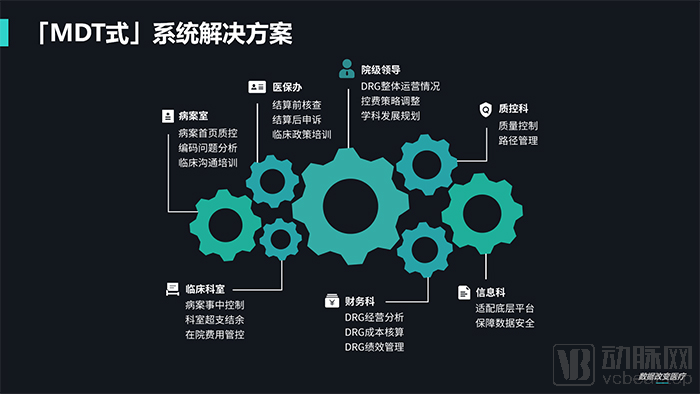
Huoshu MDT-Style System Solution Architecture Diagram
The MDT (Multidisciplinary Team) system solution is a concept first introduced by Huoshu and stands as one of the most distinctive features of its hospital-side DRG products. Grounded in the philosophy of multi-departmental collaboration, Huoshu’s MDT-style system solution seamlessly integrates in-hospital process management with post-discharge operational analysis. It offers six core functional modules: DRG grouping, inpatient DRG management, intelligent operational analytics, health insurance settlement management, medical record homepage quality control, and DRG clinical pathway management. This solution enables precise, coordinated actions among hospital leadership, clinical departments, medical records offices, health insurance offices, finance departments, IT departments, and quality control departments, thereby providing one-stop empowerment for refined hospital management.
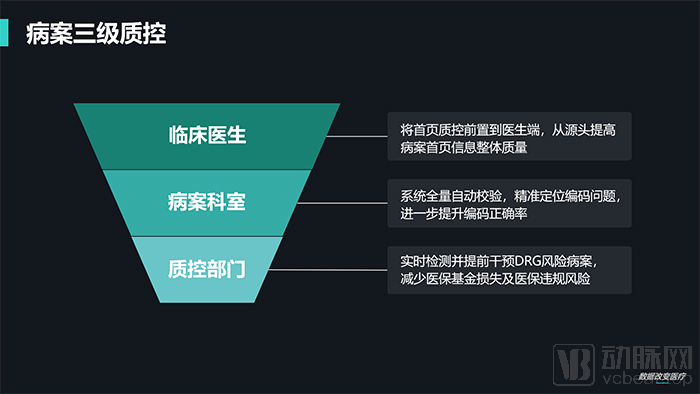
Three-Tier Quality Control System for Medical Records
Focusing on the medical record front sheet—the most critical component of DRG-based payment—Huoshu’s MDT-style system solution provides a three-tier quality control framework involving clinicians, the medical records department, and the quality control department. This approach shifts quality control of the medical record front sheet to the physician interface, ensuring data quality at the source. Additionally, it introduces intelligent algorithms to build a diagnostic omission identification model, further improving coding accuracy. Meanwhile, the system enables real-time detection and proactive intervention for DRG-risk cases.
Following the introduction of CHS-DRG, the medical insurance settlement list will replace the former role of the medical record front sheet. Huoshu has also keenly identified new avenues for optimization and will implement targeted improvements in the future to address the specific characteristics of the medical insurance settlement list (such as the adoption of the medical insurance version of disease classification and surgical procedure codes, and the emphasis on healthcare resource consumption), thereby ensuring a seamless transition for hospitals when switching to CHS-DRG.
Real-time pre-grouping functionality leverages rule engines, natural language processing (NLP), and correlation analysis to minimize the impact of DRG rules on physicians’ electronic medical record (EMR) documentation habits, shifting the completion of core grouping information to the inpatient period. Integrated with phased cost management, the solution divides the hospitalization process into distinct diagnostic and treatment stages and provides benchmark cost ranges by cost structure to serve as a reference for physicians.
Intelligent monitoring and early warning systems can provide real-time, comprehensive tracking of more than 20 DRG operational indicators. By delivering role-specific alerts for cases with abnormal costs, atypical clinical presentations, or elevated core management metrics, these systems help mitigate the risk of cost overruns associated with such outlier cases.
Settlement management enables the pre-settlement verification of cases with inconsistent grouping before and after coding, ensuring that uploaded case data is compliant and reasonable. In the event that an appeal to medical insurance authorities is required, the management tool provides an automated appeal collaboration feature that automatically organizes and directly queries relevant information, facilitating the rapid screening and identification of anomalous cases to enable efficient multi-departmental online collaborative handling of appeals.
At the core of all these functionalities lies the algorithm, which Zhang Wei considers to be the area where Huoshu, a company founded on data expertise, excels most. “All intelligent judgments are fundamentally based on algorithms, such as medical record quality control, in-hospital prediction, and real-time analysis of hospital data. Therefore, our company’s personnel composition and R&D intensity differ essentially from those of other companies. Nearly all of our staff are data analysts and algorithm engineers, with R&D investment accounting for 70% of total expenditure, thereby ensuring the goal of ‘using one generation, developing the next, and pre-researching the subsequent generation.’”
Automatic medical record coding holds significant importance for Diagnosis-Related Groups (DRGs), as it can substantially reduce the workload in the coding process. However, implementing this technology is challenging, primarily for two reasons. First, the quality of underlying hospital data is poor, with considerable variability in how individual physicians document medical records. Second, due to the high variability and complexity of the Chinese language, Natural Language Processing (NLP) word segmentation is far more difficult than in English. Leveraging its extensive experience in healthcare Business Intelligence (BI) data center operations, Hangzhou Huoshu Technology Co., Ltd. has accumulated substantial expertise in this area and is collaborating with experts to develop intelligent algorithms, including automated coding algorithms.
“Although this is our line of work, we never hype up concepts like artificial intelligence. The healthcare sector requires long-term, steadfast dedication, so we prioritize practical implementation above all else. Only with precise data can we deliver tangible value to hospitals. In pilot regions such as Zhejiang Province, where these solutions have been implemented for approximately three years, the results are relatively easy to observe. Currently, among the hospitals we have served, both within and outside Zhejiang Province, we can basically ensure that they have turned from loss-making to profitable, even amid increasingly stringent regulatory policies.” As a tech enthusiast with a touch of perfectionism, Zhang Wei believes that concepts are less important than the practical outcomes of implementation, which are what hospitals urgently need. This is precisely the established fact that Huoshu has repeatedly validated across nearly one hundred hospitals.
Remarkable Achievements: DRG Pilot Zones Forge an Innovative Path for China’s National DRG Reform
The lean management driven by DRG has been intuitively demonstrated through data comparisons. At the 14th Annual Conference of Chinese Hospital Presidents, held in Xiamen from September 25 to 27, 2020, pioneering hospitals from DRG pilot regions such as Zhejiang Province showcased the practical outcomes of DRG pilot reforms, with the majority having already implemented Huoshu’s MDT-style system solutions.
The Second Affiliated Hospital of Zhejiang University School of Medicine (hereinafter referred to as “SAHZU”) is a leading hospital in Zhejiang Province, consistently ranking among the top tier nationwide in both service capacity and medical quality. SAHZU ranks fifth in China on the Nature Index Global Top 100 list for healthcare institutions. Its number of surgeries per bed and total surgical volume lead the country; notably, its total surgical volume and Case Mix Index (CMI) rank first within Zhejiang Province.
To respond to the DRG payment reform, The Second Affiliated Hospital of Zhejiang University School of Medicine (SAHZU) proposed an internal “Efficiency Healthcare” reform. This initiative promotes reform through integrated coordination across pre-hospital, in-hospital, and post-hospital stages, and has introduced Huoshu’s MDT-style system solution to support the transformation. Over the past year, SAHZU has achieved remarkable results in its DRG reform.
The proportion of drug revenue to total revenue continued to decline, dropping from 35.07% in 2018 to 30.91% in 2019, and further decreasing to 28.51% from January to August 2020. Meanwhile, the share of medical service revenue steadily increased, rising from 26.89% in 2018 to 29.41%. This has significantly optimized the overall structure of medical revenue. The average length of hospital stay also saw a notable reduction. In 2018, the average length of stay at the Second Affiliated Hospital of Zhejiang University School of Medicine was 6.76 days; it dropped substantially to 6.09 days in 2019 and further decreased to 5.74 days from January to August 2020, breaking below the six-day threshold.
Zhejiang Taizhou Enze Medical Center (Group) (hereinafter referred to as “Taizhou Enze Medical Center”) is a leading hospital among prefecture-level hospitals in China and a pioneer in lean hospital management domestically. It was an early adopter of Huoshu’s MDT-style system solution to implement DRG-based lean management. This has enabled Taizhou Enze Medical Center to deliver medical services on par with provincial tertiary Grade A hospitals. In the DRG performance evaluation of tertiary Grade A hospitals in Zhejiang Province, the Case Mix Index (CMI) of Taizhou Hospital, under Taizhou Enze Medical Center, reached 0.9992, ranking second in Zhejiang Province, just behind The Second Affiliated Hospital of Zhejiang University School of Medicine.
Particularly in clinical pathway management, the DRG information system has provided substantial benefits to Taizhou Enze Medical Center. By integrating phased DRG grouping costs and cost control based on cost structure, cost containment within clinical pathways can be achieved. Clinical pathway analysis enables evaluation of pathway implementation and its impact on DRG costs. Furthermore, clinical pathway optimization assesses whether pathways adhere to DRG cost-containment principles and optimizes them by incorporating DRG performance data and factors influencing DRG costs.
“We began implementing clinical pathways in 2004, and we were among the first batch of clinical pathway pilot sites established by the former National Health and Family Planning Commission. Effective implementation of these pathways provides a tangible foundation for your DRG pilot management. By adjusting and optimizing the pathways, we can identify where costs are incurred. Currently, Huoshu’s system integrates clinical pathways by incorporating node-based pathway management into cost control. This combination provides an additional analytical tool for pathway optimization.” As one of the earliest experts in China to implement lean hospital management, Chen Haixiao, Director of Taizhou Enze Medical Center, has a profound understanding of the role of clinical pathways.
Final Thoughts
Overall, the DRG reform is a crucial component in realizing the Healthy China strategy. It exerts a significant impact on medical quality management and hospital operations, presenting new challenges to current hospital management and operational models while imposing higher requirements for refined hospital management. Naturally, this also raises the bar for hospital informatization capabilities, requiring IT enterprises to “help basic medical insurance save costs, facilitate the implementation of commercial health insurance, and make healthcare more affordable for the general public.” This is also Zhang Wei’s vision for the future of Huoshu Technology.
Based on practical experience from DRG pilot regions such as Zhejiang Province, the reform of the Diagnosis-Related Groups (DRG) system has led to varying degrees of improvement in hospital medical quality and informatization levels, along with a significant reduction in medical costs. Using DRGs as an evaluation metric helps hospitals leverage their strengths, identify weaknesses, thereby improving their management systems and achieving refined hospital management.
References
VBInsight: “Behind the Launch of Zhejiang’s DRG System: A Province’s Journey of Experimentation, Negotiation, and Choice in Health Insurance Payment”
Zhejiang Provincial Healthcare Security Administration: “Director Yang Ye Interprets the Top-Level Design of Policies for Promoting DRG Point-Based Payment Reform Across the Province”
Chen Haixiao: “DRG: Impact on Medical Practices”