

China Pacific Insurance Builds a Big Data-Powered Moat to Safeguard the Stable Operation of Medical Insurance Funds
As the “lifeline” for the public, fluctuations in the revenue and expenditure of the basic medical insurance fund are a constant source of public concern.
According to statistical data released by the Ministry of Human Resources and Social Security and the National Healthcare Security Administration, medical insurance revenue reached RMB 968.7 billion in 2014, while expenditures amounted to RMB 813.4 billion. In the subsequent years, pressure on the medical insurance system continued to mount. By 2018, the growth rate of medical insurance expenditures had reached 22.08%, surpassing the 17.61% growth rate of revenue. This marked the first time that the expenditure growth curve crossed above the revenue growth curve. This trend indicated that, if left unchecked, medical insurance expenditures would exceed revenue by 2023, resulting in a deficit in the operation of the medical insurance fund.
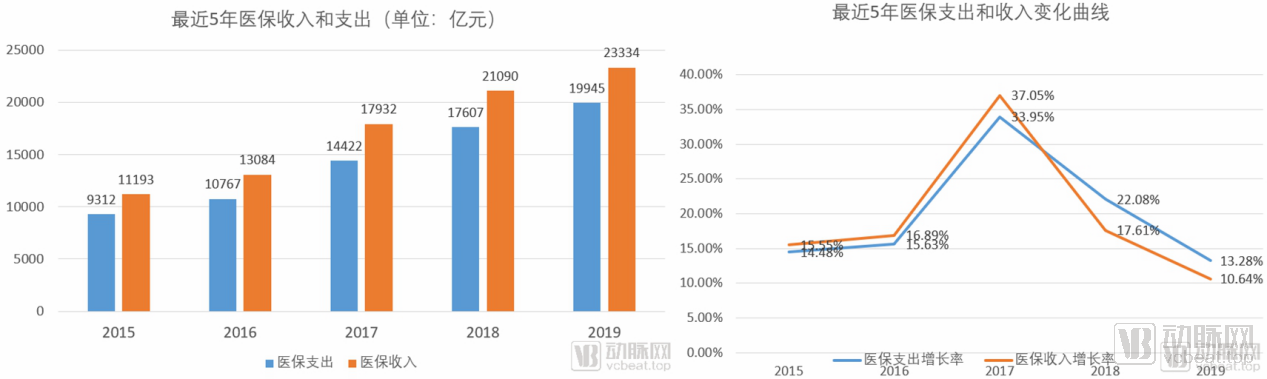 (Revenue and Expenditure of Medical Insurance)
Confronted with the predicament of the medical insurance fund, the National Healthcare Security Administration (NHSA) was entrusted with a critical mission in a time of crisis. Established on May 31, 2018, the NHSA has made the supervision of medical insurance funds a primary mandate. Prior to its establishment, medical insurance funds were subject to illegal fraud and waste. Since its inception, the NHSA has standardized the operation of these funds through a series of measures, including cracking down on fraudulent claims and streamlining channels for reporting violations.
According to the “2019 Statistical Bulletin on the Development of Medical Security Undertakings” released by the National Healthcare Security Administration, medical security departments at all levels conducted on-site inspections of 815,000 designated medical and pharmaceutical institutions in 2019, and investigated and dealt with 264,000 medical and pharmaceutical institutions found in violation of laws, regulations, or contractual agreements.A total of RMB 11.556 billion was recovered throughout the year.. The practical needs of anti-fraud efforts in medical insurance and the stable operation of the fund make it imperative to innovate methods for supervising medical insurance funds.
Regarding the regulatory approaches for medical insurance funds, they can be divided into three phases.
Prior to 2010, the regulatory approach relying primarily on manual on-site inspections characterized Era 1.0 of medical insurance fund supervision. After 2010, the approach centered on information-based supervision marked Era 2.0 of medical insurance fund supervision. Since 2015, the utilization of big data and artificial intelligence as primary regulatory tools has defined Era 3.0 of medical insurance fund supervision.
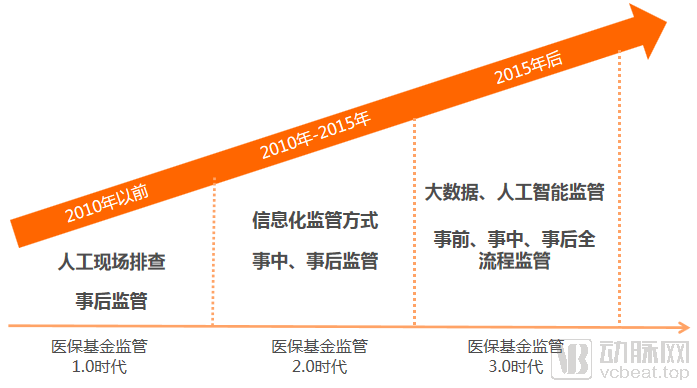
(Development and Changes in the Supervision Methods of Medical Insurance Funds)
Prior to 2010, the supervision of medical insurance funds was in its 1.0 era. During this phase, regulatory authorities typically employed methods such as random sampling and manual on-site inspections for oversight. However, manual audits suffered from drawbacks including low coverage, inefficiency, heavy workload, difficulties in recovering misused funds, and prolonged verification cycles, resulting in limited effectiveness in controlling medical insurance expenditures.
Around 2010, with the advancement of internet technology and informatization, local medical insurance departments began piloting the use of information-based tools, ushering in the 2.0 era of medical insurance fund supervision. Compared to manual oversight, this informatized approach significantly improved audit efficiency. However, issues such as drug abuse, falsified medical records, and fraudulent claims remained prevalent, and post-hoc recovery of funds continued to pose significant challenges. Consequently, medical insurance authorities have continued to explore more innovative and rational regulatory mechanisms.
After 2015, technologies such as big data and artificial intelligence were gradually applied in the healthcare sector, providing new approaches to intelligent monitoring of medical insurance and ushering in the 3.0 era of medical insurance fund supervision. The application of big data and artificial intelligence has shifted the key focus of medical insurance fund supervision to “intelligent and refined regulation, real-time dynamic monitoring, and whole-process oversight of medical insurance.” Leveraging big data and artificial intelligence, regulatory authorities have strengthened their capabilities in identifying violations, recovering funds, and imposing penalties.
Over the years, medical insurance supervision methods have developed rapidly, but they also face more urgent demands. Due to demographic changes, improvements in healthcare standards, and the rapid iteration of various new diagnostic and treatment projects and techniques, the pressure of an imbalance between income and expenditure of the medical insurance fund is growing. There is an urgent need for real-time monitoring and trend forecasting of the balance of medical insurance fund revenues and expenditures to support the coordinated allocation of medical insurance resources.
This work involves a high barrier to professional expertise. Experts from Pacific Health Management Co., Ltd. (hereinafter referred to as “Pacific Health”) stated: “First, medical insurance policies, enrollment levels, and reimbursement scopes vary significantly across different regions in China, leading to substantial differences in the focus of medical insurance fund supervision and considerable local heterogeneity. Second, medical insurance data is deployed in a decentralized manner; there are professional and technical barriers to the integration, interconnection, and sharing of massive datasets, including enrollee data, revenue and expenditure statistics, and hospital data. Third, the combined implementation of various policies has a direct impact on fund operations. Policymakers and regulatory authorities must engage in comprehensive planning to accurately and effectively quantify both the immediate and long-term effects of policy changes on the operation of medical insurance funds.”
On February 26, 2019, the National Healthcare Security Administration issued the “Notice on Doing a Good Job in the Supervision of Medical Security Funds in 2019,” emphasizing the launch of pilot programs for innovative supervision methods, actively engaging third-party entities, and leveraging information technology to build a big data-driven intelligent system for monitoring medical expenses.
Against this backdrop, Pacific Health Insurance, as the specialized subsidiary of China Pacific Insurance (CPIC) in the healthcare sector, has entered the field of innovative supervision of medical insurance funds, leveraging CPIC’s 23 years of accumulated experience and risk control advantages in serving national healthcare reforms and administering basic medical insurance programs.
Pacific Health Insurance has given multiple considerations to the development of a big data risk control platform for the operation of medical insurance funds.
A representative from Pacific Health Insurance stated, “Coordinating the development of big data infrastructure for medical insurance and centralizing medical insurance data within a unified architecture, followed by systematic development in accordance with relevant rules, will facilitate rational design for future fundraising, risk control, and expenditure of medical insurance funds. This approach will effectively enable medical insurance funds to fulfill their role in safeguarding and serving people’s livelihoods.”
For many years, China Pacific InsuranceComprehensively Participate in the Construction of China’s Multi-Tiered Healthcare Security System Through an “Insurance + Services + Technology” ModelAs of now, China Pacific Insurance (CPIC) is administering more than 260 government-collaborative health insurance projects across 26 provinces and municipalities and over 90 regions. A representative from Pacific Medical Health stated that health insurance administration is evolving from a “traditional cashier-style” model to a “stewardship-oriented” service model. This transition places higher demands on refined management of health insurance administration and intelligent supervision of health insurance funds. Cost containment and regulatory oversight of these funds are inherent requirements for effective health insurance administration, aligning closely with the objectives of health insurance fund management authorities.
Meanwhile, the application of big data enables commercial health insurance and basic medical insurance to extend their synergy in areas such as risk control and services, jointly promoting the development of a multi-tiered medical security system. Based on unified rule engines and big data models, claims adjudication for both basic medical insurance and commercial insurance will become more precise and intelligent. Furthermore, in-depth analysis of basic medical insurance data will deliver long-term value to commercial insurers in product development, pricing, and optimization of claims rules.
For Pacific Health Insurance, developing a big data risk control platform for the operation of medical insurance funds serves three purposes at once: meeting the practical needs of medical insurance administration, unlocking the potential technical value to empower commercial health insurance, and fulfilling the social mission of safeguarding public welfare.
With over two decades of experience in administering medical insurance programs, China Pacific Insurance (CPIC) has enabled Pacific Medical Health to develop a profound understanding of government-led medical insurance management, policy interpretation, and fund supervision requirements. This background grants Pacific Medical Health an inherent advantage in the intelligent supervision of medical insurance funds.
In the field of big data research and development, Pacific Health Insurance continues to innovate in its applications. It is reported that Pacific Health Insurance has completed a total of 192 data technology projects, covering 26 provinces and 45 regions across China. The company has independently developed more than 50 data models, 34 of which have received intellectual property certification. In addition, Pacific Health Insurance actively engages in exchanges and collaborations with research institutions and specialized technical companies, integrating resources, talent, and technological advantages to strengthen innovation.
“By further leveraging the technical expertise that China Pacific Insurance (CPIC) has accumulated over the past two decades, we aim to provide comprehensive solutions for government supervision of medical insurance funds, thereby delivering greater social value in serving the government and improving public welfare.” Supported by strategic considerations and inherent advantages, Pacific Medical Health has developed a big data risk control platform for medical insurance fund supervision.
The Big Data Risk Control Platform for Medical Insurance Fund Operations has innovatively developed nearly 500 indicators, enabling real-time monitoring, dynamic early warning, precise forecasting, and decision support through visualized charts. It monitors the dynamics of medical insurance funds in real time, analyzes and predicts their future development, assists administrative departments in making scientific decisions, and promotes a more scientific, refined, and intelligent approach to medical insurance fund management, thereby building a “moat” to ensure the stable operation of medical insurance funds.
In terms of real-time monitoring, the Big Data Risk Control Platform for Medical Insurance Fund Operations conducts real-time monitoring of fund revenue, expenditure, and balance at macro, meso, and micro levels. Management personnel can drill down through the indicator system layer by layer to precisely pinpoint risk areas, thereby achieving real-time monitoring and early warning of key metrics such as the number of months of fund solvency and the status of revenue, expenditure, and balance.
In terms of dynamic forecasting, Pacific Health Care leverages multidisciplinary algorithms—including exponential regression fitting, time series fitting, multiple linear regression, and decision tree fitting—to conduct in-depth modeling and analysis on billions of data sets. Based on the dynamic forecasting model for fund revenue, expenditure, and balance, it projects the development trends of fund income, expenses, and surplus over the next five years, thereby assisting medical insurance authorities in risk management and control.
In terms of decision support, Pacific Health quantifies policy adjustment factors into structured policy parameters. The head of the Pacific Health Big Data Laboratory stated, “General predictions of medical insurance funds are typically based on historical expenditure data; however, such expenditures are heavily influenced by policy changes. Any shift in policy can lead to significant deviations in these forecasts.”Therefore, the big data risk control platform for medical insurance fund operations allows administrators to independently input policy parameters based on pre-established predictive models. The platform then forecasts total future healthcare expenditures and trends using model algorithms and these policy parameters, thereby enhancing the accuracy of medical insurance fund expenditure projections. This supports scientific decision-making by medical insurance authorities and facilitates the rational pooling and management of medical insurance funds.
Currently, this innovatively developed big data risk control platform for the operation of medical insurance funds has been deployed and launched in Quzhou, Zhejiang Province. In 2019, Quzhou was designated by the National Healthcare Security Administration as one of the demonstration sites for intelligent monitoring of medical insurance. This August, the National Healthcare Security Administration conducted an interim on-site evaluation of the construction progress at 17 demonstration sites, with Quzhou’s demonstration site ranking among the top.
Pacific Healthcare has stated that it will leverage its R&D capabilities in healthcare big data and its extensive experience in government collaborative projects to broaden the application scenarios of big data. By continuously integrating and maximizing its advantages in resources, talent, and technology, the company aims to build differentiated competitive strengths through data-driven strategies, thereby serving public welfare and contributing to society.
References:
VCBeat: A Decade of New Healthcare Reform: Reviewing the Four Major Shifts in the Evolution of Medical Insurance Cost Containment