

Masimo: The Quiet Medical Tech Giant Behind the Wearables Patent Wars with Apple, Samsung, and Google
Masimo
Developer, Manufacturer, and Seller of Medical Monitoring Instruments
In early 2020, Apple Inc. was sued by a medical technology company for allegedly infringing upon the company's patent rights and trade secrets.Like a stone thrown into water, causing ripples far and wide: while some “Apple fans” have voiced their indignation on behalf of Apple Inc., the vast majority of the public is eager to know what kind of company could possibly embroil Apple in allegations of “patent infringement.”
And even before this lawsuit, another industry giantPhilips was ordered to pay a $466 million fine in a patent infringement lawsuit against this company in 2014.
Compared with such an impressive track record, the company’s public profile is far more understated. It is Masimo (NASDAQ: MASI), headquartered in California, United States.
Masimo, founded in 1989, is dedicated to the development and manufacturing of leading monitoring technologies and devices for the healthcare industry, including measurement instruments, sensors, pulse oximeters, patient monitors, and automated equipment.Over its 30-plus years of development, how has Masimo grown into today’s “hidden champion” of the industry? What core technologies has it mastered that have enabled it to repeatedly go head-to-head with industry giants?
What did Masimo sue Apple for?
The latest development is that Masimo filed a document with the court on the evening of September 21,The document states that Apple is attempting to delay the lawsuit alleging that its latest Apple Watch infringes on Masimo’s blood oxygen monitoring technology.Masimo believes that Apple's delay is intended to sell more Apple Watches, thereby gaining a larger share in the smartwatch market.
On September 15, 2020, Eastern Time, Apple released the Apple Watch Series 6, with blood oxygen monitoring as one of its key features. Interestingly,In January 2020, Masimo sued Apple, alleging that the company stole trade secrets and poached key employees by promising to establish a working relationship with Masimo., including the former Chief Medical Officer of Masimo and the former Chief Technology Officer of Cercacor.
To date, Apple has not issued a formal response to these allegations; instead, it has actively petitioned the court to dismiss the case. Furthermore, Apple recently filed a request with the United States Patent and Trademark Office (USPTO) seeking to invalidate Masimo’s patents. Additionally, pending the resolution of these matters, Apple has asked the trial court to continue staying the civil litigation.
What Sparked This “War,” and How Will It Unfold?In the healthcare industry, patents confer market exclusivity in the pharmaceutical sector, while in the medical device sector, patented technologies often establish high barriers for competitors.
In court filings, Masimo CEO Joe Kiani stated, “I have seen reports from consumers and others indicating that the Apple Watch Series 6 is being used as a medical device. This practice not only harms consumers but also affects sales of our genuine clinical-grade products.” It is evident thatThe ongoing patent dispute has already impacted the market sales of both companies' products.
So, do patents related to technologies such as blood oxygen monitoring constitute infringement? Why does Apple place such significant emphasis on this technology? According to court filings, among the 10 Masimo patents allegedly infringed by Apple, some pertain to methods for measuring blood oxygen levels and heart rate using light emitters and detectors, whileLight-based non-invasive monitoring technology is key to Apple overcoming the performance issues of the Apple Watch.
This is not the first time Apple has faced allegations over similar conduct. In August, a New York cardiologist accused Apple of failing to pay him royalties for the use of monitoring-related technology that provides notifications of irregular heartbeats.
What are Masimo’s unique advantages in this technology?
In the global field of non-invasive blood oxygen monitoring, Masimo is the undisputed industry leader, a position attributable to its more than 30 years of dedicated expertise.
MorningIn 1995, Masimo launched Masimo SET, the world’s first pulse oximeter capable of measuring during motion and low perfusion conditions.®。At that time, Masimo, having achieved both fame and fortune, did not expand into other medical device sectors but instead continued to focus its research on pulse oximetry monitoring.
In 2005, Masimo launched rainbowSET.®PulseCO-Oximetry Technology. This technology enables non-invasive, continuous measurement of blood components., including measurements of total hemoglobin, blood oxygen content, carboxyhemoglobin, methemoglobin, Pleth Variability Index, as well as SpO2, pulse rate, and perfusion index.
Currently,Masimo's SET®The technology has been proven by over 100 third-party institutes or reports worldwide to be superior to other pulse oximetry technologies.
Beyond technology,Masimo’s patient monitors have also achieved significant success.. In 2009, Masimo launched rainbow Acoustic Monitoring™, the first non-invasive, continuous acoustic respiration rate monitoring device, which helps clinicians monitor patients’ vital signs to guide treatment. In 2012, Masimo introduced its flagship product, Radical-7, automating the care process and thereby effectively helping clinicians stay informed of patients’ conditions at all times.
It is worth noting that Masimo’s non-invasive technology inherently endows it with the DNA for mobile healthcare.This marked the beginning of the strategic rivalry between Masimo and industry giants. In 2013, Masimo launched iSpO2, its pulse oximetry technology designed for the Apple ecosystem. By placing the white fingertip optical sensor on a finger and connecting the other end to an iPhone, users could measure blood oxygen saturation, pulse rate, and perfusion index through the corresponding application.
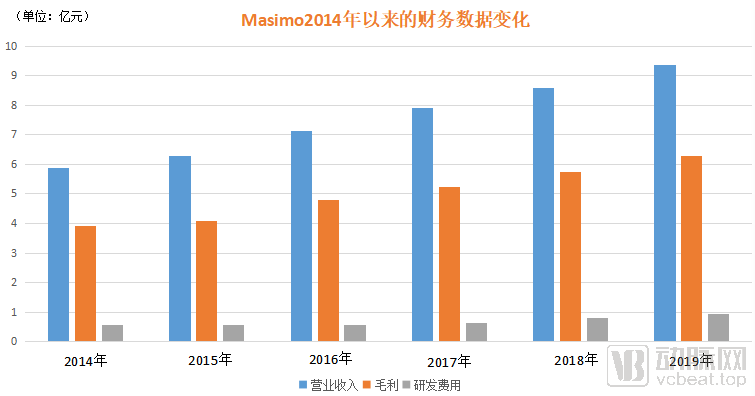
After more than 30 years of development, Masimo’s core products currently primarily include the Masimo SET pulse oximeter.®and rainbowSET®, other non-invasive monitoring products include the Masimo Pronto-7 hemoglobin monitor®, Radical-7 patient monitor, etc.These products have delivered substantial returns to Masimo, enabling the company to successfully list on the NASDAQ in 2007. According to annual report data from the past six years, Masimo has maintained an average annual revenue growth of approximately 9%, with its market capitalization reaching RMB 12.7 billion (as of September 30, 2020).
In the Chinese market, Baolite, a leading player in patient monitors, is the first domestic medical device company to receive authorization. Baolite has adopted Masimo Rainbow SET pulse CO-oximetry technology in its Anyview series of high-end modular patient monitors.
If it were merely a matter of technology, Apple would not have gone so far as to poach Masimo’s core executives, let alone face allegations of infringement. Behind this lies a fierce race among tech giants to capture a share of the wearable device market, which is valued at approximately $50 billion.
Throughout the evolution of technology and business, countless medical technology companies have attempted to enter the field of vital signs monitoring, but the vast majority have achieved little success.Nevertheless, the vast commercial opportunities underlying this sector continue to attract new entrants. In recent years, global tech giants—including Apple, Samsung, and Google—have joined the fray.
Mobile monitoring of vital signs such as blood oxygen, blood glucose, and heart rate has long been a challenge, but advances in non-invasive technologies have made it possible to monitor these parameters.For example, a beam of light can be directed through the patient’s skin, and a spectrometer can then be used to analyze the blood glucose level in their blood.
For tech giants,Non-invasive technologies, particularly industry-leading analogous solutions, represent a critical technological development pathway for wearable devices.Once equipped with these vital sign monitoring applications, wearable technology products—including smartwatches and wristbands—will transition from “non-essentials” to “necessities,” becoming indispensable for individuals in suboptimal health or those with medical conditions, as well as serving as tools for health management among the healthy population.
As John Smith, former Chief Scientific Officer of Johnson & Johnson, stated in a media interview, “There is significant demand for monitoring metrics such as blood glucose via mobile phones. Mastering this capability will yield substantial returns.”
Examining market demand specifically, as healthcare costs rise, developed countries have shifted health monitoring devices from hospitals to homes. Medical testing equipment in hospitals requires trained practitioners to ensure the quality of clinically relevant measurements. However, a significant portion—90%—of valuable non-structured data in clinical settings is verbally reported by patients to physicians, making the information prone to bias.
How to Integrate Data with Clinical Practice: Medical-Grade Devices in Home Settings Can Better Meet Needs by Ensuring Monitoring Accuracy. A growing number of examples demonstrate that hospital-based monitoring provides only a snapshot, failing to capture continuously evolving issues, whereas continuous monitoring can detect significant physiological changes missed in hospital settings. Addressing this pain point, out-of-hospital vital signs monitoring has become highly sought-after.
This makes it easy to understand why tech giants such as Apple place such high value on this field, leading them to both collaborate with Masimo and end up in court over patent disputes.After all, for the industry giants, the wearable market is so vast that unlocking its potential requires the “keys” held by companies like Masimo.。
In China, several companies are also engaged in the research and development of vital signs monitoring technologies. For instance, Chengdu-based Huaxintong Technology developed its iCares medical intelligent digital multi-parameter vital signs monitor with the aim of competing against top-tier vital signs monitoring companies such as Masimo from the outset of the project.
It is still too early to determine the legal outcome of this patent battle, but historical experience suggests that Masimo has consistently maintained robust patent protection. After all,In the medical technology sector, characterized by high entry barriers and significant technical hurdles, patented technologies often constitute a company’s core competitive advantage.
Taking the field of single-cell sequencing as an example, in its 2019 prospectus filed for an initial public offering on the Nasdaq, 10x Genomics acknowledged thatDue to years of patent disputes, its business faces significant risks, and the ultimate outcome of these disputes will determine the company’s survival.Therefore, it is extremely necessary to strengthen the research and development and protection of patents.
From a landscape of fierce competition three decades ago to its current position of solitary prominence, Masimo has come a long way. As a leading enterprise in vital signs monitoring equipment, VCBeat believes that Masimo’s development trajectory mayThree Takeaways for Domestic Medical Technology Innovation Enterprises
First, achieve sufficient depth and expertise in your specific niche.Deepening the moat has never been just a slogan. For medical innovation enterprises, it is essential to achieve a leading position in their respective fields and continuously iterate. Given the current market’s robust momentum, many companies are venturing beyond their core businesses into new domains, such as medical device manufacturers allocating part of their R&D budgets to invest in specialized outpatient clinics upon perceiving profitability in medical services. This strategy is not only likely to yield poor returns despite significant effort but may also detract from their core business.
Second, prioritize the filing and protection of patents.Valuing patents means valuing talent. For innovative enterprises, patents legally protect the intellectual achievements of their teams and raise competitive barriers, thereby providing greater support for corporate development. Of course, in the course of business growth, companies should not only focus on the quantity of patents but also prioritize patent quality.
Third, we must adhere to long-term value.The most significant distinction between the healthcare industry and other sectors is that it directly impacts people’s lives, health, and well-being. Therefore, across all subsectors of the healthcare industry, companies should remain committed to long-term value. By diligently focusing on product research and development to deliver superior medical products to the market, companies will, in turn, reap substantial rewards. This is exemplified by Masimo’s thirty-year steadfast dedication to vital signs monitoring, which has yielded considerable market returns.
As China places increasing emphasis on life sciences and fundamental scientific research, its healthcare industry has been elevated to an unprecedented strategic height. Against the backdrop of policy support and capital-driven growth, medical innovation in China is poised to enter a golden era. Seizing this opportunity, a growing number of enterprises akin to Masimo are certain to emerge.