

Guardant Health: Revolutionizing Precision Oncology with Liquid Biopsy

Guardant Health
Early Cancer Screening Medical Technology Researcher and Precision Oncology Researcher
Liquid biopsy is a non-invasive and convenient detection method that enables cancer detection by quantifying circulating tumor cells, circulating tumor DNA, and tumor-derived exosomes in the blood. It holds significant application potential in early cancer screening and diagnosis, prediction of therapeutic efficacy and prognosis, detection of recurrence, and assessment of tumor heterogeneity and evolution.
Since being named one of the Top 10 Breakthrough Technologies of 2015 by MIT Technology Review, liquid biopsy technology has attracted increasing attention from the corporate capital market due to its broad application prospects in cancer diagnosis and treatment. Its popularity has continued to rise, making it a breakthrough point for precision oncology diagnosis and therapy.
In recent years, the total number of liquid biopsy companies in China has continued to grow. According to the "2019 In-Depth Research Report on China's Liquid Biopsy Industry," by the end of 2018, more than 157 companies had entered the liquid biopsy field in China. Since 2010, newly established companies have experienced rapid growth, peaking in 2015 with 28 companies registered that year. Most of these companies are focused on the sector of precision oncology testing.
Abroad, the oncology liquid biopsy industry has seen the emergence of companies such as Guardant Health, Foundation Medicine, Grail, and Myriad. Multiple oncology liquid biopsy products have been approved to meet the needs of diverse patient populations, and tumor genetic testing is increasingly being adopted as a companion diagnostic, closely integrated with targeted therapy utilization to truly achieve precision medicine.
Amid intensifying domestic competition, VCBeat takes industry leader Guardant Health as a case study, analyzing its product portfolio, business model, and financing history to provide insights for the development of Chinese enterprises.
Helmy Eltoukhy is the founder and CEO of Guardant Health, holding a Ph.D. in Electrical Engineering from Stanford University. In 2006, he conducted research on next-generation, low-cost, long-read gene sequencing platforms at the Stanford Genome Technology Center. Building on this research, he co-founded Avantome in 2007. In August 2008, Avantome was acquired by Illumina. He subsequently founded Guardant Health in California, USA, in 2012.
Guardant Health is a leading company in oncology liquid biopsy. It firmly believes that the key to defeating cancer lies in obtaining accurate molecular information at every stage of the disease. Therefore, Guardant Health is providing cancer patients with products for treatment guidance, recurrence monitoring, and early screening through blood-based genomic testing. Notably, the company’s business focus is on detecting cancer during its early, curable stages, namely cancer early screening.
According to Crunchbase, in February 2014, Guardant Health completed a $10 million Series A financing round, followed by a $30 million Series B round in April, with investments from Khosla Ventures, Sequoia Capital, and others. The company secured a $50 million Series C round in 2015, a $100 million Series D round in 2016, and a $360 million Series E round in 2017, led by SoftBank. Guardant Health’s cumulative funding totals $550 million. Although this amount is less impressive than that of Grail, it has been sufficient to establish Guardant Health as a star player in the field of liquid biopsy for oncology.
In February 2018, Guardant Health went public on the NASDAQ in the United States. As of September 30, 2020, its market capitalization reached $11.06 billion.
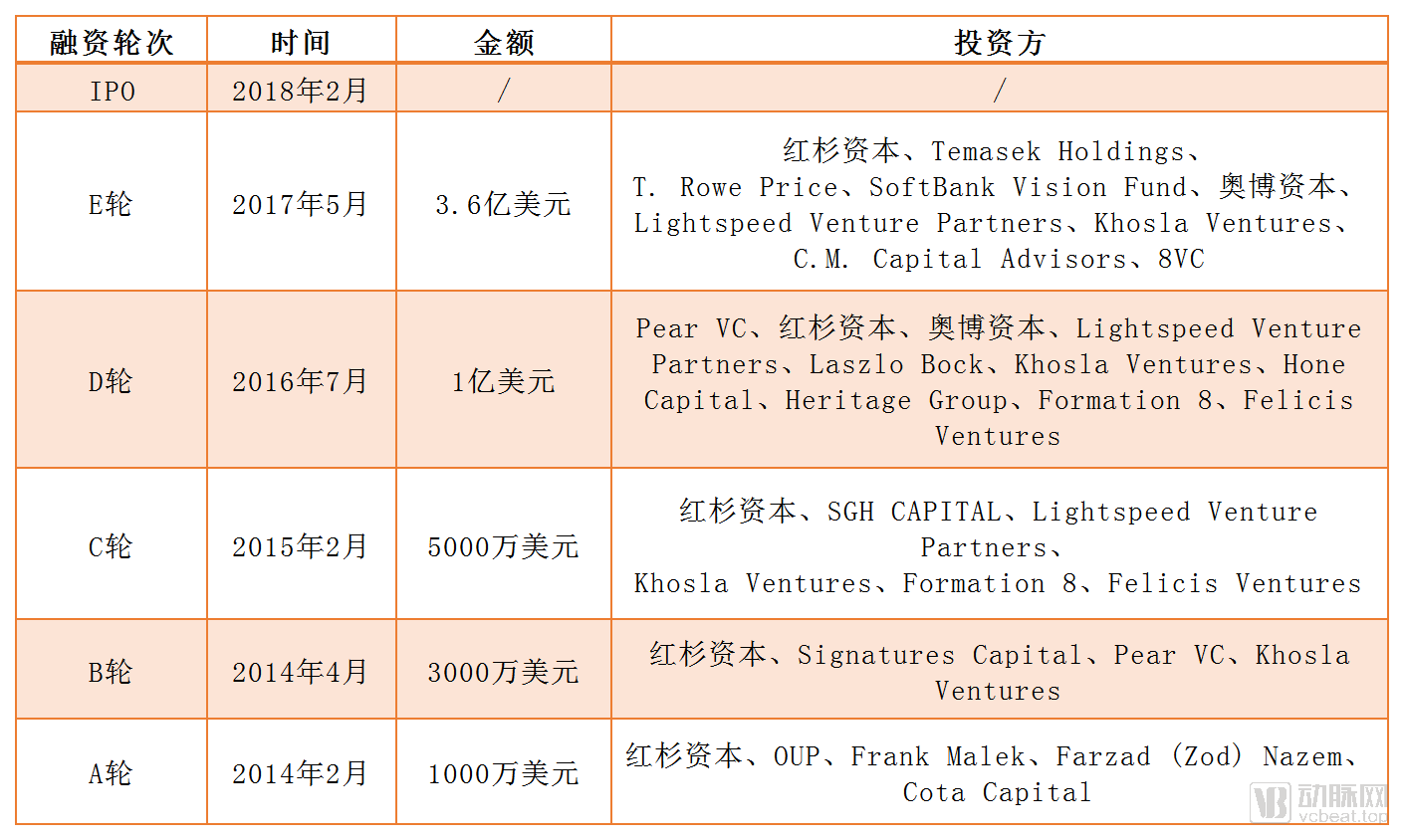
Guardant Health Funding History
Leveraging its next-generation sequencing (NGS) deep-sequencing technology platform, Guardant Health’s R&D portfolio essentially covers the full spectrum of cancer testing. The company offers four products: Guardant360 and GuardantOMNI for monitoring gene mutations in patients with advanced cancer; LUNAR-1 for recurrence monitoring; and LUNAR-2 for early cancer screening.
Guardant360: Providing Precision Medication Regimens for Patients with Advanced Solid Tumors
Guardant360 is Guardant Health’s first commercialized product, launched in 2014 as a laboratory-developed test (LDT). Designed for patients with advanced solid tumors, it employs next-generation sequencing (NGS) technology to analyze 73 cancer-related genes. By profiling genomic alterations, it helps physicians determine the most appropriate treatment regimen for patients with advanced solid tumors.
In addition, Guardant360 can also be used to accelerate clinical trials of new drugs, help pharmaceutical companies select target patients, and speed up patient enrollment and R&D progress.
According to official data, Guardant360 has been widely used in blood-based genomic analysis across more than 150 peer-reviewed publications, earning the high trust of over 7,000 oncologists, accumulating clinical sample reports from more than 150,000 cases, and partnering with over 60 biopharmaceutical companies.
In August 2020, Guardant360 CDx received FDA approval for comprehensive genomic profiling of all solid tumor types. The FDA also approved it as a companion diagnostic to identify patients with metastatic non-small cell lung cancer (NSCLC) harboring epidermal growth factor receptor (EGFR) gene mutations.
Guardant360 CDx is the first NGS-based liquid biopsy product to receive FDA approval. In addition, PGDx’s elio™ Plasma Resolve has obtained CE marking for market launch in the European Union. The approvals of these two products address the gap in the tumor genetic testing market, which previously offered only NGS-based tissue biopsy products, marking the formal transition of NGS-based liquid biopsy from clinical research to clinical application.
In China, liquid biopsy products based on fluorescence PCR methods have been approved for market launch, while those based on NGS have not yet been approved.
GuardantOMNI: Detecting 500 Tumor-Related Genes to Empower New Drug Development
Guardant Health has noted that since 2016, immunotherapy and targeted therapy have become top priorities for pharmaceutical companies in new drug development. To this end, the company launched GuardantOMNI in 2017, aiming to provide pharmaceutical companies with comprehensive genomic analysis tools to help accelerate clinical trials and develop targeted anticancer drugs and immunotherapies.
GuardantOMNI can detect 500 tumor-related genes, offering a significantly broader detection scope than Guardant360, with an accuracy rate of up to 99.3%, and it can identify genetic variants that may be missed by physician examinations.
Lunar-1: For postoperative monitoring, enabling earlier detection of tumor recurrence risk than traditional technologies
After tumor resection, patients require regular follow-up examinations to monitor for recurrence. Lunar-1 is a product designed for cancer recurrence monitoring, primarily targeting four cancer types: lung cancer, breast cancer, colorectal cancer, and ovarian cancer. It enables early detection of recurrence signs, improves patients’ recurrence-free survival, and outperforms conventional technologies across all performance metrics.
Meanwhile, Lunar-1 can also be used to assist pharmaceutical companies in developing new drugs. Currently, the product has not yet entered clinical use and is limited to scientific research.
Lunar-2: For Early Cancer Detection, with Astonishing Potential Market Value
Early cancer screening is considered an effective means of improving survival rates among cancer patients; however, its adoption remains low due to technological limitations. Guardant Health is developing Lunar-2, a blood-based early cancer screening product, primarily targeting asymptomatic individuals at elevated risk of cancer due to genetic factors, smoking, and other risk factors.
This product is currently in the research and development phase. In Guardant Health’s latest annual report, the projected market size for LUNAR-2 is estimated at $33 billion.
In October 2019, Guardant Health initiated the ECLIPSE trial to evaluate the potential of Lunar-2 in screening for early-stage colorectal cancer. In its second-quarter 2020 financial report, the company disclosed that Lunar-2 achieved a sensitivity of 90% and a specificity of 94% in detecting early-stage colorectal cancer. Reportedly, the results from the ECLIPSE trial were pivotal in securing FDA approval for Lunar-2.
In May 2017, Guardant Health launched the “Guardant 1 Million” initiative, aiming to complete liquid biopsy genomic sequencing for one million cancer patients within five years. The company sought to leverage sequencing data to advance cancer treatment and accelerate the development of the blood-based early cancer screening and detection industry. This initiative marked the company’s formal shift in strategic focus toward early cancer screening.
Collaborate with leading pharmaceutical companies to accumulate data and increase revenue
Leveraging liquid biopsy technology, Guardant Health has established partnerships with multiple pharmaceutical companies worldwide, including AstraZeneca, Pfizer, and Merck & Co. These collaborations primarily focus on two areas: the joint development of companion diagnostic products and the joint development of innovative drugs.
In 2017, Guardant Health partnered with Merck & Co. to utilize Guardant360 CDx in identifying patients likely to benefit from tepotinib, a C-MET inhibitor targeted therapy for lung cancer, during its Phase II clinical trials. In 2018, the company collaborated with AstraZeneca to provide companion diagnostic products for Tagrisso, AstraZeneca’s drug for advanced non-small cell lung cancer.
Through extensive collaborations with pharmaceutical companies, Guardant Health not only increases its revenue but also accumulates data on the relationship between genetic mutations and drug efficacy, creating a proprietary database that can better guide medication decisions. After a drug is successfully launched, the company’s diagnostic technology can be bundled and sold as its companion diagnostic product.
Liquid biopsy for cancer is currently a hot field, and Guardant Health faces numerous competitors, including the star company Grail, which was recently acquired by Illumina for $8 billion.
Let’s make a simple comparison. In terms of financing, Grail is truly the “financing king,” with total funding reaching $1.69 billion, while Guardant Health lags significantly behind at only $550 million. Regarding products, Guardant Health launched its offerings early and has gained broad clinical recognition, whereas Grail has yet to introduce any product. In the area of cancer early screening, both Guardant Health and Grail are actively making strategic moves, but neither has brought related products to market.
In addition to Grail, Guardant Health’s competitors include Foundation Medicine, Freenome, and Myriad. Amid intense competition, Guardant Health has still delivered impressive financial performance.
In Guardant Health’s Q2 2020 financial report released in August 2020, the company reported completing 16,499 tests during the second quarter. Among these, 13,694 tests were for clinical clients, representing a 15% year-over-year increase, while 2,805 tests were for pharmaceutical company clients, marking a 47% year-over-year decrease.
Revenue in the second quarter was $66.3 million, representing a 23% year-over-year increase. Of this, revenue from oncology precision diagnostics business was $51.0 million, up 21% year over year, while revenue from R&D services was $15.3 million, up 29% year over year.
As can be seen, Guardant Health’s core revenue stems from its oncology precision diagnostics business, which accounts for approximately 77% of total revenue, with growth driven by an increase in average selling price. Among these, the increased volume of test samples from clinical customers indicates growing recognition of the company’s products in the clinical market. The significant decline in test sample volume from pharmaceutical company clients was due to fluctuations in sample volumes resulting from the progress of clinical studies, as well as negative impacts brought about by the pandemic.
Although R&D services revenue accounts for a relatively small proportion, it is growing rapidly. The company will continue to invest in this area as one of its core businesses in the future. In its report, the company stated that it will continue to expand its base of pharmaceutical enterprise clients while retaining existing customers.
Revenue from the precision oncology business is derived from Guardant360 and Guardant OMNI. As the sales force expands and marketing efforts intensify, sales volumes of Guardant360 and Guardant OMNI are expected to continue growing. Meanwhile, the market launch of the cancer early screening product Lunar-2 is poised to make a significant contribution to the company’s revenue.
So, what insights can Guardant Health offer to domestic companies?
From a product portfolio perspective, Guardant Health has consistently expanded its offerings, initially entering the market through late-stage oncology and gradually extending into prognostic monitoring and early screening and diagnosis. As competition in the domestic tumor-guided medication sector intensifies, Chinese companies likewise need to continuously broaden their product lines and explore new business directions. Comprehensive monitoring and early screening and diagnosis represent promising avenues for growth, making Guardant Health’s product strategy a valuable reference.
Compared with guided medication use, whole-process monitoring and early screening and diagnosis impose higher requirements on data accumulation as well as on the sensitivity and specificity of tests. This undoubtedly presents greater challenges to companies in the tumor liquid biopsy sector, which must continuously enhance their technical capabilities and accumulate more data, such as big data on genetic information from healthy controls.
In terms of R&D services, Guardant Health maintains strong collaborative relationships with numerous leading pharmaceutical companies worldwide. Many testing offerings are essentially one-time transactions, making profitability challenges and high cash burn persistent difficulties for genetic testing firms, particularly those focused on companion diagnostics. In addition to developing more tests with high repeat-purchase rates, collaborating with pharmaceutical companies on new drug development represents a significant avenue for increasing revenue, overcoming profitability hurdles, and accumulating data.
Overall, liquid biopsy for cancer remains in the early stages of market development; correspondingly, companies such as Guardant Health and Grail are still in their infancy, and the industry landscape remains subject to change.
It is worth noting that this industry faces impediments such as technological limitations and low economic returns. In terms of applications, the liquid biopsy market holds the greatest potential for early cancer screening; however, current implementations are predominantly concentrated in the mid-to-late stages of the cancer care continuum, namely treatment and prognosis, while its application in early screening and diagnosis remains immature. Nevertheless, we believe that with decreasing costs and advancements in technologies such as tumor cell capture, liquid biopsy is poised to make significant strides in the field of cancer diagnosis and treatment.